

Content operations is the strategic framework that connects people, processes, and technology to manage the entire content lifecycle at scale.
- Organizations using structured content lifecycle management report faster asset creation and increased productivity when leveraging AI capabilities.
- AI agents are transforming content ops from reactive, manual processes into autonomous workflows that can enrich, review, and distribute content without constant human oversight.
- Digital asset management serves as the backbone of content operations, providing the central hub where all content lives, connects, and flows to downstream channels.
If your team spends more time searching for assets than creating them, a content operations framework isn’t optional anymore.
Ninety-two percent of businesses now leverage AI-driven personalization to drive growth, and customers increasingly expect tailored experiences across every touchpoint. Yet most marketing teams still struggle with fragmented workflows, scattered assets, and manual processes that can’t keep pace with content demands. The gap between what audiences expect and what teams can deliver has never been wider.
This is where content operations becomes essential. It’s the operational backbone that determines whether your content strategy actually translates into business results. When done right, it transforms chaotic content production into a scalable system that consistently delivers value. When ignored, even the best content strategy falls apart during execution.
What Is Content Operations?
Content operations is the set of processes, people, and technologies needed for strategically planning, creating, managing, and analyzing all content across channels to ensure it aligns with business objectives and delivers value to the audience.
Think of it as the operational layer between content strategy and content execution. Your strategy defines what content you’ll create and why. Content ops determines how you’ll actually make it happen at scale, consistently, and without burning out your team.
Content lifecycle management provides a framework for how an enterprise creates the content that powers its customer experiences. This includes everything from initial ideation and creative briefs through production, review, approval, distribution, and performance analysis. Organizations that treat content operations as a strategic function rather than an administrative afterthought consistently outperform those that don’t.
How Does Content Operations Differ from Content Strategy?
Content strategy focuses on the what and why of content creation. It defines goals, identifies target audiences, establishes messaging frameworks, and determines the overall approach. Content strategy lives in planning documents and stakeholder presentations.
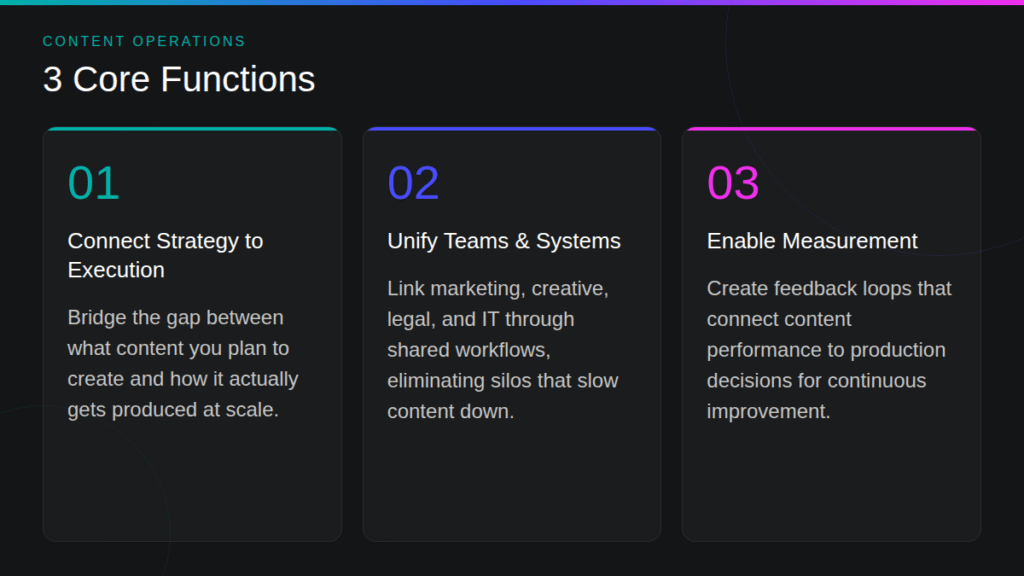
Content operations focuses on the how. It involves the practical aspects of content creation, distribution, and performance analysis. Content ops takes the content strategy blueprint and turns it into actionable steps that bring content to life. It’s the difference between having a great plan and actually executing that plan efficiently.
A brilliant content strategy without solid operations is like having architectural blueprints but no construction crew, no tools, and no building materials. The vision exists, but nothing gets built. Content operations ensures that strategic intent becomes published reality.
What Role Does Content Operations Play in Content Management?
Content operations is the backbone of content management, enabling businesses to efficiently handle content throughout its lifecycle. From ideation to publication and beyond, content ops streamline the entire process, ensuring a consistent and coherent brand message across various channels.
By optimizing the content workflow, businesses can reduce redundancy, improve productivity, and deliver high-quality content consistently. This includes standardizing how content moves through approval processes, establishing clear ownership at each stage, and creating feedback loops that continuously improve quality.
The operational layer also connects disparate systems and teams. When content operations function well, marketing, creative, legal, compliance, and IT teams work from the same playbook rather than operating in silos that slow everything down.
Who Needs Content Operations?
Every organization that creates content can benefit from content operations. However, the need becomes urgent for businesses facing specific challenges.
If your team spends significant time searching for assets instead of creating them, you need content ops. If content approvals bottleneck at the same points repeatedly, you need content ops. If you can’t measure how content contributes to business outcomes, you need content ops.
Customers now expect experiences that are not only relevant but delivered at the pace of business. 2025 was a turning point in how companies run and scale operations, with organizations identifying five key priorities (like unlocking next-generation productivity and embedding digital tools) to reshape performance at scale. Meeting these elevated expectations means having scalable content operations that can deliver the right content, in the right context, at the right moment.
Having a strong solution empowers teams in every stage of content creation, from planning through performance analysis. Specifically, content ops helps marketing teams:
- Optimize planning and execution across campaigns
- Maximize content creation efficiencies through automation
- Streamline production workflows and reduce bottlenecks
- Manage content centrally, maximizing findability and usage
- Remain on-brand and compliant with regulatory requirements
- Gain confidence in how content contributes to the bottom line
The investment in building customer experiences continues to grow. Both businesses and customers agree that customer experience outweighs both price and product in driving loyalty and purchase decisions.
How Do AI Agents Transform Modern Content Lifecycle Management?
Unlike traditional automation that follows rigid if-then rules, AI agents function as autonomous digital team members that can perceive context, make decisions, and execute tasks without constant human oversight.
Gartner predicts that by 2028, at least 15% of day-to-day work decisions will be made autonomously through agentic AI. For content operations, this means workflows that adapt in real-time, assets that enrich themselves, and reviews that happen proactively rather than reactively.
Traditional content operations were reactive, built around responding to requests and following fixed paths. AI agents take over routine tasks and move work forward autonomously. Marketing workflows become dynamic, adjusting paths in real time based on what’s happening rather than following predetermined routes.
What Are the Five Categories of AI Agents in Content Workflows?
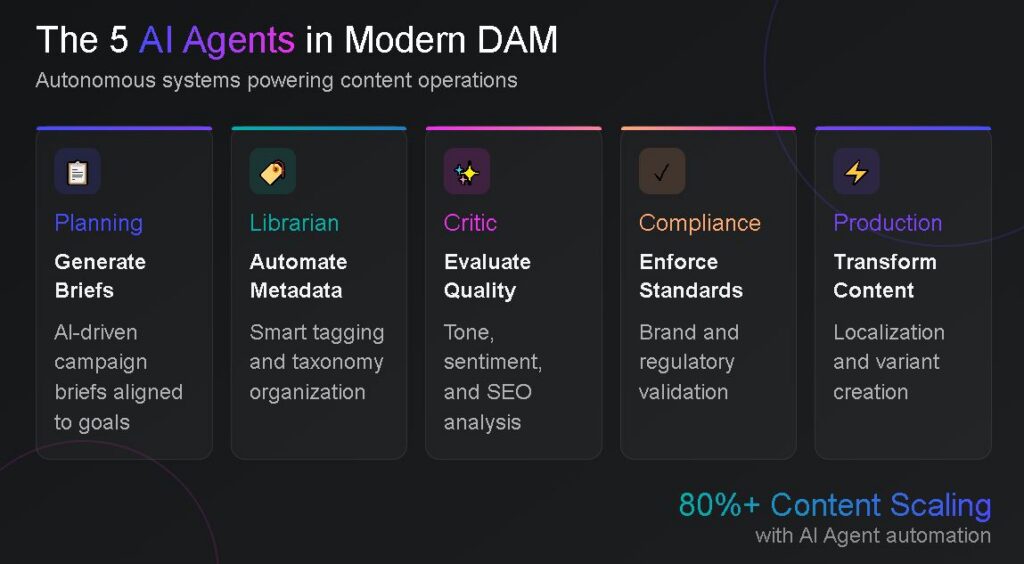
Modern platforms leverage specialized AI agents that work together to automate end-to-end processes. Understanding these categories helps leaders identify where autonomous capabilities can deliver the most value.
Planning Agents generate structured, insight-driven content and campaign briefs. They align proposed creative work to business objectives, audience needs, and performance goals. Rather than starting from scratch, these agents turn fragmented requests into clear, actionable briefs that can be broken into regional or channel-specific versions. Planning agents eliminate rework and give creative teams a strategic head start.
Librarian Agents handle metadata automation and asset organization. They auto-populate metadata fields using generative AI, organize files based on proprietary taxonomies, and apply predictive tagging that makes content discoverable. Instead of manual categorization that consumes hours, librarian agents ensure every asset is findable the moment it enters the system.
Critic Agents evaluate content quality by analyzing tone, sentiment, and language. They provide optimization suggestions for search visibility and assess compositional balance. These agents maintain quality standards across all touchpoints without requiring human reviewers to examine every piece of content.
Compliance Agents automate brand and regulatory checks. They validate content against approved claims libraries, enforce brand guidelines automatically, and check for legal and industry-specific regulation requirements. For organizations in regulated industries, compliance agents accelerate approvals while reducing risk.
Production Agents handle content transformation and localization. They automate image transformations, translate content, apply local taxonomies, and create regional campaign variants. Production agents turn single assets into dozens of channel-optimized versions without manual intervention.
How Does Content Flow Through an Agentic System?
Consider how a single product image moves through a modern, AI-enhanced content workflow.
- The image arrives in the system. Immediately, Librarian Agents analyze the visual content and auto-populate metadata fields, including product category, colors, style attributes, and suggested tags based on the organization’s taxonomy. No manual tagging required.
- Next, Critic Agents assess the image against brand guidelines. Does the background color align with brand standards? Is the composition appropriate for the intended channels? The agents flag any concerns and route the asset accordingly.
- Compliance Agents then check for potential issues. Is the image AI-generated? Are there digital rights considerations? Does it include any elements that require legal review? If the image passes, it automatically moves forward. If not, it routes to the appropriate human reviewer with specific context about what needs attention.
- Finally, Production Agents create variants. The original high-resolution image becomes web-optimized versions, social media crops in multiple aspect ratios, and email-ready formats. Each variant inherits the metadata and compliance status of the original.
What previously required multiple team members, several handoffs, and hours of manual work now happens in minutes with human oversight focused only where it adds value.
What Are the Benefits of Effective Content Ops?
Organizations that invest in content operations see measurable improvements across multiple dimensions. The benefits compound over time as processes become more refined and teams become more efficient.
Improved Consistency and Quality
Content operations ensure that content maintains consistent tone, style, and messaging across all channels. When every piece of content flows through the same operational framework, brand identity remains coherent regardless of who creates the content or where it appears.
Consistency builds trust with audiences. When customers encounter the same brand voice and quality level across touchpoints, they develop confidence in the organization. Inconsistent content, by contrast, creates confusion and undermines credibility.
Quality also improves through standardized review processes. Rather than ad-hoc feedback that varies by reviewer, content operations establish clear quality criteria and systematic evaluation. Teams know exactly what good looks like, and processes ensure content meets those standards before publication.
Enhanced Content Collaboration and Workflow Efficiency
Content operations define clear roles and responsibilities for everyone involved in the content creation process. This clarity eliminates confusion about who owns what, reduces duplicated efforts, and prevents communication breakdowns.
Efficient workflows move content from concept to publication with minimal friction. Bottlenecks get identified and addressed systematically rather than causing repeated delays. Teams spend less time on administrative overhead and more time on creative work that actually moves the needle.
Organizations report productivity gains after implementing structured content lifecycle management. With AI-enhanced workflows, teams can achieve even greater efficiency by automating routine tasks that previously consumed valuable human attention.
Increased Engagement and Conversion
When content is tailored to the target audience’s needs and preferences, engagement increases and conversion rates improve. Content operations enable this personalization by ensuring the right content reaches the right audiences at the right moments.
The connection between operations and outcomes is direct. Teams that can produce more relevant content faster outperform teams stuck in manual processes. When you can respond to market opportunities quickly with quality content, you capture attention that competitors miss.
Organizations leveraging content personalization capabilities report measurable increases in engagement metrics and revenue attribution. The operational infrastructure makes personalization possible at scale rather than as a one-off effort.
Why Is DAM the Backbone of Content Operations?
Digital asset management serves as the central nervous system of content operations. Every piece of content, every workflow, and every distribution channel connects through DAM. Without a solid DAM foundation, content ops become fragmented and inefficient.
Modern DAM systems provide the infrastructure for intelligent content discovery, automated enrichment, compliance tracking, and omnichannel distribution. DAM becomes the single source of truth that eliminates scattered assets across shared drives, email attachments, and desktop folders.
The connection between DAM and content operations is essential for several reasons:
- Centralized governance ensures that only approved, compliant content reaches market. When assets live in a controlled environment with proper metadata, teams avoid the risks of using outdated logos, expired images, or unapproved messaging.
- Enhanced discoverability means teams find what they need when they need it. AI-powered search capabilities can improve time-to-find compared to traditional keyword-based systems. Less time searching means more time creating.
- Automated workflows connect DAM to downstream systems and channels. When an asset is approved, it can automatically flow to web platforms, social channels, email systems, and commerce applications without manual intervention.
- Performance intelligence closes the loop between creation and results. Modern DAM platforms track how content performs in market, providing insights that inform future content investments. This feedback loop continuously improves content ROI.
For organizations serious about scaling content operations, digital asset management is the foundation everything else builds upon.

How Do You Get Your Content Strategy Right?
Designing your strategy requires an intimate understanding of the content operations ecosystem. You need to understand how the various elements connect both internally and externally with the enterprise’s broader operational units.
The core components include four primary capabilities:
- Digital Asset Management provides the central hub for creating, managing, and deploying content across channels. This is where assets live, where metadata gets applied, and where workflows originate.
- Productivity Management enables content collaboration, allowing teams to align and move in step through marketing work management. This includes project planning, task assignment, review cycles, and resource allocation.
- Strategic Planning connects content efforts to business objectives through calendaring, budgeting, and campaign coordination. Planning ensures content production aligns with market opportunities and organizational priorities.
- Embedded Intelligence leverages AI and analytics to automate tasks, surface insights, and optimize performance. This layer transforms content operations from manual processes into intelligent systems that continuously improve.
Together, these components make up the basics of your content operations solution. The larger ecosystem includes these core capabilities plus the content ops tech stack and your core integrations.
Content ops is fundamentally about making the best use of cutting-edge technologies. By designing an effective tech stack with a content management solution at the center and implementing the right integrations and marketing automations, you lay the groundwork for delivering personalized customer experiences across channels.
5 Essential Elements of Modern Content Ops
These foundational components apply regardless of organization size or industry.
- Clear ownership and accountability. Every stage of the content lifecycle needs a defined owner. When responsibilities are ambiguous, work falls through cracks and bottlenecks emerge. Establish who approves what, who reviews when, and who has final authority.
- Documented workflows and processes. Ad-hoc processes don’t scale. Document how content moves from request to publication, including decision criteria at each stage. This documentation enables consistency and makes onboarding new team members faster.
- Integrated technology systems. Disconnected tools create friction and data silos. Your CMS, DAM, project management, and analytics platforms should connect seamlessly. Integration strategies that link systems together multiply the value of each individual tool.
- Measurement and feedback loops. What gets measured gets managed. Define KPIs for content performance, track them consistently, and use insights to improve processes. Without measurement, you’re guessing about what works.
- Governance and compliance frameworks. Especially for regulated industries, governance structures ensure content meets legal and brand requirements. Build compliance checks into workflows rather than treating them as afterthoughts.
What Are Common Challenges in Content Management?
Even well-designed content operations face obstacles. Anticipating these challenges helps organizations prepare and respond effectively.
How Do You Overcome Bottlenecks and Delays?
Content ops frequently face delays due to approval processes, resource constraints, or ineffective workflows. Identifying and addressing these bottlenecks is crucial for maintaining content velocity.
Regular evaluation of the content production process helps identify areas requiring improvement. Look for stages where content consistently stalls, reviewers who create backlogs, or handoffs that lose momentum. Once identified, bottlenecks can be addressed through process changes, additional resources, or automation.
How Do You Maintain Content Relevance and Freshness?
As audience preferences and market trends change, content must stay up-to-date and relevant. Content operations must address content refreshment to avoid stagnation and maintain engagement.
Revisit and update existing content to ensure it remains valuable and informative. Content audits should happen regularly, with processes for retiring outdated assets and refreshing evergreen content that still drives value.
How Do You Manage Content Governance and Compliance?
For businesses operating in regulated industries, content operations must adhere to compliance standards and governance policies. This includes ensuring accuracy of information, copyright compliance, and adherence to industry-specific regulations.
AI agents help by automating compliance checks and flagging potential issues before they become problems. However, human oversight remains essential for complex regulatory requirements.
How Do You Measure Success?
Common operational KPIs include production velocity (how quickly content moves from request to publication), asset utilization (how often content gets reused), and workflow efficiency (time spent at each stage). These metrics reveal operational health.
Performance KPIs connect content to results: website traffic, engagement rates, conversion rates, and revenue attribution. Data-driven insights allow content teams to identify what resonates with audiences and optimize strategies accordingly.
The most mature content operations combine both operational and performance measurement, creating a complete picture of how efficiently content gets created and how effectively it performs in market.
FAQs
What are the primary benefits of implementing content operations? Implementing content operations ensures streamlined content creation and delivery, leading to increased efficiency and productivity. Content ops also improve content consistency and quality, enhancing brand reputation and credibility. Additionally, it enables businesses to measure content performance and make data-backed decisions for continuous improvement.
How do AI agents change content operations? AI agents transform content operations from reactive, manual processes into autonomous workflows. Unlike traditional automation that follows rigid rules, AI agents can perceive context, make decisions, and execute multi-step tasks without constant human oversight. They handle routine work like metadata tagging, compliance checking, and content transformation automatically, freeing human teams to focus on strategic and creative work that requires judgment.
What tools are essential for effective content operations? Essential tools include digital asset management systems for central content storage and governance, productivity management platforms for workflow coordination, and analytics tools for performance measurement. AI capabilities embedded within these systems increasingly automate routine tasks and surface insights. Integration between systems is critical because disconnected tools create friction and data silos that undermine operational efficiency.
What is the relationship between DAM and content operations? Digital asset management serves as the backbone of content operations. DAM provides the central hub where content lives, metadata gets applied, and workflows originate. Without solid DAM infrastructure, content management becomes fragmented across scattered files and disconnected systems. Modern DAM platforms also provide AI-powered discovery, automated enrichment, compliance tracking, and distribution capabilities that enable content ops at scale.
Get Started With the Right Content Ops Strategy
Content impacts every business unit: Marketing, Product teams, Legal, Training, HR, eCommerce, and R&D. For this simple reason, having a content operations solution in place reliably improves a wide swath of the business.
Content operations play a pivotal role in enabling businesses to produce high-quality content that engages target audiences and drives business results. By implementing efficient workflows, selecting the right tools, and leveraging AI capabilities, businesses create content engines that consistently deliver value.
Aprimo’s agentic digital asset management platform provides the foundation for intelligent content operations at scale. Get a demo of Aprimo to see how autonomous workflows and AI agents can accelerate your content performance.