

The integration of AI in digital asset management has moved from experimental feature to operational necessity, changing how marketing and creative teams store, find, and deploy content.
- The global DAM market is projected to reach $12.80 billion by 2030, driven largely by AI capabilities that automate tedious workflows and unlock new creative possibilities.
- 88% of organizations now regularly use AI in at least one business function, with productivity gains and operational efficiency topping the list of expected outcomes.
- Smart asset tagging and intelligent metadata now eliminate hours of manual work while improving how quickly teams locate the assets they need.
If your DAM strategy hasn’t evolved to embrace generative AI and autonomous workflows, 2026 is the year to catch up or risk falling behind.
The conversation around AI in digital asset management has shifted over the past two years. What started as basic image recognition and automated tagging has matured into something far more sophisticated. Today’s AI DAM systems understand context, predict what you need, and increasingly handle complex tasks without human intervention.
According to recent market analysis, 66% of large organizations already have generative AI pilots within their content operations. Marketing teams now devote roughly 39% of their budgets to content creation, much of it short-form video and interactive formats that require sophisticated metadata, rights tracking, and rendition management. Manual processes can’t keep pace with this volume.
How Has AI in Digital Asset Management Evolved Beyond Simple Automation?
Early implementations of AI in digital asset management focused primarily on convenience. Upload an image, and the system would generate a handful of generic tags based on what it “saw” in the file. Useful but limited. The tags often missed the business context that actually matters when someone needs to find that asset six months later.
Modern artificial intelligence for DAM operates on an entirely different level. Machine learning algorithms now train on your specific content library, learning your brand vocabulary, product names, and campaign terminology. The system doesn’t just recognize that an image contains a person wearing a jacket. It identifies that the jacket is from your fall 2025 collection, features your signature color palette, and was shot for your sustainability campaign.
This contextual understanding extends across asset types. Video summarization extracts key scenes and generates searchable transcripts. Document analysis pulls relevant terminology from PDFs and presentations. Audio files get indexed for spoken content. The result is a unified, searchable repository where every asset becomes discoverable through multiple pathways.
How Does Generative AI Transform DAM Workflows?
Generative AI is the most impactful shift in content operations since the move to cloud-based systems. Rather than simply organizing and retrieving existing assets, GenAI enables DAM platforms to actively create, modify, and adapt content based on your needs. This capability addresses one of the most persistent challenges in modern marketing: the insatiable demand for content variations across channels, audiences, and markets.
Content demands continue to accelerate, with 39% of enterprise marketers expecting budget increases and investment in AI for content creation growing. Creative teams are stretched thin, with the majority reporting bandwidth issues that delay campaigns and limit personalization efforts.
What Role Does GenAI Play in Asset Creation?
Generative AI within DAM systems powered by intelligent automation can resize and recompose images for different platforms while maintaining focal points. Need that hero image reformatted for Instagram Stories, LinkedIn posts, and email headers? The system handles it in seconds rather than hours.
Background replacement and extension have become particularly valuable. Product images shot in a studio can be placed into contextual environments that resonate with specific audiences. A piece of outdoor gear might appear against a mountain backdrop for adventure seekers and a suburban trail setting for casual hikers. These variations happen programmatically, guided by AI that understands both the visual requirements and the strategic intent.
The technology also enables what many teams call “intelligent derivatives.” Rather than storing a single master file with a few standard crops, AI can generate dozens of optimized variations on demand. This approach reduces storage costs while expanding creative possibilities.
How Does AI Enable Content Personalization at Scale?
Personalization has been a marketing buzzword for years, but the practical reality often fell short of the promise. Creating truly personalized experiences required either massive creative resources or significant compromises on quality and relevance. AI changes this equation.
Modern DAM systems with AI capabilities can automatically translate text elements within assets while maintaining design integrity. They adapt images to reflect local cultural nuances and preferences. They generate regionally appropriate visual elements. A global campaign that once required separate creative development for each market can now scale efficiently from a core set of master assets.
Personalization extends to audience segments. AI can analyze behavioral data to understand which content variations perform best with specific customer profiles, then automatically serve optimized versions based on real-time signals. This capability transforms DAM from a passive storage system into an active participant in the customer experience.
Why Is Smart Asset Tagging a Game-Changer for Content Teams?
If there’s one AI capability that delivers immediate, tangible value, it’s smart asset tagging. The traditional approach to metadata required human judgment for every file. Someone had to open each asset, evaluate its contents, and manually enter descriptive tags. This process was slow, inconsistent, and nearly impossible to scale.
Smart asset tagging automates this entire workflow. When assets enter the system, AI analyzes visual elements, extracts text, and generates comprehensive metadata without human intervention. The technology uses computer vision to identify objects, scenes, colors, and emotions. Natural language processing handles documents and audio content. The result is rich, consistent metadata across your entire library.

The benefits extend well beyond time savings:
- Consistency across contributors: When multiple people manually tag assets, they inevitably use different terminology for the same concepts. AI applies uniform standards regardless of who uploads the content.
- Completeness of metadata: Human taggers typically add a handful of obvious keywords and move on. AI can generate dozens of relevant tags, capturing details that might seem minor but prove valuable during future searches.
- Reduced time to usability: Assets become searchable and deployable almost immediately after upload, accelerating the entire content lifecycle.
Organizations implementing automated metadata systems report productivity improvements that free creative teams to focus on strategic work rather than administrative tasks. AI-powered solutions help brands reduce asset search time by up to 40%, eliminating hours previously spent on repetitive tagging and categorization.
How Does Intelligent Metadata Improve Asset Findability?
The value of intelligent metadata becomes most apparent when someone needs to find a specific asset. Traditional DAM search relied on exact keyword matching. If you didn’t remember the precise terms used during tagging, good luck finding what you needed. This limitation created what many organizations call “dark assets,” files that technically exist in the system but remain effectively invisible because no one can locate them.
AI-powered search transforms this experience. Semantic search understands the intent behind queries, not just the literal words. Ask for “professional headshots from the leadership team,” and the system returns relevant results even if those exact terms don’t appear in the metadata. The AI understands the relationship between concepts and can make intelligent inferences about what you’re actually seeking.
What Makes AI-Powered Search Different?
Visual search takes findability even further. Upload a reference image or describe visual elements, and the system locates similar assets based on color schemes, composition, objects, and style. This approach proves valuable when you know what something looks like but struggle to describe it in words.

The technology behind these capabilities combines multiple AI disciplines. Natural language processing interprets conversational search queries. Computer vision analyzes visual content. Machine learning continuously improves results based on user behavior and feedback. Together, these technologies create a search experience that feels intuitive rather than frustrating.
For creative teams, improved findability translates directly to increased asset reuse. When people can actually locate existing content, they stop recreating assets that already exist somewhere in the system. This efficiency gain compounds over time as libraries grow and the AI learns more about organizational patterns and preferences.
What Are AI Agents and Why Do They Matter for DAM?
The next frontier in AI in digital asset management involves autonomous agents capable of executing complex, multi-step workflows without constant human oversight. Unlike traditional automation that follows rigid rules, AI agents can perceive their environment, make decisions based on the information they gather, and adapt their approach as circumstances change.
McKinsey’s 2025 State of AI survey found that 62% of organizations are now experimenting with AI agents, though only about one-third have begun scaling these capabilities enterprise-wide. High-performing organizations are moving beyond passive text generators toward agents that can plan and execute multiple steps to achieve a goal, transforming workflows from linear processes into dynamic, context-aware systems.
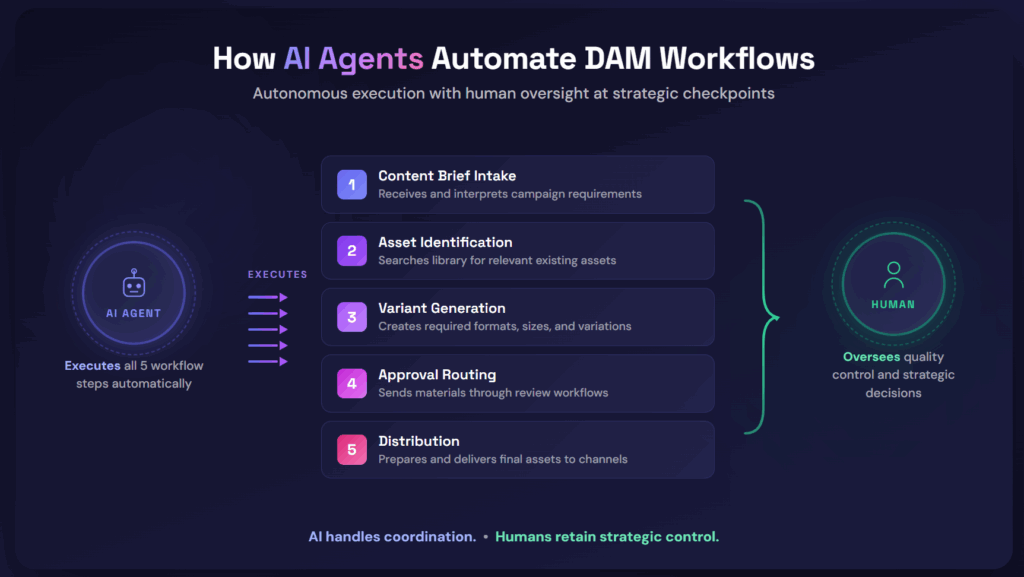
In the DAM context, AI agents might handle entire content workflows autonomously. An agent could receive a brief for a new campaign, identify relevant existing assets, generate required variations, route materials through appropriate approval workflows, and prepare final deliverables for distribution. Human oversight remains essential for quality control and strategic decisions, but the tedious coordination work happens automatically.
AI agents can monitor content performance, identify gaps in asset coverage, and proactively recommend content creation priorities. They can flag potential compliance issues before assets reach public channels. They can ensure brand consistency across distributed teams and external partners. This proactive capability pivots from reactive asset management to strategic content operations.
How Does AI Ensure Brand Safety and Compliance?
As AI becomes more prevalent in content creation, the need for AI-powered governance grows proportionally. Organizations face legitimate concerns about brand consistency, regulatory compliance, and the appropriate use of AI-generated content. Sophisticated DAM systems address these concerns through intelligent monitoring and automated safeguards.
AI content detection can identify which assets were created or modified using generative AI tools. This transparency matters for industries with strict disclosure requirements and for brands that want to maintain clear provenance records. Automated workflows can route AI-influenced content through additional review steps before approval.
Compliance checking extends to traditional concerns as well. AI can analyze assets for potential copyright or trademark issues, flagging problems before they become costly legal headaches. It can verify that required disclaimers appear on regulated content. It can ensure that expired licenses don’t result in unauthorized asset usage.
Brand Safety & Compliance at a Glance
| Focus Area | What AI Does | Value to the Organization |
| AI Content Detection | Identifies AI-generated or AI-modified assets | Provides provenance transparency; supports disclosure requirements |
| IP & Copyright Checks | Flags potential copyright or trademark conflicts | Reduces legal risk and prevents costly errors |
| Regulated Content Review | Verifies required disclaimers and compliance elements | Ensures industry-specific adherence (FINRA, FDA, MLR, etc.) |
| Digital Rights Management | Alerts teams to expired or restricted asset licenses | Prevents unauthorized use and protects brand integrity |
| Regional & Cultural Standards | Assesses content against geography-specific rules | Supports global accuracy, accessibility, and cultural alignment |
For organizations operating across multiple markets, AI helps navigate the complexity of regional requirements. Accessibility mandates, privacy regulations, and cultural considerations vary by geography. Intelligent systems can automatically assess content against relevant standards and identify potential issues that might escape human reviewers working under time pressure.
Frequently Asked Questions
How quickly can AI tag assets compared to manual processes? AI-powered tagging happens in seconds rather than minutes or hours per asset. While a human might spend several minutes evaluating and tagging a single file, AI can process the same asset almost instantaneously upon upload. For organizations managing thousands or millions of files, this difference translates to massive time savings and faster content availability.
Does AI replace the need for human oversight in DAM? No. AI handles repetitive tasks and provides intelligent recommendations, but human judgment remains essential for strategic decisions, quality control, and handling edge cases. The most effective implementations position AI as a productivity multiplier that frees people to focus on other work rather than a replacement for human expertise.
How does AI handle industry-specific terminology and brand vocabulary? Modern AI DAM systems can be trained on your specific content and taxonomy. This customization allows the AI to recognize and apply highly relevant, business-specific tags that go beyond generic object identification. The system learns your products, campaigns, and brand attributes through exposure to representative examples from your library.
Ready to Transform Your Content Operations?
The integration of AI into digital asset management changes what’s possible for marketing and creative teams facing unprecedented content demands. Smart asset tagging eliminates manual drudgery. Intelligent metadata makes every asset discoverable. Generative AI unlocks personalization at scale. Autonomous agents handle complex workflows that once required significant human coordination.
Aprimo’s AI-powered content operations platform brings these capabilities together in a unified system designed for enterprise scale. From predictive metadata and semantic search to content intelligence and real-time personalization, we help organizations transform their digital assets from a cost center into a strategic advantage. Request a demo to see how AI can reshape your approach to digital asset management.