

Marketing workflow automation is the key to scaling content operations without burning out your team.
- Organizations using automation see a 14.5% increase in sales productivity and a 12.2% reduction in marketing overhead.
- Teams implementing AI-powered automation report fewer tedious tasks and more efficient workflows.
- Automated lead nurturing generates more sales-ready leads at lower costs.
If your team is still managing content approvals through email threads and tracking campaigns in spreadsheets, you’re working harder than you need to.
Marketing teams are producing more content than ever before, yet many are struggling to keep pace with demand. Forty percent of B2B marketers say their biggest challenge is creating content that converts, while a lack of resources remains the top situational obstacle. The solution is to build smarter systems that automate repetitive tasks, freeing your team to focus on strategy and creativity. Content operations have evolved, and the teams that thrive are embracing marketing workflow automation as a core capability rather than a nice-to-have tool.
What Is Marketing Workflow Automation?
Marketing workflow automation uses technology to streamline, automate, and optimize repetitive marketing tasks and processes. Instead of manually executing each step in your content creation, approval, and distribution processes, automation tools handle these tasks based on predefined rules and triggers.
Every automated workflow consists of three interconnected components:
- Triggers initiate the workflow based on specific events, such as a form submission, a deadline approaching, or content reaching a certain status.
- Actions define what happens next, whether that’s sending a notification, assigning a task, updating a record, or publishing content.
- Conditions determine whether and how the workflow proceeds based on data-driven criteria, allowing for intelligent branching and personalized paths.

The beauty of this approach is consistency. When you automate a workflow, you’re codifying your best practices into a system that executes perfectly every time. No more forgotten steps, missed handoffs, or inconsistent processes across team members. Your content operations become predictable, measurable, and scalable in ways that manual processes can’t match.
Why Does Workflow Automation Matter in Marketing?
The pressure on marketing teams has never been more intense. Audiences expect personalized content across multiple channels, delivered at the right moment in their journey. Leadership demands measurable ROI from every campaign. Meanwhile, budgets remain tight, and headcount stays flat. Something has to give, and for most organizations, that something is their approach to managing content workflows.
Consider how much time your team spends on tasks that don’t require human creativity or judgment. Routing content for approval, sending status update emails, reformatting assets for different channels, and updating project management tools with completed tasks. These activities are necessary, but they pull talented marketers away from work that actually moves the needle.
The shift toward automation has accelerated with advances in AI and machine learning. Modern workflow tools can do far more than follow simple if-then rules. They can analyze content for brand compliance, suggest optimal publishing times, route tasks based on team capacity, and automatically generate metadata. Organizations that embrace these capabilities gain a competitive advantage, producing more content with higher quality while their competitors remain mired in manual processes.
How Does Marketing Automation Drive Results?
The benefits of automating your marketing workflows extend beyond saving time. When implemented thoughtfully, automation transforms how your entire team operates and delivers measurable improvements across multiple dimensions of performance.
Productivity and Efficiency Gains
The most immediate impact of marketing workflow automation shows up in productivity metrics. Companies using marketing automation see a 14.5% increase in sales productivity alongside a 12.2% reduction in marketing overhead.

Consider what happens when you automate your content approval process. Instead of sending emails back and forth, waiting for responses, and manually tracking who has reviewed what, the system automates all of this. Reviewers receive notifications when content is ready for their input. Reminders go out if deadlines approach. Once approved, content moves to the next stage without anyone having to push it along. The time savings compound quickly across dozens or hundreds of content pieces.
Automation also reduces the cognitive load on your team. When people don’t have to remember to follow up on approvals or manually update status reports, they can devote their mental energy to creative and strategic work. This shift often leads to higher quality output and greater job satisfaction, as marketers spend less time on administrative tasks and more time doing work they find meaningful.
Cost Reduction and ROI
Automation delivers financial benefits that go straight to the bottom line. By reducing manual effort, you can accomplish more with your existing team or reallocate resources to impactful initiatives. Many organizations find they can delay or eliminate planned hires by implementing effective workflow automation, generating greater cost savings.
The ROI case becomes even stronger when you factor in error reduction. Manual processes are prone to mistakes, from missed deadlines to incorrect asset versions and compliance violations. Each error requires time and resources to correct, and some mistakes can have serious consequences for brand reputation or regulatory standing. Automated workflows execute consistently every time, eliminating entire categories of costly errors.
Organizations also see revenue benefits through faster time-to-market. When content moves through your pipeline more quickly, campaigns launch sooner, seasonal opportunities get captured, and competitive responses happen in real time rather than days or weeks later. The ability to produce and deploy content at speed translates directly into business results.
Improved Content Quality and Consistency
Counterintuitively, automation often leads to better quality content, not just faster production. When workflows include built-in quality checkpoints and standardized review processes, nothing slips through the cracks. Every piece of content receives the appropriate level of scrutiny before publication.
Automated workflows also enforce consistency across your content operations. Brand guidelines get applied uniformly because the system ensures the right reviewers see every piece. Metadata standards are maintained because the workflow requires certain fields before content can advance. This consistency strengthens brand recognition and reduces the risk of off-brand content reaching your audience.
The quality benefits extend to content lifecycle management as well. Automated workflows can track content expiration dates, trigger reviews when assets need updating, and archive outdated materials. Your content library stays current and accurate without requiring constant manual attention.
What Are the Essential Types of Automated Content Workflows?
Different stages of your content operations benefit from different types of automation. Understanding these categories helps you identify where automation can have the greatest impact on your specific challenges.
Content creation and approval workflows manage the process of developing new content from initial brief through final approval. These workflows assign tasks to creators, route drafts to reviewers, collect feedback, and track revisions. Advanced systems can leverage AI to assist with content production, generating first drafts or suggesting improvements based on performance data.
Review and compliance workflows ensure content meets brand standards and regulatory requirements before publication. In industries like financial services, healthcare, and pharmaceuticals, these workflows are essential for maintaining compliance. Automated systems can flag potential issues, route content to appropriate subject matter experts, and maintain audit trails that demonstrate proper review processes.
Distribution and publishing workflows handle the final mile of getting content to your audience. These workflows can automatically format content for different channels, schedule publication at optimal times, and push assets to connected systems like your CMS, social media platforms, or email marketing tools. The result is seamless, consistent content delivery across all your channels.
Performance optimization workflows close the loop by using engagement data to inform future content decisions. These automated systems track how content performs, identify trends and patterns, and surface insights that help your team create more effective content. Some advanced platforms can even automatically adjust content distribution based on real-time performance metrics.
What Are the Key Components of Effective Workflow Tools for Marketers?
The best workflow tools for marketers share certain characteristics that make them particularly effective for content operations.
Triggers That Initiate Smart Actions
Effective workflow tools offer a rich variety of triggers that can initiate automated actions. Beyond simple time- or status-based triggers, look for systems that can respond to user behavior, content attributes, and external events. The more granular your trigger options, the more precisely you can automate your specific processes.
For example, you might want a workflow that triggers when a particular type of content reaches a certain stage, but only if it’s intended for a specific channel and targets a particular audience segment. This level of specificity allows you to build workflows that truly match your operational reality rather than forcing your processes into a one-size-fits-all mold.
The best systems allow triggers from external sources through integrations and APIs. Your workflow might need to kick off when something happens in your CRM, project management tool, or analytics platform. Flexible triggers ensure your automation can span your entire technology ecosystem.
Conditional Logic for Intelligent Routing
Simple linear workflows handle straightforward processes, but real content operations involve complexity. Different content types need different reviewers. High-risk materials require additional approvals. Rush projects follow expedited paths. Your automation tools need conditional logic sophisticated enough to handle these variations.
Conditional branching allows workflows to make decisions based on content attributes, metadata, or other variables. A workflow might route content differently based on its intended channel, target market, or compliance risk level. This intelligence ensures the right people see the right content at the right time, without requiring manual intervention to direct traffic.
Look for tools that make this conditional logic accessible to non-technical users. Visual workflow builders with drag-and-drop interfaces allow marketers to create and modify complex workflows without IT involvement, enabling rapid iteration and continuous improvement of your automated processes.
AI-Powered Automation Capabilities
The latest generation of workflow tools incorporates artificial intelligence to handle tasks that previously required human judgment. AI agents can analyze content for brand compliance, automatically generate metadata and tags, suggest optimal reviewers based on content type and workload, and predict potential bottlenecks before they occur.
Instead of simply following predetermined paths, AI-powered workflows can adapt to circumstances, learn from outcomes, and make intelligent decisions that improve over time. Organizations implementing these advanced capabilities see dramatic improvements in both efficiency and effectiveness.

The key is finding tools that integrate AI thoughtfully rather than bolting it on as an afterthought. The best solutions weave AI assistance throughout the workflow experience, making intelligent suggestions and automations feel natural rather than disruptive.
How to Implement Content Process Automation Successfully
Implementing marketing workflow automation requires thoughtful planning and execution. Organizations that rush into automation without proper preparation often end up with systems that don’t match their actual processes or fail to deliver expected benefits.
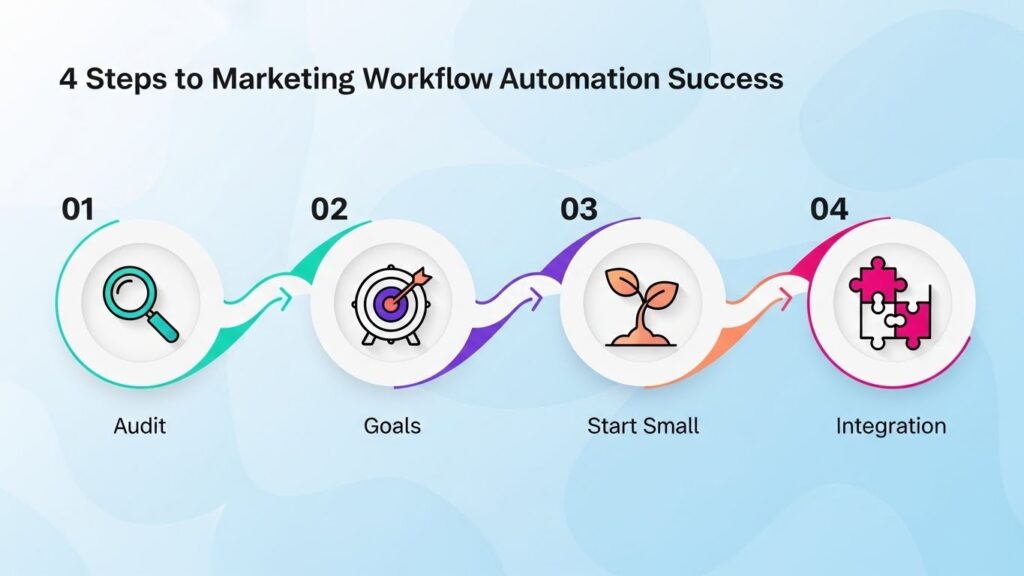
Audit Your Current Workflows
Before automating anything, you need a clear understanding of your current processes. Map out each stage of your content operations, from ideation through publication and beyond. Document who does what, how long each step takes, where handoffs occur, and where bottlenecks typically develop. This audit reveals your prime candidates for automation.
Pay particular attention to tasks that are repetitive, time-consuming, or error-prone. These are your most impactful opportunities for automation. Also note any inconsistencies in how different team members handle the same processes, as automation can help standardize these variations.
Don’t forget to involve the people who actually do the work in this audit. They understand the nuances and pain points better than anyone and can identify content process automation opportunities that might not be obvious from a higher level view.
Define Clear Goals and KPIs
Successful automation initiatives start with clear objectives. What specific outcomes do you want to achieve? Faster content production? Fewer compliance errors? Reduced time spent on administrative tasks? Define measurable goals that will help you evaluate whether your automation efforts are working.
Establish baseline metrics before implementing automation so you can accurately measure improvement. Track things like average time to approval, number of revision cycles, content output volume, and error rates. These baselines provide the foundation for demonstrating ROI and identifying areas for further optimization.
Be realistic about what automation can and cannot accomplish. While the benefits are substantial, automation won’t solve problems rooted in unclear strategy, inadequate resources, or poor content quality. Set expectations accordingly and focus automation efforts on operational efficiency rather than expecting it to fix fundamental strategic issues.
Start Small and Scale
Resist the temptation to automate everything at once. Start with a single workflow that offers clear benefits and manageable complexity. Get that working well, learn from the experience, and then expand to additional processes. This incremental approach reduces risk and allows you to build internal expertise gradually.
Choose your initial automation project carefully. Look for workflows that are well-defined, involve multiple handoffs, and have clear success metrics. Content planning processes often make good starting points because they’re relatively standardized and improvements are easy to measure.
As you scale, maintain documentation and governance around your automated workflows. Track what’s been automated, who owns each workflow, and how to modify processes when needs change. Without this discipline, you can end up with a tangle of automations that nobody fully understands.
Integrate with Your Existing Tech Stack
Automation delivers the greatest value when it connects your various marketing tools into a unified system. Look for workflow solutions that integrate with your creative applications, content management systems, digital asset management platforms, and analytics tools. These integrations allow automation to span your entire content ecosystem rather than operating in isolation.
API capabilities are particularly important for organizations with complex or unique technology environments. The ability to build custom integrations ensures automation can accommodate your specific tools and processes rather than forcing you to change how you work.
Consider data flow as well as task automation. The best implementations automatically move information between systems, eliminating duplicate data entry and ensuring everyone works from a single source of truth.
What Are Common Pitfalls to Avoid with Marketing Workflow Automation?
Even well-intentioned automation initiatives can go wrong. Understanding common pitfalls helps you avoid mistakes that undermine your efforts.
The first pitfall is over-automation without human oversight. Not every task should be automated, and even automated processes benefit from human checkpoints. Content that goes directly from creation to publication without human review risks brand damage, compliance violations, or simple errors that automation can’t catch. Build appropriate review stages into your workflows, particularly for high-stakes or sensitive content.
Another common mistake is implementing automation without clear metrics. If you can’t measure the impact of your automation, you can’t prove its value or identify areas for improvement. Define success criteria upfront and consistently track performance. This data-driven approach ensures your automation continues to deliver value over time.
Poor integration planning also derails many automation projects. Workflows that don’t connect to your other systems create data silos and require manual effort to bridge gaps. Before implementing any automation, map out how it will interact with your existing tools and processes. Invest in proper integration work upfront to avoid ongoing friction.
Finally, watch out for automation that becomes too rigid. Business needs change, and your workflows should evolve accordingly. Choose tools that allow easy modification of automated processes and build review cycles into your governance approach. Regularly evaluate whether your automations still match your current operational reality.
Frequently Asked Questions
What is the difference between marketing automation and marketing workflow automation? Marketing automation typically refers to automating customer-facing activities like email campaigns, lead nurturing, and social media posting. Marketing workflow automation focuses on internal operational processes, including content creation, approval routing, asset management, and team collaboration. Both types of automation work together to create efficient, scalable marketing operations.
How long does it take to see ROI from marketing workflow automation? Most organizations begin seeing measurable benefits within three to six months of implementation. Initial gains typically come from time savings on repetitive tasks, with larger benefits like error reduction and improved content quality becoming apparent over longer periods. The timeline depends on the complexity of your workflows and how comprehensively you implement automation.
Can small marketing teams benefit from workflow automation? Absolutely. Small teams often benefit even more from automation because they have less capacity to absorb inefficient manual processes. Automation allows small teams to punch above their weight, producing content volumes and maintaining quality standards that would otherwise require additional headcount. Many workflow automation tools offer scalable pricing that makes them accessible to organizations of all sizes.
What tasks should not be automated in marketing workflows? Strategic decision-making, creative concept development, and final quality judgment should remain human responsibilities. Automation excels at routine, repeatable tasks but can’t replace human creativity, contextual understanding, or nuanced judgment. The best approach combines automated efficiency for operational tasks with human expertise for strategic and creative work.
Transform Your Content Operations
Marketing workflow automation has moved from a competitive advantage to an operational necessity. Teams that master automated content workflows produce more content, maintain higher quality, and operate more efficiently than those still relying on manual processes. Organizations using automation outperform those that don’t across virtually every meaningful metric.
The path forward starts with understanding your current processes, identifying opportunities for improvement, and implementing automation thoughtfully and incrementally. Focus on workflows that deliver clear benefits, integrate with your existing tools, and maintain appropriate human oversight. As you build experience and confidence, expand your automation footprint to encompass more of your content operations.
Aprimo’s AI-powered content operations platform provides the workflow automation, digital asset management, and intelligent capabilities that modern marketing teams need to thrive. Get a demo of Aprimo and discover what’s possible when your workflows work for you.