

Brand reputation rarely collapses from one dramatic mistake. More often, it erodes through a series of small ones that no one saw. A regional page that shows an old logo. A promotion that ended months ago but still appears in search. A product claim that legal retired but a partner still publishes. Each item looks minor. A customer, a journalist, or a regulator who finds several of them forms a conclusion about how well the company controls its own brand.
Chief marketing officers carry responsibility for brand health, yet the tools and data to assess it across every channel are often missing. Review processes concentrate on new content before it publishes. The content already live, much of it created by others, receives far less attention.
This article explains how content problems become a reputation risk, which types matter most, who should own the risk, what a CMO should expect from reporting, and how AI-generated content changes the equation.
TL;DR
- Off-brand and outdated content becomes a reputation risk when customers, regulators, or the press find it before the company does.
- The most damaging types include withdrawn claims, expired promotions, unlicensed imagery, retired brand elements, and content that fails accessibility or disclosure requirements.
- Ownership usually splits across brand, legal, compliance, regional marketing, and IT, which leaves no single accountable leader for the whole portfolio.
- Closing that gap requires a named owner, portfolio-level reporting by region or severity, and continuous monitoring that produces evidence of control.
How Does Off-Brand Content Turn Into a Reputation Problem?
Off-brand content becomes a reputation problem when someone outside the company finds it, interprets it as a sign of poor control, and shares or acts on that conclusion. The exposure grows with visibility and time.
Three steps typically occur. The content stays live, unnoticed internally, because no process checks it after publication. An external party encounters it: a customer who relied on an outdated claim, a competitor who documents inconsistency, or a regulator who reviews a disclosure. Then the finding spreads, either through social posts, press coverage, complaints, or formal inquiry. By that point, the company is responding, not preventing.
The loss comes less from the content itself than from what it signals. A single outdated page is an error. A pattern of outdated pages suggests the company does not know what it publishes. Trust, once questioned, takes longer to rebuild than the page takes to fix. The ideas in the building blocks of brand trust and loyalty show why consistency forms part of that trust.
Which Types of Content Cause the Most Reputational Damage?
Content that misleads customers, violates rules, or contradicts the brand’s stated values causes the most damage. Severity depends on whom the content affects and how visible it is.
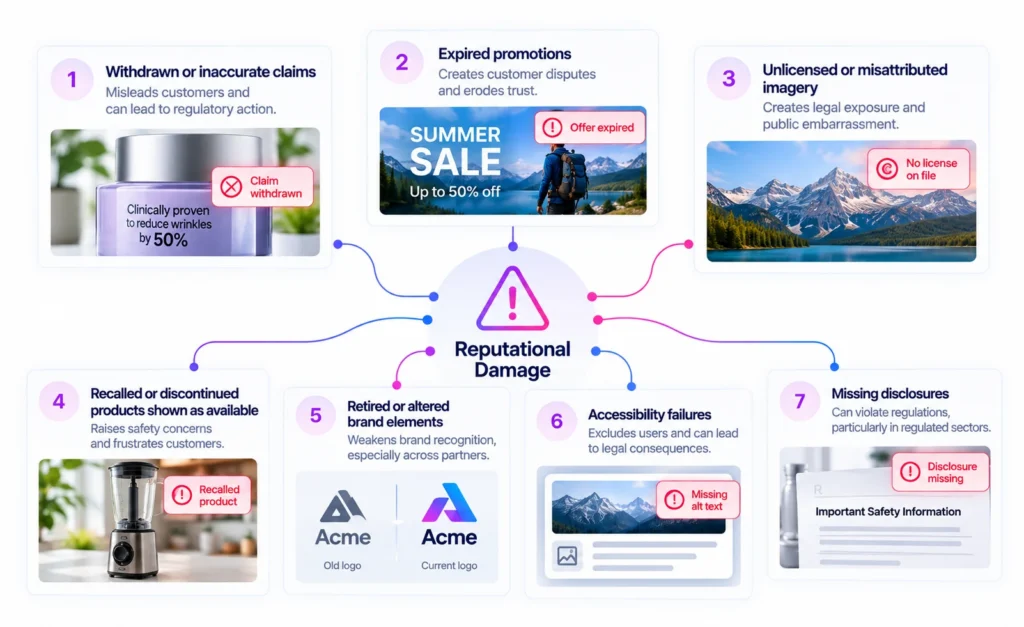
- Withdrawn or inaccurate claims. Product, health, financial, or environmental claims that no longer hold can mislead customers and invite regulatory attention.
- Expired promotions. Offers that no longer apply create disputes, then erode confidence in the brand’s word.
- Unlicensed or misattributed imagery. Rights violations create legal exposure, and public discovery adds embarrassment.
- Recalled or discontinued products shown as available. This can raise safety concerns and customer frustration.
- Retired or altered brand elements. Distorted logos and old identities weaken recognition, especially across partner networks.
- Accessibility failures. Missing alt text or low contrast excludes users, which can create legal and reputational consequences.
- Missing disclosures. Absent or incorrect required language can violate regulations, particularly in regulated sectors.
Ranking these by exposure helps leadership focus. A stylistic inconsistency is worth fixing, but a withdrawn claim live on a high-traffic page needs a faster response.
Who Owns Content Risk Inside the Enterprise?
Ownership of content risk usually sits in several places at once, which means it often sits nowhere. Brand owns the standards, legal owns the claims, compliance owns the regulations, regional teams own local publishing, and IT owns the systems.
Definition: Content risk is the potential for brand, legal, regulatory, or financial harm arising from content that is outdated, unapproved, non-compliant, or inconsistent with brand standards.
Fragmented ownership creates a predictable gap. Each function sees part of the picture and assumes another function covers the rest. When an incident occurs, the question of who was responsible takes longer to answer than the fix.
A workable model assigns a single accountable owner for portfolio-level content risk, often within brand governance, marketing operations, or content operations. That owner does not fix every problem. The role sets the standards, runs the monitoring, reports the posture, and holds property owners to deadlines. Legal and compliance teams define the rules. Regional and property owners remediate. IT supports the connectors. The guide to managing content governance risk describes how to operationalize these controls inside a content platform, and the model here extends them to content outside it.
How Mature Is Your Content Governance?
Benchmark where your content governance program stands today, then see where to focus first.
What Should a CMO Ask For in a Brand Health Report?
A CMO should ask for a report that shows compliance posture by region, brand, and severity, with time-live metrics. The report should answer where risk concentrates, how long issues persist, and whether the trend is improving.
Useful elements include:
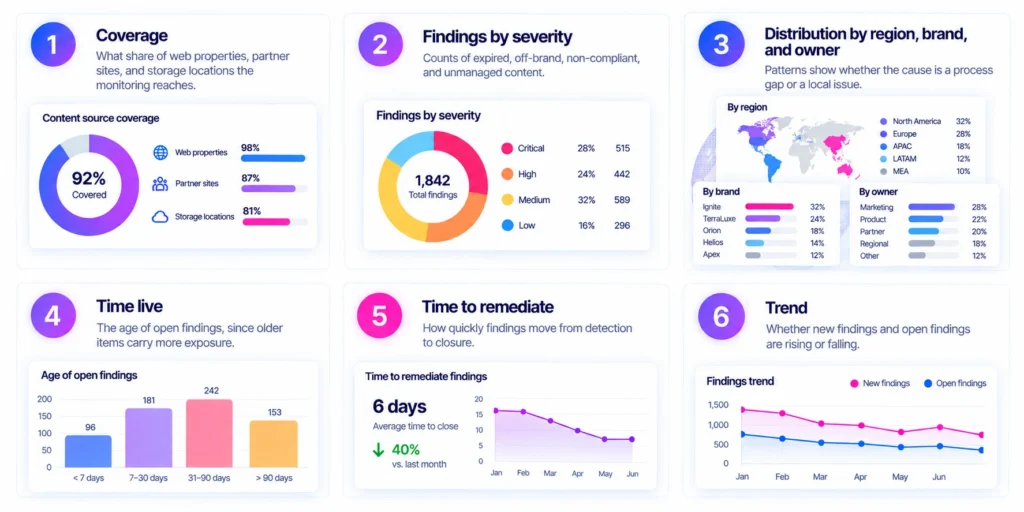
- Coverage. What share of web properties, partner sites, and storage locations the monitoring reaches. A report that covers a small share of the estate understates the risk.
- Findings by severity. Counts of expired, off-brand, non-compliant, and unmanaged content.
- Distribution by region, brand, and owner. Patterns show whether the cause is a process gap or a local issue.
- Time live. The age of open findings, since older items carry more exposure.
- Time to remediate. How quickly findings move from detection to closure.
- Trend. Whether new findings and open findings are rising or falling.
Many organizations cannot produce this report quickly. Compiling a compliance view by region and brand can take weeks. The data is stale on arrival. Automating the data collection turns the report into a standing dashboard. The Content Governance Maturity Assessment helps leaders judge where the current program stands before they set targets.
How Does AI-Generated Content Change the Risk?
AI-generated content raises the volume of content, shortens the time to publish, and introduces new disclosure requirements, which all increase the risk of unmonitored content. Governance has to keep pace with production.
When teams can generate far more variants than before, manual review becomes less feasible. Risks include off-brand tone, unverified claims, and inconsistent visuals. Regulation adds another layer. Transparency obligations for AI-generated content, such as those discussed in EU AI Act transparency for content teams, require organizations to know which content is AI-generated and how it is labeled. An organization that cannot see its content estate cannot confirm labeling.
Guidance on using AI safely for brand governance and compliance covers controls on the production side. A related post on AI marketing compliance adds detail. Monitoring covers the other side, by verifying what actually went live.
What Does a Defensible Governance Posture Look Like?
A defensible posture combines clear policy, continuous monitoring, prioritized remediation, and an audit trail showing that the organization acted. It shows regulators, auditors, and leadership that control exists in practice, not only on paper.
Policies alone do not meet this standard. Auditors and executives increasingly ask for evidence: what was checked, what was found, what was done, and when. A system that logs automated checks, human decisions, and remediation steps produces that evidence as a byproduct of normal work.
Aprimo Content Portfolio Management (CPM) supports this posture. It discovers content across websites, storage, partner portals, and the DAM. AI agents apply brand or compliance checks. A dashboard ranks risks by region, brand, asset type, and severity. The design includes audit-logged decisions plus human review of exceptions, as the launch announcement describes. The Ensure Brand Safety and Compliance page outlines the wider capabilities.
Conclusion
A company’s reputation depends on what it publishes and on what it fails to retire. Review processes protect the first half. The second half, the large and growing body of live content that no one revisits, is where most avoidable damage hides.
The remedy is organizational as much as technical. Someone must own portfolio-level content risk. The reporting must show coverage along with age, not only counts. Monitoring must run without relying on memory or goodwill. CMOs who ask for a brand health view by region and cannot get one have found the first thing to fix. The harder question follows: how much unseen content would the report reveal if it existed today?
FAQ
Is outdated content really a reputation risk, or just a housekeeping issue?
It depends on the content. A stale blog post is housekeeping. A withdrawn claim, an expired offer, or a recalled product shown as available can mislead customers or invite scrutiny, which makes it both a reputation issue and a legal issue.
What is the difference between brand risk and compliance risk?
Brand risk concerns consistency and trust. Compliance risk concerns legal and regulatory requirements. The two overlap, since a compliance failure often becomes a brand story.
How can a CMO measure brand consistency across channels?
Use coverage-based monitoring that compares live content to approved assets, then report the results by region and brand. Survey-based measures complement this but do not locate specific violations.
Should legal or marketing own content risk?
Legal defines the claims. Marketing operations or brand governance usually owns monitoring and reporting. A single accountable leader for the portfolio avoids gaps between the two.
What is a reasonable target for time to remediate?
Set targets by severity. High-severity findings, such as legal or safety issues, warrant the fastest response, while cosmetic issues can follow a longer schedule.
Do small and mid-size companies face the same risk?
The types of risk are the same, but the scale differs. Smaller companies have fewer properties to check, so manual review may suffice longer. Growth in channels or partners raises the need for automation.
Related reading: auditing web content for brand risk, monitoring dealer sites, finding expired campaign content.