
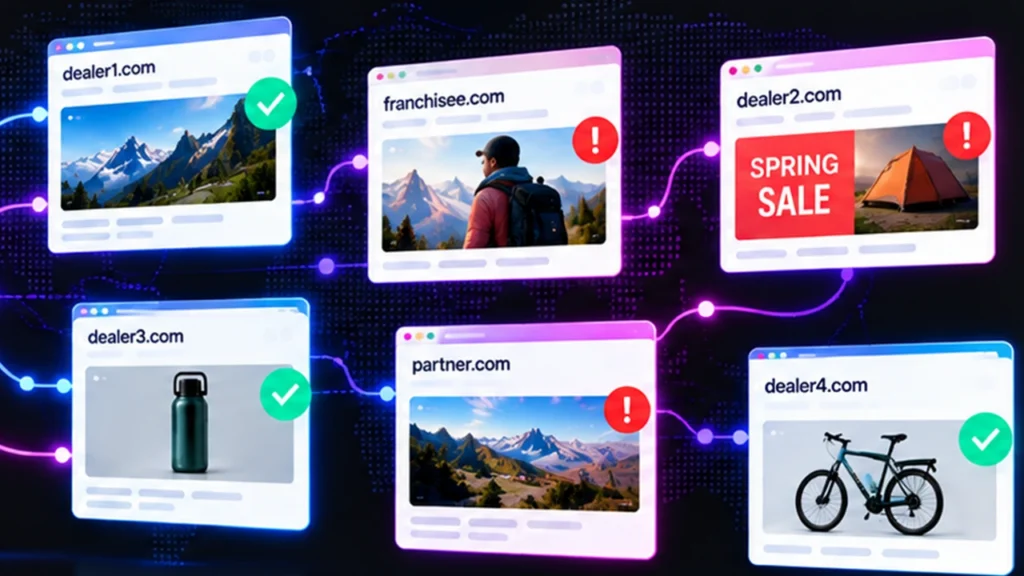
A manufacturer with four hundred dealers has four hundred websites, each managed by a different owner with a different level of care. Some dealers refresh their sites weekly. Others have not changed a page since a web agency built it five years ago. All of them display the manufacturer’s brand, products, and claims, so brand compliance becomes a network-wide problem.
The brand team can publish guidelines, ship asset kits, and run training. What the team cannot do is look at every site on a regular schedule. A retired logo, a withdrawn offer, or an unlicensed photo can stay live for months before anyone at headquarters notices. The same pattern applies to franchise networks, reseller programs, retail partners, and distributors.
This article explains why partner network compliance fails, what to monitor, how to build a monitoring program that does not need an army of reviewers, and how to keep the relationship with partners productive.
TL;DR
- Monitoring brand compliance across dealer and franchisee websites requires three things: automated discovery of partner sites, comparison of their content against approved brand assets, and prioritized reporting by region or severity.
- Manual review cannot cover hundreds of independently run sites, so networks that rely on it find violations late or not at all.
- Effective programs combine three elements: a central library of approved assets that partners can use easily, continuous scanning of partner properties, and a clear process for correcting violations.
- Enablement and monitoring work together, because partners comply more often when compliant content is easy to obtain.
Why Is Brand Compliance Harder to Enforce on Sites You Do Not Own?
Brand compliance is harder on partner sites because the brand owner lacks direct access, direct control, and direct visibility. Partners publish on their own platforms, on their own schedules, using their own vendors.
Three conditions combine to create the difficulty. The first is access: the brand owner cannot log into a dealer’s content management system to see or edit pages. The second is scale: a network of hundreds or thousands of sites turns a monthly review into a full-time job for a large team. The third is divergence: each partner makes small local changes, such as a photo swap or a promotion, that drift from the approved version over time.
Because of these conditions, most networks rely on partner self-reporting, periodic spot checks, or complaints from customers. Each of these methods finds problems after they have been live for some time. A program that looks at partner content continuously changes the timing of detection, which is where most of the avoidable damage occurs.
What Should You Monitor on Dealer and Franchisee Sites?
Monitor the content types that carry the most brand, legal, or customer risk: logos, product imagery, claims, pricing, offers, disclosures, and accessibility. Each category has a clear approved reference.
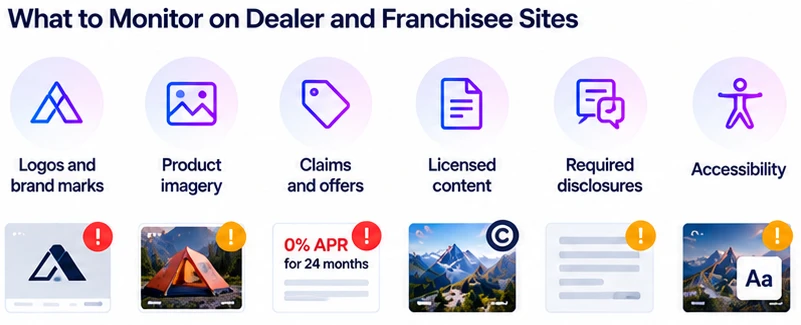
- Logos and brand marks. Check for retired versions, distorted proportions, or incorrect color treatments.
- Product imagery. Compare images against approved product assets, and flag discontinued or recalled products.
- Claims and offers. Look for expired promotions, withdrawn specifications, or statements that legal has not approved.
- Licensed content. Identify photos, fonts, or music used beyond the license terms the brand holds.
- Required disclosures. Confirm that legally required language appears where regulations demand it.
- Accessibility. Check alt text and text contrast, since partner sites inherit accessibility obligations that can reflect on the brand.
Not every item has the same weight. A mismatched hero image is a brand issue. An expired financing offer is a legal issue. A recalled product still on display is a safety and reputation issue. Classifying the types ahead of time lets the monitoring system rank what it finds.
How Do You Monitor Hundreds of Partner Sites Without Manual Review?
Use automated discovery and comparison to scan partner sites continuously, then send only the exceptions to people. The method follows five steps.
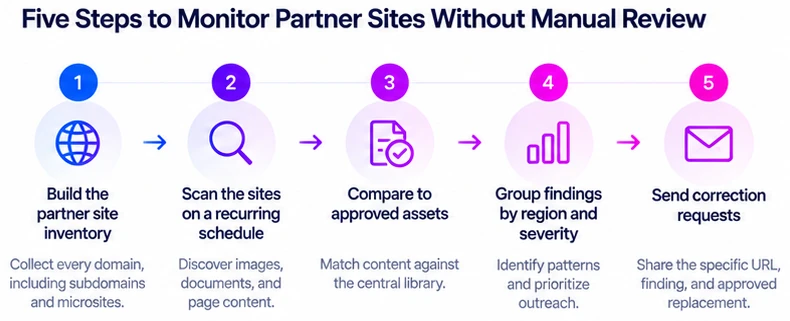
- Build the partner site inventory. Collect every partner domain, including subdomains and microsites. Reconcile the list against the partner database, since the two rarely match.
- Scan the sites on a recurring schedule. Discover images, documents, and page content on each site.
- Compare discovered content to approved assets. Match what appears on partner sites against the central library. Exact matches pass, near matches suggest edits, and unknown items get flagged.
- Group findings by region, partner, and severity. Aggregation shows whether a problem is isolated or systemic. It also shows which partners need outreach first.
- Send correction requests with evidence. Share the specific URL, the finding, and the approved replacement, so the partner can act quickly.
The comparison step does most of the work. A scan that only lists what appears on partner sites produces a pile of data. A scan that matches each item to an approved original produces findings that people can act on.
Automation changes the economics. Monitoring a single dealer site by hand might take thirty minutes. Monitoring four hundred dealers by hand every month would take a full team, and the results would be stale by the time they arrived. Automated scanning turns the same coverage into a background process.
How Mature Is Your Content Governance?
Benchmark where your content governance program stands today, then see where to focus first.
What Authority Does a Brand Owner Have Over Partner Content?
A brand owner’s authority over partner content comes from the partner agreement, not from technical access. Dealer, franchise, and reseller contracts usually specify brand standards, approval requirements, or consequences for violations.
Monitoring supplies the evidence that makes those clauses practical. A correction request that cites a specific page, a specific violation, and the relevant standard is easier to resolve than a general reminder. The brand owner should confirm with legal counsel which remedies the agreements allow, since terms vary by industry, region, and contract.
Some organizations tie compliance to co-op marketing funds or program tiers. That approach turns monitoring data into a lever, but it requires accurate and defensible findings. False positives damage trust quickly, so a human review of flagged items before escalation protects the relationship.
How Do You Prioritize Violations Across a Partner Network?
Prioritize by severity, reach, and recurrence. A network will always have some violations, so the goal is to fix the high-risk ones first and track patterns over time.
Severity separates legal and safety issues from cosmetic ones. Reach considers how many visitors a partner site receives. Recurrence identifies partners who repeatedly drift from standards, which signals a training or process gap rather than an isolated error.
Regional grouping adds a useful view. If most violations cluster in one market, the cause may be a missing translated asset or an outdated regional kit. Fixing the kit resolves dozens of findings at once. Teams that report compliance posture by region and brand also have a ready answer when leadership asks for a network-wide view.
How Does Monitoring Fit With Partner Enablement?
Monitoring works best alongside enablement, because partners comply more often when approved assets are easy to find and use. Policing alone creates friction, and enablement alone leaves gaps.
A brand portal gives partners one place to download current logos, imagery, templates, and guidelines. Posts such as how companies use brand portals to distribute digital assets and DAM brand compliance for global teams cover the supply side. Monitoring covers the verification side. When a scan finds an outdated logo, the correction request can link directly to the current version in the portal, which shortens the fix.
Aprimo Content Portfolio Management (CPM) supports the verification side. It discovers partner sites, groups violations by region or severity, then helps teams act without manual oversight, as described in the launch announcement. Industries with large partner networks, such as manufacturing, consumer goods, and retail, see the clearest fit.
Conclusion
Partner networks multiply brand exposure faster than any central team can review it. The fix is not a larger review team. It is a monitoring model that treats every partner site as part of the brand’s content portfolio, compares what is live to what is approved, and sends people only the exceptions that need judgment.
Networks that adopt this model also change how partners experience compliance. Instead of occasional audits and angry emails, partners receive specific, evidence-based requests with a ready replacement. That experience builds the cooperation the brand needs for the long term. The harder question for most brands is internal: whether the organization is prepared to act on what continuous monitoring will reveal about its own network.
FAQ
How many partner sites can be monitored automatically?
The limit depends on the tool and its allowances, not on human effort. Automated scanning treats a network of hundreds or thousands of sites as a recurring job. Check the scan allowances and connector terms of any platform under consideration.
What if a partner site blocks scanning?
Publicly accessible pages can usually be scanned like any visitor would view them. Content behind logins requires the partner’s cooperation. Contracts can require access for brand compliance purposes.
Does monitoring replace partner training?
No. Training sets expectations, and monitoring verifies that the expectations hold. The two work together, and monitoring data often shows which topics the training needs to cover.
How do you handle a partner who ignores correction requests?
Escalate according to the agreement, using the documented findings as evidence. Legal counsel should confirm the available remedies. Tracking the response time per partner also helps identify chronic issues.
Can monitoring detect AI-generated or altered images on partner sites?
Near-duplicate detection can flag images that resemble approved assets but differ from them. Whether a tool identifies synthetic content depends on its capabilities, so verify this before relying on it.
What is a reasonable first goal for a monitoring program?
Start with the highest-risk content types, such as logos, claims, and offers, across the top-traffic partner sites. Prove the process, tune the checks, and then widen coverage.
Related reading: auditing web content for brand risk, finding expired campaign content, content risk as a reputation issue.