
Marketing leaders face a paradox. The demand for more content, produced faster and distributed across more channels, has never been higher. Yet the stakes for getting it wrong have never been greater. A single misused asset can trigger trademark violations, brand erosion, regulatory fines, or reputational damage that takes months to repair. The problem is not that governance frameworks do not exist.
The problem is that most governance lives outside the systems where content is actually created, reviewed, and distributed. Policies documented in PDF guides and compliance tracked in spreadsheets cannot keep pace with teams operating across time zones, agencies, and platforms. The result is predictable: bottlenecks, shadow workflows, and the kind of preventable mistakes that expensive legal reviews were supposed to catch. Content governance and risk management must be operationalized, not documented. That means embedding controls, permissions, and policy enforcement directly into the content operations platform itself.
TL;DR
- Effective content governance and risk management requires a unified framework that embeds approval workflows, rights tracking, and policy enforcement directly into the content operations platform where teams already work.
- The most successful governance programs combine technical controls such as metadata validation and automated compliance checks with clear role-based permissions that prevent unauthorized asset use before it occurs.
- Organizations that centralize governance within their digital asset management platform reduce audit cycles by an average of forty percent while eliminating the fragmented spreadsheets and email threads that create compliance gaps.
- Integrating rights management and expiration tracking at the asset level transforms passive compliance into active risk mitigation that scales across global teams and diverse regulatory requirements.
- Teams that operationalize governance within content operations platforms accelerate campaign velocity while simultaneously reducing legal exposure, creating measurable competitive advantage through speed and safety in equal measure.
What Content Governance and Risk Management Actually Mean
Content governance is the system of policies, roles, and technical controls that determine who can create, modify, approve, and distribute content assets. Risk management in this context refers to the identification, assessment, and mitigation of threats tied to content misuse, non-compliance, rights violations, and brand inconsistency. Together, they form the operational backbone that allows marketing organizations to move quickly without breaking things.
Definition: Content governance is the structured framework of roles, policies, workflows, and technical controls that ensures content assets are created, approved, stored, and distributed in alignment with brand standards, legal requirements, and organizational risk tolerance.
Most organizations approach governance as a set of documents: brand guidelines, legal checklists, and approval matrices. These artifacts matter, but they are inherently static. Effective governance is dynamic. It lives in the permissions that prevent an agency partner from accessing embargoed product imagery. It lives in the metadata field that flags an asset whose usage rights expire in thirty days. It lives in the approval workflow that routes every customer-facing claim through legal review before publication. When governance is operationalized inside the content platform, it becomes an invisible infrastructure that works in the background, not a friction point that slows teams down. Risk, by contrast, is not hypothetical. Expired rights lead to injunctions. Off-brand creative damages customer trust. Unapproved health claims trigger regulatory action. The cost of these failures is measurable, and the common thread is almost always a breakdown in governance: the right control existed on paper, but the platform allowed the wrong action anyway.
Key Components of Effective Content Governance Frameworks
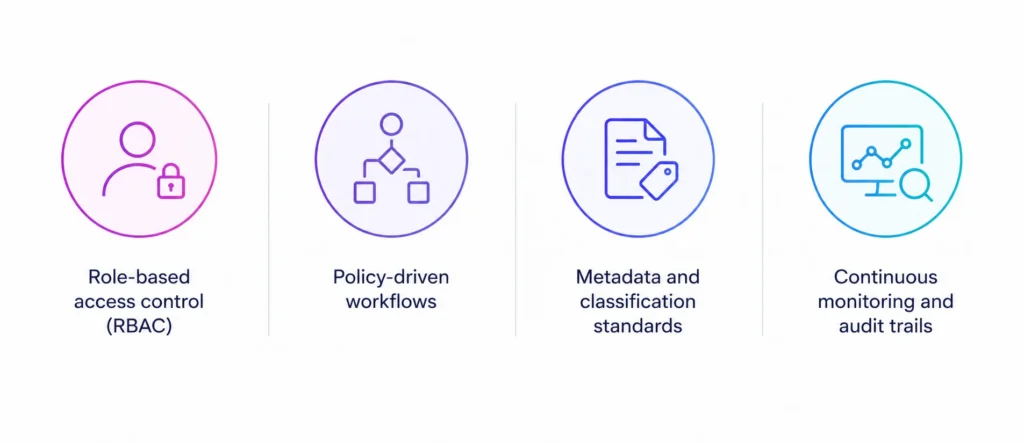
A governance framework that actually works rests on four interdependent components: role-based access control, policy-driven workflows, metadata and classification standards, and continuous monitoring with audit trails. Each component addresses a different governance challenge, and each must be enforceable within the platform to be effective.
Role-based access control (RBAC) ensures that users see only the assets and actions appropriate to their function. A regional marketing manager in APAC does not need access to North American retail assets still under embargo. An external agency does not need download rights for raw photography that has not cleared legal review. RBAC is the first line of defense against accidental misuse, and it scales far better than ad hoc permission requests. When permissions are tied to roles rather than individuals, onboarding and offboarding become straightforward, and the risk of orphaned access disappears.
Policy-driven workflows automate the decision points that governance requires. Every piece of content destined for a regulated channel (healthcare marketing, financial services advertising, food and beverage claims) should pass through a defined approval sequence. The workflow enforces the policy. It routes the asset to the right reviewers, captures their decisions, and blocks publication until all gates are cleared. This is not bureaucracy for its own sake. It is the mechanism that prevents a well-meaning content creator from inadvertently violating a rule they did not know existed.
Metadata and classification standards provide the semantic layer that makes governance searchable and enforceable. An asset tagged with its usage rights, expiration date, region, product line, and approval status can be governed by rules. An untagged asset cannot. Predictive metadata capabilities that auto-tag assets at ingest reduce the manual burden and improve consistency. The metadata schema is the data model for risk: if the platform cannot identify which assets are subject to which rules, governance becomes guesswork.
Continuous monitoring and audit trails close the loop. Governance is not a one-time gate. It is an ongoing state. Automated alerts notify stakeholders when rights are about to expire, when assets are accessed outside approved geographies, or when usage patterns deviate from policy. Audit logs provide the forensic record required for compliance reviews and post-incident analysis. Together, monitoring and logging transform governance from a preventive control into a learning system.
How Digital Asset Management Platforms Enforce Governance Policies
Digital asset management platforms enforce governance by embedding policy logic directly into the user experience, making compliant behavior the default path and non-compliant actions either impossible or highly visible. This is a shift from documentation to automation, and it changes the nature of compliance work. The platform becomes the single source of truth for what is approved, what is permissible, and what is restricted. When an asset is uploaded, the system can require mandatory metadata fields (rights holder, expiration date, intended use case) before the file is even saved. When a user searches for an image, the results are pre-filtered based on that user’s role and geographic permissions. When a download is requested, the platform can present a usage agreement or log the transaction for audit purposes. These are not features bolted on after the fact. They are the architecture of the system.
Approval workflows are the most visible enforcement mechanism. A content creator uploads a new banner ad. The platform routes it to brand review, then legal, then the regional marketing lead. Each reviewer sees only the assets in their queue. Each decision is captured with a timestamp and rationale. If legal rejects the asset, it does not advance. If brand requests a revision, the creator is notified and the workflow resets. The entire process is trackable, and nothing reaches distribution without passing every checkpoint. This is governance as code: the policy is expressed in the workflow configuration, and the platform executes it without exception.
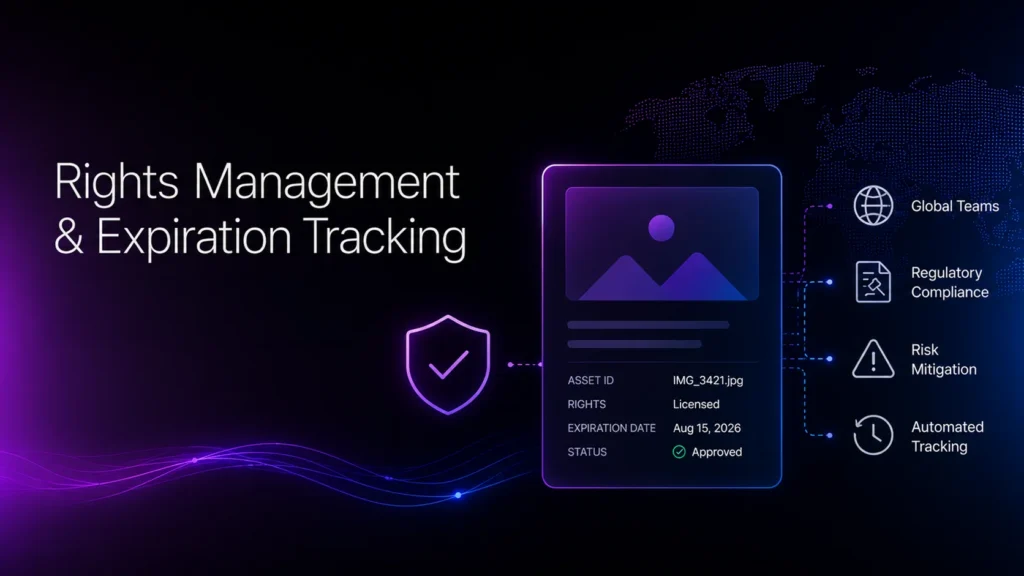
Rights management and expiration tracking turn passive metadata into active controls. An asset tagged with a usage rights expiration date of June 30 triggers an automated alert to the asset owner thirty days in advance. If the asset is not renewed or replaced, the platform can automatically remove it from public-facing libraries or restrict further downloads. This prevents the most common and costly governance failure: the continued use of an asset whose license has lapsed. Legal exposure is reduced not because someone remembered to check a spreadsheet, but because the system enforced the rule.
Version control and change tracking provide another layer of enforcement. Every edit to an approved asset creates a new version. The platform logs who made the change, when, and why. If an updated logo replaces an outdated one, the old version can be deprecated across all collections simultaneously, ensuring no one accidentally uses the wrong file. This level of control is impossible when assets are stored in shared drives or scattered across departmental silos. Centralization is not just a convenience. It is a prerequisite for governance at scale.
Practical Steps to Mitigate Content-Related Risks
Mitigating content-related risks requires a structured approach that moves from assessment to implementation to continuous improvement. The following sequence operationalizes risk management within the content operations platform.
- Conduct a comprehensive content risk audit to identify which assets, channels, and workflows carry the highest exposure. Regulated industries (pharmaceuticals, finance, food and beverage) have obvious high-risk categories, but every organization has them. Identify assets that include customer testimonials, health or safety claims, celebrity likenesses, licensed imagery, or region-specific pricing. Map these assets to the regulatory or contractual obligations they must satisfy. This audit generates the risk register that informs every subsequent control.
- Define and document governance policies that are specific, measurable, and enforceable. A policy that says “follow brand guidelines” is not enforceable. A policy that says “all customer-facing video must be reviewed by legal before publication and tagged with approval date and reviewer name” is enforceable. Policies should address approval requirements, usage restrictions, metadata standards, retention schedules, and escalation procedures. These policies become the configuration blueprint for the platform.
- Implement role-based access control and metadata schemas that reflect the risk categories identified in the audit. Users in high-risk functions (product marketing, clinical affairs, investor relations) may require additional approval layers. Assets in high-risk categories (product claims, financial disclosures, licensed content) require richer metadata to support compliance tracking. The platform configuration should make it easy to do the right thing and difficult (or impossible) to do the wrong thing.
- Automate approval workflows and rights management processes so that governance happens without manual intervention. Configure the platform to route assets through the appropriate review sequence based on asset type, intended channel, and geographic market. Set up automated alerts for expiring rights, pending reviews, and policy violations. Automation reduces the cognitive load on individuals and eliminates the failure mode where someone forgets to check the spreadsheet.
- Establish monitoring dashboards and regular governance reviews to track compliance metrics and surface emerging risks. Key metrics include approval cycle time, rights expiration rate, policy violation frequency, and audit finding severity. Review these metrics quarterly with stakeholders from legal, brand, and marketing operations. Use the data to refine policies, adjust workflows, and identify training needs. Governance is a system, and systems require feedback loops to improve. These steps are not theoretical. They represent the playbook that high-performing marketing organizations use to scale content production without increasing risk exposure. The difference between a governance program that works and one that is ignored is execution: controls must be embedded in the platform, not documented in a binder.
The Business Case for Integrated Governance and Risk Management
Integrating content governance and risk management within a single content operations platform delivers measurable operational and financial benefits that extend well beyond compliance. The business case rests on three pillars: velocity, cost avoidance, and competitive differentiation.
Velocity improves because governance becomes frictionless. When approval workflows, rights tracking, and metadata validation are built into the platform where content is already managed, teams do not context-switch between tools. A campaign manager can search for approved assets, check usage rights, download the file, and log the usage without leaving the DAM. This reduces approval cycle time and eliminates the bottlenecks that occur when governance is a separate, manual process. Organizations that centralize governance report faster time-to-market for campaigns and higher throughput for creative teams.
Cost avoidance is the most direct financial benefit. Legal fees for trademark disputes, regulatory fines for non-compliant advertising, and settlement costs for rights violations can easily run into six or seven figures per incident. The cost of implementing governance controls in a content platform is a fraction of the cost of a single serious breach. Beyond the catastrophic risks, integrated governance eliminates the waste associated with recreating lost assets, tracking down approvals after the fact, and manual audit preparation. These are hidden costs that accumulate across every campaign, and they vanish when governance is automated.
Competitive differentiation emerges when an organization can move faster than competitors while maintaining higher standards of compliance and brand consistency. This is the operational paradox that integrated governance resolves. In contrast to the traditional trade-off between speed and control, a well-configured content operations platform makes speed and control mutually reinforcing. Teams can launch campaigns in days rather than weeks because the approval path is clear, the assets are pre-cleared, and the risk is already managed. Customers perceive this as brand excellence. Regulators perceive it as maturity. Investors perceive it as operational discipline. All three perceptions create value.
The alternative is fragmentation. Governance policies documented in SharePoint. Approval tracked in email. Rights managed in spreadsheets. Asset storage scattered across cloud drives and local folders. This model worked when content volume was low and distribution channels were few. It does not scale. Fragmentation creates blind spots, and blind spots create risk. The integrated model collapses the distance between policy and execution, turning governance from overhead into infrastructure.
Governance vs. Agility: Resolving the False Trade-Off
The perceived tension between governance and agility is one of the most persistent misconceptions in content operations. Marketing teams often view governance as bureaucracy that slows them down. Legal and compliance teams view agility as recklessness that exposes the organization. The truth is that well-designed governance enables agility rather than constraining it.
Governance without a platform is slow because every decision requires human intervention. A content creator needs an asset, emails a request to the brand team, waits for a response, searches a shared drive, finds three versions of the logo, guesses which one is current, and proceeds. If the guess is wrong, the error is discovered later, after publication, triggering rework and potential risk exposure. This is the slow, fragile model that gives governance a bad name.
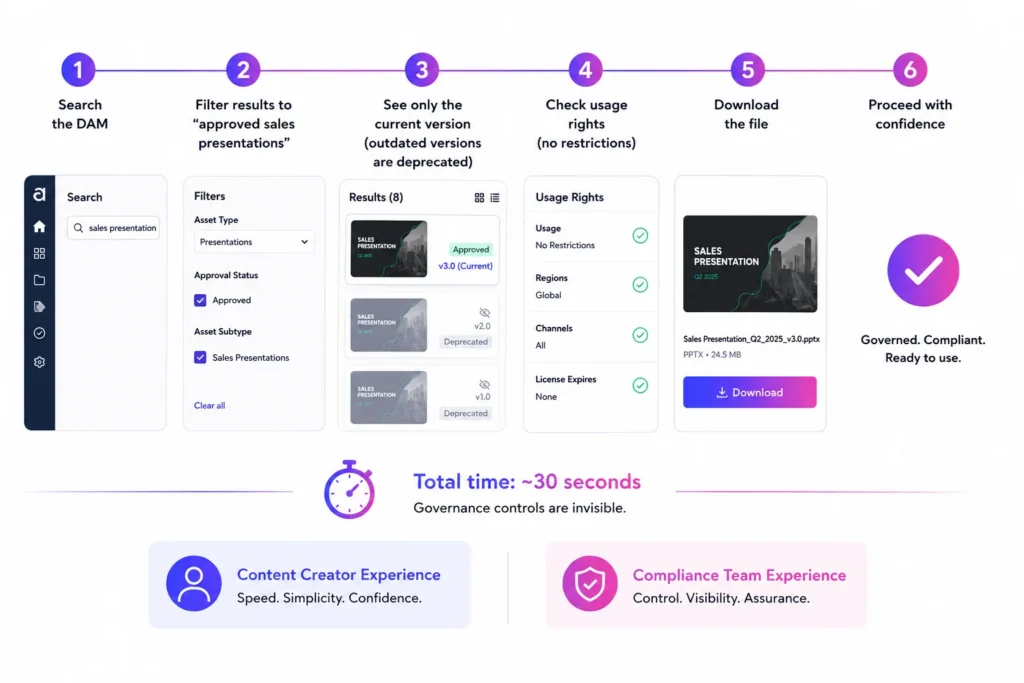
Governance within a platform is fast because the system answers most questions automatically. The same content creator searches the DAM, filters results to “approved sales presentation,” sees only the current version (outdated versions are deprecated), checks the usage rights (no restrictions), downloads the file, and proceeds. The entire transaction takes thirty seconds, and the governance controls are invisible. The creator experiences speed. The compliance team experiences control. Both are correct.
Agility, properly understood, is not the absence of rules. It is the ability to move quickly within a known and reliable framework. A racecar is agile not because it lacks structure, but because its structure is optimized for speed and safety simultaneously. The same principle applies to content operations. Teams move faster when they trust that every asset is approved, every workflow routes to the right reviewers, and the platform prevents policy violations automatically. That trust is the foundation of agility.
The false trade-off dissolves when governance becomes automated and transparent. Automated controls enforce policy without adding wait time. Transparent workflows show teams exactly what is required and how long each step will take. The result is a content operation that is both faster and safer than the unmanaged alternative. Organizations that achieve this balance do not choose between governance and agility. They use governance to unlock agility, and they do it by embedding both into the platform architecture.
Conclusion
Content governance and risk management are not compliance exercises to be tolerated. They are operational capabilities that determine how fast an organization can move and how much risk it carries while doing so. The shift from documented policies to operationalized controls is not optional. It is the difference between governance that scales and governance that becomes a bottleneck as content volume grows.
Digital asset management platforms that embed approval workflows, rights tracking, role-based permissions, and audit capabilities transform governance from overhead into infrastructure. The business outcomes are clear: faster campaign cycles, lower legal exposure, higher brand consistency, and the competitive advantage that comes from being both fast and safe.
Marketing leaders who treat governance as a platform capability rather than a policy document gain the ability to accelerate content operations without increasing risk. That combination is rare, valuable, and increasingly necessary as content complexity continues to grow.
Ready to Modernize Your Content Operations?
Generate a tailored Digital Asset Management RFI based on your requirements, use cases, and business goals.

FAQ
How do you measure the effectiveness of a content governance program?
Effectiveness is measured through a combination of process metrics and outcome metrics that reveal both efficiency and risk reduction. Process metrics include approval cycle time, percentage of assets with complete metadata, rights expiration rate, and workflow completion rate. Outcome metrics include number of policy violations, audit findings, legal incidents related to content misuse, and rework frequency. The most mature programs also track time saved through automation and the delta between content volume growth and governance overhead growth, demonstrating that controls scale efficiently.
Can small marketing teams implement content governance without slowing down production?
Small teams can and should implement governance, but the approach must be proportional to risk exposure and content volume rather than mimicking enterprise-scale controls. Start with the highest-risk asset categories and channels, then automate the controls that prevent the most common and costly failures. A small team benefits even more from automation because there is no compliance department to catch errors manually. Platform-based governance allows a lean team to enforce standards that would be impossible to maintain through manual review alone, actually increasing production speed by reducing rework cycles.
How should organizations handle governance for user-generated content or third-party contributions?
User-generated content and third-party contributions require a two-stage governance model that separates intake from approval and publication. All externally sourced content should be ingested into a holding area within the platform where it can be reviewed, tagged, and cleared for rights before it becomes available to internal teams. Automated workflows should route each submission through legal and brand review, with clear acceptance criteria documented in the workflow configuration. Once approved, the content is promoted to the main library with appropriate metadata and usage restrictions, ensuring external contributions meet the same governance standards as internally created assets.
How does content governance directly impact marketing ROI and campaign performance?
Effective content governance reduces costly mistakes like brand inconsistencies, regulatory violations, and expired asset usage that can damage customer trust and result in financial penalties. Marketing leaders who implement strong governance see faster content approval cycles because pre-approved templates and automated compliance checks eliminate bottlenecks in the review process. Governance also enables better content reuse and localization strategies, allowing teams to scale campaigns more efficiently across multiple markets without duplicating effort. Organizations with mature governance frameworks report up to 40 percent reduction in content production costs while maintaining higher quality standards.