
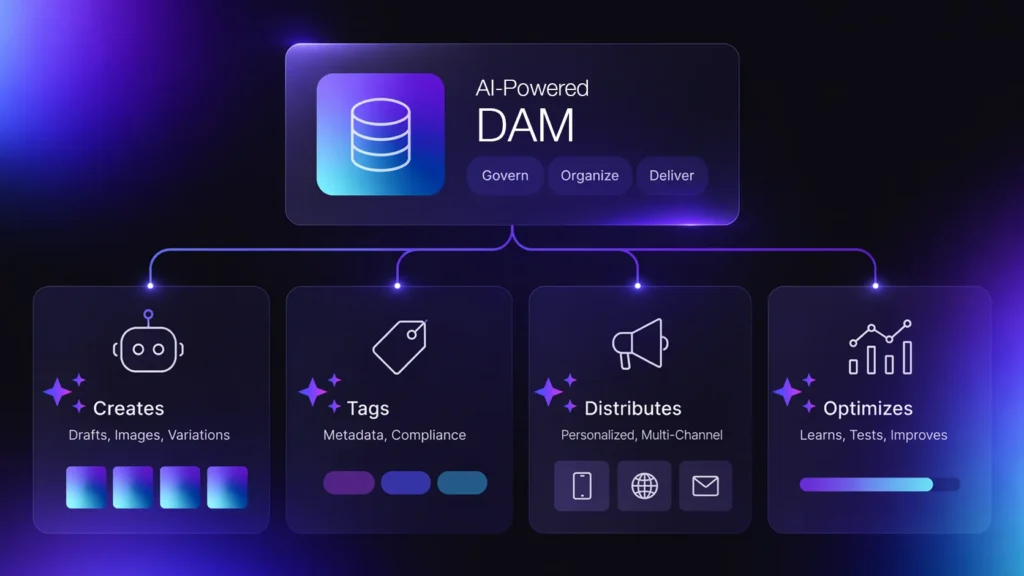
AI in marketing has moved past experimentation. Teams are no longer asking whether to use AI. They are asking how to operationalize it.
That shift is where AI agents come in.
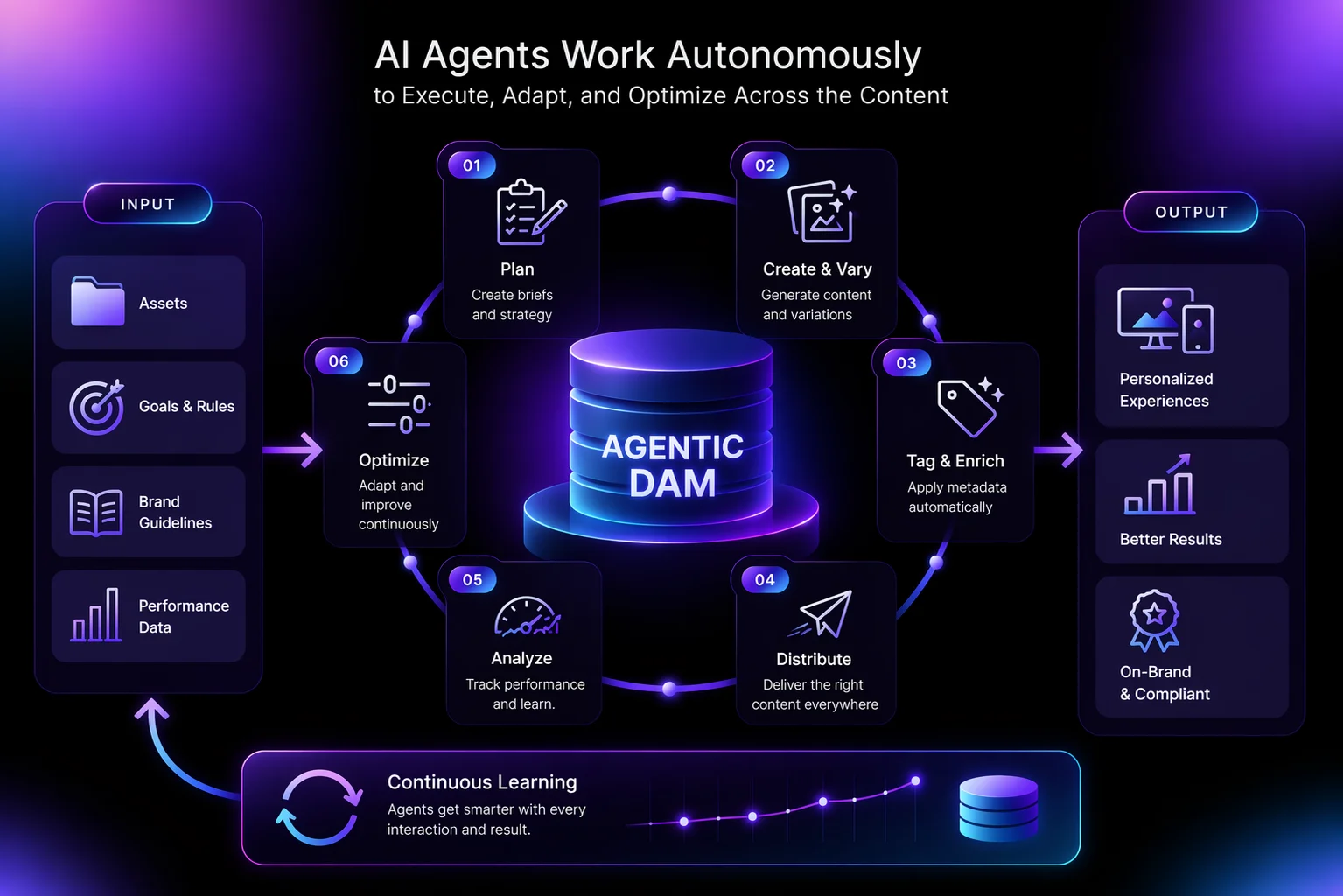
Unlike basic AI tools that respond to prompts, AI agents can take action. They can execute tasks, make decisions within defined rules, and interact with systems across the content lifecycle. In digital marketing, that means they can help plan campaigns, generate assets, tag content, route approvals, and even optimize performance.
But this creates a new challenge.
As AI agents increase content velocity, they also increase complexity. More content gets created. More versions exist. More workflows run in parallel. Without structure, this quickly becomes harder to manage.
That is why AI agents and digital asset management need to work together.
DAM acts as the core nucleus of the entire content operations process in digital marketing. It ensures that content remains governed, searchable, reusable, and compliant. AI agents, when connected to that system, become part of a controlled content operation rather than a source of chaos.
TL;DR
AI agents are changing how digital marketing operates. They are not just tools. They act as autonomous systems that can create, organize, distribute, and optimize content across channels. For teams managing content at scale, AI agents are most valuable when connected to digital asset management (DAM) and content operations.
Key takeaways:
- AI agents automate content workflows across creation, tagging, distribution, and optimization
- DAM becomes critical as the control layer for AI-generated and AI-assisted content
- Without governance, AI agents can increase risk, inconsistency, and duplication
- Metadata, taxonomy, and workflow are essential to make AI agents usable at scale
- The real value comes from combining AI agents with structured content operations
What Are AI Agents in Digital Marketing?
AI agents are systems that can perform tasks autonomously based on goals, rules, and context. In digital marketing, they operate across different parts of the content lifecycle:
- Content creation and variation
- Metadata tagging and enrichment
- Asset discovery and recommendations
- Workflow automation
- Campaign optimization
The key difference from traditional AI tools is action. Instead of waiting for input, AI agents can initiate workflows, trigger updates, and adapt based on data.
For example, an AI agent could:
- Generate multiple versions of a campaign asset for different audiences
- Tag assets automatically using metadata and taxonomy rules
- Route content for approval based on predefined workflows
- Recommend existing assets for reuse instead of creating new ones
This moves AI from a support tool to an operational layer.
Why AI Agents Matter for Content Operations
Most marketing organizations are not struggling to create content. They are struggling to manage it. Content volume continues to grow. Teams work across more channels, regions, and audiences. Approval processes become more complex. Reuse becomes harder. Governance becomes inconsistent.
AI agents help address these challenges, but only when aligned with structured content operations.
They increase content velocity
AI agents can generate and adapt content faster than manual workflows. This helps teams meet demand for personalization and omnichannel delivery.
They reduce manual work
Tasks like tagging, searching, routing, and organizing assets can be automated. This frees teams to focus on strategy and execution.
They improve discoverability
AI agents can enrich assets with metadata, making it easier to find and reuse content across the organization.
They support scalability
As content operations grow, AI agents help manage complexity without requiring proportional increases in resources.
But there is a trade-off. Without governance, these same capabilities can increase duplication, inconsistency, and risk.
Where AI Agents Fit in DAM
AI agents are most effective when integrated into a DAM environment.
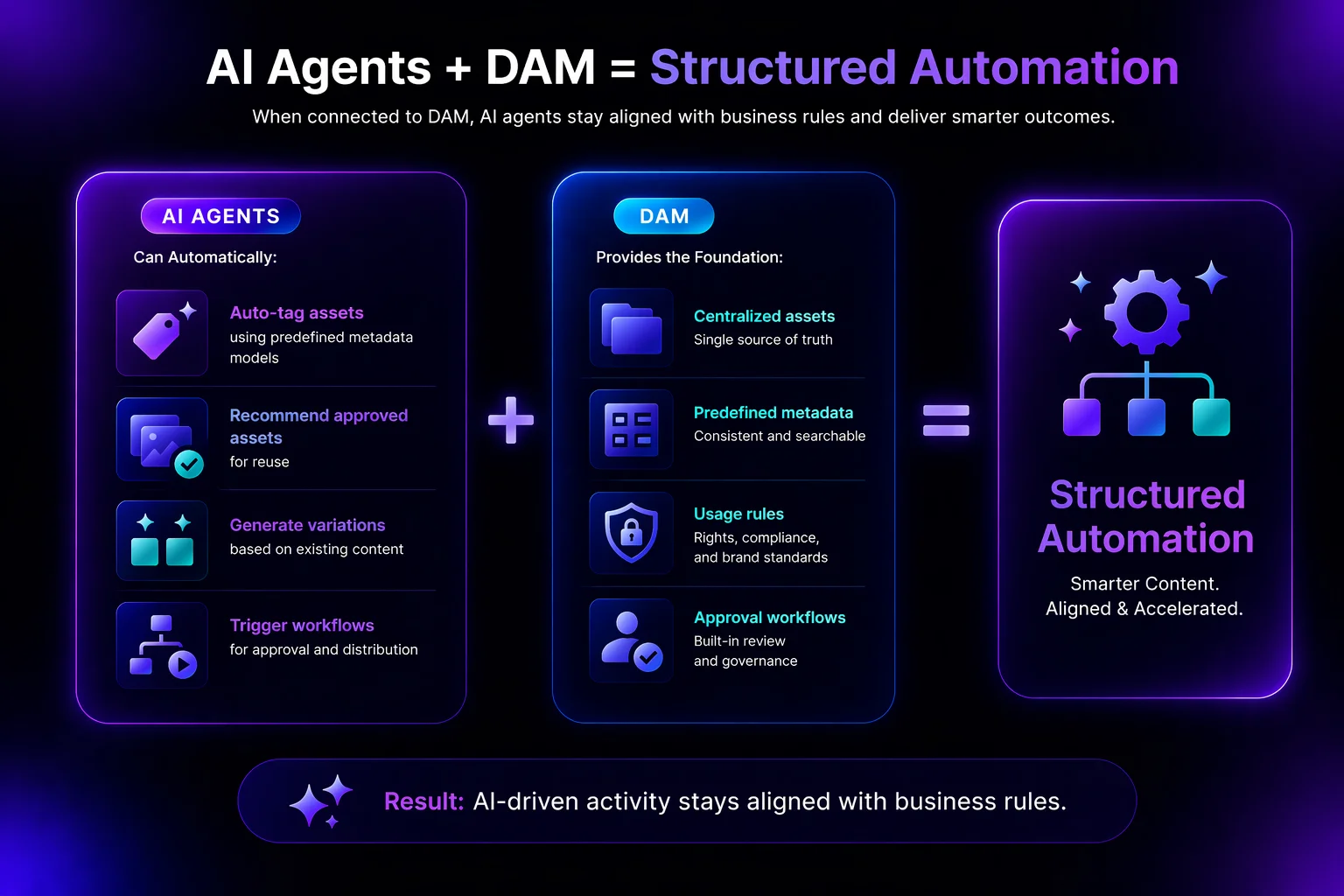
DAM acts as the foundation for content operations. It centralizes assets, enforces governance, and provides structure through metadata and taxonomy.
AI agents build on top of that foundation.
AI Agents + DAM = Structured Automation
When connected to DAM, AI agents can:
- Auto-tag assets using predefined metadata models
- Recommend approved assets for reuse
- Generate variations based on existing content
- Enforce usage rules and rights metadata
- Trigger workflows for approval and distribution
This ensures that AI-driven activity stays aligned with business rules.
For a deeper look at how DAM supports modern workflows, read Is Your Generative AI DAM Ready for Modern Workflows?
Core Use Cases for AI Agents in Marketing
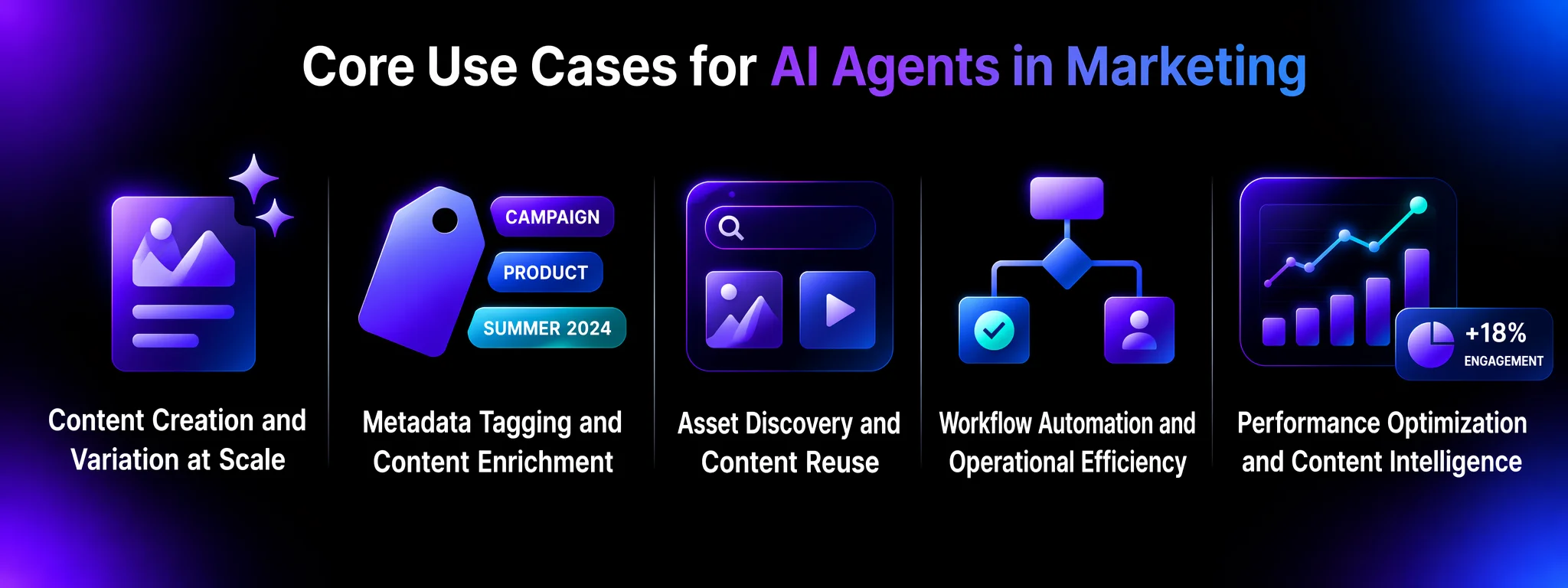
AI agents are most valuable when applied across the full content lifecycle. Their impact is not limited to one stage. They influence how content is created, managed, distributed, and optimized over time.
Below are the most important use cases where AI agents are already reshaping digital marketing operations.
Content Creation and Variation at Scale
One of the most immediate applications of AI agents is in content creation and adaptation. Marketing teams are under pressure to produce more content for more audiences, across more channels, in less time.
AI agents help address this challenge by generating content variations based on existing assets and structured inputs.
Instead of creating every asset from scratch, teams can use AI agents to:
- Adapt messaging for different audience segments
- Localize content for regional markets
- Generate channel-specific formats for social, web, and email
- Create multiple versions of campaign assets for testing and optimization
This approach shifts content production from a linear process to a modular one. Teams can build from existing, approved content rather than recreating everything repeatedly.
However, scaling content creation without structure introduces risk. As content volume increases, so does the complexity of managing approvals, consistency, and compliance.
This is why organizations need to combine AI-driven content generation with structured governance. As explored in Aprimo’s guide on scaling personalized content without losing governance, the key is not just producing more content, but doing so within a controlled operational framework.
Metadata Tagging and Content Enrichment
Metadata is one of the most important foundations of digital asset management. Without it, even the most valuable content becomes difficult to find, understand, and reuse.
AI agents play a critical role in improving metadata quality and consistency.
They can automatically:
- Analyze images, videos, and documents
- Apply relevant metadata tags
- Classify assets based on taxonomy rules
- Enrich content with contextual information such as product, campaign, or audience
This significantly reduces the manual effort required for tagging while improving accuracy and consistency across the DAM.
The impact is not just operational. Better metadata directly improves:
- Searchability
- Content reuse
- Governance
- Reporting and analytics
As outlined in Aprimo’s article on organizing digital assets using metadata and taxonomy, structure is what turns a content library into a usable system. AI agents help maintain that structure at scale.
Asset Discovery and Content Reuse
One of the most common inefficiencies in marketing organizations is the underuse of existing content. Teams often recreate assets because they cannot find what already exists or cannot determine whether it is approved.
AI agents help solve this problem by making asset discovery more intelligent.
They can:
- Recommend relevant assets based on user behavior or context
- Identify similar or duplicate content
- Surface approved versions of assets for reuse
- Suggest content that can be adapted instead of recreated
This shifts the focus from content creation to content utilization.
Instead of asking, “What do we need to create?” teams can ask, “What do we already have that we can use?”
This improves return on content investment while reducing production costs and time to market.
Workflow Automation and Operational Efficiency
Content operations involve multiple stakeholders, approval stages, and dependencies. Managing these workflows manually can slow down execution and introduce inconsistencies. AI agents help streamline these processes by automating workflow steps and decision points.
They can:
- Route content to the right stakeholders for approval
- Trigger workflows based on asset status or metadata
- Assign tasks and notify users automatically
- Monitor progress and flag bottlenecks
This creates more predictable and repeatable workflows.
Rather than relying on manual coordination, teams can operate within structured processes that scale with content demand.
Workflow automation becomes even more powerful when combined with DAM. As explained in Aprimo’s blog on essential DAM integrations for enterprise content ecosystems, connecting systems and workflows is critical for reducing operational friction and improving efficiency across the stack.
Performance Optimization and Content Intelligence
AI agents are not limited to content creation and management. They also play a role in analyzing performance and optimizing content over time.
They can:
- Analyze engagement data across channels
- Identify high-performing assets
- Recommend content updates or variations
- Suggest reuse opportunities based on performance trends
This closes the loop between content production and content performance.
Instead of relying on static reporting, teams can use AI-driven insights to continuously improve content effectiveness. This is especially important in omnichannel environments, where content performance varies across platforms, audiences, and formats.
The Role of Governance in AI-Driven Marketing
AI agents increase content velocity. Governance ensures that this increased speed does not come at the cost of quality, consistency, or compliance. As organizations adopt AI at scale, governance becomes more important, not less.
Without governance, AI agents can introduce several risks:
- Inconsistent brand messaging across channels and regions
- Use of outdated or unapproved assets
- Duplication of content across teams
- Compliance and legal exposure
The challenge is not to limit AI, but to guide it. Strong governance frameworks include:
- Structured metadata and taxonomy
- Defined workflows and approval processes
- Role-based permissions and access control
- Rights management and usage tracking
- Centralized asset management through DAM
As highlighted in Aprimo’s perspective on generative AI readiness in DAM workflows, AI should operate within governed systems, not outside them.
AI Agents and Omnichannel Marketing
Modern marketing operates across multiple channels simultaneously. Content needs to be consistent, relevant, and adaptable across web, social, email, commerce, and partner ecosystems.
AI agents help enable this by:
- Adapting content for different channels
- Recommending channel-specific variations
- Supporting real-time content updates
However, omnichannel consistency depends on having a single source of truth. This is where DAM becomes essential.
A centralized DAM ensures that:
- Teams access approved and up-to-date assets
- Brand consistency is maintained across channels
- Content updates are reflected everywhere
As explored in Aprimo’s blog on omnichannel digital asset management for consistent customer experience, DAM provides the foundation for delivering consistent experiences at scale.
The Risks of Using AI Agents Without DAM
Some organizations adopt AI tools in isolation, without integrating them into structured content operations. This approach often leads to fragmentation and inefficiency.
Common risks include:
- Fragmented content ecosystems: Assets are created across multiple tools and systems, making them harder to manage and govern.
- Poor discoverability: Without metadata and centralization, content becomes difficult to find and reuse.
- Increased duplication: Teams recreate assets because they lack visibility into existing content.
- Governance gaps: Approval processes, compliance controls, and brand standards become inconsistent.
- Limited scalability: As content volume grows, operations become harder to manage without structure.
These challenges reinforce a key point. AI agents are not a replacement for content operations. They are an extension of it.
How to Implement AI Agents in a DAM-Centric Model
To get the most value from AI agents, organizations need to integrate them into a structured content operations framework.
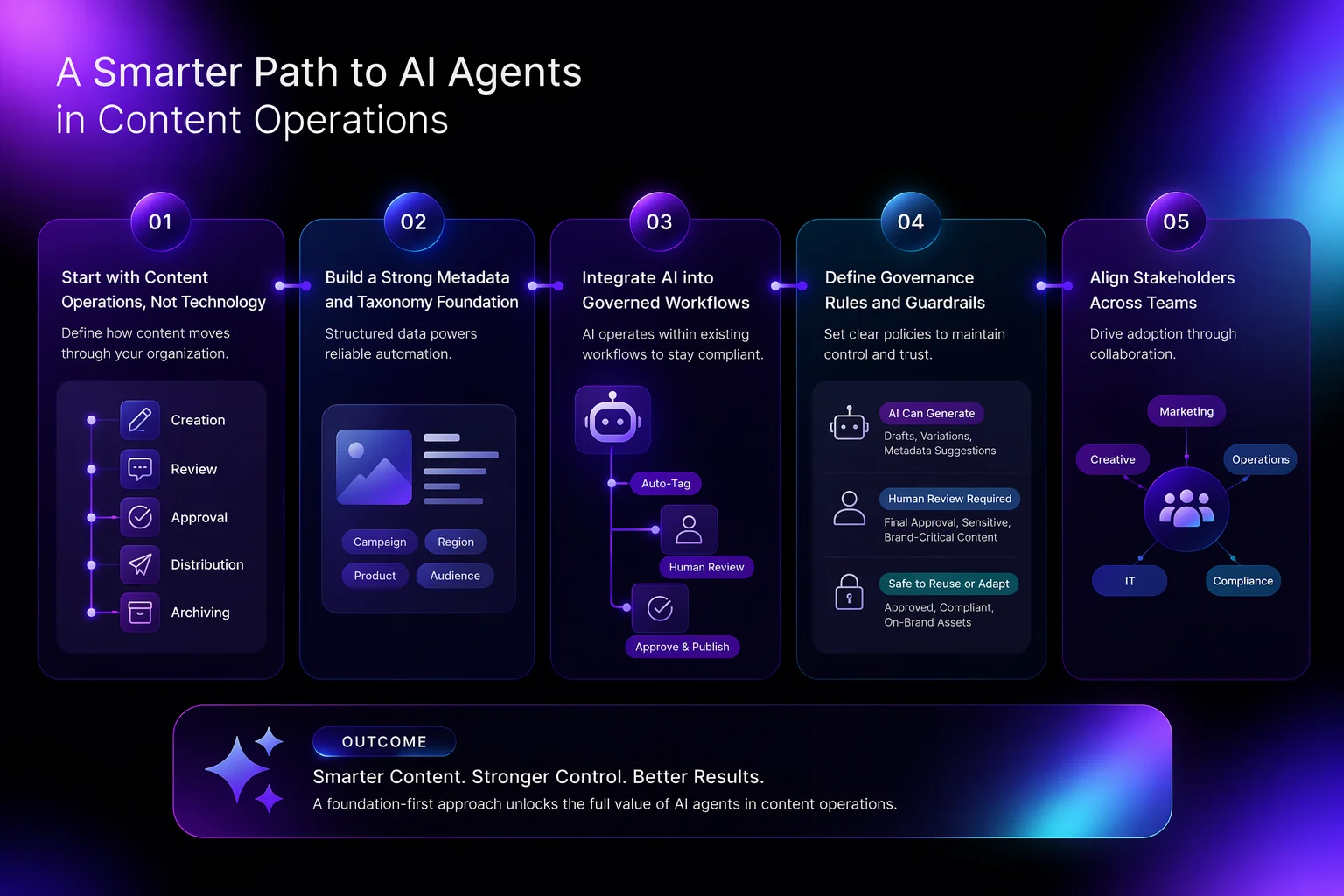
Start with content operations, not technology
Before introducing AI, define how content moves through your organization.
Map the lifecycle:
- Creation
- Review
- Approval
- Distribution
- Archiving
This provides the foundation for identifying where AI agents can add value.
Build a strong metadata and taxonomy foundation
AI agents rely on structured data to function effectively. Without consistent metadata and taxonomy, automation becomes unreliable and inconsistent.
Integrate AI into governed workflows
AI should operate within existing workflows, not outside them. This ensures that content remains compliant, approved, and aligned with business rules.
Define governance rules and guardrails
Establish clear policies for:
- What AI can generate
- What requires human review
- What content can be reused or adapted
This helps maintain control as content volume increases.
Align stakeholders across teams
AI agents affect multiple functions across the organization.
This includes:
- Marketing
- Creative
- Operations
- IT
- Compliance
Alignment ensures consistent adoption and reduces friction.
The Future of AI Agents in Digital Marketing
AI agents will continue to evolve as part of broader content operations ecosystems.
Key trends include:
- Multi-agent systems managing different stages of the content lifecycle
- Deeper integration with DAM, CMS, and PIM platforms
- Increased focus on real-time personalization
- Greater emphasis on governance and compliance
- Expansion of AI-driven content intelligence
As these trends develop, the role of DAM will become even more critical. As explained in Aprimo’s guide to digital asset management architecture for enterprise content operations, DAM provides the structural foundation that enables content to scale effectively.
Conclusion
AI agents are transforming digital marketing, but they are not a standalone solution. Their value depends on how they are integrated into content operations.
When combined with DAM, metadata, workflow, and governance, AI agents can:
- Increase speed
- Improve efficiency
- Enhance content reuse
- Support scalability
Without that structure, they can create more problems than they solve. The goal is not just to adopt AI. It is to operationalize it in a way that supports the business. That is where DAM becomes essential.
FAQ
What are AI agents in digital marketing?
AI agents are autonomous systems that can perform tasks such as content creation, metadata tagging, workflow automation, and performance optimization. They operate across the content lifecycle, helping teams execute marketing activities more efficiently and at scale.
How do AI agents work with digital asset management?
AI agents integrate with digital asset management systems to automate processes like tagging, asset discovery, content generation, and workflow routing. This allows organizations to scale content operations while maintaining governance, consistency, and control.
Why are AI agents important for content operations?
AI agents help organizations scale content production, reduce manual effort, and improve asset discoverability across teams and channels. They also enable more efficient workflows, allowing content to move faster through creation, approval, and distribution.
What risks do AI agents introduce in marketing?
Without proper governance, AI agents can create inconsistent messaging, increase content duplication, and introduce compliance risks. They can also lead to the use of outdated or unapproved assets if not connected to a centralized system like DAM.
How can organizations use AI agents safely?
Organizations can use AI agents safely by embedding them into DAM workflows and applying structured metadata and taxonomy. They should also enforce approval processes and maintain human oversight for high-risk or external-facing content.
What is the future of AI agents in marketing?
AI agents will become more integrated into content operations, enabling scalable personalization, automation, and real-time optimization. Their effectiveness will depend on how well they are aligned with governance, workflows, and enterprise content systems like DAM.