

Most digital asset libraries do not become messy all at once. They get there gradually.
A team uploads more content. Another region creates its own naming conventions. Different departments describe similar assets in different ways. Search results become less reliable. Reuse drops because people cannot find what already exists. Before long, the DAM has plenty of content, but not enough structure.
That is where metadata and taxonomy come in. They help organizations organize digital assets in a way that supports findability, consistency, governance, and long-term scale. Without them, even the best DAM platform becomes harder to use over time. With them, teams can manage assets more intelligently and get more value from the content they already have.
TL;DR
If your digital assets are hard to find, the problem is usually not the assets themselves. It is the structure around them. Metadata and taxonomy give teams a consistent way to organize content so assets are easier to search, manage, govern, and reuse across the business.
Metadata describes the asset. Taxonomy gives that information structure. Together, they help turn a growing asset library into a system people can actually use. For teams managing content at scale, organizing digital assets with metadata and taxonomy is one of the most important steps in making DAM useful, sustainable, and scalable.
Why metadata and taxonomy matter in DAM
Digital asset management is not just about storing files. It is about making those files useful.
That only happens when people can find the right asset quickly, trust that it is approved, understand how it should be used, and know whether a similar asset already exists. Metadata and taxonomy make that possible by giving assets context and structure.
Metadata adds descriptive information to each asset. That can include fields such as title, campaign, product line, region, file type, usage rights, expiration date, audience, or approval status. Taxonomy organizes those fields into a consistent classification system so the same types of information are applied in the same way across the library.
Together, metadata and taxonomy improve search, support governance, reduce duplication, and make it easier for teams to scale content operations without losing control.
What is metadata in digital asset management?
Metadata is the descriptive information attached to an asset that helps users understand what it is, where it belongs, and how it should be used.
Some metadata is basic and system-generated, such as file type, file size, or upload date. Other metadata is custom and business-specific, such as brand, region, campaign, audience, product category, channel, or rights status.
In DAM, metadata is what turns a file into a usable business asset. Without metadata, a library becomes dependent on file names, folders, and tribal knowledge. With metadata, assets become searchable, filterable, and easier to govern.
What is taxonomy in digital asset management?
Taxonomy is the framework used to classify assets consistently across the DAM.
It defines the categories, labels, relationships, and controlled vocabularies that shape how metadata is applied. For example, taxonomy might define approved brand names, region values, asset types, campaign categories, product families, or content stages. Instead of letting every user describe assets in a different way, taxonomy creates a shared organizational model.
That consistency matters because search quality depends on structure. If one user tags an asset as “North America,” another uses “NA,” and another uses “U.S. and Canada,” the DAM becomes harder to search and harder to govern. Taxonomy helps prevent that kind of fragmentation.
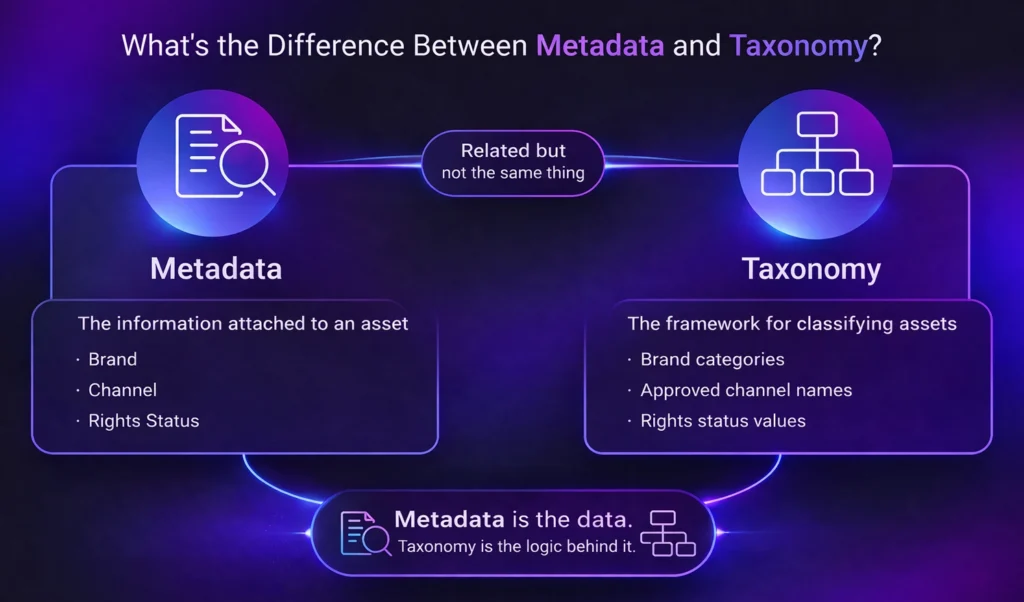
Metadata versus taxonomy: what is the difference?
Metadata and taxonomy are closely related, but they are not the same thing.
Metadata is the information attached to an asset. Taxonomy is the structure that defines how information should be organized.
A simple way to think about it is this: metadata is the data, and taxonomy is the logic behind it. Metadata tells you what an asset is. Taxonomy ensures that information is applied consistently so users can find and manage assets in a reliable way.
You need both. Metadata without taxonomy becomes inconsistent. Taxonomy without metadata is just a framework with nothing applied. Together, they create the structure that makes DAM work.
How to organize digital assets using metadata and taxonomy
Start with how people search for content
The best metadata model is not built in a vacuum. It starts with real user behavior.
Look at how teams search for assets today. What terms do they use? What filters would help them narrow results faster? What information do they need in order to decide whether an asset is usable? Start with the questions users are already asking and build your metadata strategy around those needs.
This helps ensure your DAM is organized for actual business use, not just administrative neatness.
Define the most important metadata fields
Not every field deserves equal importance. Start by identifying the metadata that matters most to search, governance, and reuse.
Common high-value fields include asset type, brand, region, campaign, product, audience, channel, usage rights, expiration date, approval status, and owner. The right mix depends on your business, but the goal is the same: make assets easier to find, understand, and govern.
Keep the model focused. Too few fields create ambiguity. Too many create complexity and inconsistent tagging.
Create a clear taxonomy structure
Once the metadata fields are defined, build the taxonomy that supports them. This includes controlled vocabularies, approved naming conventions, hierarchical categories, and standardized labels.
For example, if region is a metadata field, taxonomy should define the approved list of region values. If product category is a field, taxonomy should reflect how products are classified across the business. This creates consistency and reduces the risk of duplicate or conflicting labels.
A good taxonomy should be structured enough to support governance, but flexible enough to evolve with the business.
Standardize naming and tagging rules
Metadata only works when teams apply it consistently. That means defining clear rules for how assets should be named, tagged, reviewed, and maintained.
Establish standards for required fields, optional fields, controlled vocabularies, and who is responsible for tagging quality. Make sure different teams are not using different terms for the same concept. Consistency is what makes metadata useful at scale.
Balance governance with usability
One of the most common mistakes in DAM is making metadata too complex. When tagging becomes too burdensome, adoption suffers and data quality drops.
The goal is not to collect every possible detail. It is to collect the right information in a way users can realistically maintain. Good governance should support usability, not compete with it.
That often means requiring only the most important fields at upload, automating metadata where possible, and using taxonomy to guide users toward consistent choices.
Review and refine over time
Metadata and taxonomy should evolve with the business. New products, campaigns, regions, regulations, and team structures can all affect how assets need to be organized.
Review your metadata model regularly. Look for fields that are underused, inconsistent, or no longer useful. Identify where users struggle with tagging or search. Refine taxonomy as needed so the structure continues to support how people work.
A DAM library is never static. Its organizational model should not be either.
Best practices for organizing digital assets in DAM
Start with business needs, not abstract categories. Build metadata around how teams find, use, and govern content. Use controlled vocabularies wherever consistency matters. Keep required fields focused and meaningful. Avoid overengineering the model too early. Test search and filtering with real users. Treat governance as an ongoing discipline rather than a one-time setup task.
It is also important to align metadata and taxonomy across teams. Marketing, creative, product, compliance, and regional stakeholders may each think about assets differently. A strong DAM structure reflects those differences where needed, but still creates one shared system that the broader organization can use.
Common mistakes to avoid
A common mistake is treating metadata as an afterthought. If structure is added only after the library is already crowded and inconsistent, cleanup becomes harder and adoption suffers.
Another mistake is creating too many fields or too much taxonomy depth too early. Complexity can feel thorough, but it often leads to inconsistent tagging and lower usability. Another issue is allowing uncontrolled terms to grow without review. That weakens search, introduces duplication, and makes governance harder over time.
Finally, many teams focus only on upload organization and forget about retrieval. The real test of metadata and taxonomy is not whether assets are tagged. It is whether users can quickly find what they need and trust what they find.
Why this matters for enterprise teams
For enterprise organizations, metadata and taxonomy are not just organizational tools. They are operational tools.
They help global teams work from a common structure. They support governance across brands, regions, and business units. They improve content reuse, which reduces duplication and speeds execution. They also make it easier to scale asset management as content volume and complexity grow.
Without strong metadata and taxonomy, DAM becomes harder to manage as the organization expands. With them, it becomes a more reliable foundation for enterprise content operations.
Conclusion
If you want a DAM system that people can actually use, metadata and taxonomy need to be part of the foundation.
Metadata gives digital assets meaning. Taxonomy gives that meaning structure. Together, they make it easier to find content, govern usage, improve reuse, and support consistency across the organization.
That is what turns a growing asset library into a system that can scale. Organizing digital assets with metadata and taxonomy is not just a best practice for DAM. It is one of the key reasons DAM delivers value in the first place.
FAQ
How do you organize digital assets using metadata and taxonomy?
You organize digital assets using metadata and taxonomy by defining the key information that should describe each asset, then structuring that information with standardized categories, labels, and controlled vocabularies. This improves search, governance, consistency, and reuse across the DAM.
What is metadata in digital asset management?
Metadata in digital asset management is the descriptive information attached to a digital asset, such as brand, campaign, region, product, usage rights, approval status, or expiration date. It helps users find, understand, and govern assets more effectively.
What is taxonomy in DAM?
Taxonomy in DAM is the classification framework that organizes metadata consistently across the asset library. It defines approved categories, naming conventions, and relationships so assets are tagged and structured in a reliable way.
What is the difference between metadata and taxonomy?
Metadata is the information attached to an asset. Taxonomy is the structure that determines how information is categorized and applied. Metadata describes the asset, while taxonomy creates consistency across the DAM.
Why are metadata and taxonomy important in digital asset management?
Metadata and taxonomy are important because they improve asset discoverability, support governance, reduce duplication, and make it easier for teams to manage and reuse content at scale.
What are the best practices for DAM metadata and taxonomy?
Best practices include building around user search behavior, prioritizing high-value metadata fields, using controlled vocabularies, standardizing tagging rules, balancing governance with usability, and reviewing the structure over time as business needs evolve.