

Key Takeaways
Most digital asset management platforms weren’t built for the volume, velocity, and governance demands of generative AI content, and the gap is widening fast.
- According to McKinsey’s 2025 State of AI survey, 62% of organizations are experimenting with AI agents, yet nearly two-thirds haven’t begun scaling AI across the enterprise.
- A generative AI DAM strategy requires more than tagging automation; it demands native content generation, real-time compliance checks, and intelligent metadata enrichment working together.
- Legacy DAM systems that treat AI as an add-on create governance blind spots, especially in regulated industries where content provenance and brand safety are non-negotiable.
- The organizations pulling ahead are those redesigning their content workflows around agentic AI, where autonomous agents handle creation, governance, and distribution in a unified platform.
If your DAM can’t tell you which assets were AI-generated, who approved them, and whether they comply with brand and regulatory standards, it’s time for an upgrade.
Generative AI has moved from novelty to necessity inside enterprise marketing teams. Creative departments that once spent weeks producing campaign assets now expect to generate, tag, approve, and distribute content in hours. But here’s the uncomfortable reality: the content operations platforms most organizations rely on were never designed for this kind of volume or complexity. A generative AI DAM environment requires more than a chatbot bolted onto a file repository. It requires infrastructure that can create, govern, and orchestrate AI-generated content at enterprise scale, while maintaining the brand integrity and regulatory compliance that stakeholders demand.
The stakes are rising fast. Gartner predicts that 40% of enterprise applications will feature task-specific AI agents by the end of 2026, up from less than 5% in 2025. For marketing teams managing thousands of digital assets across global markets, the question is no longer whether AI will reshape their DAM workflows. The question is whether their current system can keep up.
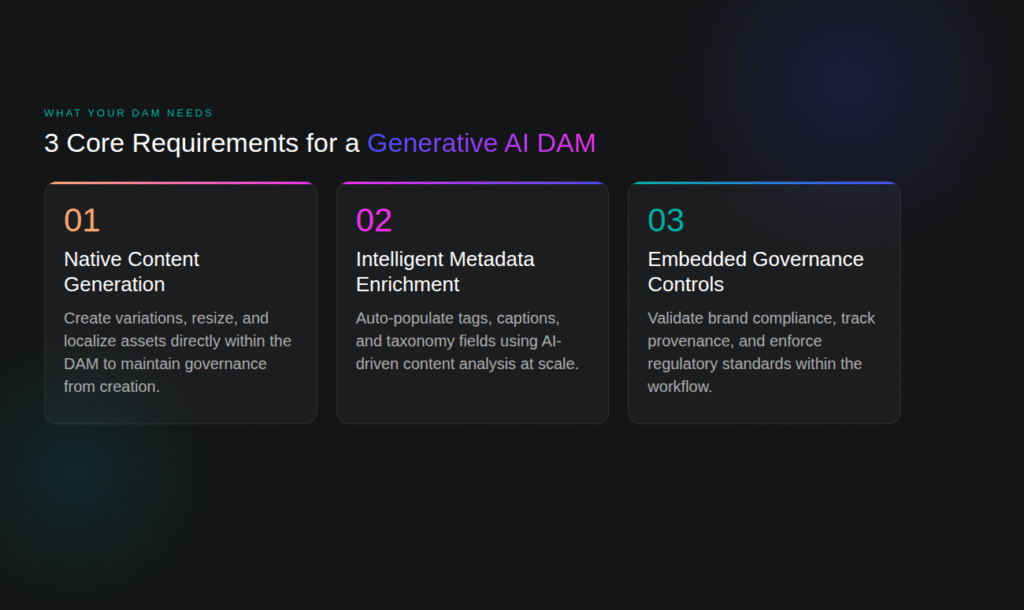
What Does a Generative AI DAM Actually Require?
The term “generative AI DAM” gets tossed around frequently, but the capabilities behind it vary wildly from platform to platform. Understanding the real requirements helps separate marketing-speak from meaningful functionality.
Native Content Generation Capabilities
A DAM platform built for generative AI workflows enables teams to create content variations directly within the system, without switching between disconnected tools. This means generating image variations, resizing assets for different channels, extending backgrounds, and producing localized versions of campaign materials from a single interface. The key distinction here is “native” versus “integrated.” When content generation lives inside the DAM, every asset inherits the metadata, permissions, and governance controls already in place. When teams generate content in a separate tool and then upload it, those guardrails disappear. Version control breaks down. Provenance tracking vanishes. And compliance teams lose visibility into what was machine-generated versus human-created.
Intelligent Metadata and Taxonomy Enrichment
Generative AI doesn’t create content in a vacuum. It produces assets that need context: what campaign is this for, which audience segment, what usage rights apply, when does it expire? Traditional DAM systems depend on humans to fill in these details manually. Modern AI-ready DAM platforms use AI-driven discovery and enrichment to auto-populate metadata fields based on visual content analysis, brand taxonomies, and campaign context. They apply predictive metadata, generate smart captions through OCR, and even provide facial recognition for content recommendations. The result is that every asset, whether human-created or AI-generated, enters the system fully tagged and immediately discoverable by downstream teams.
Embedded Governance and Compliance Controls
This is where most legacy systems fall short. Generating content with AI introduces a completely new category of governance challenges: content provenance, disclosure requirements, brand consistency validation, and regulatory compliance for industries like financial services or life sciences. A DAM designed for generative AI workflows doesn’t treat governance as an afterthought. It embeds compliance checks into the creation workflow itself. Before an AI-generated asset can move forward, the system validates it against approved brand guidelines, legal claim libraries, and industry-specific regulations. Assets flagged for potential issues route automatically to the appropriate reviewer, with full context about what triggered the flag.
How Legacy DAM Systems Fall Short with Generative AI
Not all DAM platforms are created equal, and the differences become painfully obvious when generative AI enters the picture.
The Bolt-On Problem
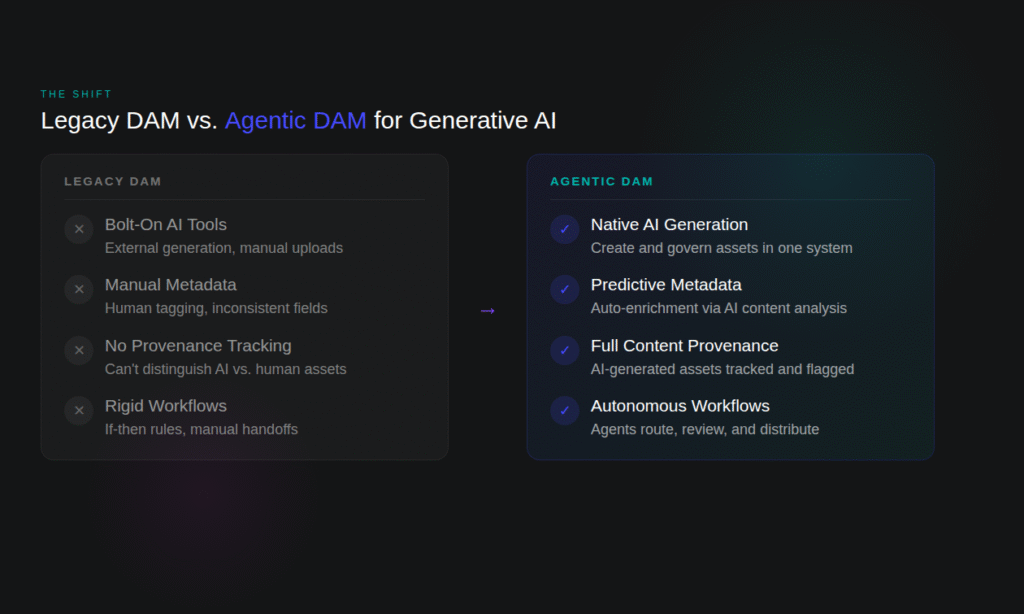
Many traditional DAM vendors have responded to the AI wave by adding surface-level integrations: a text-to-image generator here, an automated tagging feature there. These bolt-on capabilities create a fragmented experience where AI-generated content lives outside the core governance framework. Teams generate an asset in one tool, upload it to the DAM, manually tag it, and then route it through a separate approval workflow. Every handoff introduces risk, from inconsistent metadata to missed compliance reviews to assets published without proper approval chains.
Missing Content Provenance
In regulated industries, knowing exactly how an asset was created matters. Was it human-designed? AI-generated? A hybrid of both? Which model generated it, and what prompts were used? Legacy systems rarely capture this provenance data. That’s a growing liability as regulatory frameworks like the EU AI Act mature and enterprises face increasing scrutiny around AI-generated content disclosure. Forrester predicts that 60% of Fortune 100 companies will appoint a head of AI governance in 2026, signaling that content provenance will move from a “nice-to-have” to a board-level concern.
Disconnected Workflow Orchestration
Perhaps the biggest limitation of legacy systems is their inability to orchestrate complex, multi-step workflows autonomously. Traditional DAMs operate on rigid “if-then” logic. If a file is uploaded, send a notification. If approved, move it to the published folder. Generative AI workflows require something far more dynamic. An asset might need to be generated, enriched with metadata, checked against brand guidelines, reviewed for regulatory compliance, converted into twelve regional variants, and distributed across multiple channels. When each of these steps requires manual intervention, the speed advantage of generative AI evaporates entirely.
5 Signs Your DAM Isn’t Ready for Generative AI Workflows
How do you know if your current platform is holding your team back? Here are the clearest indicators.
- Your team generates AI content outside the DAM. If creative teams use standalone AI tools and then manually import assets, your DAM lacks native generation capabilities.
- Metadata for AI-generated assets is incomplete or inconsistent. When human-created and AI-generated content follow different tagging workflows, discoverability suffers and governance gaps appear.
- You can’t distinguish AI-generated assets from human-created ones. If your system doesn’t track content provenance, you’re exposing your brand to compliance risks that grow more serious by the quarter.
- Compliance reviews happen outside the DAM workflow. When legal, brand, and regulatory checks require emailing files back and forth or using separate review tools, your approval process is fragmented and slow.
- Content localization and variant creation requires manual effort. If producing regional or channel-specific versions of a campaign asset still involves a designer recreating each variant, your DAM isn’t leveraging AI production capabilities.
What Agentic AI Changes About DAM Workflows
The next evolution in generative AI DAM goes beyond basic content generation. It introduces agentic AI, where autonomous agents handle entire content workflows without constant human oversight.
From Automation to Autonomy
Traditional automation follows predetermined rules. Agentic AI understands context, makes decisions, and adapts processes in real time. In a DAM environment, this means an agent can receive a campaign brief, identify relevant existing assets, generate required variations, route materials through appropriate approval workflows, and prepare final deliverables for distribution. Human oversight focuses on strategic decisions and quality control, while the tedious coordination work happens automatically.

Specialized Agents Working in Concert
The most sophisticated platforms deploy multiple specialized agents across the content lifecycle. Planning agents generate structured campaign briefs aligned to business objectives. Librarian agents automate metadata creation and organize files based on proprietary taxonomies. Critic agents evaluate content quality by analyzing tone, sentiment, and compositional balance. Compliance agents enforce brand guidelines and regulatory requirements. Production agents handle content transformation and localization across markets. When these agents work together within a unified DAM platform, the entire content lifecycle accelerates. Campaigns that previously required weeks of manual coordination launch in days, with every asset fully governed and tracked.
The Governance Advantage
Agentic AI actually strengthens governance rather than undermining it. Because agents operate within defined parameters and maintain detailed audit trails, every action is traceable. Every decision, from metadata assignment to compliance routing, is logged and auditable. This creates a level of operational transparency that manual processes simply cannot match, which is particularly valuable in regulated industries where content workflow compliance is mission-critical.
How to Evaluate Your DAM for Generative AI Readiness
Assessing your current platform requires honest answers to some pointed questions. Start with infrastructure: does your DAM support native AI content generation, or does it rely on external tool integrations? Native capabilities keep every asset within the governance framework from the moment of creation. External integrations create gaps.
Next, evaluate metadata intelligence. Can your system automatically enrich AI-generated content with contextually accurate metadata, or does that still require human input? Organizations using intelligent automation for metadata report significant productivity gains, and the difference between meaningful improvement and marginal returns often comes down to how well a platform handles metadata at scale.
Then examine governance depth. Does your DAM track content provenance for AI-generated assets? Can it automatically route content through compliance checks based on asset type, intended market, and regulatory requirements? Or does governance live in a separate tool, disconnected from the content creation workflow? Finally, consider workflow orchestration. Can your DAM coordinate multi-step processes autonomously, adapting routes and requirements based on context? Or does every handoff require someone to click a button, send an email, or update a spreadsheet?
Frequently Asked Questions
What is a generative AI DAM? A generative AI DAM is a digital asset management platform that natively supports AI-driven content creation, automated metadata enrichment, and intelligent governance workflows. It enables teams to generate, manage, and distribute AI-created content within a unified system that maintains brand compliance and content provenance tracking.
How does agentic AI differ from generative AI in a DAM context? Generative AI creates content on command, such as images, text, or video variations. Agentic AI goes further by autonomously executing multi-step workflows: generating content, enriching metadata, routing approvals, checking compliance, and distributing assets across channels without constant human intervention.
Why can’t I use a standalone AI tool alongside my existing DAM? You can, but the approach creates significant governance and efficiency gaps. Assets generated outside the DAM lack provenance tracking, automated metadata enrichment, and embedded compliance checks. Every manual upload and re-tagging step introduces risk and slows delivery. Native AI capabilities within the DAM keep every asset governed from creation through distribution.
What industries benefit most from agentic DAM capabilities? Any industry with high content volume and compliance requirements sees outsized benefits: financial services (FINRA, regulatory disclosures), life sciences (MLR review, FDA compliance), consumer brands (global localization), and retail (seasonal campaign velocity). The combination of faster content creation and stronger automated governance delivers measurable ROI across regulated and high-volume environments.
Getting Started with a Generative Content DAM Strategy
Transitioning to a generative AI DAM environment doesn’t require replacing your entire tech stack overnight. It does require a clear-eyed assessment of where your current system falls short and a prioritized roadmap for closing those gaps.
Begin with an audit of your existing AI content workflows. Map every step from content request to publication, noting where manual handoffs occur, where governance gaps exist, and where bottlenecks slow delivery. These pain points become your priority targets.
Evaluate platforms based on native AI capabilities rather than integration promises. A DAM that generates, tags, governs, and distributes content within a single system will always outperform a patchwork of point solutions connected by APIs. And prioritize platforms with agentic capabilities, where intelligent agents can manage routine decisions and workflow coordination autonomously, freeing your team for the strategic creative operations work that actually requires human judgment.
Aprimo’s agentic DAM platform was built for exactly this kind of generative content DAM strategy, with AI Agents that have operated in production environments since 2023, comprehensive governance controls, and the industry’s strongest workflow engine. If your current system isn’t keeping pace with how your team creates, governs, and deploys content, see how Aprimo can transform your creative operations.