

Key Takeaways
Brands that unify their content operations across channels retain more customers, generate more revenue, and build stronger loyalty.
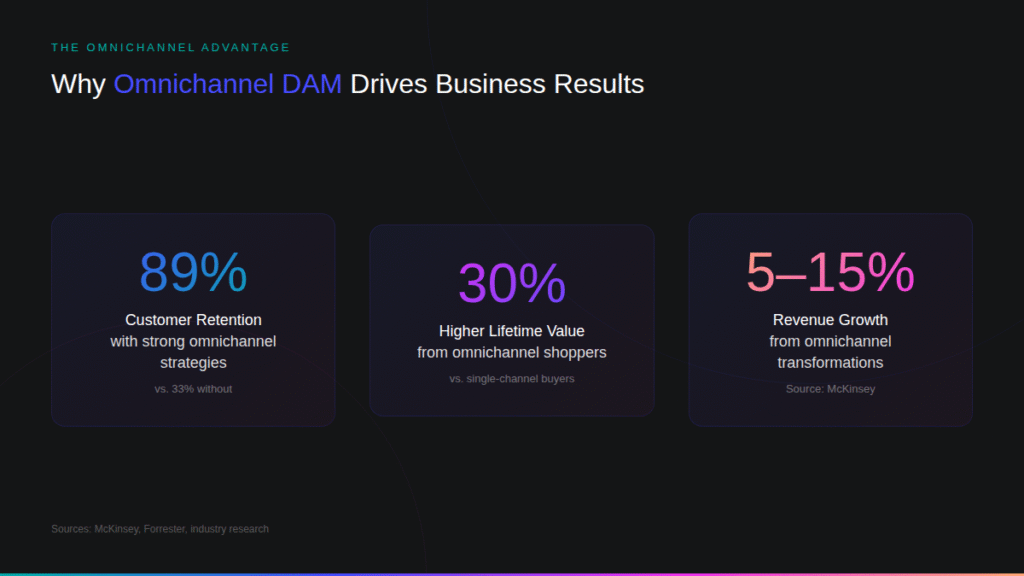
- Companies with strong omnichannel strategies retain 89% of customers, compared to 33% for those with weak cross-channel integration.
- A centralized DAM eliminates content silos, version chaos, and off-brand assets that erode trust across every touchpoint.
- AI-driven automation transforms DAM from passive storage into a strategic engine for real-time content delivery and personalization.
- Channel-ready content requires governance, metadata intelligence, and seamless integrations across your entire marketing technology stack.
If your teams are still hunting through shared drives and email threads to find the right asset, you’re losing ground to competitors who have already centralized their content operations.
Every marketing campaign today touches a minimum of three to five channels before reaching its audience. Web, email, mobile apps, social media, in-store displays, print collateral, and digital signage all demand content that looks, sounds, and feels like it came from the same brand. Yet behind the scenes, most organizations are juggling fragmented content repositories, outdated assets floating across shared drives, and inconsistent creative being pushed live without proper approvals. According to McKinsey, companies implementing omnichannel transformations see revenue growth of 5 to 15 percent alongside meaningful improvements in cost-to-serve efficiency. That’s a significant gap between organizations that have unified their content operations platform and those that haven’t.
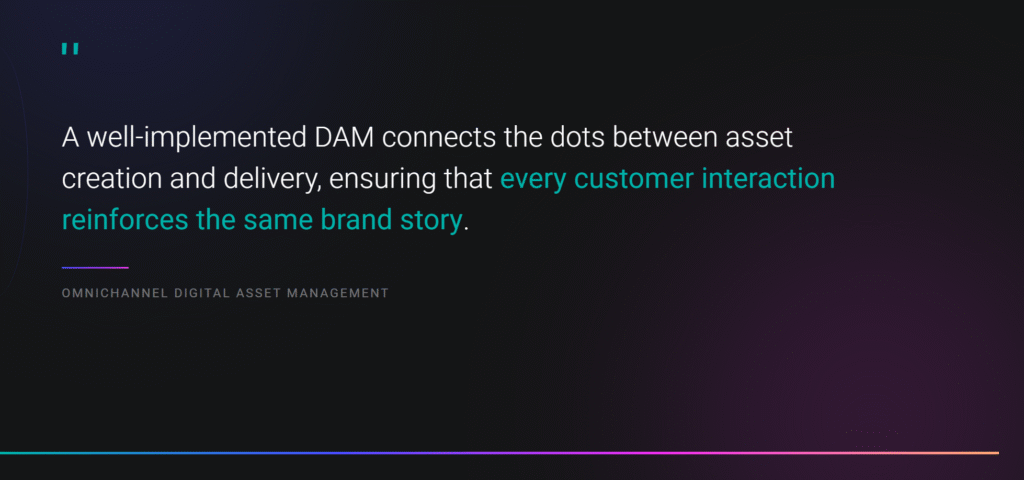
Omnichannel digital asset management addresses this challenge by serving as the central nervous system for every piece of content an organization creates, stores, governs, and distributes. Rather than treating each channel as an isolated destination, a well-implemented DAM connects the dots between asset creation and delivery, ensuring that every customer interaction reinforces the same brand story.
Why Omnichannel Digital Asset Management Matters More Than Ever
The math behind cross-channel consistency is compelling. Research shows that brands with robust omnichannel engagement retain 89% of their customers, while those with weak strategies hold onto only about 33%. Omnichannel shoppers also deliver a 30% higher lifetime value than single-channel buyers. Separate research from Forrester’s US Customer Experience Index confirms that CX quality reached an all-time low in 2024, making the case for unified content delivery even more urgent. For marketing teams under pressure to do more with less, those numbers make a strong case for investing in the infrastructure that makes consistency possible.
The problem is that achieving consistency at scale is extraordinarily difficult without the right systems in place. A single campaign might require dozens of asset variations: different image crops for Instagram versus LinkedIn, mobile-optimized banners for email, high-resolution files for print, and properly formatted video for web. When those assets live in different folders across different tools, the risk of someone using an outdated logo, the wrong product shot, or an unapproved creative spikes dramatically.
The Real Cost of Content Fragmentation
Content fragmentation affects more than brand aesthetics. When teams can’t find the right asset quickly, they either waste time searching or recreate something that already exists. This redundant work drains budgets and slows time-to-market. Worse, inconsistent assets reaching customers across touchpoints erode trust. If a customer sees one version of a promotion in their inbox and a different version on your website, confusion replaces confidence. Over time, that inconsistency chips away at the brand equity you’ve spent years building.
Compliance risks compound the problem further. Without centralized governance, there’s no reliable way to ensure that every image being posted to social media is properly licensed, that region-specific promotions don’t accidentally go global, or that regulated content meets legal requirements before it goes live.
How DAM Creates Channel-Ready Content at Scale
A modern digital asset management system does far more than store files. It functions as an operational hub that connects people, processes, and technology across the entire content lifecycle. Here’s what that looks like in practice for omnichannel execution.
Centralized Asset Governance
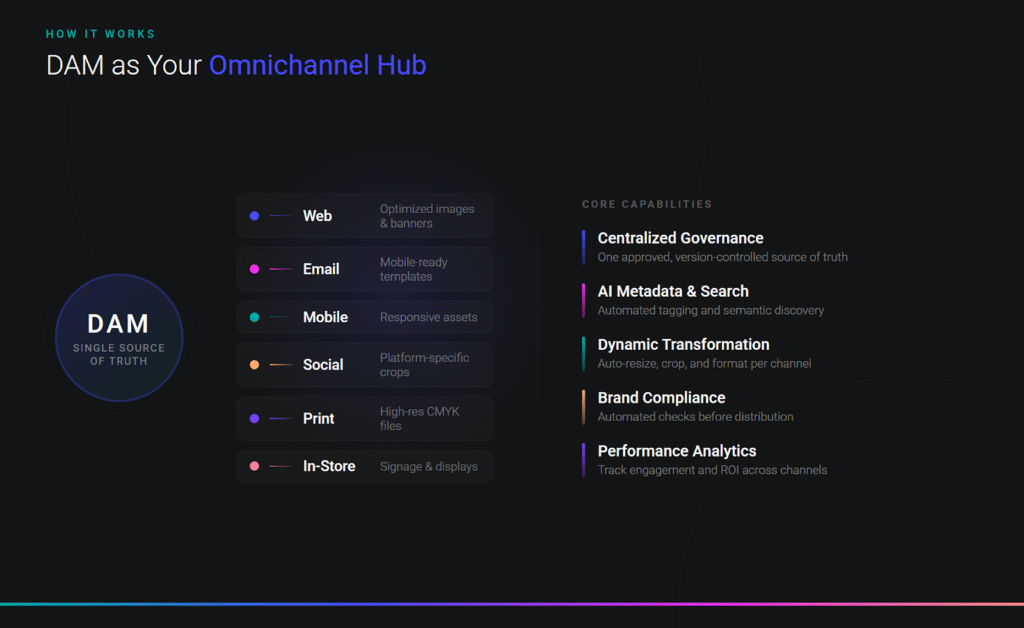
At the foundation, DAM provides a single source of truth for every approved asset. Instead of creative living on individual desktops, in email threads, or scattered across cloud folders, everything resides in one searchable, permission-controlled repository. Version control ensures teams always access the latest approved files, while lifecycle management automatically archives or retires outdated content. This centralization is what makes consistent omnichannel delivery possible in the first place. Without it, you’re relying on manual coordination, and at enterprise scale, that approach inevitably breaks down.
Intelligent Metadata and Search
Finding the right asset quickly is essential when you’re managing content across multiple channels. Advanced DAM platforms use AI to automatically generate metadata, tag assets with relevant classifications, and organize files according to proprietary taxonomies. This means a regional marketing team in Tokyo can search for “spring campaign hero image” and immediately find the correct, approved version, formatted for their specific channel requirements. Semantic search capabilities take this further by understanding the context behind a query, delivering relevant results even when users don’t know the exact file name or tag.
Dynamic Asset Transformation
Different channels demand different asset specifications. What works as a hero banner on desktop needs to be cropped differently for mobile. A print-ready CMYK file won’t render correctly in an email client. Rather than requiring creative teams to manually produce every variation, modern DAM platforms automate content transformation and delivery. Smart cropping, automatic resizing, format conversion, and web optimization happen on demand, ensuring that each channel receives exactly the right rendition without manual intervention. This capability is what separates a customer experience DAM from a basic file repository.
5 Ways DAM Strengthens Your Omnichannel Strategy
When evaluating how omnichannel digital asset management fits into your broader marketing technology stack, consider these core capabilities that directly support cross-channel execution.
- Brand consistency enforcement: Automated governance ensures only approved, on-brand assets are available for distribution. Compliance workflows catch deviations before content reaches customers, maintaining visual and messaging coherence across web, email, social, print, and in-store channels.
- Accelerated time-to-market: Centralized access eliminates the search-and-request bottlenecks that slow campaign launches. When every team member can find the right asset in seconds rather than hours, campaigns move from concept to market faster.
- Scalable personalization: By connecting DAM to your marketing automation and personalization platforms, you can serve tailored content variations to different audience segments without creating exponential manual work. The DAM becomes the content source that feeds personalized experiences across every channel.
- Rights management and compliance: Automated tracking of usage rights, license expirations, and regulatory requirements protects your organization from costly legal exposure. This is particularly critical for global brands operating across jurisdictions with different rules.
- Performance analytics and optimization: Advanced DAM platforms track how assets perform across channels, providing data on downloads, shares, engagement, and conversion impact. These insights help teams double down on high-performing content and retire underperformers.

What Role Does AI Play in Customer Experience DAM?
Artificial intelligence has fundamentally changed what’s possible within content operations and digital asset management. AI-driven capabilities are transforming DAM from a passive storage system into an active, intelligent participant in omnichannel content delivery.
Automated Enrichment and Classification
Rather than relying on humans to manually tag every asset, AI agents can automatically populate metadata fields, apply custom taxonomies, recognize image content, and classify assets by type. This automation dramatically reduces the time between asset upload and availability, ensuring that new content is discoverable and deployable across channels within minutes rather than days.
Predictive Content Recommendations
Intelligent AI systems analyze behavioral data, engagement patterns, and audience preferences to recommend which assets are most likely to perform well for specific channels and segments. Instead of marketers guessing which image will resonate with a particular audience, the system surfaces recommendations based on actual performance data.
Real-Time Personalization at Scale
Perhaps the most transformative capability is AI-driven content personalization. By connecting DAM to delivery channels, AI agents can analyze visitor behavior and serve the most relevant content variation in microseconds. A returning customer might see different hero imagery than a first-time visitor, with the DAM providing the content source and AI orchestrating which assets appear where, when, and for whom.
Quality and Compliance Checks
AI agents can automatically scan content for brand guideline adherence, regulatory compliance, sentiment alignment, and legal requirements before assets are distributed. This built-in governance layer reduces risk and eliminates the bottleneck of manual review cycles, accelerating the path from creation to publication across all channels.
How to Build an Omnichannel DAM Strategy That Delivers
Implementing omnichannel digital asset management isn’t a plug-and-play exercise. Success requires intentional strategy across three dimensions: technology, process, and people.
Start with Integration Architecture
Your DAM needs to connect seamlessly with the rest of your marketing technology stack. That means tight integrations with your CMS, marketing automation platform, email service provider, social media management tools, creative suites, and commerce systems. Look for platforms that offer robust APIs, pre-built connectors, and composable architecture that can adapt as your tech stack evolves. Without these connections, your DAM becomes another silo rather than the central hub it needs to be for omnichannel delivery.
Establish Governance Before Scaling
Before you open the floodgates on cross-channel distribution, define clear governance frameworks. Who can upload assets? What metadata is required? What approval workflows must content pass through before it’s available for distribution? How are usage rights tracked? Answering these questions upfront prevents the chaos that often accompanies rapid scaling and protects your brand from compliance risks that multiply across channels.
Measure What Matters
Track metrics that directly connect to omnichannel success. Asset reuse rates indicate whether teams are leveraging existing content or wastefully recreating it. Time-to-publish reveals how efficiently content moves from creation to distribution. Channel-specific engagement data shows where your DAM omnichannel strategy is working and where it needs refinement. Content performance analytics close the feedback loop, informing future asset creation with data rather than intuition.
Frequently Asked Questions
What is the difference between multichannel and omnichannel digital asset management? Multichannel DAM simply distributes assets to various channels independently. Omnichannel DAM ensures those assets are consistent, governed, and optimized for each channel within a unified strategy. The key difference is coordination: omnichannel DAM treats every touchpoint as part of a single, connected customer experience rather than managing channels in isolation.
How does DAM support content personalization across channels? A DAM system serves as the content source that feeds personalization engines. By maintaining a centralized library of approved, properly tagged assets, DAM enables marketing automation and personalization platforms to pull the right content variation for each audience segment and channel. Advanced DAM systems with embedded AI Agents can even recommend or auto-select the most relevant assets based on behavioral data.
What types of assets can a DAM manage for omnichannel delivery? Modern enterprise DAM platforms support virtually every digital file type: images, videos, audio files, PDFs, design files, 3D models, AR/VR assets, documents, and presentation files. Advanced systems also manage modular content components that can be assembled and transformed for different channel specifications automatically.
How long does it take to see results from a DAM implementation? Most organizations begin seeing measurable improvements within the first few months after deployment. Early wins typically include faster asset discovery, reduced duplicate content creation, improved brand consistency, and streamlined approval workflows. The full ROI compounds over time as teams adopt the platform more deeply and integrations with other marketing technologies mature.
Deliver Consistent Experiences at Every Touchpoint
Omnichannel digital asset management is the infrastructure that makes consistent, scalable customer experiences possible. Without it, marketing teams are stuck in a cycle of content fragmentation, manual workarounds, and brand inconsistency that costs revenue and erodes customer trust. With it, every channel becomes an extension of the same brand story, powered by governed, optimized, channel-ready content that reaches the right audience at the right moment.
Aprimo delivers the agentic DAM capabilities that enterprise marketing teams need to centralize, govern, and deploy content across every channel. From AI Agents that automate metadata enrichment to real-time content personalization and dynamic asset transformation, Aprimo turns content operations into a strategic growth engine. Ready to see how it works? Get a demo of Aprimo and start delivering the omnichannel experiences your customers expect.