
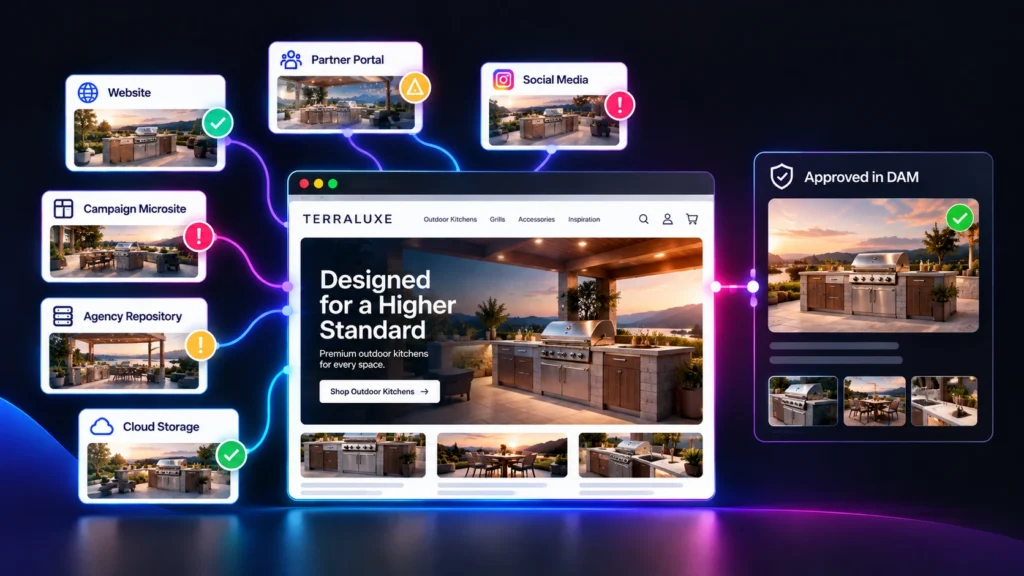
A DAM governs what enters it. Rights data, approval status, version history, and usage rules all attach to assets that someone uploaded. That works well for the content inside the system, but it leaves a large share of enterprise content untouched: files on shared drives, assets in partner portals, images on agency servers, and copies in cloud buckets created before the DAM existed.
The common response is a migration project. Move everything into the DAM, the thinking goes, and governance follows. In practice, migration projects stall. Owners resist moving files they use daily. Agencies keep their own repositories. Legacy storage holds terabytes that no one has time to classify. Meanwhile, the ungoverned content keeps circulating.
A second approach has matured in the last few years: govern the content where it sits. This article explains what that means, how to build a program around it, where it works well, and where it does not.
TL;DR
- Teams can govern content outside the DAM in place by discovering it where it lives, linking it to approved versions in the DAM, and running automated policy checks against it.
- This approach avoids migrating files into a central repository, which most organizations cannot justify for partner portals, agency archives, and legacy storage.
- The DAM remains the source of truth for approved assets, rights, and standards, while a governance layer extends enforcement to every other location.
- Teams get visibility and control first, then decide which content deserves ingestion.
Why Does So Much Enterprise Content Live Outside the DAM?
Most enterprise content lives outside the DAM because many teams create, share, then store it before, during, or after it reaches the DAM. The DAM holds the approved master, while working files, derivatives, and published copies spread across other systems.
Several forces drive the spread. Creative teams work in tools with their own storage. Agencies deliver files to their own servers or shared folders. Regional teams build local versions in local systems. Partners download assets from portals and host them on their own sites. Acquisitions bring legacy repositories that no one consolidates. Each system makes sense for its owner, so the sprawl is a byproduct of normal work rather than a failure of discipline.
The effect on governance is direct. A rights restriction recorded in the DAM does nothing for a copy of the asset sitting in a cloud folder. An approval withdrawn in the DAM does not reach the version already published on a partner site. The hidden cost of fragmented content operations grows with every copy that drifts away from its approved original.
What Does It Mean to Govern Content in Place?
Governing content in place means applying discovery and policy checks to content at its current location instead of moving it into a central repository first. The files stay where they are, while the governance system learns what they are, where they live, and whether they comply.
Definition: In-place content governance is the practice of discovering, identifying, and checking content across external systems by reference, linking each discovered asset back to an approved source without requiring migration.
The mechanism has three parts. Discovery scans the source systems to inventory what exists. Identification fingerprints each asset so the system can match it to approved versions, find duplicates, and recognize derivatives. Checking applies brand, compliance, and quality rules to the discovered content. The output is a record of what exists across the ecosystem and which items violate policy.
This differs from a search tool or a file index. An index tells a team that a file exists. Governance in place tells a team whether the file is approved, current, licensed, and compliant. It also recommends what to do if the file is not.
What Can You Govern Without Moving Content?
Teams can govern a wide range of checks without moving files, provided the system has a reference to compare against. The checks fall into five groups.
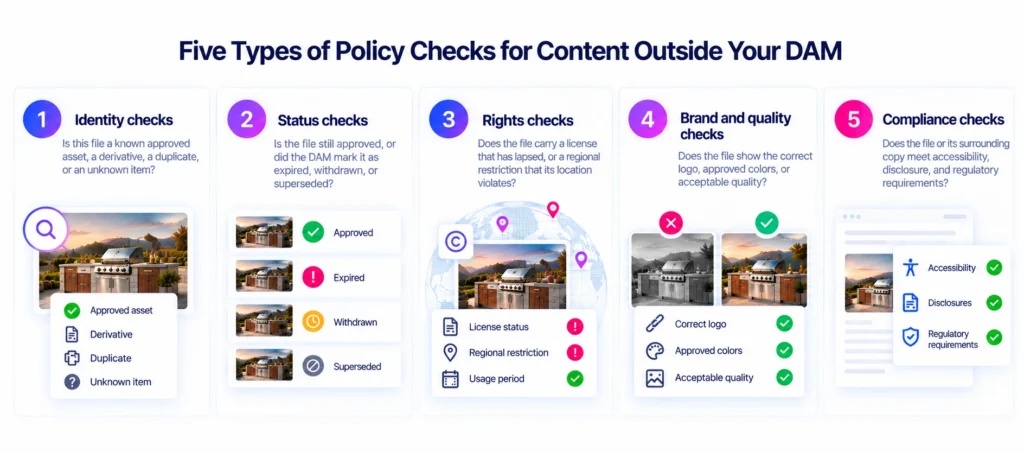
- Identity checks. Is this file a known approved asset, a derivative, a duplicate, or an unknown item?
- Status checks. Is the file still approved, or did the DAM mark it as expired, withdrawn, or superseded?
- Rights checks. Does the file carry a license that has lapsed, or a regional restriction that its location violates?
- Brand and quality checks. Does the file show the correct logo, approved colors, or acceptable quality?
- Compliance checks. Does the file or its surrounding copy meet accessibility, disclosure, and regulatory requirements?
Some checks need the DAM as a reference, such as status, rights, and version conflicts. Others work without one, such as duplicate detection, accessibility checks, and finding unmanaged content. This distinction matters when scoping a program. An organization without a DAM can still gain visibility, while an organization with a DAM can compare live content to approved records.
How Do You Build a Governance Program for Content Outside the DAM?
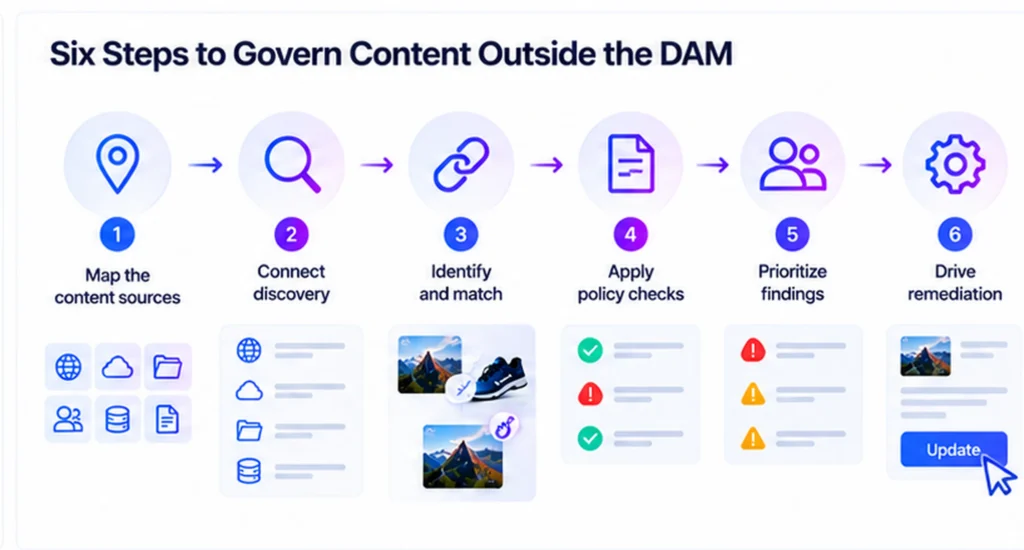
Build the program in six steps, starting with visibility and ending with remediation. Each step produces something usable even if the program stops there.
- Map the content sources. List the file stores, portals, agency repositories, and web properties that hold brand content. Interview owners, because the official list is usually incomplete.
- Connect discovery to the highest-risk sources first. Start with public websites and partner portals, since content there carries the most exposure.
- Establish the reference. Confirm which system holds approved assets, rights data, and brand standards. In most organizations this is the DAM.
- Define the policy set. Translate brand and compliance rules into checks a system can run. Keep the first set small and precise.
- Review the findings, then tune. Early results reveal false positives, gaps in the rules, or both. Adjust before widening scope.
- Connect remediation to workflow. Route findings into the ticketing or workflow tools that owners already use, and track time to resolution.
The order matters. Teams that start with policy design before they know what exists tend to write rules for the wrong content. Visibility first gives the program evidence to prioritize.
How Mature Is Your Content Governance?
Benchmark where your content governance program stands today, then see where to focus first.
How Does the DAM Stay the Source of Truth When Content Lives Elsewhere?
The DAM stays the source of truth by serving as the reference record for approved assets, status, rights, and standards, while the governance layer compares external content against it. The DAM does not need to hold every copy to remain authoritative.
| Dimension | Migrate everything first | Govern in place |
|---|---|---|
| Time to first visibility | Months, after migration completes | Weeks, after connectors are configured |
| Owner disruption | High, since files move | Low, since files stay |
| Coverage of agency and partner content | Often incomplete | Possible wherever a connector reaches |
| Role of the DAM | Holds all content | Holds approved content, acts as reference |
| Risk during rollout | Broken links, lost context | Minimal change to existing workflows |
The two approaches are not mutually exclusive. Many organizations govern in place first, then promote selected high-value or high-risk assets into the DAM once discovery shows which ones matter. This sequence uses evidence to decide what to migrate, which is more efficient than migrating by assumption.
For teams comparing system roles, DAM vs. cloud storage explains why storage alone does not provide governance. The post on how DAM integrates with CMS, PIM, and ERP covers the connections that keep downstream systems current.
What Does This Look Like With Aprimo Content Portfolio Management?
Aprimo Content Portfolio Management (CPM) implements this model. Its Mesh capability scans websites, file storage, partner portals, social accounts, and the DAM. It fingerprints each asset, then maps it to its source location. Mesh checks discovered assets against known DAM content to identify duplicates and derivatives. Aprimo’s Librarian, Critic, and Compliance agents then check the discovered content. A risk dashboard ranks findings by region, brand, asset type, and severity.
CPM works with or without a DAM. Without one, it provides discovery, duplicate detection, and compliance checks. With a connected DAM, it adds comparisons for rights, expiry, status, and version conflicts. The launch post describes the capabilities, and the Content Governance Maturity Assessment helps teams gauge their current coverage.
What Are the Limits of Governing Content in Place?
Governing content in place detects and prioritizes risk, but it does not by itself fix content or replace specialized review workflows. Three limits deserve a clear statement.
First, detection depends on access. A system can only govern sources it can reach, so locked-down or offline repositories need explicit connections or manual handling. Second, remediation still needs owners. Findings identify the problem, and people or connected workflows must update or remove the content. Third, specialized regulated workflows, such as medical, legal, and regulatory review in life sciences, need their own depth. Portfolio governance adds monitoring and pre-flight checks around those workflows rather than replacing them.
Stating these limits early helps programs set honest expectations. A governance layer reduces blind spots sharply, yet it works best as part of a wider operating model that includes clear ownership.
Conclusion
Enterprise content will keep spreading across systems because the work itself is distributed. A governance strategy that depends on bringing everything into one repository will keep losing to the pace of that spread. The more realistic strategy treats the DAM as the authority for what is approved, then extends checks outward to wherever approved and unapproved content actually circulates.
That shift changes the question from where content should live to whether the organization can see and judge it wherever it lives. Organizations that answer the second question first gain the evidence to make smarter decisions on the first. The remaining challenge is not technical reach but ownership: who in the organization acts when the system shows what has been live all along.
FAQ
Can you govern content without a DAM?
Yes, within limits. Discovery, duplicate detection, accessibility checks, and unmanaged content analysis do not need a DAM. Checks for rights, status, and version conflicts need an approved reference such as a DAM.
Does in-place governance replace a DAM?
No. The DAM remains the home for approved assets, metadata, rights, and workflows. A governance layer extends the DAM’s standards to content in other locations.
What types of external systems can be governed?
Typical sources include public websites, partner portals, social accounts, agency repositories, or cloud storage such as SharePoint, OneDrive, Google Drive, and S3. The exact list depends on the connectors available.
How is this different from enterprise search?
Enterprise search locates files. Governance evaluates them against brand, rights, and compliance rules, then prioritizes the violations. Search answers where something is, while governance answers whether it should be there.
Who should own governance for external content?
Brand or content operations usually owns the program, while property owners handle remediation. Compliance teams define the rules, and IT supports the connectors.
What should happen to content that the scan finds but no one owns?
Treat it as a finding in itself. Assign a temporary owner, decide whether to retire, update, or promote the asset into the DAM, and record the decision for audit purposes.
Related reading: auditing web content for brand risk, DAM versus content governance, adding governance without migration.