
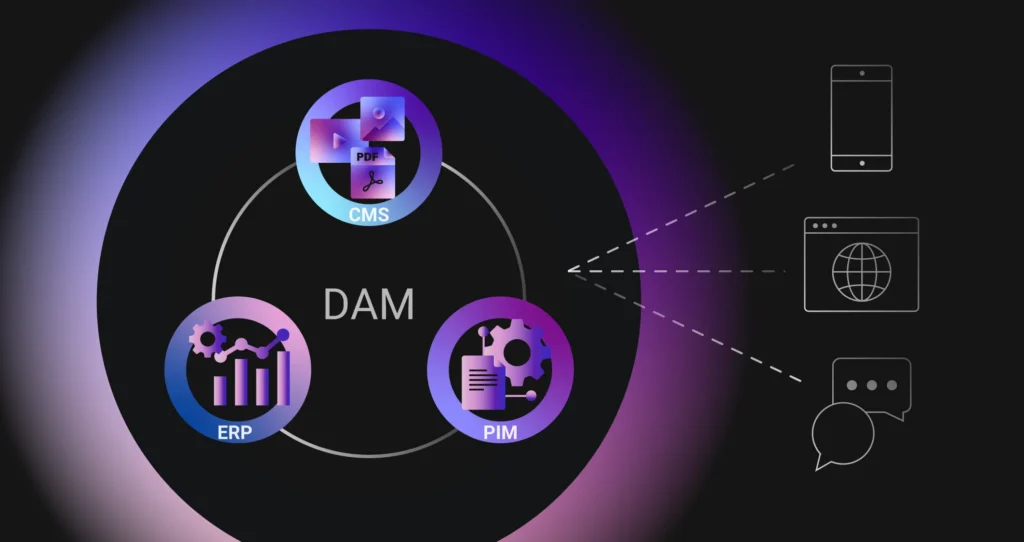
A DAM platform does not create much value in isolation. Its real value comes from how well it connects to the systems teams already use to create, manage, enrich, publish, and govern content.
That is why DAM integrations matter so much. Marketing teams want approved assets available directly inside their CMS. Product teams want images, videos, and documents connected to product records in PIM. Operations and enterprise teams often need those same assets tied into broader business processes that live in ERP or adjacent systems. Both Aprimo and Bynder position integrations as a core part of enterprise DAM value, with marketplaces that include common CMS, PIM, and other business applications.
When these systems are disconnected, teams end up duplicating work, manually transferring files, and struggling to keep content, product data, and business context aligned. When they are integrated, DAM becomes more than a library. It becomes a content hub that supports the wider operating model around digital experiences, product content, and enterprise workflows.
TL;DR
DAM platforms integrate with CMS, PIM, and ERP systems by connecting digital assets to the systems that publish content, manage product data, and run core business processes. In practice, that usually happens through APIs, prebuilt connectors, middleware, marketplaces, and metadata synchronization rules that let teams search, select, update, and distribute approved assets without moving files manually. Aprimo and Bynder both highlight marketplace-driven and connector-based integration strategies, especially for CMS and PIM ecosystems.
The value of these integrations is not just technical connectivity. It is operational alignment. CMS integrations help teams publish approved assets into web experiences. PIM integrations keep product data and rich media aligned. ERP integrations are typically more process-driven, helping connect asset usage to product, supplier, inventory, packaging, or business workflow data through APIs and enterprise integration layers. When done well, these connections reduce duplicate work, improve consistency, and make content operations easier to scale.
Why DAM integrations matter
Most organizations do not manage content in one platform. They manage assets in DAM, web pages and experiences in CMS, product attributes in PIM, and operational data in ERP or related enterprise systems.
That creates a coordination challenge. A product page, for example, may require structured product data from PIM, approved images and videos from DAM, and downstream business context that originates in ERP. If those systems are not connected, teams often rely on manual uploads, spreadsheet tracking, and one-off updates that are hard to scale. Inriver’s current PIM and DAM guidance emphasizes that integrated product data and rich media improve speed, consistency, and scalability across channels, while Sitecore describes modern DAM integration as API-led connectivity across the broader application landscape.
That is why DAM integrations are so important. They help organizations maintain one source of truth for assets while still making those assets usable inside the systems where work actually happens. CMS users can insert approved content into digital experiences. PIM users can align product data and media. Enterprise teams can connect asset workflows to broader business processes rather than treating content as a disconnected layer.
What DAM integration with CMS looks like
DAM and CMS integration is usually the most visible and most widely used connection in the stack. The DAM remains the system of record for approved digital assets, while the CMS remains the system used to create and publish web content, landing pages, articles, product pages, and other digital experiences. Aprimo’s current CMS integration materials describe this relationship directly, noting that DAM stores and governs assets while CMS manages content and publishing.
In a typical integration, users can browse or search DAM assets directly from within the CMS interface, select approved files, and place them into pages without downloading and reuploading them manually. Aprimo’s Optimizely connector, for example, allows users to browse, search, and drag and drop Aprimo assets inside the CMS environment. Marketplace listings also show Aprimo connectors for headless CMS platforms such as Contentstack and Sanity.
The main goal is to keep publishing teams working with approved, current assets while preserving governance in the DAM. Instead of creating multiple unmanaged copies, the integration lets teams reuse centrally managed content inside web experiences and other digital touchpoints. That improves consistency and reduces the risk of outdated or off-brand assets appearing in market.
What DAM integration with CMS looks like
DAM and CMS integration is usually the most visible and most widely used connection in the stack. The DAM remains the system of record for approved digital assets, while the CMS remains the system used to create and publish web content, landing pages, articles, product pages, and other digital experiences. Aprimo’s current CMS integration materials describe this relationship directly, noting that DAM stores and governs assets while CMS manages content and publishing.
In a typical integration, users can browse or search DAM assets directly from within the CMS interface, select approved files, and place them into pages without downloading and reuploading them manually. Aprimo’s Optimizely connector, for example, allows users to browse, search, and drag and drop Aprimo assets inside the CMS environment. Marketplace listings also show Aprimo connectors for headless CMS platforms such as Contentstack and Sanity.
The main goal is to keep publishing teams working with approved, current assets while preserving governance in the DAM. Instead of creating multiple unmanaged copies, the integration lets teams reuse centrally managed content inside web experiences and other digital touchpoints. That improves consistency and reduces the risk of outdated or off-brand assets appearing in market.
What DAM integration with PIM looks like
DAM and PIM integration is about connecting rich media with structured product data. The PIM manages product attributes such as titles, specifications, dimensions, categories, and market variations. The DAM manages the images, videos, documents, and other media associated with those products. Aprimo’s recent PIM and DAM guidance and Inriver’s integration materials both emphasize that these systems are complementary and stronger when connected.
In practice, DAM-PIM integrations usually sync product-linked assets, metadata, or relationships between product records and approved media. Bynder’s marketplace highlights bi-directional synchronization with Inriver, including digital assets, metadata, and product links. Its marketplace also lists a Bynder-Salsify integration that streamlines the connection between DAM and PIM.
This matters because product content is experienced together by customers even when it is managed in separate systems behind the scenes. Acquia’s DAM-PIM guidance makes that point directly, noting the natural convergence of product information and rich media in digital commerce and product content workflows. For teams managing large catalogs, multiple channels, or frequent product updates, PIM integration helps keep assets and product data aligned.
What DAM integration with ERP looks like
DAM integration with ERP is usually less about direct publishing and more about business process alignment. ERP systems manage core operational data such as products, suppliers, manufacturing details, inventory, pricing logic, orders, packaging workflows, and other business records. DAM does not replace that role. Instead, it connects assets to the business objects and processes that ERP governs.
In many organizations, this connection happens through APIs, middleware, or broader enterprise integration layers rather than through a simple out-of-the-box drag-and-drop connector. Sitecore’s DAM integration overview describes the modern model as API-based interoperability with cloud applications, and Aprimo’s marketplace includes broader synchronization and workflow-oriented integration services rather than only channel-specific connectors.
A practical example would be linking product imagery, packaging files, sell sheets, or technical documents from DAM to ERP-managed product records or downstream supply chain and operational workflows. The exact implementation varies by business, but the pattern is consistent: ERP remains the source for operational business data, and DAM remains the source for governed digital assets, with integration ensuring those two contexts stay connected.
How the integrations usually work technically
APIs
Most modern DAM integrations rely on APIs. APIs allow DAM platforms to exchange assets, metadata, identifiers, and status information with CMS, PIM, ERP, and middleware platforms. Sitecore explicitly describes modern DAM integration as API-led, and vendor marketplaces from Aprimo and Bynder reinforce that current DAM ecosystems are designed to connect across multiple systems rather than operate as closed repositories.
Prebuilt connectors
Many DAM vendors offer prebuilt connectors for common CMS and PIM platforms. These are meant to reduce implementation effort and help teams get value faster. Aprimo’s marketplace includes integrations for CMS platforms such as Optimizely, Contentstack, and Sanity, while Bynder’s marketplace includes common CMS and PIM integrations and dedicated apps such as Inriver.
Middleware and integration platforms
When organizations need to connect DAM to ERP or to more complex enterprise workflows, middleware is often used to orchestrate data movement and business logic between systems. This is especially common when multiple systems need to stay synchronized or when the integration requires transformation rules, approval logic, or event-driven updates. Aprimo’s marketplace includes broader synchronization services and implementation partners that support DAM-PIM ecosystems, which is a strong signal that many integrations extend beyond simple one-to-one connectors.
Metadata synchronization
A key part of DAM integration is not just moving files, but keeping metadata aligned. That includes asset identifiers, product links, rights information, channel usage, approval status, and taxonomy fields. Bynder’s Inriver connector explicitly mentions synchronizing assets, metadata, and product links, which reflects a common integration requirement across DAM-PIM ecosystems.
Common integration patterns by system
DAM plus CMS
The DAM stores and governs approved media. The CMS references or pulls those assets into web pages and digital experiences. Users work inside the CMS, but the asset source of truth remains in the DAM.
DAM plus PIM
The PIM owns structured product data. The DAM owns rich media. The integration links the two so product records always have access to the correct supporting images, videos, and documents.
DAM plus ERP
The ERP owns business and operational records. The DAM owns the governed digital content associated with those records. Integration connects the asset layer to business workflows, product operations, or enterprise data processes. This is usually more customized and process-specific than DAM-CMS integration.
What to evaluate before integrating DAM with CMS, PIM, and ERP
Start with source-of-truth decisions. Be clear about which system owns which data. DAM should own governed digital assets. CMS should own publishing and page structure. PIM should own product attributes. ERP should own operational business data. Integration works best when these roles are clear.
Next, evaluate metadata alignment. Search, reuse, and governance depend on shared identifiers and consistent taxonomy across systems. Then look at workflow requirements. Some integrations only need asset retrieval, while others require approval status, versioning, expiration handling, or bi-directional updates. Finally, assess whether prebuilt connectors are enough or whether middleware and custom API work will be required. Vendor materials today show that both models are common depending on stack complexity.
Why this matters for enterprise teams
For enterprise organizations, DAM integration is not just an IT project. It is a content operations decision.
The more content a business manages, the more important it becomes to connect assets to publishing, product information, and business processes without losing control. Aprimo’s current integration materials frame this as content operations connectivity, while Bynder describes enterprise DAM as the system of record for digital content across systems and channels. Those positions reflect the same larger reality: enterprise DAM creates the most value when it is deeply connected to the stack around it.
When DAM is integrated well, teams spend less time chasing files, duplicating uploads, or reconciling inconsistent content across systems. They can work with approved assets where they already work, while governance stays centralized. That is what makes integration so important to scale.
Conclusion
DAM platforms integrate with CMS, PIM, and ERP systems by connecting the asset layer to the systems that publish content, manage product data, and run core business processes.
CMS integrations help teams publish approved assets into digital experiences. PIM integrations connect rich media to structured product information. ERP integrations link digital content to broader operational workflows and business records. The technical mechanisms may vary, from prebuilt connectors to APIs to middleware, but the goal is the same: create a connected content ecosystem where assets stay governed and usable across the enterprise.
That is what turns DAM from a storage system into an operational platform.
FAQ
How do DAM platforms integrate with CMS systems?
DAM platforms typically integrate with CMS systems through APIs and prebuilt connectors that let users search, select, and place approved assets directly into web pages and digital experiences while keeping the DAM as the source of truth for the assets.
How does DAM integrate with PIM?
DAM integrates with PIM by linking rich media such as images, videos, and documents to structured product data such as specifications, categories, and attributes. This helps keep product content aligned across channels.
How does DAM integrate with ERP systems?
DAM usually integrates with ERP systems through APIs, middleware, or enterprise integration layers that connect governed digital assets to operational records and workflows such as product, packaging, supplier, or business process data.
What is the difference between DAM-CMS and DAM-PIM integration?
DAM-CMS integration focuses on publishing approved assets into web and digital experiences. DAM-PIM integration focuses on aligning rich media with structured product data so product content stays accurate and complete across channels.
Do DAM vendors offer prebuilt integrations?
Yes. Current vendor marketplaces from Aprimo and Bynder show prebuilt integrations for common CMS and PIM platforms, alongside broader partner-supported and implementation-led integration options.
What should companies evaluate before integrating DAM with CMS, PIM, and ERP?
Companies should evaluate source-of-truth ownership, metadata alignment, workflow needs, available connectors, API support, and whether the integration requires simple retrieval or deeper bi-directional synchronization and business process orchestration.