

Key Takeaways
Disconnected content systems silently drain marketing budgets and team productivity.
- Marketing teams using fragmented tools face compounding inefficiencies, with employees losing nearly a full workday each week searching for internal information across disconnected platforms.
- The martech landscape has exploded to over 15,000 solutions, yet less than half of organizations use their existing tools to full capacity, creating expensive redundancy.
- Unified content operations platforms eliminate the hidden taxes of tool sprawl by centralizing asset management, automating workflows, and restoring seamless content flow across teams.
Organizations that consolidate fragmented content operations into unified platforms consistently report faster campaign launches and measurable productivity gains.
Why Do Disconnected Content Systems Waste Marketing Budget?
Marketing teams today operate under extraordinary pressure. They must produce more content, reach more channels, and personalize more experiences than ever before. Yet the infrastructure supporting these efforts often works against them. Fragmented content operations create a silent tax on productivity that accumulates daily, draining budgets and burning out teams without delivering proportional results.
The numbers tell a stark story. According to the McKinsey Global Institute, employees spend nearly 20% of their work week searching for internal information or tracking down colleagues who can help with specific tasks. That translates to roughly one full day per week lost to hunting through disconnected systems rather than creating value. When content teams operate across siloed platforms, this time drain compounds exponentially.
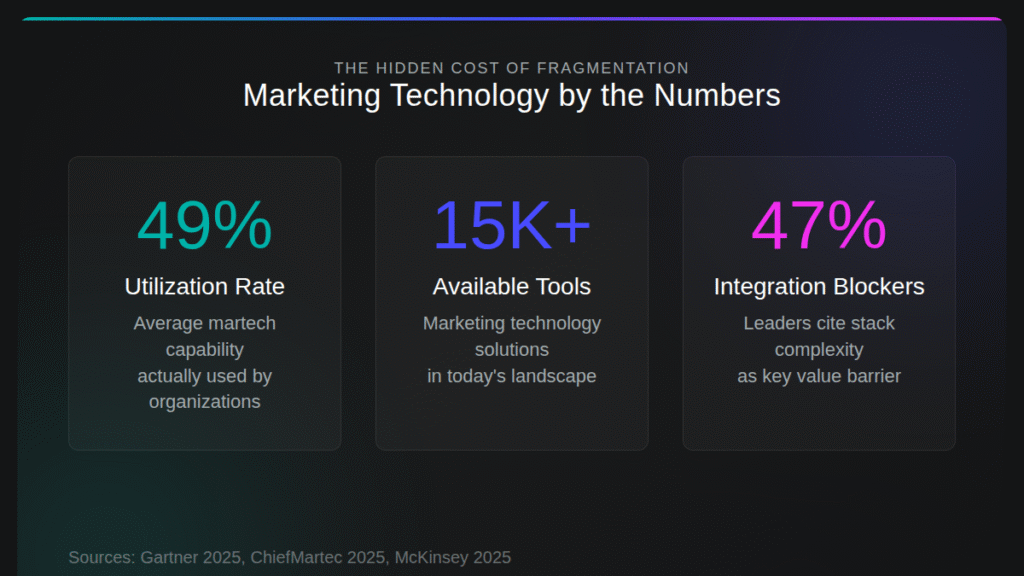
The problem extends beyond wasted hours. According to McKinsey research on martech effectiveness, 47% of marketing decision-makers cite stack complexity and system integration challenges as key blockers preventing them from getting value from their technology investments. This fragmentation creates operational inefficiencies that undermine the ability to orchestrate seamless customer journeys. The inefficiency bleeds into every aspect of content operations, from asset creation and review to distribution and measurement.
The Real Price of Disconnected Systems
Fragmented content operations manifest in ways that often go unnoticed until they reach crisis levels. Teams recreate assets because they cannot locate existing ones. Version control becomes guesswork when files scatter across multiple repositories. Approval workflows stall as stakeholders hunt for the latest versions in email threads, shared drives, and project management tools that do not communicate with each other.
These inefficiencies carry concrete financial weight. Organizations routinely discover they are paying for duplicate software licenses, maintaining redundant storage systems, and employing staff whose primary function has become navigating complexity rather than producing creative work. The cumulative effect transforms content from a strategic asset into an operational burden.
What Is Tool Sprawl and Why Does It Hurt Marketing Performance?
The martech landscape has grown at a pace that defies reasonable management. According to the 2025 Marketing Technology Landscape report, there are now 15,384 marketing technology solutions available, representing a staggering 9,295% increase since 2011. This proliferation creates both opportunity and chaos for marketing organizations trying to maintain competitive content operations.
Tool sprawl emerges naturally in most organizations. A team adopts one platform for social media management, another for email marketing, a third for project coordination, and yet another for digital asset management. Each addition solves an immediate problem while contributing to a larger systemic issue. The average marketing team now operates with dozens of technology tools, and some enterprises manage far more applications across their customer engagement ecosystem.
The Utilization Gap
Perhaps more troubling than the sheer number of tools is how poorly organizations leverage the ones they already own. According to Gartner’s 2025 Marketing Technology Survey, martech utilization has dropped to just 49% of available capabilities, continuing years of decline from 58% in 2020 and 42% in 2022. Organizations are paying for roughly double the software functionality they actually use.
This utilization gap stems from several interconnected factors that compound marketing inefficiencies. New tools arrive faster than teams can learn them. Integration challenges prevent platforms from sharing data effectively, with system and data integration consistently ranking among the top barriers to martech value. Training budgets shrink even as technical complexity grows, leaving staff to figure out sophisticated platforms through trial and error.
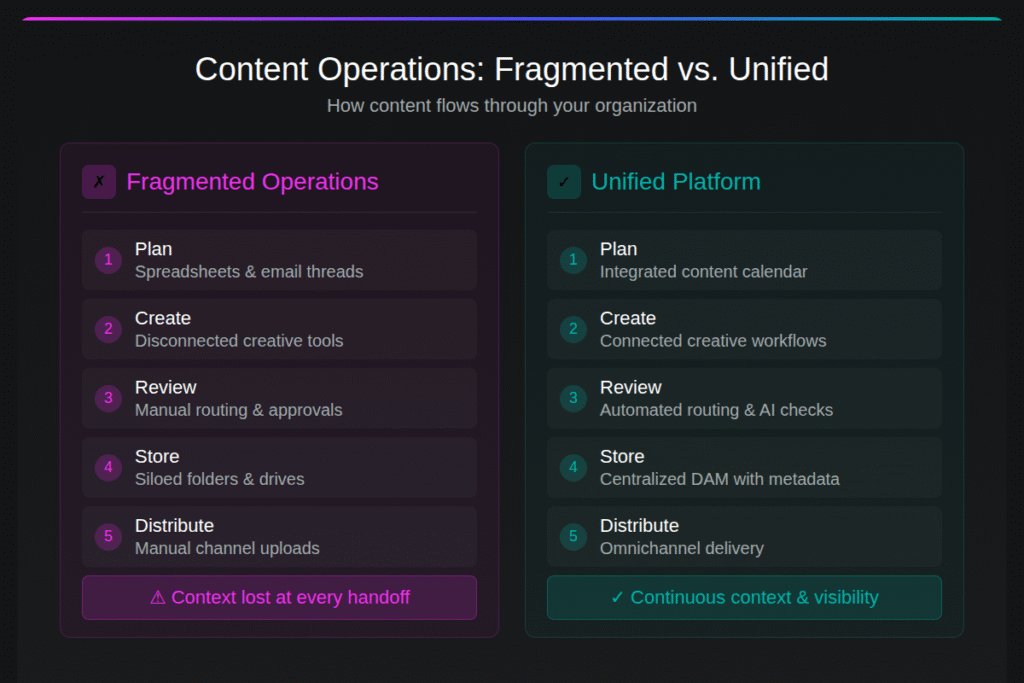
The consequence is a content flow that stutters rather than streams. Assets get stuck in one system while approvals wait in another. Performance data lives in isolation from creative planning. Teams develop workarounds that technically function but multiply manual effort and introduce error at every handoff.
What Is the True Cost of Disconnected Content Systems?
Quantifying the damage from siloed content infrastructure requires looking beyond obvious software expenses to the hidden costs embedded in daily workflows. These costs accumulate in three primary areas that most organizations underestimate.
Time Lost to System Navigation
Content creators spend significant portions of their days navigating between disconnected platforms rather than doing creative work. They download assets from one system, upload them to another for editing, transfer them to a third for review, and move them again for distribution. Each transition introduces delay, potential for error, and cognitive overhead that depletes creative energy.
The time spent searching for assets compounds this problem. Without centralized content repositories that feature intelligent search capabilities, teams resort to asking colleagues where files live, scrolling through folder structures, or simply recreating assets from scratch because finding the original would take longer than starting over.
Redundant Work and Asset Recreation
Organizations with siloed content systems frequently discover that different teams have created nearly identical assets without knowing about each other’s work. Marketing produces product photography that sales already commissioned. Regional teams translate materials that headquarters localized months earlier. Campaign concepts get developed multiple times because no system connects planning to execution across departments.
This redundancy wastes more than creative hours. It consumes budget on duplicate production, storage, and distribution. It fragments brand presence when slightly different versions of content reach audiences through different channels. It demoralizes teams who learn their carefully crafted work duplicated effort happening elsewhere.
Revenue Impact and Missed Opportunities
The most significant costs from siloed content infrastructure often appear as opportunities never captured rather than expenses directly incurred. When campaign launches delay because assets cannot move smoothly through review and approval, competitors reach audiences first. When personalization requires manual assembly across disconnected systems, scalable approaches become impractical. When performance data remains siloed from content planning, optimization decisions rely on intuition rather than evidence.
Five Signs Your Content Operations Are Siloed
Recognizing disconnected content systems early allows organizations to address the problem before inefficiencies become entrenched. The following indicators suggest content flow has broken down and marketing inefficiencies are mounting.
- Asset searches routinely fail. Team members regularly cannot find content they know exists, resorting to recreating assets or using outdated versions because locating current files takes too long.
- Version confusion causes rework. Multiple versions of the same asset circulate simultaneously, leading to approved content getting replaced by earlier drafts or compliance-cleared materials being substituted with unapproved alternatives.
- Approvals bottleneck inconsistently. Review cycles vary wildly in duration depending on which systems happen to be involved, with some content moving quickly while similar materials stall for days waiting for stakeholders to check the right platform.
- Integration maintenance consumes technical resources. IT staff spend significant time maintaining connections between content platforms, troubleshooting data sync failures, and responding to requests for access across multiple systems.
- Performance measurement requires manual assembly. Understanding how content performs across channels demands pulling reports from multiple sources, manipulating data in spreadsheets, and reconciling metrics that different platforms calculate differently.
How Can Teams Build a Unified Content Operations Strategy?
Addressing disconnected content systems requires more than consolidating tools. It demands rethinking how content moves through the organization from initial concept to final deployment and measurement. The most successful transformations center on establishing a single source of truth for digital assets while automating the workflows that connect creation to distribution.
Centralizing Asset Management
A unified digital asset management workflow forms the foundation of streamlined content operations. When all approved assets reside in a single accessible repository, teams eliminate the time spent searching across scattered storage locations. When metadata standards apply consistently, intelligent search surfaces relevant content based on context rather than requiring exact keyword matches.
Centralization extends beyond storage to encompass the full asset lifecycle. Version control becomes automatic rather than manual. Usage rights attach to assets themselves rather than residing in disconnected spreadsheets. Expiration dates trigger proactive notifications rather than requiring calendar reminders that someone must remember to set.
Automating Review and Distribution
Manual content routing creates bottlenecks that automated workflows eliminate. When assets move automatically to appropriate reviewers based on content type, region, or channel, approval cycles accelerate. When distribution rules apply consistently, content reaches intended channels without requiring individual intervention at each step.
AI Agents now handle tasks that previously required human coordination. Planning agents generate campaign briefs aligned to strategic objectives. Librarian agents automatically enrich assets with metadata based on content analysis. Compliance agents check materials against brand guidelines and regulatory requirements before human reviewers ever see them. Production agents transform and localize content for different markets and channels.
These autonomous capabilities shift human effort from administrative coordination to strategic decision-making. Teams focus on creative quality and campaign effectiveness rather than file management and system navigation.
Connecting Planning to Performance
Unified content operations close the loop between content creation and business outcomes. When planning tools connect directly to asset repositories and distribution channels, teams can trace how specific content contributes to campaign results. When performance data flows back into planning systems, future content decisions draw on evidence rather than assumption.
This connectivity enables content intelligence that fragmented systems cannot support. Organizations can identify which asset types drive engagement with specific audiences, which creative approaches outperform alternatives, and which content gaps represent opportunities worth pursuing. Data-driven content strategy becomes practical rather than aspirational.
Frequently Asked Questions
What causes content operations to become fragmented?
Disconnected content systems typically develop gradually as teams adopt point solutions to address immediate needs without considering how those tools will integrate with existing systems. Mergers and acquisitions compound the problem by combining different technology stacks. Departmental autonomy leads to parallel tool adoption across marketing, sales, and creative teams. The result is a patchwork of disconnected platforms that technically function individually but fail to support seamless content flow across the organization.
How much does fragmented content operations cost organizations?
The cost of disconnected content systems includes both direct expenses and hidden productivity drains. Direct costs include redundant software licenses, duplicate storage fees, and integration maintenance. Hidden costs encompass employee time spent navigating between systems, asset recreation due to findability failures, and delayed campaigns that miss market opportunities. Studies consistently show that fragmented operations lead to significant budget waste and reduced marketing effectiveness compared to integrated approaches.
What is the first step toward unifying fragmented content operations?
The most effective first step is conducting an honest audit of current content workflows to identify where disconnection creates the most friction. This assessment should map how content actually moves through the organization, document the tools involved at each stage, and quantify the time spent on system navigation versus productive work. With this baseline established, organizations can prioritize integration efforts based on potential impact rather than attempting to address everything simultaneously.
How do unified platforms improve content flow compared to integrated point solutions?
Unified platforms provide native connectivity between content planning, asset management, workflow automation, and distribution capabilities, eliminating the integration overhead that consumes technical resources when connecting disparate point solutions. Content moves through a single system rather than transferring between multiple platforms at each workflow stage. Metadata, permissions, and version control apply consistently rather than requiring reconciliation across different tools with different data models. The result is faster content velocity with fewer errors and reduced administrative burden.
The Path Forward for Content Teams
Disconnected content systems did not develop overnight, and resolving them requires sustained attention rather than quick fixes. Organizations that successfully unify their content flow typically begin by auditing their current state honestly, identifying the specific points where disconnection creates the most friction.
The goal is not eliminating every specialized tool but rather establishing clear hierarchy among systems and ensuring that content can move between them without manual intervention. A central content operations platform serves as the hub that coordinates activity across specialized applications, maintaining consistent governance while enabling flexibility in execution.
Measurement frameworks must evolve alongside technology changes. Organizations should track not only content production volume but also time-to-publish metrics, asset reuse rates, and the proportion of staff effort devoted to creative work versus system administration. These indicators reveal whether operational changes are delivering genuine efficiency gains.
Aprimo delivers the unified platform that transforms disconnected content systems into streamlined workflows. From agentic AI that automates asset management to intelligent workflow automation, Aprimo helps organizations eliminate tool sprawl and restore seamless content flow across every team and channel. Get a demo to see how centralized content operations can accelerate your marketing performance.