

Why Enterprises Need Both DAM and CRM for Seamless Operations
Enterprise marketing success relies on the perfect harmony of customer data and creative content. While CRM platforms excel at tracking leads and sales cycles, they often fall short when it comes to managing the vast libraries of digital assets required to fuel those interactions. This is where a dedicated Digital Asset Management system becomes essential. By integrating a DAM with your CRM, you provide your teams with a unified ecosystem that reduces silos and drives operational excellence.
TL;DR
Enterprises must integrate DAM and CRM systems to ensure brand consistency and operational efficiency. While CRMs manage customer data, DAMs provide the single source of truth for assets, ensuring sales teams always have access to the right content at the right time.
Why Are DAM and CRM Systems Better Together?
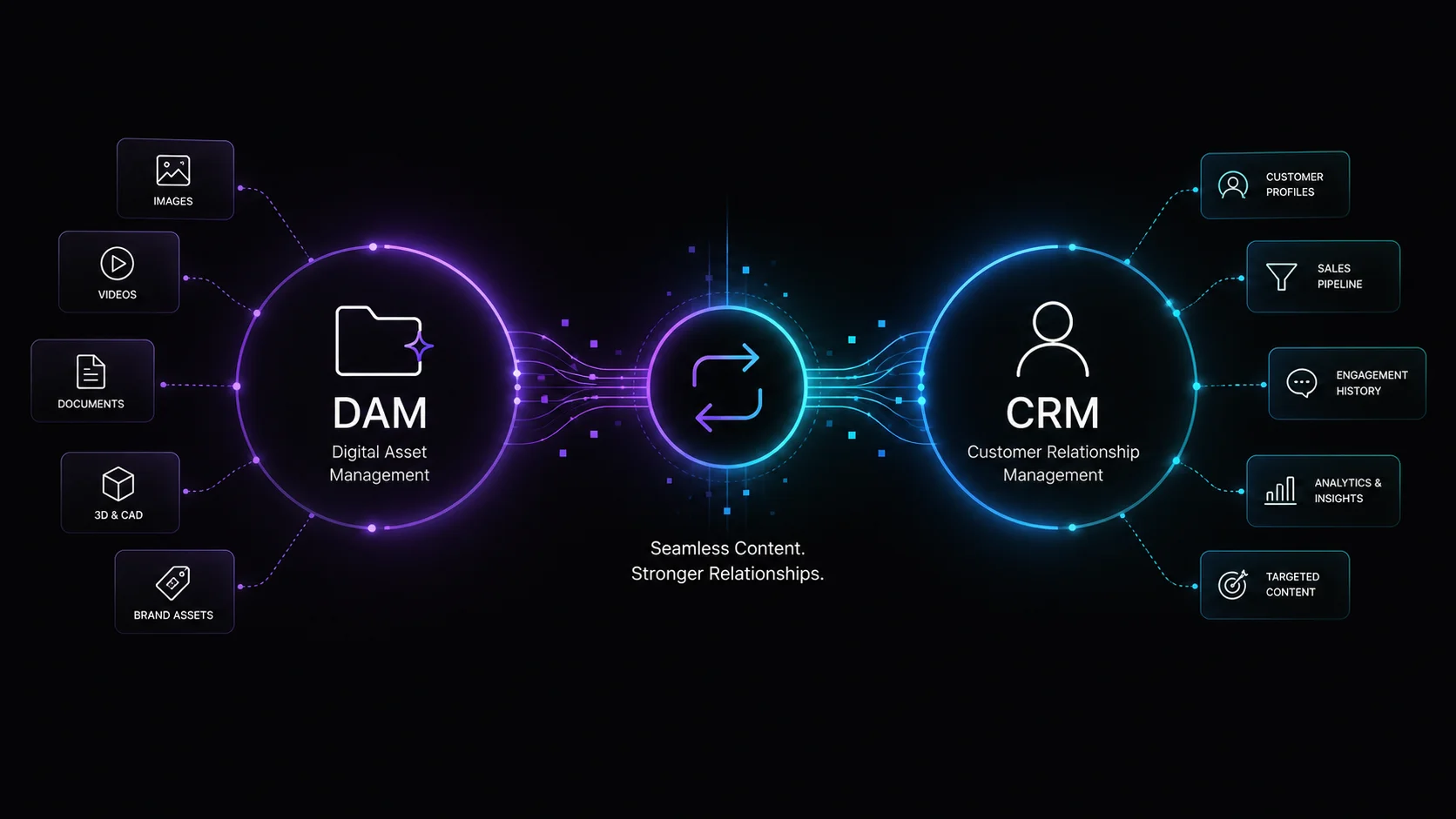
In the modern enterprise landscape, many leaders ask whether a CRM can double as a content repository or if a DAM is just a fancy storage folder. The reality is that these tools serve two different masters. A CRM is the system of record for customer interactions, containing data like purchase history and contact details. On the other hand, a Digital Asset Management system is the system of record for brand assets, managing large files, version control, and usage rights. While a CRM knows who the customer is, the DAM knows what the customer sees. Without a DAM, a CRM is often cluttered with outdated PDFs and low-resolution images that slow down performance and create brand inconsistency.
Solving the Content Bottleneck Through Integration
The biggest challenge in enterprise marketing is the content bottleneck. When sales teams try to pull collateral directly from a CRM that lacks a DAM integration, they often find outdated brochures or assets that are not approved for their specific region. This leads to brand non-compliance and a poor customer experience. By integrating these systems, the DAM acts as the single source of truth. When a creative updates a file in the DAM, that update automatically flows through to the CRM interface. This ensures that every outreach attempt by the sales team is backed by high quality, approved, and relevant content.
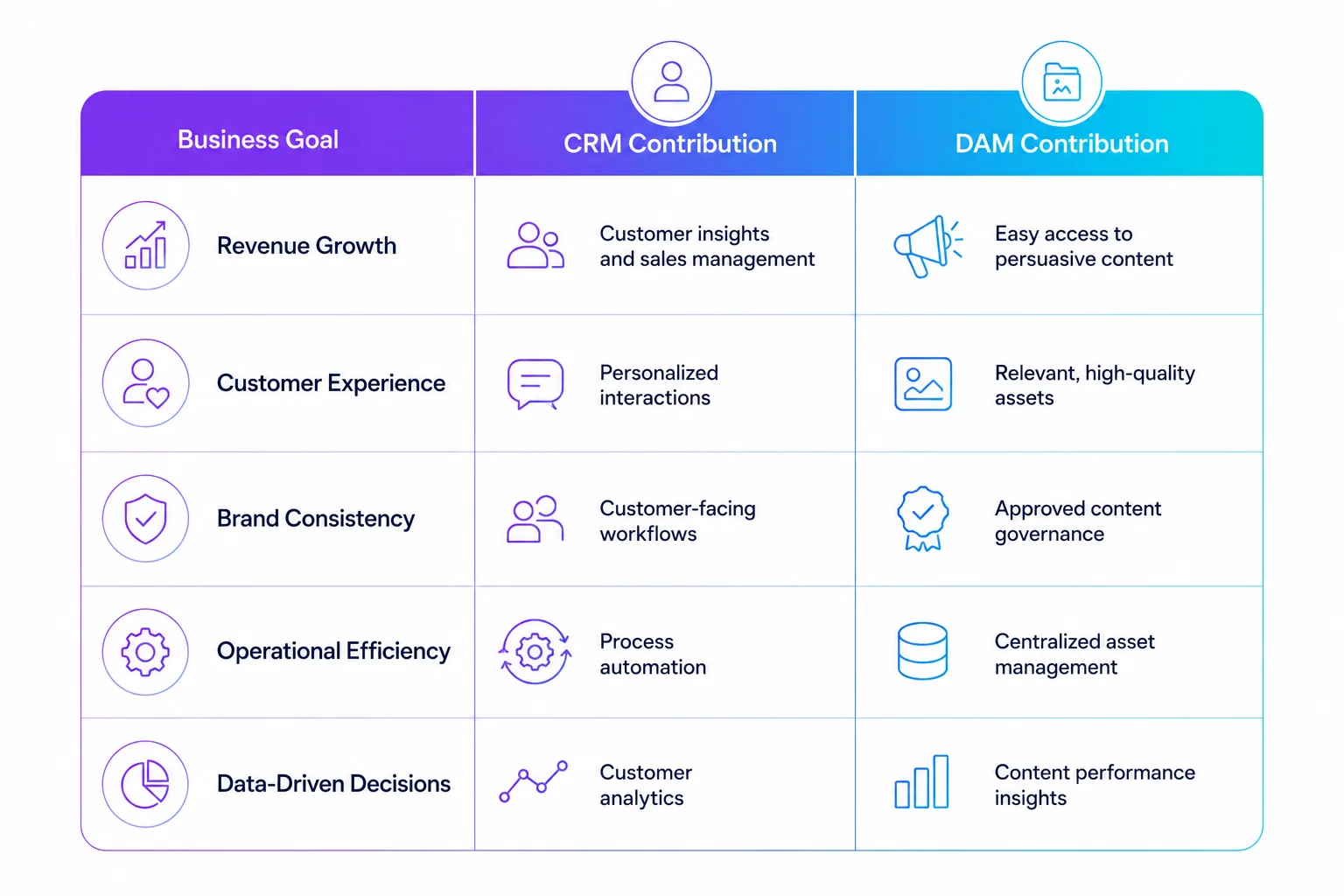
DAM systems provide governance and scalability, while CRM systems manage growing customer relationships. Together, they support sustainable business growth without creating information silos.
How Do You Synchronize Customer Data and Creative Assets?
How do you synchronize customer data with creative assets effectively? The process begins by mapping metadata between the two systems. For instance, if your CRM identifies a lead as being in the healthcare industry, the integration should surface healthcare-specific whitepapers and case studies from the DAM directly within the sales representative view. This level of automation reduces the time spent searching for files and allows the sales team to focus on closing deals. Furthermore, high-performance enterprises use this to track asset performance, seeing exactly which creative content led to successful conversions in the CRM.
Mitigating Risk and Ensuring Global Brand Compliance
Modern digital asset management has evolved far beyond simple storage. For a global enterprise, the DAM handles the complex logic of rights management, expiration dates, and localized versions of assets. A CRM alone cannot manage the legal risks associated with expired talent licenses or stock photography. By connecting a robust platform like Aprimo with your CRM, you create a safety net. The moment an asset reaches its expiration date in the DAM, it can be flagged or removed from the CRM view, preventing costly legal disputes and protecting the integrity of the brand across all global markets.
Strategic Advantages Over All-In-One Solutions
While some CRM providers have added basic file storage features, they lack the sophisticated orchestration capabilities of a dedicated DAM. Competitors in the space often struggle to provide a unified view of the content lifecycle, while an integrated Aprimo solution offers deep insights into both production and distribution. Enterprises that rely solely on CRM storage find that their systems become bloated and slow, leading to poor user adoption. A dedicated DAM offloads this weight, providing a high speed environment for asset manipulation, transformation, and distribution that a CRM is simply not built to handle.
Conclusion
The combination of a CRM and a DAM is no longer a luxury but a necessity for enterprise efficiency. By bridging the gap between customer data and brand assets, companies can deliver more personalized, compliant, and impactful experiences. To learn more about how Aprimo can transform your marketing operations through seamless integrations, contact our team for a personalized demonstration today.
FAQ
What is the difference between a CRM and a DAM?
A CRM manages customer relationships and data, while a DAM manages the creation, storage, and distribution of digital assets used to engage those customers.
How does DAM and CRM integration improve sales?
Integrating these systems allows for better personalization, ensures only approved assets are used, and provides insights into which content drives the most revenue.
Does a DAM reduce CRM storage costs?
Yes, a DAM handles complex metadata, versioning, and large file formats that would otherwise bloat and slow down a CRM platform.
How difficult is it to connect a DAM to an existing CRM?
Most enterprise DAM platforms like Aprimo offer pre built connectors or robust APIs to facilitate seamless data and asset flow between the systems.