

A modern DAM system has evolved from simple file storage into an intelligent content operations platform powered by autonomous AI agents.
- Digital asset management encompasses both business processes and technology platforms that centralize, organize, and distribute digital content at enterprise scale.
- AI agents automate metadata creation, compliance checks, and content personalization, reducing manual work while improving asset discoverability.
- Organizations managing high volumes of digital content can expect measurable ROI through faster campaign launches, reduced duplication, and improved brand consistency.
The question is no longer whether you need a DAM system, but whether your current approach can keep pace with AI-driven content demands.
The digital asset management market reached $6.59 billion in 2025 and continues growing at roughly 14% annually. What’s driving this growth isn’t just the explosion of digital content. It’s the realization that scattered files, manual tagging, and hope-based organization cost organizations real money. Marketing teams lose hours searching for assets. Creative departments recreate work that already exists somewhere. Compliance teams scramble to track usage rights across systems.
In response, organizations are rethinking how digital assets fit into broader content operations. A modern DAM system is no longer just a repository; it’s an operational backbone that connects people, processes, and platforms across the content lifecycle. When done right, it reduces friction between teams, enforces governance by default, and turns assets into reusable, measurable business resources. This guide breaks down what capabilities matter, how expectations have evolved, and how to evaluate solutions with long-term impact in mind.
What Is a DAM System?
A clear digital asset management definition starts with understanding that DAM operates on two interconnected levels. It’s both a strategic business process for managing content lifecycles and a technology platform that centralizes your digital files. Getting this distinction right determines whether your investment pays off or becomes another underutilized tool.
DAM as a Business Process
Digital asset management as a process refers to how organizations systematically handle their content lifecycle. This definition includes planning what content you need, establishing governance rules, defining who can access what, and creating workflows that move assets from initial concept through approval to final deployment.
The process side often gets overlooked, which explains why so many DAM implementations underperform. Without structured processes, even sophisticated technology becomes expensive file storage. You need clear policies for naming conventions, metadata standards, approval chains, and archival rules before the technology can deliver its full value.
DAM as a Technology Platform
A DAM system is specialized software designed to centralize, organize, and distribute digital files at scale. Unlike generic cloud storage like Dropbox or Google Drive, DAM software includes features specifically built for content operations. Think intelligent search capabilities, automated metadata tagging, brand compliance tools, and deep integrations with creative and marketing software. If you’ve ever spent twenty minutes hunting for a file you know exists somewhere, you understand why these capabilities matter.
Modern DAM platforms now include AI-powered automation that can recognize image content, suggest relevant tags, predict which assets will perform best for specific campaigns, and automatically generate content variants. This technological shift is transforming DAM from passive storage into an active participant in content operations.
Why the Distinction Matters
Understanding both sides of the digital asset management definition explains why some organizations get tremendous value from DAM while others struggle with adoption. Technology without process leads to underutilized systems and frustrated users. Process without proper technology creates bottlenecks and limits how much you can scale.
The most successful DAM strategies combine systematic business processes with platforms designed for modern content operations. This holistic view is vital as AI-powered workflow automation reshapes how assets move through your organization.
How Are AI Agents Reshaping Modern DAM?
The conversation around artificial intelligence in digital asset management has shifted. What started as basic image recognition and automated tagging has matured into something far more sophisticated, and frankly, more useful for the teams actually doing the work. According to McKinsey’s 2025 State of AI report, 62% of organizations are now experimenting with AI agents, though only about one-third have begun scaling these capabilities enterprise-wide.
The term “agentic” refers to AI systems that can act autonomously, make decisions, and execute multi-step processes without constant human intervention. This technology differs from assistive AI (which helps humans complete tasks) and generative AI (which creates content on command).
In a SMART DAM context, agentic AI means systems that can independently route assets through workflows, make metadata decisions, trigger compliance checks, optimize content placement, and adapt processes in real time based on context. In practical terms, it’s the difference between having AI suggest what to do next versus having AI handle the task entirely while you focus on work that actually requires human judgment.
The Five Categories of AI Agents in DAM
Modern digital asset management platforms organize AI capabilities into specialized agents, each handling distinct aspects of content operations:
- Planning Agents generate structured, insight-driven content briefs aligned to business objectives. They can break campaign briefs into regional or channel-specific versions, eliminating the back-and-forth that typically delays creative work.
- Librarian Agents handle the heavy lifting of metadata automation. They auto-populate fields using generative AI, organize files based on your proprietary taxonomies, and apply predictive metadata, smart captions, and optical character recognition without human intervention.
- Critic Agents evaluate content quality by analyzing tone, sentiment, and language. They provide optimization suggestions for SEO and assess compositional balance, helping maintain quality standards across all touchpoints.
- Compliance Agents automate brand guideline enforcement and legal checks. They validate content against approved claims libraries and accelerate approvals in regulated industries like financial services and life sciences.
- Production Agents handle content transformation and localization at scale. They automate image transformations, translate content, apply local taxonomies, and create regional campaign variants.
Organizations using AI agents report scaling content creation by 80% or more while improving content engagement by approximately 30%. Human oversight remains essential for quality control and strategic decisions, but the tedious coordination happens automatically.

DAM and AI Architecture: How Do They Work Together?
Understanding how AI integrates with your DAM system helps you evaluate solutions and plan implementations. The architecture typically includes several interconnected layers.
At the foundation, you have your centralized asset repository, essentially a content hub where all digital files live. Above that sits the metadata layer, now largely automated through AI analysis of visual content, text extraction, and business rules. The workflow engine orchestrates how assets move through review, approval, and distribution processes. AI agents operate across all these layers, making decisions, flagging issues, and executing tasks based on predefined objectives.
The integration layer connects your DAM to creative tools like Adobe Creative Suite, marketing platforms like your CMS and email systems, and business systems like CRM and ERP. Modern platforms offer 70 or more pre-built connectors plus APIs for custom integrations.
What makes this architecture powerful is the feedback loop. Performance data from distributed content flows back into the system, informing future recommendations and continuously improving AI accuracy.
10 Essential Features That Define a Modern DAM System
The platforms driving real business value combine foundational capabilities with AI-powered automation. Here are the features that separate professional digital asset management solutions from glorified cloud storage.
1. Intelligent Search and Discovery
Advanced search capabilities powered by AI understand natural language queries, visual similarity, and contextual relationships. Users find assets by describing what they need (“red jacket from fall campaign”) rather than remembering exact file names or folder structures. The best systems include facial recognition, object detection, and automated tagging that make every asset discoverable.
2. Automated Metadata Management
AI-driven metadata creation automatically populates tags, descriptions, and taxonomies based on image analysis and your business rules. This feature eliminates manual data entry, which typically bogs down DAM adoption, while ensuring consistent, searchable asset information across your entire library.
3. Workflow Automation and Approval Processes
Streamlined review cycles with automated routing, approval tracking, and stakeholder notifications keep content moving. Modern workflows adapt based on asset type, project requirements, and user roles. Intelligent automation handles routine decisions, escalates issues appropriately, and maintains audit trails for compliance.
4. Brand Compliance and Governance Tools
Automated brand guideline enforcement prevents off-brand content from entering workflows. Assessments cover color palette validation, logo usage monitoring, and messaging consistency checks. AI-powered compliance agents flag potential issues before they become expensive mistakes or regulatory violations.
5. Advanced Integration Ecosystem
Seamless connectivity with creative tools, marketing platforms, and business systems eliminates manual file transfers between systems. Look for pre-built connectors for the tools your teams already use, plus robust APIs for custom requirements.
6. Dynamic Asset Transformation
On-demand resizing, cropping, and format conversion automatically deliver the right asset variant for each channel. AI can adapt assets for responsive image delivery, social media optimization, and print-ready file generation without requiring manual intervention from creative teams.
7. Comprehensive Rights and Licensing Management
Modern DAM systems automatically track usage rights, expiration dates, and licensing agreements with proactive notifications before assets expire. This automation prevents costly legal issues and ensures compliance with photographer, vendor, and stock photo agreements.
8. Real-Time Collaboration and Review Tools
Built-in annotation, commenting, and feedback systems keep project discussions tied to specific assets. This feature eliminates email chains and version confusion, especially for distributed teams working across time zones.
9. Performance Analytics and Usage Insights
Data-driven reporting on asset performance, user behavior, and content ROI helps optimize future content strategies. Modern analytics identify which assets drive engagement and suggest improvements for underperforming content.
10. Enterprise Security and Access Controls
Granular permission management, encryption, and audit logging meet enterprise security requirements. Measurements include single sign-on integration, role-based access, and compliance with regulations like GDPR and industry-specific requirements.
How Can You Build DAM System Workflows That Actually Scale?
A DAM system workflow transforms scattered, manual processes into systematic operations that move content efficiently from creation to deployment. Unlike basic file management, DAM workflows orchestrate every step of the content lifecycle while maintaining brand compliance, version control, and stakeholder accountability.
The Modern Workflow Architecture
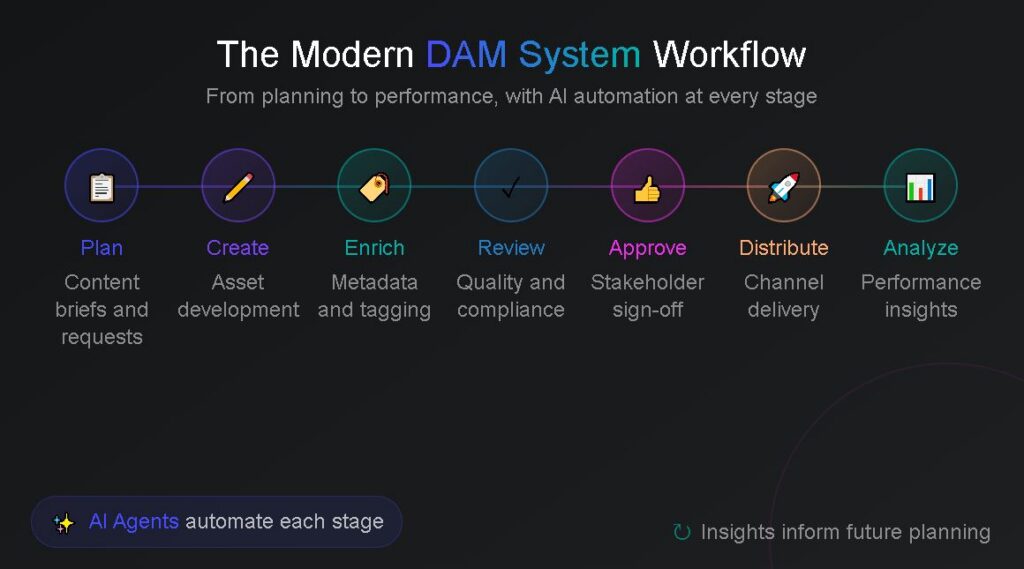
Effective DAM workflows combine human creativity with AI agents that handle routine decisions, route approvals, and maintain governance. Here’s how the stages typically flow.
Content Planning and Brief Creation: Workflow begins with structured content requests capturing requirements, deadlines, and approval chains upfront. AI-powered planning agents can analyze campaign goals and automatically suggest asset types, formats, and distribution channels based on historical performance data.
Asset Creation and Ingestion: Creative teams develop content using integrated tools that connect directly to the DAM platform. Modern workflows eliminate manual file transfers by allowing creators to work within their preferred applications while automatically syncing to the central repository.
Automated Metadata and Organization: AI librarian agents analyze visual content, extract text from documents, and apply business-specific taxonomies without manual intervention. Assets become searchable and discoverable immediately upon ingestion.
Quality Control and Brand Compliance: Automated quality checks evaluate technical specifications, brand guideline adherence, and content appropriateness before human review. Compliance agents flag potential issues before they become costly mistakes.
Review and Approval Routing: Dynamic approval workflows adapt based on asset type, project scope, and stakeholder availability. Intelligent routing escalates decisions when needed and handles substitutions when reviewers are unavailable.
Distribution and Activation: Automated distribution ensures approved assets reach the right channels in appropriate formats. This includes social media posting, website updates, email campaign integration, and print-ready file preparation.
Performance Monitoring: Closed-loop workflows capture asset performance data and feed insights back into future content planning. Successful assets inform new creation strategies, creating continuous improvement.
The Automation Factor
The difference between effective and ineffective DAM workflow implementation often comes down to automation intelligence. Manual workflows create bottlenecks, increase errors, and limit scalability. Intelligent automation handles routine decisions while escalating complex issues to human experts.
Organizations achieving the highest ROI from DAM investments focus on workflow design that reduces manual touchpoints, accelerates decision-making, and maintains quality standards automatically.
Who Benefits Most from Implementing DAM?
Marketing, digital experience, creative, and IT teams all benefit from having accessible, modifiable, and trackable content assets. The impact varies by role and use case, and understanding this helps you build the right business case internally.
Marketing Teams store and organize assets like images, videos, logos, and brand guidelines for easy access across campaigns, social media, website content, and promotional materials. A centralized content hub enables version control and ensures brand consistency by providing only approved, up-to-date assets. No more wondering if that product shot is the final version or emailing around, asking who has the latest file.
Content and Creative Teams rely on visual and multimedia assets for daily work. DAM platforms enable version control, allowing team members to track changes, revert to previous versions, and maintain a consistent creative process. Metadata capabilities enable tagging, descriptions, and searchability that make it easier to locate and repurpose content.
Digital Experience Teams leverage DAM to store and manage digital assets specifically tailored for user interactions, including website visuals, interactive elements, UI/UX components, and multimedia content. Integration with CMS or web development platforms streamlines the entire creation, storage, and publication process.
IT Teams gain a centralized repository for digital assets, reducing the burden of managing files scattered across different storage locations. DAM makes it easier to meet compliance requirements and adhere to security protocols, reducing the risk of data breaches and regulatory issues.
Is a DAM System Right for Your Organization?
Every business participates in digital asset management, whether intentionally or not. Your current system might involve shared drives and scattered folders, which might work for now. But as your business grows, the cracks become canyons.
Ask yourself these questions:
Is your content scattered across multiple solutions? We’ve all been there: you need the latest version of a logo, but it could be in your email, a shared drive, someone’s desktop, or that folder from six months ago nobody can find. Modern digital brand management requires content for multiple channels, including website, email, marketing, social media, and product marketing. Having different versions and solutions for each channel creates chaos that only gets worse over time. Consolidating everything into a DAM system creates a unified content hub that connects assets and prepares them for distribution across every channel.
Do you want to do more than just store content? Content needs nurturing at every lifecycle stage, from ideation and planning to analysis and archival. Quality DAM solutions support work-in-progress assets so creative teams can continue using their preferred tools. They also offer analysis features that give insight into high-performing content, enabling you to update and republish what works.
Do you need to support multiple asset types? Breaking down content from any format to segment and reuse it for different purposes and customer experiences is critical. DAM supports multiple asset types, including video, audio, and images, and can track which content gets used most often and by which groups.
Do you have sophisticated content enrichment needs? Content becomes complex when managing it across versions, regions, dates, rights, and resolutions. DAM offers robust content enrichment capabilities so you can deliver the right content to the right customer at the right time, with customized metadata and taxonomy capabilities.
Do many groups need your content? Content is no longer just for marketing. Sales, legal, and customer experience teams are staking claims for enterprise content. DAM manages all assets by group or channel, allowing access controls that match your organizational structure.
How Do You Implement Your DAM Strategy?
Successfully implementing a new DAM solution requires careful planning, research, and training. You can’t flip a switch and expect transformation overnight. Rushing implementation is one of the biggest reasons DAM projects fail to deliver expected value. Take the time to get it right.
Choosing the Right DAM Software
Start by defining your objectives. Outline goals you hope your DAM system will help accomplish, whether that’s improving workflow efficiency, enhancing collaboration, or ensuring brand consistency. Search for software systems with features supporting those goals.
Key factors to compare:
- Customizability: Many platforms offer customizable features to adapt to your team’s specific needs.
- Integrations: Ensure your DAM system integrates with existing tools like CMS, CRM, or creative software.
- Cost: Look for a starting cost that fits your current budget while considering the total cost of ownership.
- Scalability: Look for scalable plans and features so you can grow without switching systems.
- Security: Evaluate access control and data security tools needed to protect your assets.
- AI Capabilities: Consider whether the platform includes AI agents for automation, or if those require additional cost.
Implementation Best Practices
Plan migration carefully: Develop a migration plan to transfer existing assets, ensuring minimal disruption to ongoing work.
Train users comprehensively: Provide training to team members so they understand functionalities and can effectively use the system. Schedule dedicated training periods to ensure everyone is on board.
Test and refine: During implementation, conduct testing and gather user feedback, making necessary refinements to optimize performance.
Establish governance early: Define naming conventions, metadata standards, approval workflows, and access permissions before rolling out to the broader team.
Start with a pilot: Consider implementing with a smaller team or project first to identify issues before full deployment.
Real Results: DAM System Success Stories
National Park Foundation: Streamlining Content Flows
National Park Foundation supports over 400 unique national park sites nationwide, meaning tons of content flows through different branches, including photo and video content supporting NPF’s charitable causes.
Before implementing a DAM solution, NPF had no clear process for storing and sharing content. The foundation relied on a combination of email and hard drive storage, leading to miscommunications, confusion, and intellectual property risks. After implementing a custom, cloud-based digital asset library, NPF achieved streamlined content output, fewer errors, and trained 100% of relevant employees on the new system.
Hachette Book Group: Replacing an Outdated DAM
Hachette Book Group, one of the biggest names in publishing, was using an outdated DAM system that no longer met their needs. Many team members avoided the system entirely, sharing content through email and other platforms, which created version control and security issues.
Working with a new DAM partner, HBG developed a system offering more storage, better accessibility, and faster sorting and sharing features. The new system made it easier for team members to access various assets without resorting to private or unmonitored channels.
What’s Next: DAM System Trends Shaping 2026 and Beyond
DAM is evolving, with AI capabilities reshaping what’s possible for marketing and creative teams facing unprecedented content demands.

Autonomous AI Agents Become Standard: The shift from assistive AI to autonomous agents is the most significant evolution in DAM technology. These systems independently execute complex, multi-step workflows. Expect AI agents that can handle entire content workflows, from identifying performance gaps to generating content briefs to distributing personalized assets, all without constant human oversight.
Real-Time Content Personalization: The connection between DAM and personalization continues tightening. Modern systems can identify what content gaps exist for specific audience segments, recommend assets to close those gaps, and dynamically serve personalized content based on individual user behavior.
Content Intelligence and Predictive Analytics: Advanced DAM platforms now include machine learning that understands what your visitors care about, influencing content strategy and prioritization. These systems surface content gaps worth prioritizing and track which campaign components have high or low coverage of personalized content.
Mobile-First DAM Experiences: With teams increasingly distributed, mobile apps and responsive interfaces allow users to upload assets, review content, approve campaigns, and share links directly from their phones. This mobility reduces feedback delays and speeds up time-to-market.
Enhanced Security and Compliance: With cybercrime projected to cost businesses $1.5 trillion, DAM security has become business-critical. Modern systems are built on trusted security frameworks like SOC 2 and ISO 27001 compliance. AI-powered detection can identify and flag AI-generated content, addressing emerging regulatory requirements around content provenance.
Composable Architecture: The move toward MACH-certified (Microservices, API-first, Cloud-native, Headless) platforms gives organizations flexibility to integrate DAM with any existing tech stack and adapt as needs evolve.
DAM System FAQs
How does AI actually improve a DAM system?
AI improves DAM in several concrete ways. Automated tagging eliminates manual metadata entry while improving accuracy. Natural language search lets users find assets by describing what they need rather than knowing exact file names. AI agents can route assets through approval workflows, flag compliance issues, and even generate content variants automatically. The result is increased productivity for teams that previously relied on manual processes.
Is a DAM system only useful for large enterprises?
No. Organizations of any size can benefit from the right DAM system. Small and medium-sized businesses often see proportionally greater impact because they’re replacing particularly inefficient manual processes. Many platforms offer scalable pricing and features that adjust as your business grows, so you’re not paying for enterprise capabilities you don’t need yet.
What’s the difference between a DAM system and cloud storage?
Cloud storage, like Google Drive or Dropbox, stores files. DAM software manages them. DAM systems include specialized search capabilities, metadata management, version control, rights tracking, workflow automation, brand compliance tools, and integrations with creative and marketing software. If you just need to store files and share them occasionally, cloud storage works fine. But if you need to actually manage a content lifecycle with multiple stakeholders, approvals, and distribution channels, you need DAM.
How long does DAM implementation typically take?
Implementation timelines vary based on complexity, but typical enterprise deployments range from 8 to 16 weeks for initial launch. Factors affecting timeline include volume of existing assets to migrate, complexity of metadata schemas, number of integrations required, and extent of workflow customization. Starting with a focused pilot project can reduce time-to-value while identifying issues before full rollout.
What should I look for in AI capabilities when evaluating DAM platforms?
Look for AI that’s production-ready, not experimental. Ask whether the platform includes native AI capabilities or requires third-party integrations. Evaluate whether AI can be trained on your specific content and taxonomy. Consider whether the platform offers AI agents that can execute autonomous workflows or just assistive features that require human initiation. And understand the pricing model for AI features, as some vendors charge more for advanced capabilities.
Start Managing Digital Assets Strategically
The digital asset management definition has evolved from a simple storage solution to a strategic content operations platform. Organizations that understand both the process and technology sides of DAM position themselves to leverage AI-powered automation, streamlined workflows, and intelligent asset discovery. The companies winning in content operations are orchestrating entire content lifecycles with systems that reduce manual work, accelerate time-to-market, and maintain brand consistency at scale.
Aprimo DAM brings AI-powered content operations capabilities together in a unified system designed for enterprise scale. Request a demo to discover how intelligent content operations can revolutionize your workflow efficiency and unlock the full potential of your digital assets.