

Content atomization transforms a single content investment into dozens of targeted assets across channels and audiences.
- Breaking down pillar content into smaller pieces can boost engagement.
- B2B marketers find that insufficient repurposing is a major scaling challenge.
- A modular approach enables faster production, consistent messaging, and measurable ROI.
- Successful atomization requires centralized asset management and clear governance frameworks.
Start auditing your existing high-performers to identify atomization opportunities.
You’ve spent weeks producing a comprehensive research report. The data is solid, the insights are valuable, and the design team knocked it out of the park. It gets published, generates some initial buzz, and then… it sits there. Meanwhile, you’re already under pressure to create the next piece, and the next one after that.
This familiar scenario is all too common among marketing teams. Fifty-one percent of marketers now use AI tools specifically for content repurposing because they recognize that creating net-new content for every channel isn’t sustainable. The solution is to work smarter by making every piece of content work harder for you. That’s where content atomization comes in.
What Is Content Atomization?
Content atomization breaks down a comprehensive piece of content into smaller, independently valuable units tailored for different platforms, formats, and audience segments. You have a molecule of content, and you’re splitting it into its constituent atoms, each capable of standing on its own while still connected to the original whole.
The term borrows from physics, where splitting an atom releases tremendous energy. In marketing terms, atomizing your content releases its full potential by extending reach, improving engagement, and maximizing the return on your creative investment.
Here’s where content atomization differs from simple content repurposing. Repurposing typically means taking one piece and converting it to another format, like turning a blog post into a video. Atomization goes deeper. You’re extracting multiple discrete elements from a single source and adapting each one for specific contexts. A 3,000-word whitepaper might yield a dozen social posts, three blog articles, an infographic, several email snippets, a podcast discussion, and a webinar presentation. Each piece independently delivers value while reinforcing your core message.
Why Does Content Atomization Matter for Modern Marketers?
Marketing teams face an uncomfortable reality: audience expectations for fresh, relevant content continue rising while budgets and headcount often stay flat. The math doesn’t work if you’re creating everything from scratch.
Research shows that 49% of content marketers don’t do enough repurposing even though they know it would help them scale. Meanwhile, audiences consume content across an average of nearly seven different social platforms each month. They expect to find you wherever they are, in formats that fit how they prefer to engage.
Content atomization solves this tension. Instead of viewing each channel as requiring entirely new content, you treat your best assets as source material for an entire ecosystem of derivative content. One substantial investment yields dozens of outputs, each optimized for its destination.
How Content Atomization Improves ROI
The financial case for content atomization is compelling. When you create content designed for reuse, your cost-per-asset drops dramatically. That whitepaper you spent $20,000 developing? If it only lives as a PDF download, you’re leaving value on the table. Atomize it into 30 derivative pieces, and suddenly your cost per asset drops to a few hundred dollars each.
Beyond cost efficiency, atomization extends content lifespan. A single report can fuel your content calendar for months rather than weeks. You’re also building message consistency because every atomized piece traces back to the same foundation. Your audience encounters reinforced themes across touchpoints rather than disconnected one-off messages.
What Types of Content Work Best for Atomization?
Not every piece of content is suited for atomization. The best candidates share certain characteristics: depth, data, and diversity of subtopics. You want source material rich enough to mine for multiple angles.
Ideal pillar content for atomization includes:
- Research reports and original studies with proprietary data
- Comprehensive guides or ultimate resource posts
- Webinar recordings with expert insights
- Long-form case studies with detailed results
- Ebooks covering multiple related topics
- Podcast interviews with industry leaders
- Conference presentations with actionable frameworks
The key is selecting content that already resonates with your audience. Look at your analytics. Which pieces drove the most engagement, generated the most leads, or sparked the most conversation? Those proven performers deserve the atomization treatment because you already know the core message connects.
How Do You Atomize Content? A Step-by-Step Guide
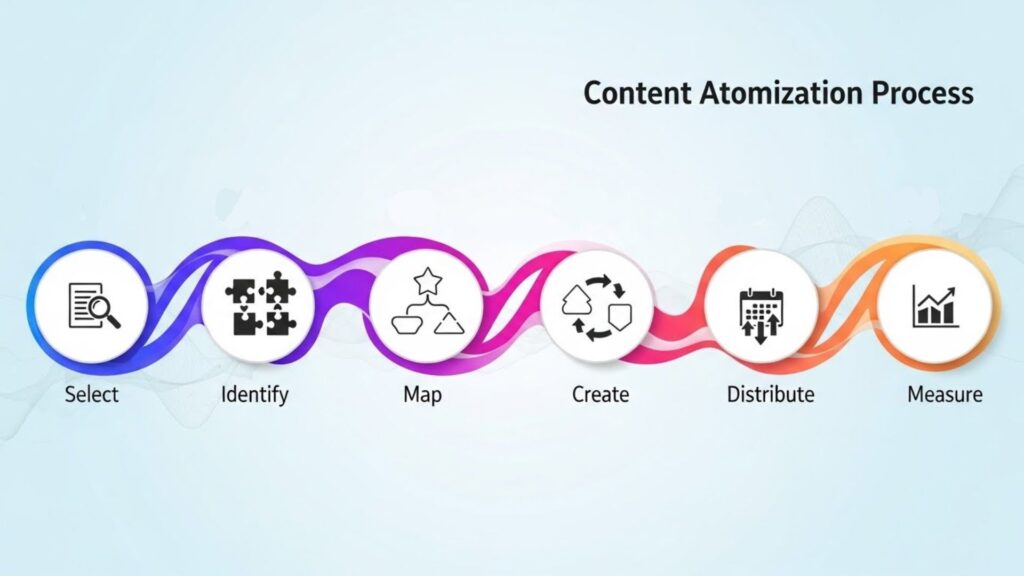
Successful content atomization follows a systematic approach. Here’s a practical framework you can implement with your next pillar piece.

Step 1: Select Your Pillar Content
Start with a comprehensive asset that offers depth and versatility. Examine past performance data to identify content that generated significant engagement or traffic. Prioritize pieces addressing timely topics or persistent audience challenges.
Step 2: Identify Extractable Elements
Review your pillar content and catalog the discrete components that could stand alone. Look for key statistics, quotable insights, step-by-step processes, frameworks, examples, and data visualizations. Create a list of every element that could capture attention independently.
Step 3: Map Formats to Channels and Audiences
Consider where your different audience segments spend time and how they prefer to consume content. A statistic might become a LinkedIn post for executives while the same data powers an infographic for visual learners. Map each extractable element to appropriate formats and distribution channels.
Step 4: Create and Adapt Assets
Transform your source material into channel-specific content. This isn’t copying and pasting. Each atomized piece should feel native to its platform. A Twitter thread has different requirements than an email newsletter section. Adapt tone, length, and presentation accordingly.
Step 5: Distribute Strategically
Develop a content calendar that sequences your atomized assets for maximum impact. Stagger releases to maintain presence without overwhelming any single channel. Cross-promote between platforms to drive traffic back to your pillar content.
Step 6: Measure and Optimize
Track performance across all atomized assets. Identify which formats and channels deliver the strongest results. Use these insights to refine your approach for future atomization efforts.
What Formats Can You Create from One Piece of Content?
The variety of outputs you can generate from a single pillar piece might surprise you. Consider a comprehensive industry report as your starting point. From that one asset, you could create:
Social media content such as LinkedIn carousels highlighting key statistics, Twitter threads breaking down findings, Instagram graphics featuring quotable insights, and short video clips summarizing recommendations. Blog content includes derivative articles exploring specific subtopics in greater depth, listicles pulling together data points, and how-to posts based on recommendations from the report.
Visual assets work particularly well for atomization. Data visualizations, infographics, and charts extracted from your research can circulate independently across channels. Email marketing benefits too, with key findings powering newsletter sections, lead nurture sequences, and promotional campaigns driving downloads.
Audio and video formats round out the possibilities. Record podcast episodes discussing the research methodology or implications. Create short explainer videos walking through frameworks. Host webinars diving deeper into controversial findings.

What Is the Difference Between Content Atomization and Content Modularity?
Content atomization and content modularity are closely related concepts that work together powerfully. While atomization focuses on breaking existing content into smaller pieces, content modularity takes a more architectural approach by designing content as reusable components from the start.
A modular content strategy organizes assets into three tiers. Content blocks are the smallest reusable components: a text snippet, disclaimer, product image, or short video clip. Content sets combine related blocks that frequently appear together, like a product image paired with description copy and legal disclaimers. Content experiences are the final assembled pieces your audience sees, incorporating relevant content sets with presentation styling.
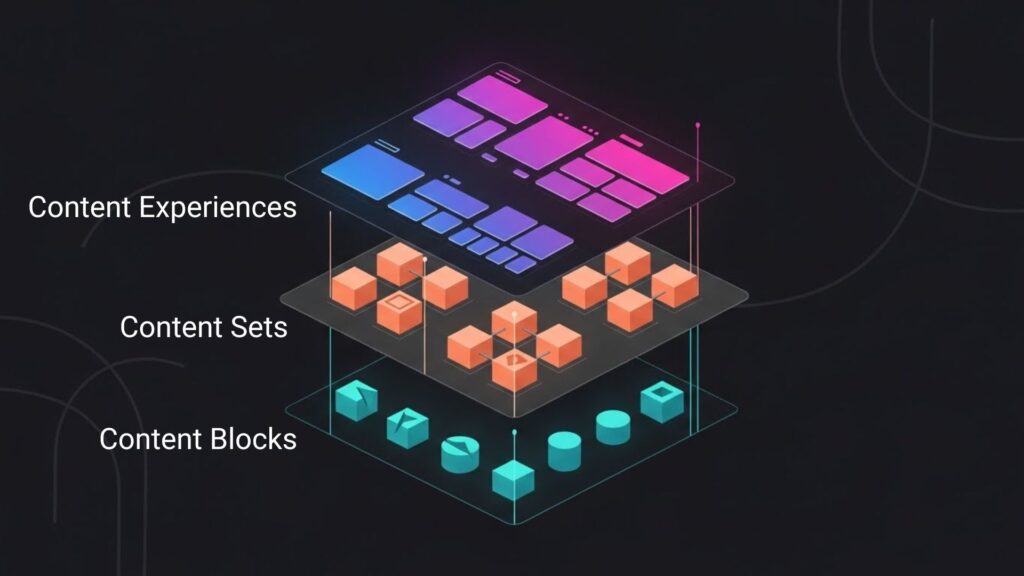
When you combine atomization with modularity, something powerful happens. You’re not only breaking down existing assets but also building a library of pre-approved components that teams can reassemble in countless configurations. This approach accelerates content production while maintaining brand consistency and regulatory compliance.
What Challenges Should You Expect with Content Atomization?
Content atomization delivers significant benefits, but implementation comes with challenges worth anticipating. The most common obstacle is asset organization. When you’re generating dozens of derivative pieces from each pillar, tracking everything becomes complicated. Teams struggle to locate specific assets, leading to duplicate work or inconsistent messaging.
Governance presents another hurdle. Who approves atomized content? How do you ensure brand standards apply consistently across high-volume output? Organizations in regulated industries like financial services or life sciences face additional compliance considerations when content multiplies rapidly.
Maintaining quality at scale requires intentional processes. The efficiency gains from atomization can backfire if derivative content feels repetitive or diluted. Each atomized piece must deliver genuine value, not just repacked filler.
Finally, successful atomization demands appropriate technology. Spreadsheets and shared folders quickly become inadequate when you’re managing complex content ecosystems across teams, regions, and channels.
How Does Technology Enable Smarter Content Atomization?
The right technology transforms atomization from a manual headache into a scalable system. Several capabilities prove essential for teams serious about maximizing content value.
Centralized repositories provide a single source of truth where all assets live, complete with rich metadata that makes components findable. When teams can quickly locate existing content, they’re far more likely to reuse and atomize rather than recreate.
AI-powered tagging and metadata automation eliminate the bottleneck of manual asset enrichment. Modern platforms can automatically classify assets, apply taxonomies, and generate searchable descriptions, making content discoverable without requiring extensive human effort.
Automated transformations accelerate the creation of format variations. Smart cropping, background removal, and dynamic resizing allow teams to generate platform-specific versions from source files without involving designers for every iteration.
Performance tracking closes the feedback loop by connecting atomized assets back to business outcomes. Understanding which derivative pieces drive engagement, conversions, or revenue helps teams optimize future atomization efforts based on data rather than intuition.
Frequently Asked Questions
What is the difference between content atomization and content repurposing? Content repurposing typically involves converting one piece of content into a different format, such as turning a blog post into a video. Content atomization goes further by extracting multiple discrete elements from a single comprehensive source and adapting each for specific platforms, formats, and audiences. Atomization treats one pillar piece as source material for an entire ecosystem of derivative content.
How many pieces of content can you create from one pillar asset? The number varies based on the depth and complexity of your source material. A comprehensive research report or guide could yield 20 to 50 or more derivative pieces, including social posts, blog articles, infographics, email snippets, video clips, and podcast discussions. Industry practitioners often reference a 1:8 ratio as a starting goal, aiming for at least eight pieces from every pillar asset.
What tools do you need for effective content atomization? Successful atomization at scale requires centralized asset management to store and organize content components, robust metadata capabilities to make assets findable, workflow tools to coordinate production across teams, and analytics to measure performance. Digital asset management platforms with AI-powered tagging and modular content support provide the foundation most organizations need.
How does content atomization help with brand consistency? Because all atomized content traces back to the same source material, messaging remains aligned across channels and formats. Teams work from approved core assets rather than independently creating disconnected pieces. When combined with a modular content approach using pre-approved content blocks, atomization actually strengthens brand consistency while increasing output volume.
Streamline Your Content Reuse Strategy with the Right Platform
Content atomization enhances how marketing teams approach content creation. Instead of the endless treadmill of net-new production, you’re building systems that extract maximum value from every creative investment. The organizations embracing this approach are scaling their content operations without proportionally scaling their budgets or headcount.
Making atomization work at enterprise scale requires more than good intentions. You need technology designed to support modular content strategies, intelligent asset management, and seamless collaboration across teams. Aprimo’s AI-powered content operations platform provides the foundation for successful atomization, from centralized asset storage and automated metadata enrichment to workflow automation and performance analytics. Request a demo of Aprimo and see what’s possible.