
Secure Cloud-Based Asset Storage for Enterprise DAM
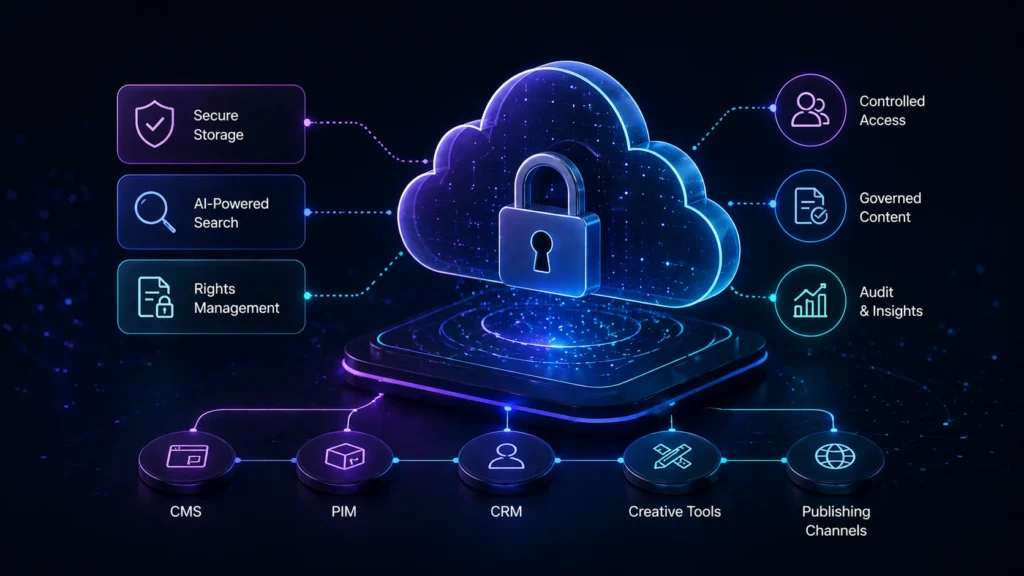
Secure cloud-based asset storage gives enterprises a governed way to store, manage, find, and distribute digital assets across teams, regions, brands, and channels. Unlike standard cloud file-sharing tools, enterprise DAM platforms combine secure storage with metadata, permissions, digital rights management, AI-powered search, audit trails, and workflow automation.
As content volumes grow, organizations need more than a place to save files. They need a centralized source of truth that protects intellectual property, prevents the use of expired or unapproved assets, and helps teams quickly access the right content. Secure cloud-based asset storage provides the foundation for scalable, compliant, and high-performing content operations.
TL;DR
Secure cloud-based asset storage is shifting from a passive utility into a strategic system of action for enterprise DAM. Leading platforms combine governed storage with metadata, rights management, AI-powered discovery, and connected workflows to support brand safety, findability, and scalable content operations across the global marketing tech stack.
Why Is Cloud Asset Storage Moving Beyond Basic File Saving
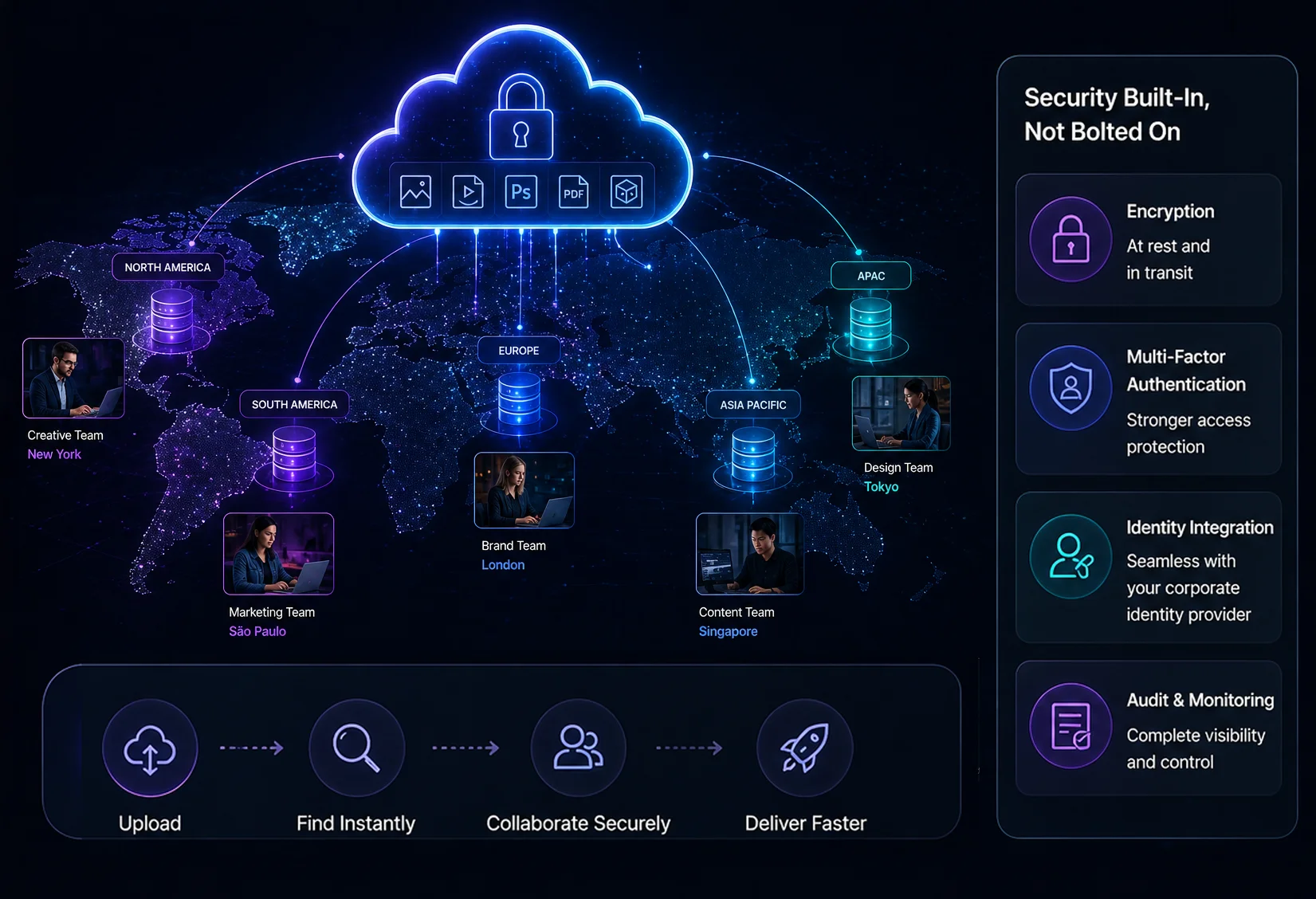
Modern marketing organizations no longer view cloud asset storage as a simple digital filing cabinet. As the volume of rich media grows, the priority has shifted from basic file storage to secure, accessible, and high-performance management. Traditional cloud storage often lacks the robust metadata structures and security protocols required to manage complex brand ecosystems. Organizations look for solutions that combine elastic scalability with enterprise-grade protection, so valuable intellectual property remains secure while staying available to those who need it. In a globalized landscape, the geographic location of data and the speed at which it can be retrieved are critical factors. Large-scale cloud storage solutions often need globally distributed infrastructure to support faster access for creative, marketing, and regional teams. At the same time, security must be baked into the architecture, not added as an afterthought. This involves encryption at rest and in transit, multi-factor authentication, and deep integration with existing corporate identity providers. The goal is to create an environment where security supports, rather than slows, the creative process.
Cloud Asset Storage vs Cloud File Sharing: What Is the Difference
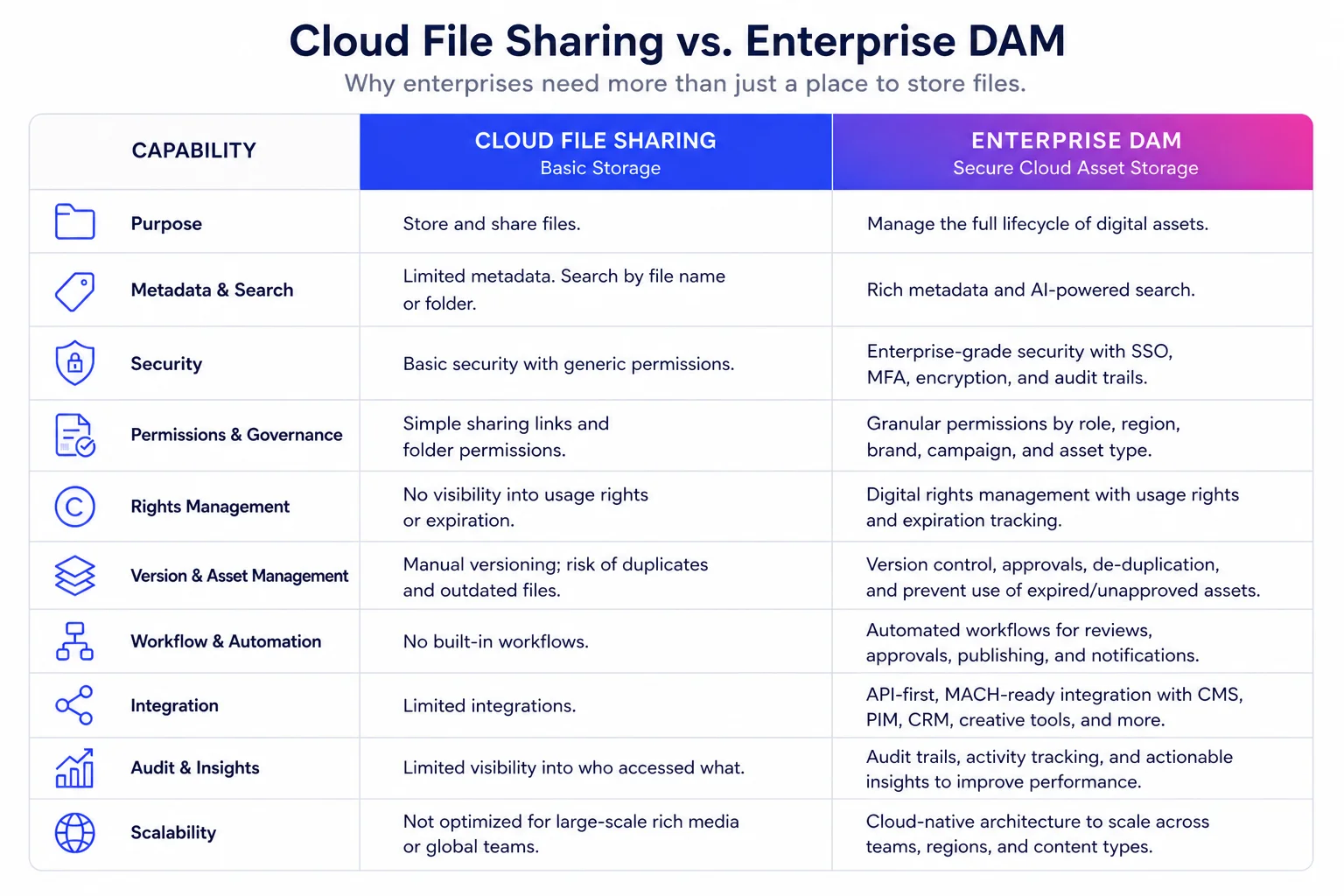
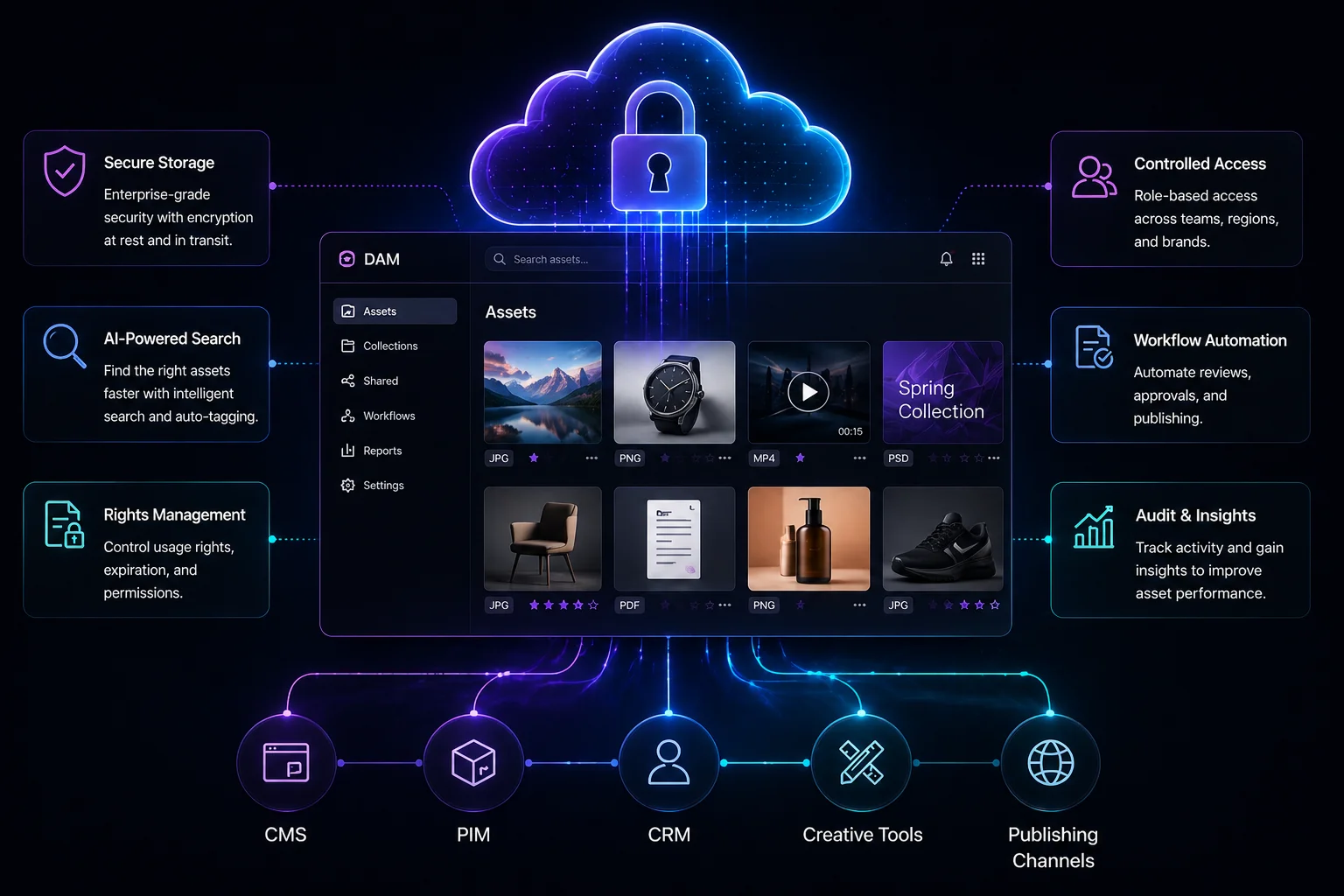
Basic cloud file-sharing tools are designed to store and share documents. Enterprise cloud asset storage is designed to manage the full lifecycle of brand, marketing, creative, and product content. With enterprise DAM, assets are organized with metadata, governed by permissions, connected to usage rights, and made searchable through AI-powered discovery. Teams can manage versions, track access, control expiration dates, and distribute approved assets across connected systems like CMS, PIM, CRM, creative tools, and downstream publishing channels. This makes cloud asset storage more than a repository; it becomes the operational foundation for secure content reuse and delivery.
Strengthening Governance and Digital Rights Management
True security in the cloud goes beyond firewalls and passwords. For enterprise organizations, it is about content provenance and granular control. Sophisticated platforms enable administrators to define exactly who can see, edit, or download an asset based on their role, region, or even the specific campaign they are working on. This level of precision prevents accidental leaks of unreleased product data or the use of expired assets that could lead to legal complications. Furthermore, a secure cloud foundation allows for better disaster recovery and business continuity. When assets are stored in a centralized, governed environment, the risk of data loss from local hardware failure or decentralized ‘shadow IT’ practices is reduced. By establishing a single source of truth, companies can ensure that their most important digital assets are protected by the same rigorous standards as their financial or customer data. This transition from fragmented storage to a unified, secure cloud model is a foundational step toward modern content operations. Aprimo helps enterprises move beyond basic cloud storage by combining secure digital asset management, metadata governance, rights management, AI-powered discovery, and connected content workflows.
How Does Intelligent Search Improve Asset ROI
One of the most significant challenges in asset storage is findability. A secure folder is useless if the people who need its contents cannot find what they are looking for. Leading platforms now incorporate advanced discovery features that use metadata and AI-based enrichment to make every file searchable. Instead of clicking through endless nested folders, users search for concepts, colors, or specific brand elements.
Some advanced systems take this a step further by using automated agents to enrich assets at the moment of ingestion. These agents can identify the type of content, apply brand-specific taxonomies, and even generate descriptive alt-text for accessibility. This layer of intelligence helps the cloud storage environment remain organized and usable as asset libraries scale across teams, regions, and channels. It moves the burden of organization from the human user to the system itself, allowing teams to focus on strategy and creation.
Why Do Scalability and Interoperability Matter for Enterprise DAM
Scaling a cloud storage solution requires more than just adding more gigabytes. It requires an architecture that can handle the increased complexity of modern content types, such as 4K video, 3D files, and generative AI outputs. Many traditional storage methods struggle with the rendering and transformation requirements of these large files. Enterprise platforms address this by providing automated renditions and smart cropping capabilities directly within the cloud environment. This modular approach enables an interoperable ecosystem. For organizations prioritizing composability, a MACH-certified system can help ensure the platform is microservices-based, API-first, cloud-native, and headless. That allows the storage layer to connect reliably with your CMS, PIM, CRM, creative tools, and downstream publishing channels. By integrating storage into the broader tech stack, organizations can automate the flow of assets from creation to distribution without manual handoffs, maintaining security and version control at every step.
How AI Agents Turn Cloud Asset Storage Into Active Asset Management
The shift toward agentic digital asset management represents the next evolution in secure cloud storage. In this model, the storage system is not passive; it is an active participant in the content lifecycle. AI agents can monitor for compliance, detect duplicates to lower storage costs, and check that every asset adheres to brand guidelines before it is ever published. This proactive governance reduces the workload on legal and creative teams while adding another layer of security. For organizations looking to move beyond simple storage, platforms like Aprimo combine secure DAM, metadata governance, rights management, AI-powered discovery, and connected workflows to support faster campaign launches and significantly reduce the risks of manual data management. By treating storage as a strategic asset rather than a utility, companies can build a measurable advantage in an increasingly content-driven market.
Conclusion
The gap between basic cloud storage and enterprise-grade asset management is widening. To stay competitive, organizations should prioritize solutions that balance strong governance with seamless accessibility through intelligent automation. Ready to see how a governed cloud environment can support your content operations? Explore how Aprimo’s platform provides the security and scalability your enterprise needs to thrive.
FAQ
How does cloud asset storage differ from standard cloud file sharing?
Cloud asset storage focuses on the centralized, secure management of rich media with features like granular permissions and digital rights management, whereas standard storage is often a simple repository for files without specialized metadata or governance.
What security features are essential for enterprise asset storage?
Enterprise solutions protect assets through encryption, multi-factor authentication, and role-based access controls. They also include audit trails to track who has accessed or modified an asset at any time.
Can cloud storage help with automated asset organization?
Yes. Modern enterprise DAM platforms use AI-powered enrichment to generate metadata, recognize objects or text, categorize assets, identify duplicates, and improve searchability. This reduces the manual effort required to keep large asset libraries organized.
What should I look for in terms of system integration?
Look for platforms that are MACH certified and offer robust API connections. This helps the storage system connect reliably with your CMS, PIM, CRM, creative tools, and downstream publishing channels.
Why do enterprises need DAM instead of basic cloud storage?
Enterprises need DAM when digital assets require metadata, permissions, usage rights, approvals, version control, and distribution across multiple teams or channels. Basic cloud storage can hold files, but DAM helps govern how those files are found, used, reused, and protected.