

Enterprise organizations need specialized digital asset management platforms that scale intelligently with growth demands. Key requirements include:
- Cloud-native infrastructure that handles massive asset volumes
- AI-powered automation for metadata and workflows
- Deep integration capabilities with existing enterprise systems
- Robust security frameworks for global compliance
The best solutions combine intelligent search, automated asset enrichment, and real-time collaboration tools that maintain performance under enterprise-scale demands.
Modern enterprises are managing exponentially more digital assets while trying to maintain operational efficiency and brand consistency. The digital asset management market is projected to grow from $5.3 billion in 2024 to $10.3 billion by 2029, driven primarily by organizations seeking scalable solutions for their expanding content operations.
Marketing departments now generate thousands of assets monthly across video, imagery, documents, and interactive content. Creative teams work across multiple time zones, requiring instant access to approved materials. Compliance teams need audit trails and rights management across global markets. Traditional file storage solutions and basic DAM systems buckle under this complexity, creating bottlenecks that slow campaigns and increase costs.
Enterprise DAM solutions turn simple asset storage into intelligent content operations platforms. These systems orchestrate entire content lifecycles while scaling seamlessly with organizational growth. For enterprise leaders evaluating digital asset management solutions, understanding scalability requirements is vital for long-term success.
What Makes Enterprise DAM Solutions Different from Basic Asset Management?
Enterprise DAM solutions work at a completely different scale than mid-market or departmental tools. While smaller organizations might manage thousands of assets for a single brand, enterprises typically handle hundreds of thousands to millions of assets across multiple brands, regions, and business units.
The differences go deep. Enterprise systems must support unlimited concurrent users without performance degradation, petabyte-scale storage that grows elastically, and real-time processing across global teams. These platforms integrate deeply with existing technology ecosystems – ERPs, customer relationship management platforms, and specialized industry tools.
Enterprise asset management governance requirements also set these solutions apart. Complex organizational structures demand sophisticated approval workflows, compliance tracking, and rights management that accommodate regulatory requirements across different markets. Instead of basic user permissions, enterprise DAM solutions provide granular access controls that map to business units, geographic regions, and project-specific roles.
Advanced analytics are a key differentiator. Enterprise teams need strategic insights into content performance, usage patterns, and optimization opportunities. These intelligence capabilities drive better business decisions and demonstrate quantifiable ROI from content investments.
How Does Infrastructure Enable Scalable Enterprise Asset Management?
Cloud-native infrastructure is the foundation of truly scalable enterprise DAM solutions. Traditional on-premises systems hit walls when organizations grow beyond predictable usage patterns. Modern enterprises experience dramatic spikes during campaign launches, seasonal events, and global product releases that would overwhelm static infrastructure.

Elastic scaling ensures consistent performance regardless of demand. When marketing teams simultaneously upload thousands of high-resolution assets or creative departments access large video files across continents, the infrastructure adapts automatically. This elasticity extends to processing power, enabling real-time transformations, automated analysis, and instant search results even under heavy load.
Global content delivery networks optimize asset access for distributed teams. Assets stored in strategically located data centers reduce latency for international users while maintaining security standards. Advanced caching mechanisms ensure frequently accessed assets load instantaneously, regardless of file size or user location.
Multi-region redundancy protects against data loss while enabling compliance with local data residency requirements. Enterprise organizations operating in Europe, Asia, and North America can ensure their digital assets remain available and compliant with regional regulations without compromising performance.
Why Are AI-Powered Features Essential for Intelligent Asset Scaling?
Artificial intelligence transforms basic asset management into intelligent content operations platforms. Leading organizations recognize that AI represents an opportunity to fundamentally reshape operations, with the potential impact equivalent to 25% to 40% of their cost base through productivity gains.

Predictive metadata generation eliminates the manual bottlenecks that plague traditional asset management. AI systems automatically analyze visual content, extract text from documents, and generate searchable tags. This automation becomes critical at enterprise scale, where manual tagging would require dedicated teams just to maintain current asset libraries.
Computer vision enables semantic search functionality that understands context rather than just filenames. Marketing teams can search for “smiling professional woman in office setting” and receive relevant results regardless of how assets were originally tagged. This intelligent search capability dramatically improves asset discoverability across large libraries.
Content recommendations powered by machine learning help teams discover relevant assets they might not find through traditional search. These systems understand usage patterns, campaign contexts, and brand guidelines to suggest complementary materials that enhance creative projects.
Automated quality assurance features detect potential brand compliance issues before assets reach production. AI systems trained on brand guidelines can flag incorrect logo usage, identify inappropriate content, or detect assets that don’t meet technical specifications.
How Do Workflow Automations Scale Team Collaboration?
Enterprises need workflow systems that accommodate complex approval processes while maintaining campaign velocity. Scalable DAM solutions provide automated routing that directs assets through appropriate review channels based on content type, intended usage, and organizational hierarchy.
Intelligent workflow engines adapt to changing business requirements without custom development. Marketing teams can establish rules for different campaign types, ensuring promotional content follows different approval paths than product documentation. These automated workflows scale across departments and regions while maintaining compliance standards.

Real-time collaboration features enable global teams to work simultaneously on projects without version conflicts. Advanced check-in and check-out systems prevent multiple editors from modifying the same asset while maintaining complete audit trails of all changes.
Automated notifications ensure stakeholders receive updates when their input is required without overwhelming them with unnecessary alerts. Smart notification systems recognize user roles, project priorities, and time zones to deliver relevant information at the most suitable times.
Integration capabilities extend workflow automation beyond the DAM system itself. Modern enterprise solutions connect with project management platforms, creative tools, and marketing automation systems to create seamless content operations workflows.
What Security and Compliance Features Enable Enterprise-Scale Growth?
Enterprise organizations face serious security requirements that only get more complex as they scale globally. Robust access controls provide granular permissions that align with organizational structures while adapting to changing needs. Role-based access ensures users only see assets relevant to their responsibilities, while temporary permissions accommodate contractors and partners.
Comprehensive audit trails track every interaction with digital assets, providing the detailed logs required for compliance reporting and security investigations. These systems record who accessed which assets, when modifications occurred, and how materials were distributed across channels.
Digital rights management capabilities become critical as enterprises expand into new markets with different regulatory requirements. Advanced DAM solutions track licensing terms, usage restrictions, and expiration dates while automatically flagging potential compliance violations.
Encryption standards protect assets both in transit and at rest, with enterprise-grade security measures that meet international compliance frameworks, including GDPR, HIPAA, and industry-specific regulations.
How Do Integration Capabilities Support Enterprise Ecosystems?
Enterprise organizations run complex technology ecosystems that need deep integration capabilities beyond basic API connections. Scalable DAM solutions provide pre-built connectors for popular enterprise software while offering flexible APIs for custom integrations.
Marketing technology stack integrations enable seamless asset flow from creation through deployment. Direct connections with email marketing platforms, social media management tools, and advertising systems eliminate manual asset transfer processes that create bottlenecks and version control issues.
Creative tool integrations allow design teams to work within familiar applications while automatically synchronizing assets with centralized libraries. Adobe Creative Cloud connections, for example, enable designers to access approved brand assets directly within Photoshop or InDesign without leaving their creative environment.
Enterprise resource planning system integrations provide cost allocation, project tracking, and resource management capabilities that align with broader business operations. These connections enable organizations to measure content ROI and optimize resource allocation based on actual performance data.
Content management system integrations ensure web and digital experience teams can access current assets without manual downloads or email transfers. These connections maintain brand consistency across all digital touchpoints while enabling rapid updates when assets change.
What ROI Metrics Matter Most for Scalable Enterprise DAM Implementation?
Measuring the business impact of enterprise DAM solutions requires tracking both quantitative and qualitative metrics that demonstrate value at scale. Here’s what actually matters:
- Time Savings and Productivity Gains: AI-powered features can reduce asset retrieval times by up to 40% through intelligent search capabilities. Organizations report that DAM solutions improved their team’s efficiency and productivity.
- Content Creation Cost Reductions: Asset reuse rates increase when teams can easily discover existing materials rather than recreating content from scratch. Organizations eliminate substantial costs associated with duplicate asset production as teams leverage existing libraries more effectively. Enhanced search capabilities and intelligent recommendations help creative teams identify relevant materials they might otherwise overlook, reducing unnecessary design work and agency fees.
- Campaign Launch Acceleration: Automated workflows and improved asset access enable faster campaign execution by eliminating bottlenecks that traditionally slow marketing teams. When creative assets move seamlessly through approval processes and teams can instantly access the materials they need, campaign timelines compress. Organizations report improvements in time-to-market as manual coordination steps are replaced with intelligent automation.
- Compliance Risk Mitigation: Automated rights management and approval workflows reduce compliance violations and associated costs. Organizations avoid expensive legal issues through better asset tracking and usage monitoring enabled by centralized governance.
- Brand Consistency Improvements: Centralized asset libraries with automated distribution ensure teams use approved materials consistently across all touchpoints and campaigns.
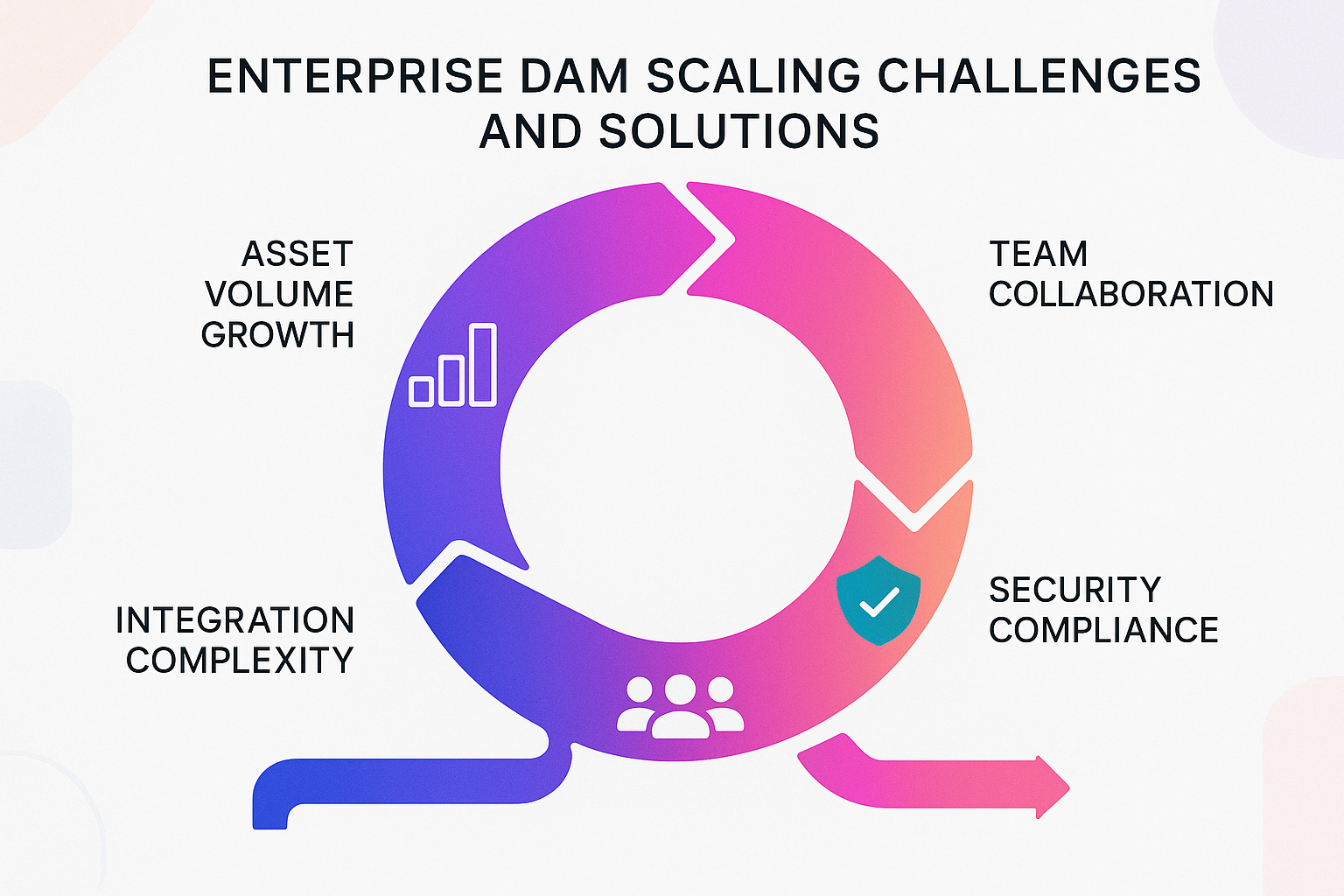
These ROI improvements compound as organizations scale, creating a virtuous cycle where better asset management enables faster growth while maintaining operational control. Enterprise DAM solutions that deliver measurable value across time savings, cost reduction, and brand consistency provide the foundation for sustainable scaling as content demands increase. The key insight is that scalability is about maintaining efficiency and quality standards while expanding operations across teams, regions, and campaigns.
Frequently Asked Questions
How long does enterprise DAM implementation typically take? Enterprise DAM implementations vary based on organization size, asset migration requirements, and integration complexity. Organizations with clear requirements and dedicated project resources typically complete implementations faster than those requiring extensive customization. Success depends more on thorough planning and change management than on timeline duration.
What are the most common scaling challenges organizations face? The primary scaling challenges include user adoption across multiple departments, integrating with legacy systems, and managing change management across global teams. Organizations that invest in comprehensive training and phased rollouts typically achieve better scaling outcomes.
How do organizations ensure successful user adoption at enterprise scale? Successful adoption requires role-specific training, clear governance policies, and demonstrable value for each user group. Organizations should establish champion networks within different departments and provide ongoing support as usage patterns evolve.
What integration capabilities are most important for enterprise environments? The most critical integrations include creative tools, marketing automation platforms, content management systems, and project management software. Organizations should prioritize integrations that address their most significant workflow bottlenecks first.
How should organizations approach asset migration for large libraries? Large-scale asset migrations require careful planning, including asset auditing, metadata cleanup, and phased migration approaches. Organizations should establish clear success criteria and maintain backup systems throughout the migration process.
Scale Your Digital Asset Management Capabilities
The future of enterprise content operations belongs to organizations that recognize digital assets as strategic business resources requiring sophisticated management platforms. As content volumes continue growing and personalization demands intensify, traditional approaches to asset management will become increasingly inadequate.
Enterprise DAM solutions provide the foundation for content operations that scale intelligently with business growth. These platforms transform scattered files and manual processes into orchestrated workflows that enable creativity while maintaining control.
Aprimo offers the enterprise-grade platform that leading brands trust to manage their most valuable content assets. Get started with a demo to see how intelligent content operations can transform your organization’s approach to digital asset management.