

AI agents in marketing are the most impactful evolution in content operations since automation itself.
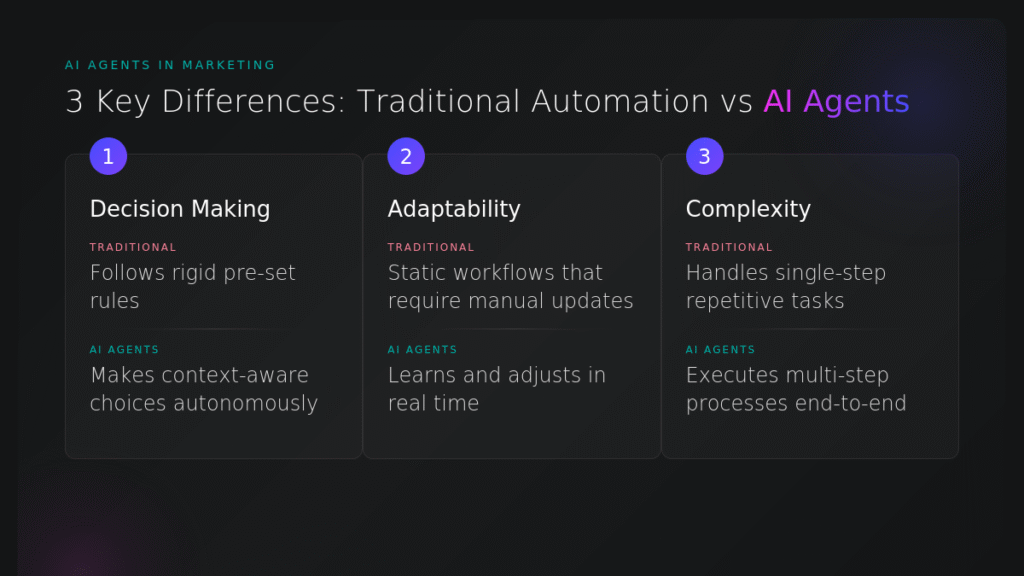
- Unlike traditional automation that follows rigid “if-then” rules, AI agents make context-aware decisions and execute multi-step processes autonomously.
- Agentic AI systems backed by digital asset management platforms maintain brand consistency while scaling content production.
- Marketing teams using AI agents report improvements in productivity, freeing teams to focus on strategy rather than execution.
- The organizations seeing real results are those connecting AI agents to centralized asset repositories that serve as the source of truth for brand standards.
Forward-thinking marketing teams should evaluate how AI agents can integrate with their existing content operations before competitors gain an insurmountable advantage.
Marketing has never been short on tools that promise to make work easier. We’ve seen the rise of scheduling platforms, email automation, and chatbots that handle basic customer inquiries. These solutions have helped teams work faster, but they’ve always required human hands on the wheel for anything beyond the most routine tasks.
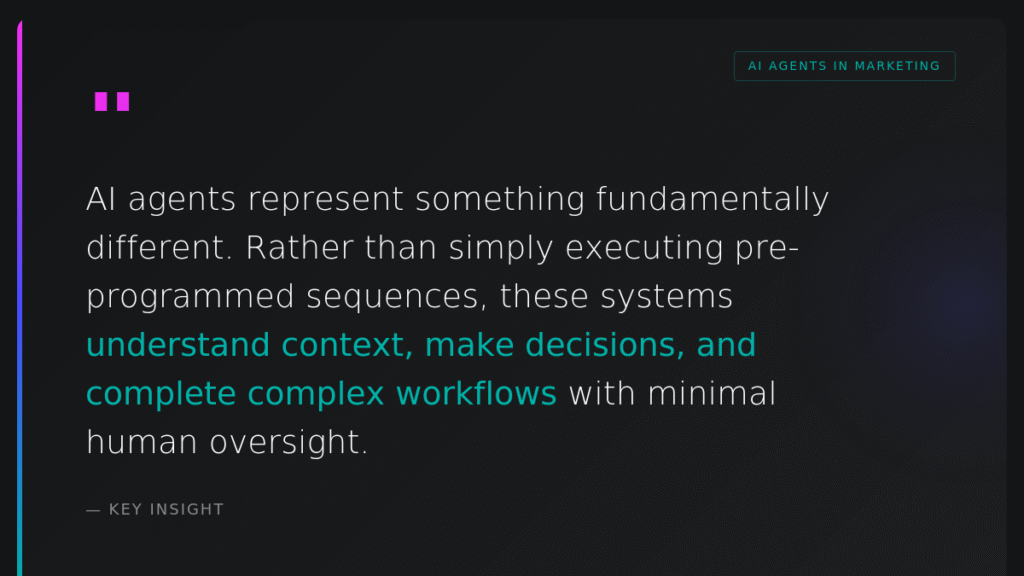
Rather than simply executing pre-programmed sequences, AI agents in marketing understand context, make decisions, and complete complex workflows with minimal human oversight. Traditional automation follows a script, while AI agents interpret the scene and improvise intelligently toward your goals.
According to research, customer interactions automated by AI agents will grow from 3.3 billion in 2025 to more than 34 billion by 2027. This surge reflects a fundamental shift in how enterprises approach content operations and customer engagement.
How Do AI Agents in Marketing Differ from Traditional Automation?
Traditional marketing automation operates on predetermined rules. If a prospect downloads a whitepaper, send email A. If they visit the pricing page three times, alert the sales team. These systems are powerful for repetitive tasks, but they lack the ability to adapt when circumstances change or when situations fall outside their programmed parameters.
AI agents in marketing function more like skilled team members who understand your brand, your goals, and your constraints. They can perceive changes in their environment, whether that’s a shift in campaign performance, a new compliance requirement, or an emerging content gap. They reason through options based on accumulated knowledge. And then they act, executing decisions that would traditionally require human intervention at every step.
This capability transforms content operations from a series of manual handoffs into a continuous, intelligent workflow. Teams no longer need to constantly monitor every asset and campaign. Instead, they set strategic direction while agents handle the execution details that consume so much of a typical marketing team’s bandwidth.
The Rise of Autonomous Marketing Workflows
The movement toward autonomous marketing is already underway. McKinsey estimates that agentic AI will power more than 60% of the increased value that AI generates from marketing and sales deployments. Their analysis suggests that effective agent deployments could deliver productivity improvements of three to five percent annually and potentially lift growth by ten percent or more.
These gains come from agents taking over tasks that previously required constant human attention. Content AI systems handle everything from intelligent campaign planning to automated metadata creation and from compliance pre-checks to personalized content delivery. The technology has matured past experimentation into production-ready solutions that enterprise teams deploy at scale.
Why Does Brand Consistency Matter More Than Ever?
Marketing automation 2.0 is about maintaining quality and coherence even as content volume explodes. The pressure to personalize at scale, serve multiple channels simultaneously, and respond to market changes in real time has created unprecedented demands on marketing teams. Content production has become a relentless requirement, and the risk of brand dilution grows with every piece of content that bypasses proper review.
In this environment, the connection between AI agents and digital asset management is essential. Autonomous systems making independent decisions can inadvertently damage brand reputation if not properly governed. A creative variation that technically follows the rules but misses the spirit of the brand. A message that performs well on engagement metrics but conflicts with positioning in other channels. These missteps accumulate when content creation outpaces human oversight.
The Governance Challenge in Autonomous Marketing
When you empower AI agents to create, modify, and deploy content without approval at every step, you’re placing trust in their ability to stay on brand. This trust must be earned through robust governance frameworks that define acceptable boundaries and decision criteria.
Research indicates that 65% of created marketing assets go unused due to findability issues. Organizations struggle to locate existing content, leading to redundant creation and inconsistent messaging across touchpoints. AI agents backed by centralized asset repositories solve this problem by making every approved asset discoverable and ensuring new content aligns with established standards.
The most effective governance approaches don’t constrain AI agents with rigid rules that limit their usefulness. Instead, they provide contextual guardrails trained on actual brand guidelines, successful examples, and compliance requirements. The agent understands what “on brand” means because it has learned from thousands of approved assets in your library.
Building Trust Through Intelligent Automation
Trust in autonomous systems develops through transparency and consistent performance. Marketing leaders need visibility into how AI agents make decisions, what factors influence their outputs, and where human review should occur. The goal isn’t to eliminate human judgment but to reserve it for situations where it adds the most value.
Effective AI-powered content operations platforms provide this transparency through audit trails, confidence scoring, and automated escalation. When an agent encounters a situation outside its trained parameters, it flags the decision for human review rather than guessing. When it detects potential compliance issues, it automatically routes content through appropriate workflows. This combination of autonomy and accountability builds the trust necessary for scaled deployment.
5 Types of AI Agents Transforming Marketing Operations
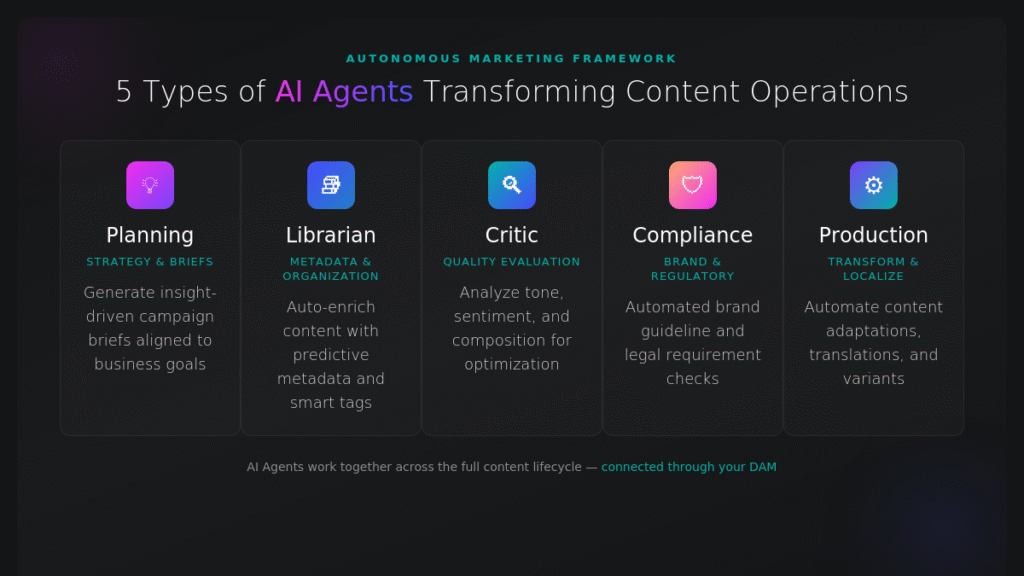
Understanding the different categories of AI agents helps marketing leaders identify where autonomous capabilities can deliver the greatest impact. While implementations vary across platforms, most enterprise solutions organize agents into specialized functional areas.
Planning Agents generate structured, insight-driven content and campaign briefs. They analyze performance data, audience signals, and brand guidelines to produce actionable recommendations that align creative work with business objectives. Rather than building from scratch, teams receive strategic starting points that accelerate campaign development and reduce rework.
Librarian Agents handle metadata automation and asset organization. They automatically enrich content with descriptive information, organize files based on proprietary taxonomies, and surface relevant materials when teams need them. This intelligent organization transforms digital asset management from passive storage into an active system that proactively recommends content for specific contexts.
Critic Agents evaluate content quality across multiple dimensions. They analyze tone, sentiment, language patterns, and compositional elements to ensure consistency and recommend optimizations. These agents catch issues that might slip past busy reviewers while maintaining quality standards across high-volume production.
Compliance Agents automate brand guideline enforcement and regulatory checks. They validate content against approved claims libraries, flag potential legal issues, and ensure industry-specific requirements are met before publication. For regulated industries like financial services and life sciences, these agents reduce approval cycles while improving accuracy.
Production Agents handle content transformation and localization at scale. They automate image adaptations, translate copy, apply regional taxonomies, and create campaign variants without requiring manual work for each variation. Teams can launch global campaigns faster while maintaining consistency across markets.
How Do DAM Systems Enable AI Agent Effectiveness?
AI agents are only as effective as the foundation they operate on. Autonomous systems need access to accurate, well-organized information to make good decisions. They need clear governance frameworks to stay within appropriate boundaries. And they need integration with the systems where content lives and work gets done.
Digital asset management platforms provide this foundation by centralizing approved content, brand guidelines, and usage rights in a single accessible repository. When AI agents connect to a properly structured DAM, they gain context that makes their outputs more relevant and their decisions more reliable.
Creating a Single Source of Truth
The most common failure mode for content AI implementations is fragmented information. When brand assets live in multiple locations, when guidelines exist as static documents that agents can’t reference, and when metadata is inconsistent or incomplete, autonomous systems struggle to maintain coherence.
Effective implementations start with consolidation. Approved assets, brand standards, compliance requirements, and performance data flow into a centralized content operations platform that serves as the single source of truth. AI agents trained on this unified repository understand what good looks like because they’ve learned from your specific brand context rather than generic patterns.
This consolidation also solves the discoverability problem that plagues most marketing organizations. When agents can find existing approved content, they recommend reuse rather than redundant creation. When they understand asset performance history, they can suggest variations that are more likely to resonate. The DAM becomes an active participant in content strategy rather than a passive filing cabinet.

Connecting Intelligence Across the Content Lifecycle
The power of AI agents multiplies when they work together across the full content lifecycle. Planning agents inform librarian agents about upcoming needs. Critic agents flag issues that compliance agents should review. Production agents pull from asset libraries that librarian agents have organized and enriched.
This orchestration requires platforms designed for integration rather than isolated point solutions. Enterprise marketing teams increasingly demand DAM integrations that connect content repositories with creative tools, distribution channels, and analytics systems. The goal is a seamless flow of assets and intelligence across every touchpoint, with AI agents coordinating handoffs that previously required manual intervention.
How Do You Measure Success with AI Agents in Marketing?
Implementing AI agents without clear success metrics leads to disappointment. Teams must define what improvement looks like before deployment and track progress against specific outcomes.
Operational metrics include time-to-market for campaigns, content production volume, asset reuse rates, and review cycle duration. These indicators show whether agents are actually accelerating work and reducing friction in content operations. Business metrics connect content activities to revenue outcomes through engagement rates, conversion improvements, and personalization effectiveness.
Organizations seeing meaningful results from content AI report improvements across multiple dimensions. Production timelines compress as agents automatically handle routine decisions. Quality improves as intelligent pre-checks catch issues earlier in the workflow. And teams can shift focus from repetitive tasks to work that leverages their expertise.
Starting Small and Scaling Strategically
The most successful AI agent implementations begin with focused pilots rather than enterprise-wide rollouts. Teams identify specific pain points where autonomous capabilities can deliver quick wins, deploy solutions, measure results, and expand based on proven value.
High-impact starting points often include metadata automation, which immediately improves asset discoverability without changing established workflows. Compliance pre-checks work well because they address a clear business risk with measurable improvement in review accuracy and speed. Content transformation for different channels demonstrates production efficiency gains that scale with volume.
From these initial wins, teams incrementally expand agent capabilities. Each successful deployment builds confidence in the technology and organizational readiness for broader automation. The goal is continuous improvement rather than a single transformative implementation that overwhelms change management capacity.
FAQ: AI Agents in Marketing
What is the difference between marketing automation and AI agents? Traditional marketing automation follows predefined rules, executing specific actions when certain conditions are met. AI agents operate with greater autonomy, making context-aware decisions and adapting their behavior based on changing circumstances. While automation handles repetitive sequences, agents can reason through complex situations and execute multi-step processes independently.
How do AI agents maintain brand consistency at scale? AI agents maintain brand consistency by training on approved assets, guidelines, and successful examples stored in centralized digital asset management platforms. They reference this single source of truth when creating or modifying content, applying learned patterns to ensure outputs align with established standards. Built-in governance frameworks flag decisions that fall outside acceptable parameters for human review.
What should marketing teams prioritize when implementing AI agents? Teams should begin with data quality and consolidation, ensuring brand assets and guidelines are accessible in a centralized system. From there, identify specific high-impact use cases where automation can deliver measurable improvement, deploy focused pilots, and expand based on proven results. Success depends on strong foundations more than rushing to implement advanced capabilities.
Are AI agents in marketing production-ready for enterprises? Yes. Leading platforms have deployed AI agent architectures in production environments since 2023, with enterprise customers achieving documented improvements in content creation speed, engagement rates, and team productivity. The technology has matured past experimental phases into solutions that scale across global marketing operations.
The Future of Autonomous Marketing is Connected
AI agents in marketing will continue evolving toward greater sophistication and broader application. The technology roadmap points toward agents that execute tasks and anticipate needs, proactively recommending content strategies based on market signals and performance patterns.
This evolution requires strong foundations. Organizations investing in clean data, robust governance frameworks, and integrated technology platforms position themselves to benefit from each wave of AI advancement. Those still operating with fragmented systems and manual processes will find the gap widening as autonomous marketing capabilities mature.
For marketing leaders ready to explore how AI agents can transform their content operations while maintaining the brand consistency their organizations demand, Aprimo delivers enterprise-grade autonomous capabilities backed by the industry’s most intelligent DAM platform. Get a demo to see how Aprimo’s AI Agents can accelerate your marketing performance.