

Agentic AI is driving the evolution from reactive automation to autonomous intelligence that acts independently in real time.
- Unlike traditional rule-based systems, agentic AI proactively identifies opportunities, makes strategic decisions, and executes campaigns without waiting for human input.
- Key benefits include faster asset discovery, real-time campaign optimization, and autonomous customer journey management at scale.
- This technology transforms content operations by integrating planning, creation, governance, and delivery into intelligent workflows.
Success requires careful governance, clear objectives, and integration with existing marketing technology stacks
Marketing automation was supposed to be our saving grace. But let’s be honest—most teams are drowning in rigid workflows, static rules, and systems that fall apart the second customer behavior changes. You set up your drip campaigns, configure your lead scoring, and cross your fingers that everything works as planned.
But what if your marketing systems could think, adapt, and act autonomously? What if they could spot opportunities in real time, adjust strategies based on live customer behavior, and execute complex campaigns without waiting for your approval on every decision?
Enter agentic AI marketing. It’s not just another automation upgrade—it’s a complete shift from following scripts to actually thinking and acting on its own, fundamentally changing how teams work and connect with customers. By 2028, at least 15% of day-to-day work decisions will be made autonomously through agentic AI, with 33% of enterprise software solutions featuring this technology.
Let’s explore how this technology transforms marketing from reactive execution to proactive intelligence.
What Is Agentic AI, and What Does It Do for Marketing?
Agentic AI refers to artificial intelligence systems that operate autonomously to achieve specific goals, making independent decisions and taking actions without constant human oversight. Unlike traditional marketing automation that follows predetermined rules, agentic AI marketing systems can sense environmental changes, reason through options, and act on insights.
Here’s how it actually works—think of it as a continuous loop of sensing, reasoning, and acting:
- Sensing: Monitors customer behaviors, campaign performance, and contextual signals across channels
- Reasoning: Interprets data patterns, predicts outcomes, and prioritizes decisions based on business objectives
- Acting: Takes initiative to launch campaigns, adjust strategies, or optimize content without waiting for human input
The numbers tell the story: the agentic AI market is exploding from $7.06 billion in 2025 to over $93 billion by 2032. That’s more than 44% growth annually, which should tell you something about where marketing is headed. Organizations are adopting the technology for its ability to address persistent marketing challenges: delivering personalized experiences at scale, optimizing campaigns in real-time, and managing complex customer journeys.
Marketing teams can move from task-oriented work to outcome-focused strategies. Instead of spending time on manual campaign adjustments and routine optimizations, marketers can focus on creative strategy, brand positioning, and high-level business objectives while AI handles execution and continuous improvement.
How Does Agentic AI Differ from Traditional Marketing Automation?
Traditional marketing automation and agentic AI serve different purposes, though many teams conflate the two technologies. Understanding the distinction helps with making informed decisions about your marketing technology investments.
| Traditional Marketing Automation | Agentic AI Marketing Systems |
| Operates on static, predefined rules and workflows | Make autonomous decisions based on real-time data analysis |
| Requires manual setup and ongoing human intervention | Continuously learn and improve from outcomes without reprogramming |
| Executes predetermined actions based on specific triggers | Proactively identify opportunities and execute strategies |
| Limited ability to adapt when conditions change | Adapt dynamically to changing customer behaviors and market conditions |
| Best suited for repetitive, predictable tasks | Handle complex, multi-variable optimization across channels |
Consider email marketing as an example. Traditional automation might send a welcome series based on signup date and predetermined intervals. An agentic system, by contrast, would analyze each subscriber’s engagement patterns, optimal send times, content preferences, and behavioral signals to determine the best message, timing, and frequency for each individual. It then continuously adjusts based on response data.
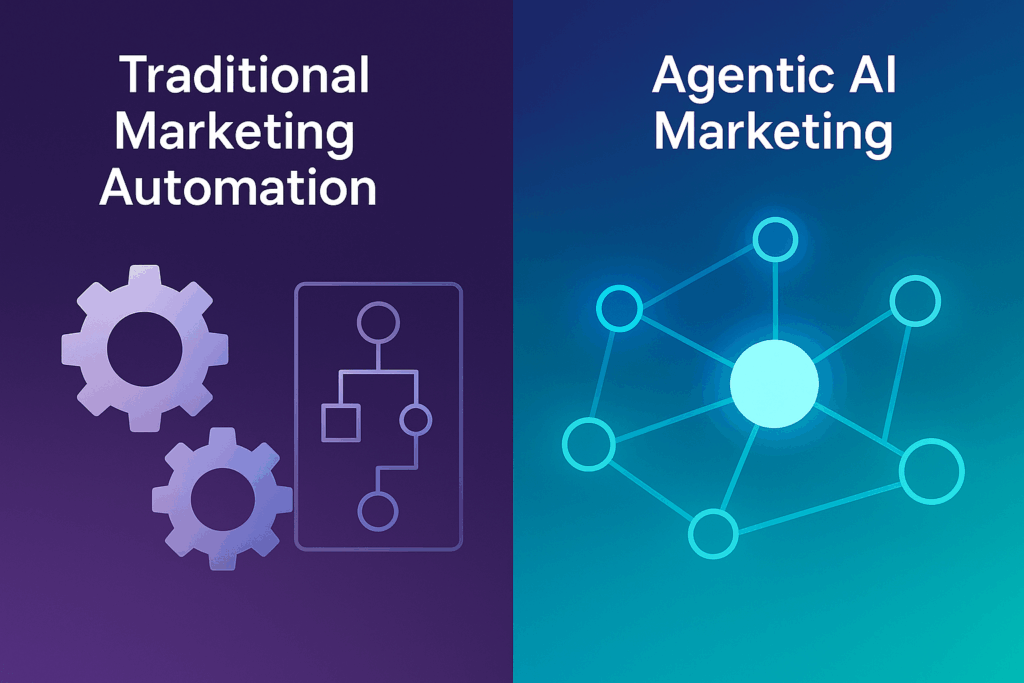
The difference becomes even more pronounced in content operations. While automation might move assets through approval workflows, AI marketing assistants can automatically generate content variations, optimize metadata for different channels, and route materials based on performance predictions and compliance requirements.
What Makes Agentic AI Different from Generative AI?
Many marketers use generative AI tools for content creation, but these systems are just one component of the broader AI technology. Generative AI and agentic AI serve complementary but distinct functions in marketing operations.
| Generative AI | Agentic AI |
| Creates content based on human prompts and instructions | Operates proactively to identify opportunities and execute strategies |
| Requires ongoing direction and input from users | Works autonomously without constant human prompting |
| Focuses primarily on content generation and creative tasks | Integrates multiple AI capabilities, including generation, analysis, and decision-making |
| Operates reactively, responding to specific requests | Focuses on business outcomes rather than individual tasks |
The most powerful marketing systems combine both approaches. For instance, AI Agents leverage generative capabilities within autonomous workflows. A production agent might identify the need for social media variants based on campaign performance, automatically generate multiple options using generative AI, test them across audience segments, and scale the highest performing variations, all without human intervention.
This integration is the future of autonomous marketing agents: systems that proactively manage entire campaigns from ideation through optimization.
5 Key Benefits of Agentic AI Marketing Systems
So what’s in it for you? Quite a lot, actually. Here are five game-changing benefits that organizations are seeing when they make the leap to agentic AI:
1. Real-Time Campaign Optimization
Think of agentic automation as your campaign’s personal trainer—constantly watching performance across every channel and making smart adjustments to budgets, creative, and targeting without you lifting a finger. Instead of waiting for weekly performance reviews, the system makes micro-adjustments throughout the day to maximize results.
Early adopters of agentic AI in marketing report that AI assistants can scale content creation by over 80%, cut time-to-market, and boost engagement by as much as 30%. Instead of waiting on manual reviews or updates, these systems continuously adapt campaigns and assets in the background, ensuring faster execution and more responsive customer experiences.
2. Autonomous Customer Journey Management
Traditional journey mapping requires extensive upfront planning and manual updates when customer behaviors shift. Agentic systems dynamically adjust customer paths based on individual interactions, preferences, and predictive modeling.
The technology excels at managing complex, non-linear journeys where customers move fluidly between digital touchpoints. Rather than forcing prospects through predetermined funnels, AI marketing assistants guide each individual along personalized paths that adapt to their specific needs and behaviors.
3. Intelligent Content Personalization
Beyond basic demographic targeting, agentic AI analyzes behavioral patterns, engagement history, and contextual signals to deliver hyper-personalized content experiences. The system can automatically generate, test, and optimize variations for different audience segments simultaneously.
This capability proves especially valuable for content-heavy industries. In financial services, teams that embraced AI-driven personalization cut approval timelines by 27% and accelerated campaign processes by over 30%. By reducing the manual effort required to customize and approve content, they were able to deliver more relevant experiences to customers at scale while keeping compliance intact.
4. Cross-Channel Orchestration
Managing consistent messaging across email, social media, paid advertising, and web experiences traditionally requires significant coordination and manual effort. Agentic systems automatically orchestrate campaigns across channels, ensuring message consistency while optimizing for each platform’s unique characteristics.
The technology prevents common issues like message fatigue, conflicting offers, and poor timing by maintaining a unified view of customer interactions across all touchpoints.
5. Predictive Performance Optimization
Rather than reacting to performance data after campaigns conclude, agentic AI predicts outcomes and adjusts strategies preemptively. The system identifies early warning signs of declining performance and implements corrective actions before significant budget waste occurs.
This predictive capability extends to content planning, helping teams prioritize creation efforts on materials most likely to drive business results based on historical performance patterns and market trends.
How Does Agentic AI Transform Content Operations Workflows?
Let’s talk about content operations—all those messy, complicated processes of planning, creating, managing, and pushing out digital assets across channels and campaigns. Agentic AI revolutionizes these workflows by introducing intelligent automation at every stage of the content lifecycle.
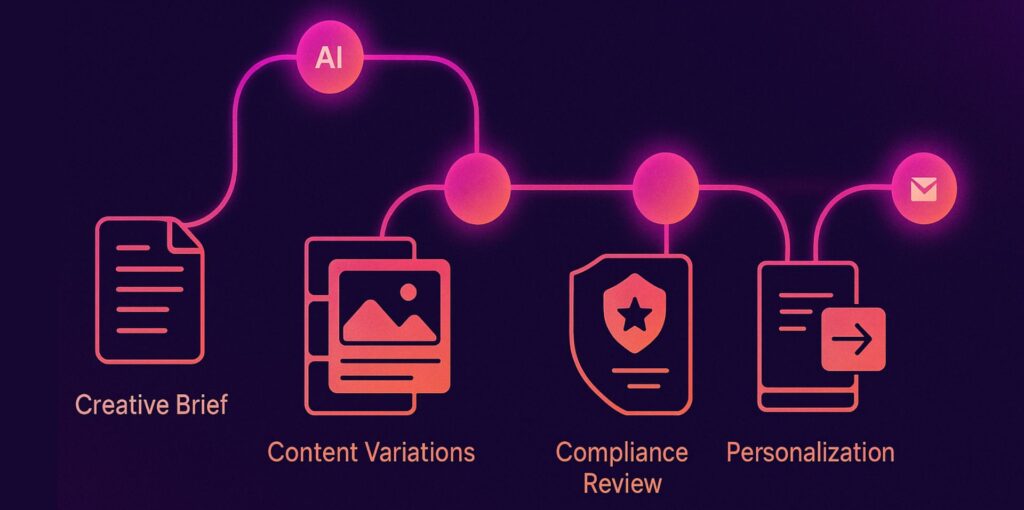
Planning and Strategy: Traditional content planning relies heavily on manual research, intuition, and historical analysis. Agentic planning agents analyze market trends, competitor activities, and customer behavioral data to automatically generate strategic content briefs aligned with business objectives.
AI agents, for example, synthesize brand guidelines, campaign goals, and audience insights to create comprehensive creative briefs that historically required hours of strategic work. The system continuously updates recommendations based on real-time performance data and market conditions.
Content Creation and Production: Production agents automate asset variations, translations, and format optimizations while maintaining brand consistency. Rather than manually creating dozens of social media variants for different platforms and audiences, the system generates, tests, and refines options autonomously.
Global enterprises have documented significant reductions in content creation time and translation effort by using AI-driven production workflows. These systems automatically generate product variations, localize copy for different markets, and adapt formats for each platform, all while ensuring brand compliance.
Governance and Compliance: Content governance becomes exponentially more complex as volume increases and teams become more distributed. Compliance agents automatically review content for brand guidelines, regulatory requirements, and legal standards before publication.
These systems excel at detecting subtle compliance issues that human reviewers might miss, especially in regulated industries like financial services and healthcare, where minor oversights can result in significant penalties.
Asset Management and Discovery: Librarian agents automatically enrich content with metadata, organize assets into logical taxonomies, and surface relevant materials when teams need them. This intelligent organization proves vital as content operations teams report that 65% of created assets go unused due to findability issues.
The technology transforms digital asset management from a passive repository into an active intelligence system that proactively suggests optimal content for specific campaigns and contexts.
What Are the Implementation Challenges and Risks?
Look, agentic AI marketing is powerful stuff, but it’s not plug-and-play. You need to tackle some real challenges and risks to get it right.
Brand Safety and Governance Concerns: Autonomous systems making independent decisions can inadvertently damage brand reputation if not properly governed. Unlike human team members who instinctively understand brand values, AI systems require explicit training on acceptable boundaries and decision frameworks.
Organizations must establish clear guardrails, approval thresholds, and escalation procedures. Consider defining scenarios where human oversight remains mandatory and implementing robust monitoring systems to detect and address issues quickly.
Over-Reliance on Automation: The efficiency gains from agentic AI can create temptation to automate everything, potentially sacrificing the human creativity and strategic thinking that drives meaningful differentiation. The most successful implementations maintain clear divisions between tasks suited for automation and those requiring human judgment.
Strategic brand positioning, creative conceptualization, and complex stakeholder management remain fundamentally human responsibilities that benefit from AI assistance rather than replacement.
Skills Gap and Training Requirements: Here’s the thing: working with autonomous marketing agents isn’t like using your old marketing tools. Your team needs to learn new skills—things like AI system design, prompt engineering, and keeping tabs on how these systems perform. Marketing teams need training on how to set appropriate objectives, interpret AI-generated insights, and intervene when systems require course corrections.
Skills development is an ongoing investment rather than a one-time training initiative, as AI capabilities continue evolving.
Budget Complexity and Cost Management: Traditional marketing budgets allocate costs across predictable categories like media spend, creative development, and personnel. Agentic AI introduces variable costs based on usage, performance, and computational requirements that can be difficult to forecast accurately.
Organizations need new budgeting frameworks that account for AI credits, storage costs for increased content volumes, and potential efficiency gains that impact staffing requirements.
How to Successfully Implement Agentic AI in Your Marketing Strategy
Successful agentic AI implementation requires balancing ambition with practical constraints. Here’s a framework for getting started:
Assess Current Capabilities and Readiness: Begin by auditing existing marketing technology, identifying process bottlenecks, and evaluating team readiness for autonomous systems. Focus on areas where manual, repetitive tasks consume significant resources or where real-time optimization would deliver measurable improvements.
Consider data quality and integration capabilities, as agentic systems require clean, accessible data to function effectively. Organizations with fragmented data sources may need foundational improvements before implementing advanced AI capabilities.
Start with Pilot Programs: Rather than attempting comprehensive transformation immediately, launch pilot programs in specific functional areas where success criteria are clear and measurable. Email marketing, social media optimization, and content tagging are good starting points with relatively contained scope and quantifiable outcomes.
Define Clear Objectives and Boundaries: Agentic systems excel when given specific goals and constraints rather than vague directives to “improve marketing performance.” Define precise objectives like “increase email open rates by 15% while maintaining brand voice consistency” rather than general efficiency improvements.
Establish decision-making boundaries that specify when systems should escalate to human oversight. This includes budget thresholds, performance variations, and scenarios involving sensitive topics or regulatory compliance.
Integration with Existing Technology Stack: Successful agentic AI implementation depends on seamless integration with existing marketing technology. Evaluate current systems’ API capabilities, data sharing protocols, and workflow compatibility before selecting agentic solutions.
AI platforms demonstrate how agentic capabilities can be embedded within comprehensive content operations systems rather than implemented as standalone tools requiring extensive integration work.
Establish Measurement and Optimization Frameworks: Implement monitoring systems that track both performance outcomes and system behavior patterns. This dual focus ensures you’re achieving business objectives while building confidence in autonomous decision-making capabilities.
Regular performance reviews should evaluate not just campaign results but also the quality of AI decision-making, identifying opportunities for system refinement and expanded autonomy over time.
What Does the Future Hold for Agentic Marketing AI?
The evolution toward autonomous marketing is reshaping fundamental assumptions about how marketing teams operate and create value.
Workforce Transformation: By 2028, AI could be filling one out of every five marketing roles. Before you panic—this doesn’t mean mass layoffs. It means humans get to focus on the good stuff: strategy, creativity, and making sure AI stays on the right track. Rather than eliminating jobs, this transition elevates human contributions to focus on areas where emotional intelligence, creative thinking, and complex judgment prove most valuable.
Technology Evolution Roadmap: Current agentic systems excel at defined tasks within specific domains. Future development will focus on cross-functional integration, enabling AI agents to coordinate complex multi-departmental initiatives and manage entire campaign lifecycles from strategic planning through performance analysis.
We can expect significant advances in contextual understanding, allowing systems to navigate ambiguous situations and make nuanced decisions that currently require human judgment.
Preparing for Autonomous Marketing Teams: Organizations should begin developing hybrid operating models that seamlessly blend human creativity with AI execution capabilities. This includes establishing new roles like AI strategists, algorithm auditors, and human-AI collaboration specialists.
Successful preparation also requires robust governance frameworks that ensure autonomous systems align with brand values, regulatory requirements, and ethical standards as their decision-making capabilities expand.
Frequently Asked Questions
What’s the difference between agentic AI and chatbots? Chatbots respond to user inputs with predetermined or generated responses, while agentic AI proactively identifies opportunities and executes strategies autonomously. Agentic systems make independent decisions across multiple marketing functions rather than simply responding to queries.
How much does agentic AI marketing automation cost? Costs vary based on implementation scope, data volume, and integration complexity. Most platforms use usage-based pricing models that scale with campaign volume and computational requirements.
Can agentic AI replace human marketers? Agentic AI handles execution and optimization tasks but cannot replace human creativity, strategic thinking, and emotional intelligence. The technology works best as a force multiplier that elevates human contributions to focus on brand strategy, creative conceptualization, and complex stakeholder management.
What industries benefit most from agentic marketing AI? Industries with high content volumes, complex customer journeys, and regulatory requirements see the greatest benefits. This group includes financial services, healthcare, retail, and B2B technology companies. However, any organization managing multi-channel campaigns can benefit from autonomous optimization capabilities.
Transform Your Marketing Operations with Intelligent Automation
Agentic AI marketing is the next evolutionary step beyond traditional automation, offering autonomous intelligence that adapts, learns, and executes strategies in real time. While implementation requires careful planning and governance, the benefits make this technology essential for teams seeking a competitive advantage.Discover Aprimo’s AI Agents and see how intelligent automation can accelerate your marketing performance while maintaining the brand consistency and governance standards your organization demands.