
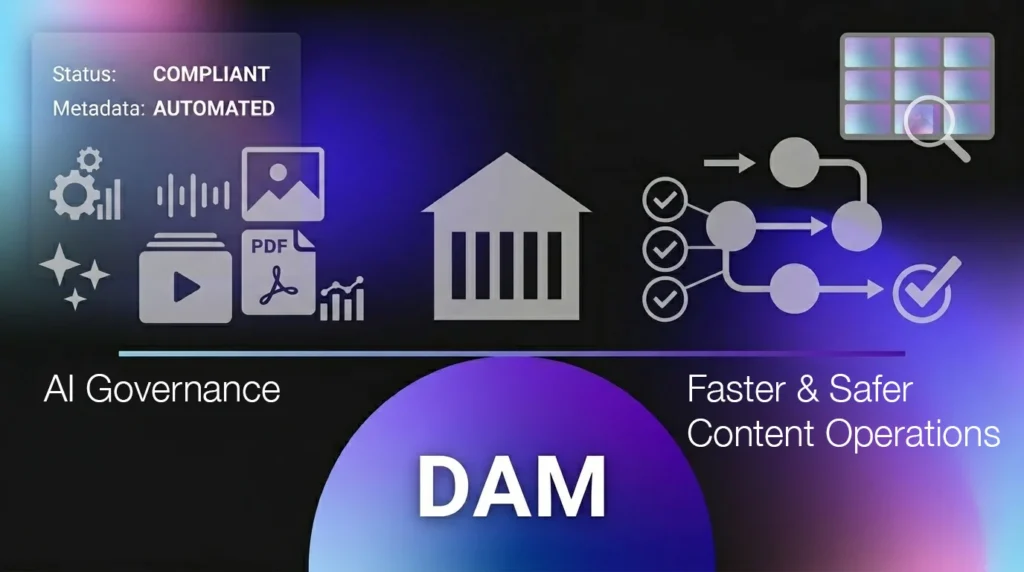
AI is changing enterprise content operations at a rapid pace. Teams are using it to generate copy, enrich metadata, automate workflows, localize content, and accelerate production across more channels and markets than ever before. That growth creates real opportunity, but it also introduces new governance pressure because the scale of output can rise much faster than the systems used to review, approve, and manage it.
This is why AI governance has become a core operational issue rather than a side discussion about policy. In content operations, the problem is not simply whether AI can create content faster. The deeper question is how organizations ensure that AI-assisted content remains accurate, on brand, rights-safe, auditable, and appropriate for the context in which it will be used.
For enterprise teams, that challenge is closely tied to digital asset management and content operations maturity. A governed AI environment depends on strong workflow controls, metadata standards, approval paths, and lifecycle visibility. That is one reason why organizations evaluating whether their DAM is ready for generative AI workflows are really evaluating whether their operating model can support AI at scale.
TL;DR
AI governance models help enterprise teams decide who controls AI use, how decisions are made, and how content stays compliant, consistent, and operationally scalable across the business.
- The strongest governance approach is rarely just about policy. It must connect oversight, workflow, metadata, approvals, and digital asset management into one repeatable operating model.
- Enterprise teams usually adopt one of five common governance models, including centralized, federated, hybrid, policy-led, and risk-tiered models, depending on organizational complexity and regulatory pressure.
- DAM plays a critical role in AI governance because it gives teams a governed system for assets, metadata, rights, approvals, and content lifecycle controls.
The goal of AI governance is not to slow innovation. The goal is to help teams move faster with more confidence, less duplication, and stronger control over enterprise content operations.
Why AI Governance Matters in Content Operations
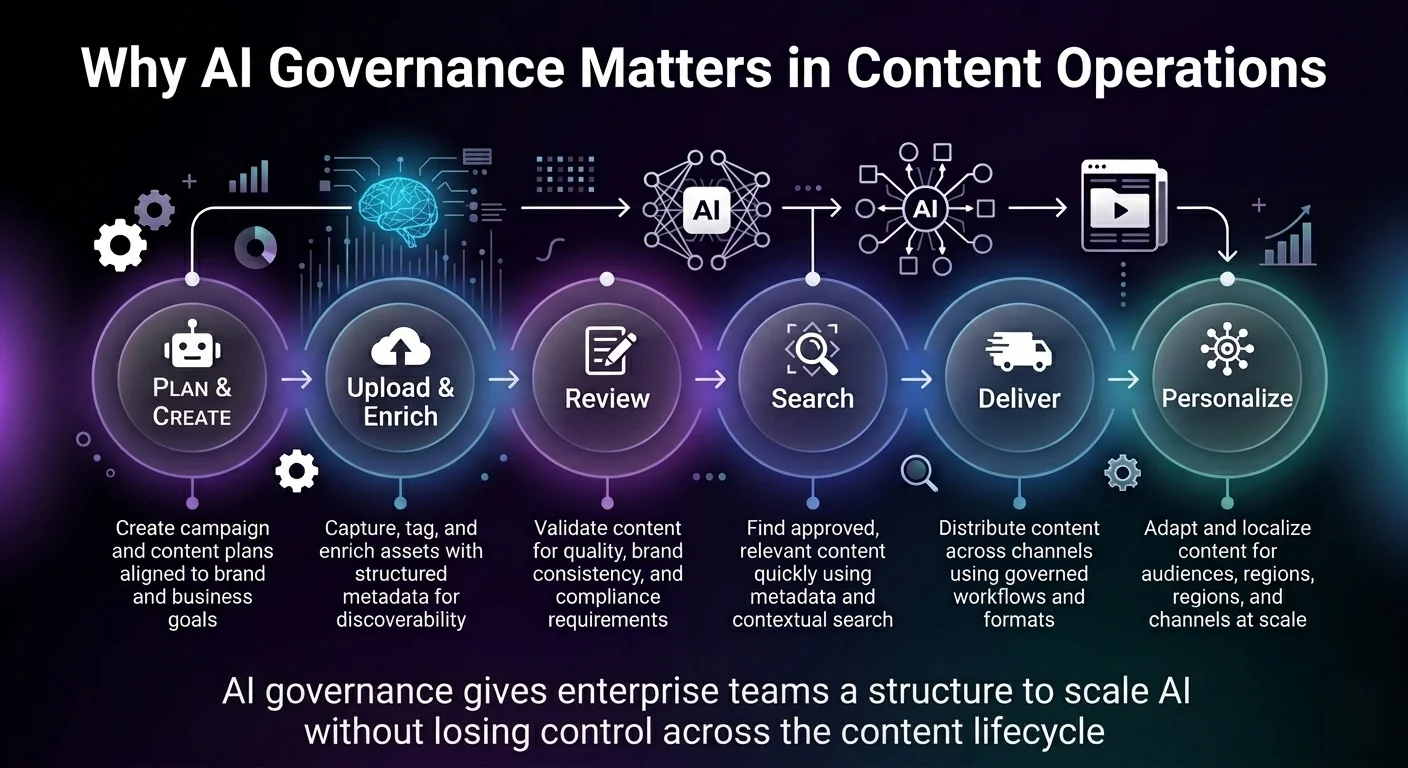
In many enterprises, AI adoption begins with enthusiasm and scattered experimentation. One team uses it for campaign copy, another for tagging assets, and another for generating variants for regional channels. Without a governance model, those activities quickly become inconsistent, making it difficult to understand what is approved, what is reusable, and what creates risk.
Content operations are especially sensitive to this problem because they sit at the intersection of brand, compliance, workflow, and customer experience. A single weak point in governance can create downstream issues across websites, email campaigns, social channels, partner portals, and regional content hubs. As more AI-assisted assets enter the system, the need for one governed structure becomes much more urgent.
That is where enterprise AI governance models come in. They define who owns oversight, how policies are enforced, what types of content require review, and how teams balance speed with control. The best models do not isolate AI from content operations. They embed it into the same governed environment that already supports approvals, metadata, rights, and enterprise-wide content consistency.
What an AI Governance Model Actually Defines
An AI governance model is not just a set of policies in a document repository. It is the operating framework that determines how AI is approved, monitored, and applied inside the business. In enterprise content operations, that usually includes ownership, risk classification, workflow rules, auditability, acceptable use, model oversight, and the relationship between AI output and human review.
A good governance model also defines how AI interacts with the systems that already manage content. That means it must account for DAM, CMS, PIM, workflow tools, and approval layers across the broader stack. If AI can generate content but cannot be governed once it enters the asset lifecycle, then the organization has not really solved the operational challenge.
This is why governance cannot be separated from content structure. Teams need shared metadata, clear taxonomy, asset status, permissions, and lifecycle controls to make AI outputs manageable. Aprimo has already written about how metadata and taxonomy support digital asset organization at scale, and that same principle applies directly to AI governance.
Five Common AI Governance Models for Enterprise Content Operations
Centralized Governance Model
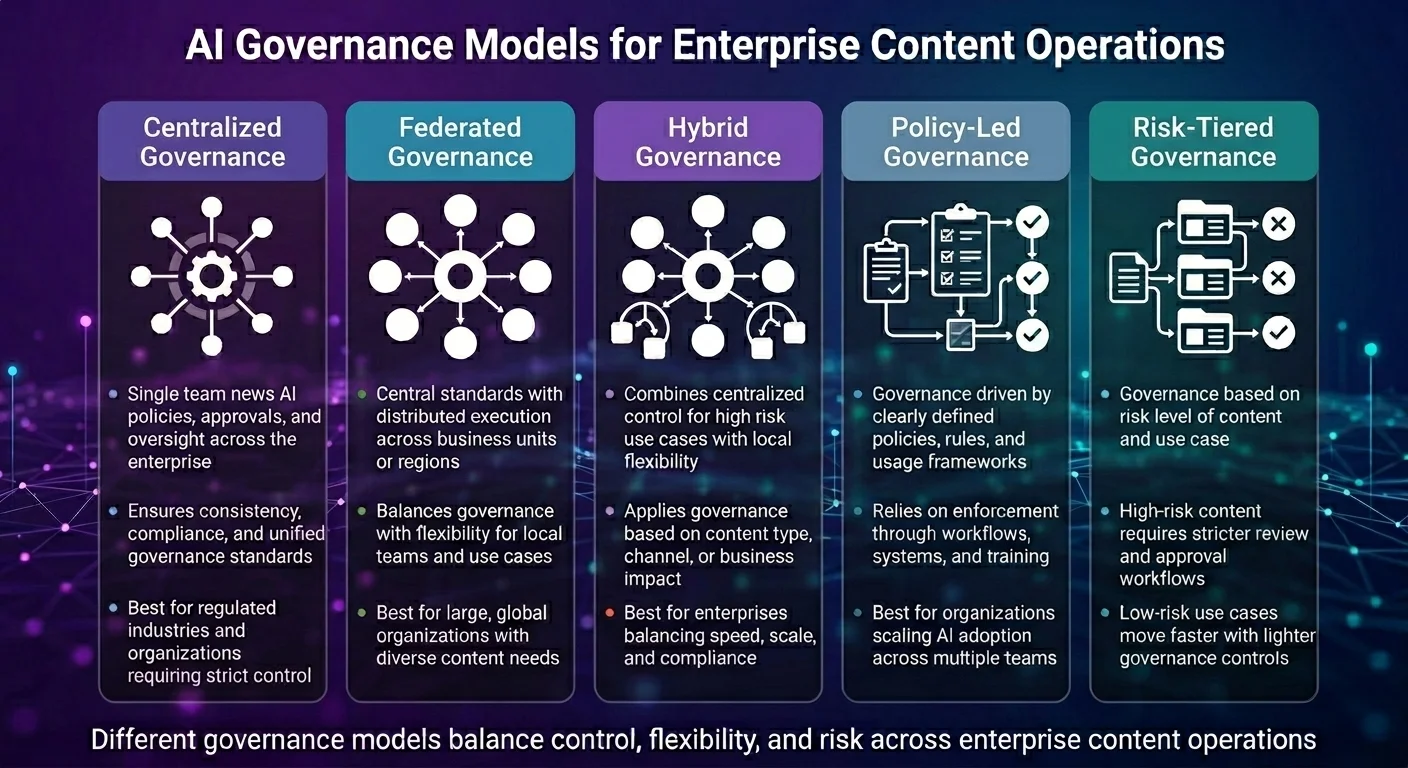
In a centralized governance model, one core team owns AI policy, standards, approvals, and oversight across the enterprise. This team typically defines approved use cases, acceptable tools, required review paths, and compliance expectations for every business unit. The strength of this model is consistency because the same standards apply across regions, brands, and teams.
This model works especially well for organizations with strict regulatory needs, a strong central brand function, or limited tolerance for variation in how AI is used. It creates a clear authority structure and often makes auditability easier because decisions flow through one established governance body. The tradeoff is that it can become slower if every request, exception, or workflow change must pass through one central group.
For content operations, centralized governance often pairs well with a mature DAM environment because content policies, rights metadata, and approval statuses are already structured centrally. It is a strong fit when the organization values uniformity above autonomy and when the cost of inconsistent AI use is especially high.
Federated Governance Model
In a federated governance model, a central team defines core standards, but individual business units or regions are allowed to manage AI operations within those guardrails. The enterprise still sets the policy baseline, but governance execution becomes more distributed. This is often useful in large organizations where different teams have very different content needs, audiences, and compliance contexts.
The benefit of federated governance is flexibility. Regional marketing teams, product groups, or business units can move faster because they do not need central approval for every operational decision. At the same time, the model only works when the central standards are clear enough to prevent fragmentation and when local teams are mature enough to follow them consistently.
For enterprise content operations, this model can work well when teams share one governed DAM structure but have different workflows layered on top of it. It supports variation without giving up total visibility, which is important for organizations trying to scale brand consistency across global markets.
Hybrid Governance Model
A hybrid governance model combines strong central control in high-risk areas with more autonomy in lower-risk workflows. It is often the most practical model for large enterprises because it recognizes that not every use case deserves the same level of control. For example, AI-generated campaign claims might require legal review, while AI-assisted metadata tagging might be allowed under lighter governance.
This model is attractive because it reflects how content operations actually work. Different asset types, channels, and teams create different levels of exposure, so applying one uniform review standard often becomes inefficient. A hybrid model allows enterprises to concentrate governance effort where it matters most while still enabling speed in lower-risk workflows.
For DAM and content operations, hybrid governance tends to work best when the organization has strong workflow automation, clear asset status rules, and role-based permissions. It can also support more advanced personalization efforts, especially when teams are trying to scale personalized content without losing governance.
Policy-Led Governance Model
A policy-led governance model focuses heavily on defined standards, documentation, and usage rules that guide AI activity across the enterprise. Instead of concentrating all authority in one team, this model relies on strong policy architecture supported by training, controls, and enforcement mechanisms. It is often used by organizations that want broad adoption but need a formal framework for what is allowed, restricted, or prohibited.
This model works best when policy can be translated into practical operational controls. If the rules live only in documentation and are not reflected in workflow, metadata, or permissions, then adoption becomes inconsistent. The model becomes much stronger when acceptable-use rules are tied directly to content systems, approval paths, and rights management.
In enterprise content operations, policy-led governance helps organizations clarify how AI-generated content should be labeled, reviewed, stored, and reused. It can also support safer handling of rights-sensitive assets, especially when linked with governance practices around digital rights and usage expiration in DAM.
Risk-Tiered Governance Model
A risk-tiered governance model organizes AI oversight according to the level of business, legal, brand, or compliance risk associated with each use case. Instead of grouping governance by department or structure alone, it groups governance by exposure. This means low-risk uses, such as internal summarization or metadata suggestions, may move quickly, while high-risk uses, such as external product claims or regulated market copy, require more rigorous review.
This model is becoming more important because not all AI use cases deserve the same governance burden. Enterprises that treat every AI output as equally risky often create bottlenecks, while those that treat everything as low risk create avoidable exposure. A tiered model gives teams a more practical framework for deciding where human review, legal input, and system controls need to be strongest.
For content operations, risk-tiered governance becomes highly effective when paired with workflow automation, asset classification, and clear source-of-truth systems. It helps organizations govern AI in a way that reflects the real operational and reputational stakes behind each content type, rather than relying on one broad rule for every scenario.
How to Choose the Right Governance Model
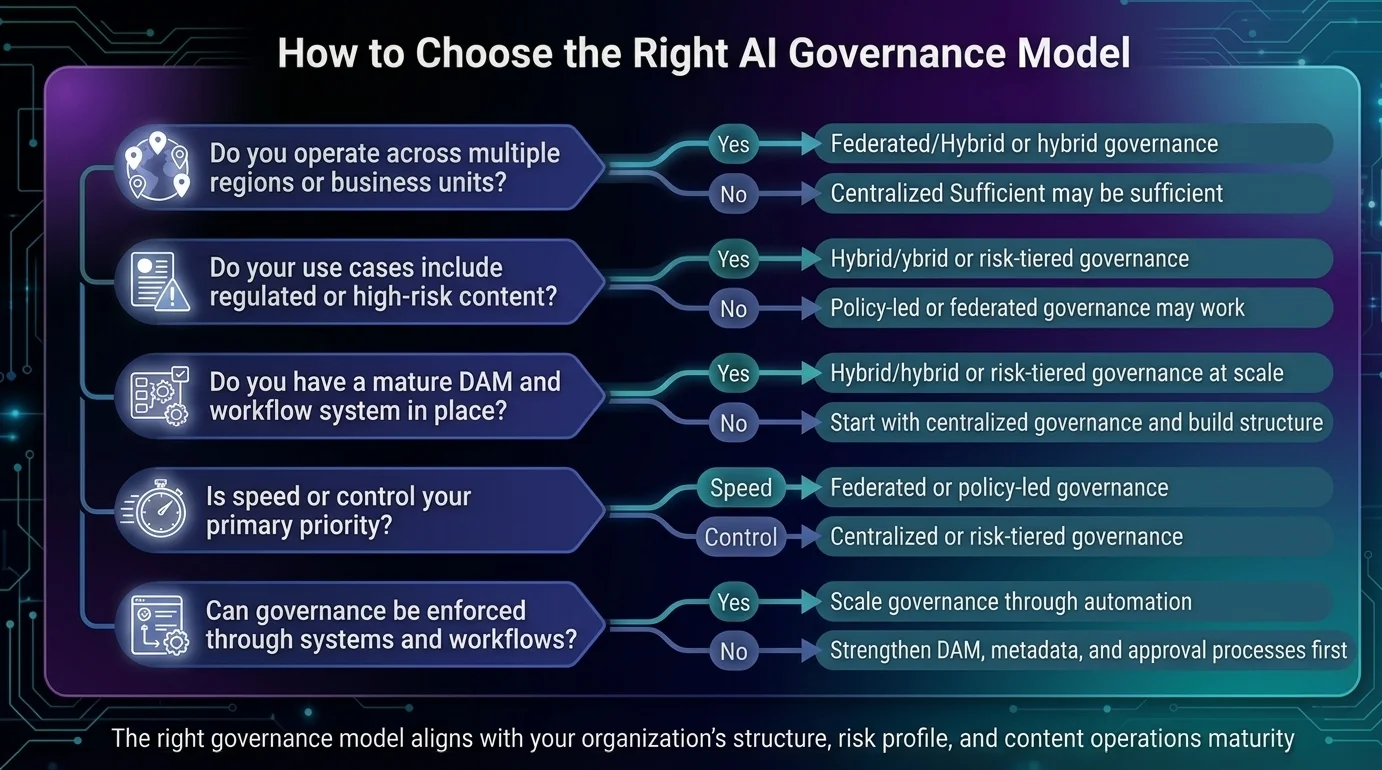
The right model depends on organizational design, regulatory pressure, content complexity, and operational maturity. A global enterprise with multiple brands and strict compliance obligations may need a hybrid or risk-tiered structure, while a smaller organization with one central content team may prefer centralized governance. The wrong model is often the one that looks clean on paper but does not match how the business actually works.
A useful way to evaluate fit is to ask a few practical questions:
- Does the organization need one enterprise-wide authority structure, or do regional and business-unit teams need room to manage AI use within common rules?
- Are most AI use cases low risk and operational, or do many of them affect regulated claims, brand-sensitive messaging, and external customer-facing content?
- Can policy be enforced through systems and workflows, or is the organization still relying too heavily on manual review and fragmented local practices?
- Does the current DAM and workflow environment already support metadata, permissions, approval status, and lifecycle controls strongly enough to operationalize governance?
- Is the business trying to optimize for consistency first, speed first, or a more balanced model that can separate low-risk and high-risk content paths?
These questions matter because AI governance is not only about oversight. It is about how AI fits into the daily movement of content through the enterprise. The more complex the content ecosystem becomes, the more important it is to connect governance with architecture, workflow, and discoverability.
The Role of DAM in AI Governance
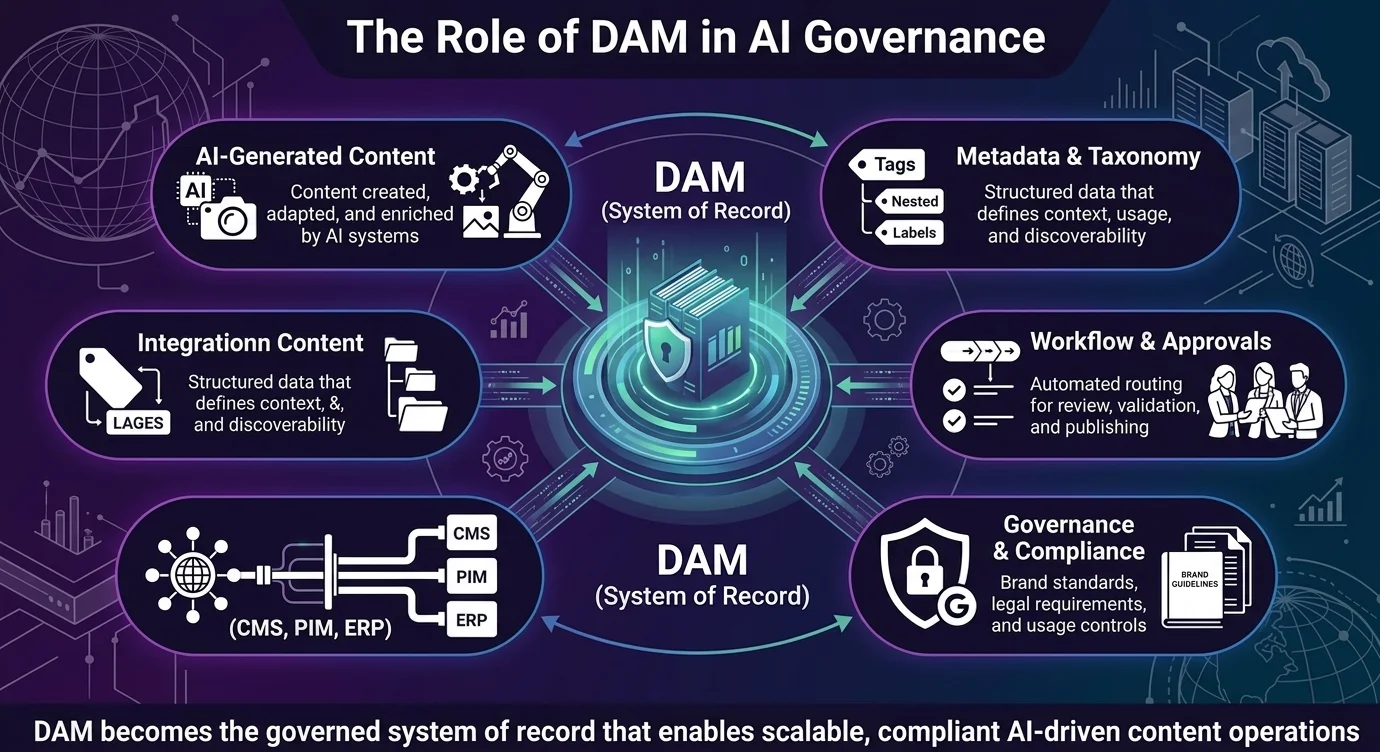
DAM is not the only part of AI governance, but it is one of the most important. When AI creates, enriches, or adapts content, that output still needs a governed home where teams can understand what it is, who approved it, where it can be used, and whether it is still current. DAM provides the structure that makes those questions answerable.
A governed DAM helps enterprises centralize approved assets, manage permissions, enforce metadata standards, and maintain asset lifecycle visibility. That matters because AI output without status, context, and governance quickly becomes just more unmanaged content. The more teams rely on AI to accelerate production, the more important it becomes to have a strong digital asset management architecture underneath the process.
This is also why AI governance should be treated as a content operations issue rather than just a technical one. Governance succeeds when it can be embedded into the systems where work actually happens. A DAM-centric operating model gives teams one place to govern reuse, brand safety, approval, and rights while AI activity increases around it.
Common Mistakes to Avoid
One common mistake is assuming that AI governance is only a legal or IT problem. In practice, many governance failures happen inside everyday content operations, where teams generate assets quickly but do not have a repeatable way to review, classify, or retire them. That gap creates inconsistency faster than central teams can correct it.
Another mistake is adopting a governance model that is too rigid for the business. An enterprise with many regional teams may struggle under a purely centralized system, while a loosely federated model may fall apart if shared standards are weak. Governance has to fit how content actually moves through teams, systems, and channels.
A third mistake is underestimating the role of integrations. AI governance becomes much harder when DAM, CMS, PIM, and workflow tools do not share the same logic around status, metadata, and ownership. That is why it helps to think about how DAM integrates with CMS, PIM, and ERP systems as part of the governance conversation rather than as a separate technical topic.
Conclusion
AI governance models help enterprises move from experimentation to operational discipline. They give teams a framework for deciding who owns oversight, how risk is managed, where approvals belong, and how AI fits into the content lifecycle without weakening compliance or brand control. The right model makes AI more usable, not less.
For enterprise content operations, governance is most effective when it is connected directly to workflow, metadata, lifecycle management, and DAM. That is what turns governance from a policy exercise into an operating model that supports speed, reuse, control, and long-term scale. As AI adoption grows, the organizations that succeed will not be the ones with the most AI activity, but the ones with the clearest and most practical structure around it.
FAQ
What is an AI governance model in enterprise content operations?
An AI governance model is the framework an organization uses to define how AI is approved, monitored, and controlled across content workflows. It determines ownership, policy enforcement, review requirements, and how AI-generated or AI-assisted content is managed inside enterprise systems.
Why do content operations teams need AI governance?
Content operations teams need AI governance because AI can increase content volume and variation much faster than manual controls can keep up. Without governance, teams risk inconsistent messaging, unclear approvals, duplicate assets, compliance issues, and reduced trust in the content ecosystem.
What are the most common AI governance models for enterprises?
The most common enterprise AI governance models include centralized, federated, hybrid, policy-led, and risk-tiered models. Each model balances control and flexibility differently, which is why the best choice depends on organizational structure, compliance needs, and content operations maturity.
Which AI governance model is best for a global enterprise?
There is no single best model for every global enterprise because the right choice depends on how the business is structured and how much variation exists across regions and teams. Many large organizations find that hybrid or risk-tiered models work well because they preserve strong oversight while allowing more practical flexibility in lower-risk workflows.
How does DAM support AI governance?
DAM supports AI governance by giving organizations a governed system for assets, metadata, approvals, permissions, and lifecycle status. This helps teams understand what content is approved, how it can be used, whether it is current, and where it belongs in the broader content operation.
How should companies choose the right AI governance model?
Companies should choose a model based on their regulatory exposure, team structure, workflow maturity, content complexity, and tolerance for variation across business units. A strong choice is one that matches how work actually happens and can be enforced through systems, approvals, and operational controls rather than policy documents alone.