

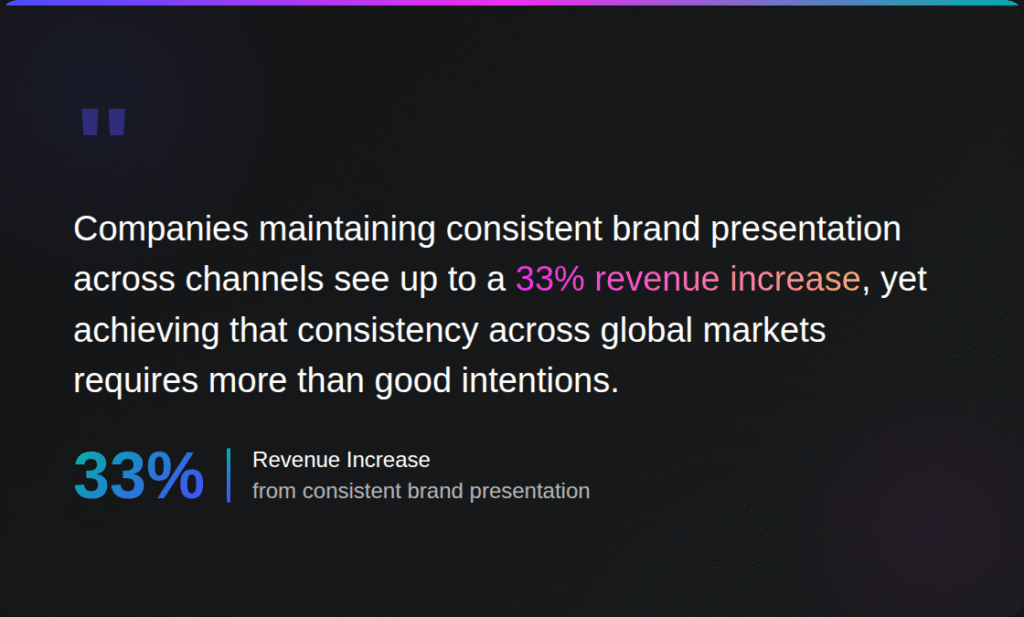
Enterprise brands that maintain consistent presentation across all channels can see revenue increases of up to 33%, yet achieving this consistency while localizing for diverse markets remains one of marketing’s greatest challenges.
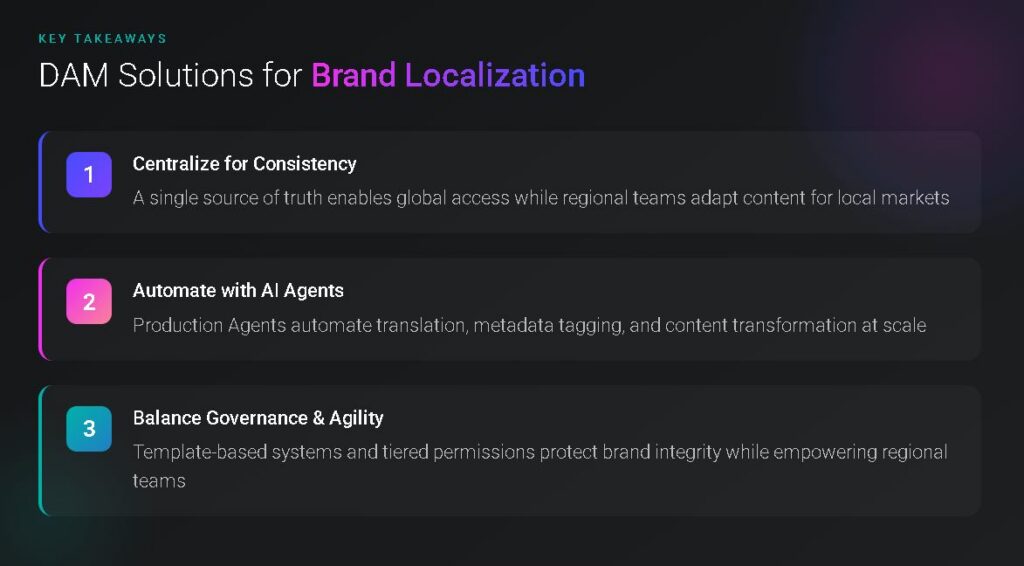
- Digital Asset Management platforms serve as a centralized hub where global teams access approved, up-to-date assets while regional marketers adapt content for local audiences.
- Agentic AI capabilities now automate translation, metadata tagging, and content transformation, reducing localization effort.
- Traditional DAM providers often require extensive workarounds for multilingual content, while modern platforms embed localization directly into workflows.
- Version control, permission-based editing, and automated compliance checks protect brand integrity during regional adaptation.
Organizations evaluating how DAM solutions help localize brand messaging should prioritize platforms that balance centralized governance with regional flexibility.
Expanding into new markets means balancing two competing priorities. On one side, you need a unified brand identity that customers recognize and trust worldwide. On the other side, you need messaging that resonates with local audiences, from the language they speak to the cultural nuances that shape their purchasing decisions.
Most marketing teams discover the hard way that centralizing digital assets through basic cloud storage creates more problems than it solves. Files scatter across regional folders, outdated logos resurface in campaigns, and brand guidelines collect dust in PDF format while local teams improvise. Companies maintaining consistent brand presentation across channels see up to a 33% revenue increase, yet achieving that consistency across global markets requires more than good intentions.
Enterprise-grade Digital Asset Management transforms content operations. Learn how DAM solutions help localize brand messaging at every touchpoint.
Why Do Global Brands Struggle with Content Localization?
Before exploring solutions, it’s worth understanding why localization creates such friction for marketing organizations. The challenges encompass more than translation.
The Volume Problem
Global campaigns generate exponentially more content variants than domestic ones. A single product launch might require asset versions for a dozen markets, each with unique language requirements, regulatory constraints, and cultural considerations. When marketing teams in Tokyo, São Paulo, and Berlin all need region-specific assets, coordination becomes a bottleneck that delays time-to-market.
Many organizations respond by giving regional teams autonomy to create their own content. This approach speeds execution but fragments brand identity. The result is what brand managers call “logo drift,” where visual elements, messaging, and tone gradually diverge until the brand feels different in every market.
Cultural Nuance and Context
Translation alone rarely captures what makes messaging resonate. Colors carry different meanings across cultures. Humor that lands in one market falls flat in another. Even product photography may need adjustment when body language or fashion choices signal different values to local audiences.
Traditional localization workflows treat these adaptations as afterthoughts, forcing creative teams to retrofit existing assets rather than building localization into the process from the start. This approach creates rework, extends timelines, and increases the risk of culturally tone-deaf content slipping through approval.
Governance vs. Agility
Perhaps the deepest tension in global content operations is the conflict between brand governance and market agility. Centralized control protects brand consistency but creates bottlenecks when regional teams wait for headquarters to approve every adaptation. Decentralized approaches move faster but sacrifice the consistency that builds customer trust across touchpoints.
Organizations need infrastructure that reconciles these competing demands rather than forcing a choice between them.
How DAM Solutions Help Localize Brand Messaging
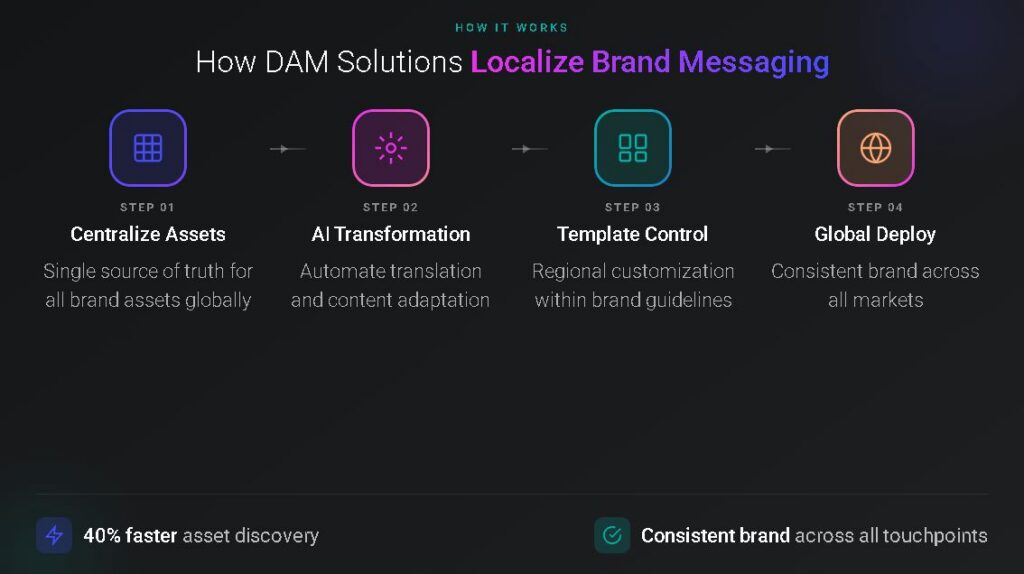
Digital Asset Management platforms address localization challenges through a combination of centralized governance, workflow automation, and intelligent content adaptation. Understanding these capabilities helps organizations evaluate which solutions fit their specific needs.
Centralized Asset Repository with Regional Access
A DAM platform provides a single source of truth for all brand assets. Instead of files scattered across regional drives, email attachments, and collaboration tools, every approved image, video, template, and brand guideline lives in one searchable system.
Centralization doesn’t mean restricting access. Modern platforms support sophisticated permission structures where global brand teams control master assets while regional marketers access localized variants appropriate to their markets. A product manager in Frankfurt might see German-language templates and EU-compliant imagery, while a colleague in Singapore accesses entirely different asset sets, all from the same underlying system.
The efficiency gains compound quickly. Teams using integrated DAM solutions find assets up to 40% faster and accelerate campaign publishing compared to organizations relying on fragmented storage.
Metadata and Taxonomy for Multilingual Content
Finding the right asset becomes exponentially harder when content exists in multiple languages. Effective DAM platforms use multilingual metadata to make every asset discoverable regardless of the searcher’s language.
DAM solutions can tag an image of a product launch event with descriptive keywords in English, Spanish, Mandarin, and any other language your organization uses. A marketer in Mexico City searching for “lanzamiento de producto” finds the same asset that their London colleague locates by searching “product launch.”
Beyond search, metadata supports automated content routing. Assets can be tagged with applicable markets, usage rights by region, expiration dates for time-sensitive promotions, and compliance status for regulated industries. When a regional team needs assets for an upcoming campaign, they see only content approved for their specific market and use case.
Automated Translation and Content Transformation
The most impactful advancement in how DAM solutions help localize brand messaging involves AI-powered content transformation. Where traditional workflows required manual translation and separate asset creation for each market, modern platforms automate much of this work.
Production Agents within advanced DAM systems can automatically generate localized content variants, applying appropriate translations, regional taxonomies, and format adaptations based on predefined rules. A master campaign asset uploaded in English can spawn localized versions for target markets without requiring creative teams to manually recreate each variant.
Organizations using these capabilities report dramatic efficiency improvements. Global enterprises have documented reductions in translation effort after implementing agentic AI capabilities within their DAM workflows, while simultaneously improving consistency across regional content.
Template-Based Localization at Scale
Templates are one of the most practical tools for balancing brand governance with regional flexibility. Rather than granting regional teams unrestricted editing access to brand assets, organizations provide pre-approved templates with editable zones.
A marketing template for a promotional banner might lock down logo placement, color palette, and typography while allowing regional teams to customize headline text, product imagery, and pricing information. The brand stays consistent while local teams adapt messaging for their audience.
This approach works particularly well when combined with automated translation. Templates can include text fields that automatically translate based on the target market, allowing regional teams to localize content in minutes rather than waiting days for creative services to process their requests.
What Should You Look for When Evaluating DAM Platforms for Localization?
Not all DAM solutions handle global content operations equally. Organizations expanding into new markets should evaluate platforms against specific localization capabilities.
Integration with Existing Marketing Technology
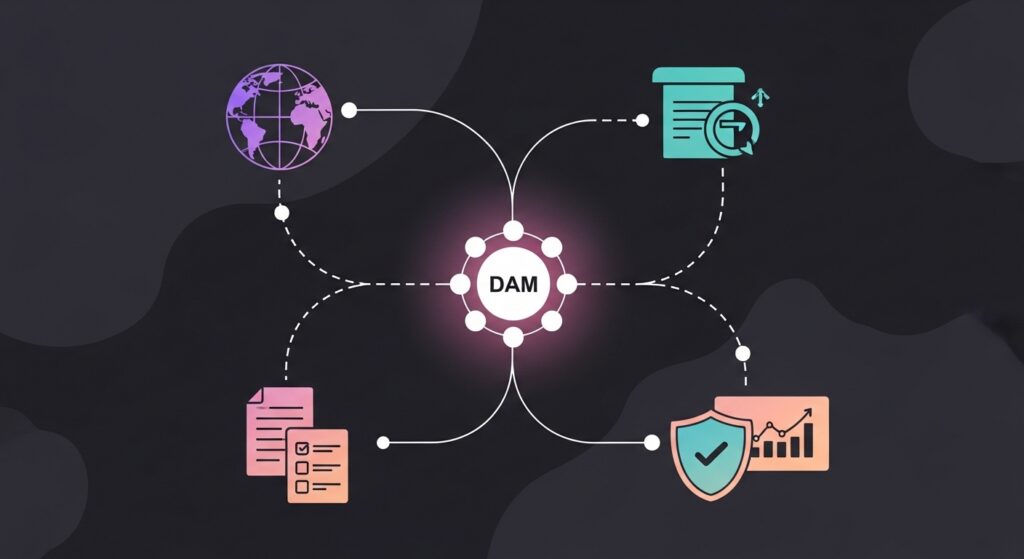
A DAM platform that doesn’t connect with your other marketing tools creates another silo rather than solving the fragmentation problem. Localization requires integrations with content management systems, marketing automation platforms, and creative tools where teams actually do their work.
When evaluating platforms, map your existing technology stack and confirm that the DAM supports direct connections. The goal is enabling teams to access localized assets without leaving the tools they already use, whether that’s pulling images into a CMS, inserting approved graphics into email campaigns, or accessing brand templates from within design software.
Support for Regional Compliance Requirements
Global operations have to navigate different regulatory environments. Financial services companies face distinct disclosure requirements in each market. Pharmaceutical brands must adhere to region-specific medical advertising rules. Consumer products may have varying labeling and claims requirements across jurisdictions.
DAM platforms that support localization include compliance workflows that vary by market. An asset approved for use in Canada might require additional review before deployment in the EU. Platforms with sophisticated brand safety and compliance capabilities can automate these checks, flagging content that needs additional approval before regional teams can access it.
Scalability Across Markets and Asset Volume
Organizations rarely expand into one new market and stop. A platform that handles localization for three countries today needs to scale as the business grows to 30 countries.
Beyond geographic expansion, consider your growth in asset volume. Marketing teams produce more content every year, and localized variants multiply that growth. Platforms should handle increasing volumes without compromising search performance or requiring expensive storage upgrades.
Analytics and Performance Tracking
Localization without measurement is guesswork. Effective DAM platforms provide analytics showing how assets perform across different markets, which content gets reused versus recreated, and where bottlenecks slow regional teams.
These insights inform ongoing optimization. If certain asset types consistently require manual localization despite available automation, the workflow needs adjustment. If one region frequently creates off-brand content, they may need additional templates or clearer guidelines. Content intelligence capabilities transform localization from a one-time project into a continuously improving operation.
What Are the Signs Your Current Approach Isn’t Working?
Organizations often don’t recognize localization problems until they’ve accumulated significant brand debt. Watch for these warning signs that indicate your current approach needs rethinking.
- Regional teams routinely recreate assets that already exist. When teams in different markets produce similar content independently, you’re paying for duplication while risking inconsistency.
- Brand guidelines exist as PDF documents that nobody updates. Static guidelines can’t keep pace with evolving brand standards or regional variations. If your guidelines require emailing updated PDFs whenever something changes, compliance will lag.
- Approval workflows vary by region with no central visibility. When headquarters can’t see what content regional teams have in market, brand drift happens invisibly until a customer or partner notices the inconsistency.
- Translation bottlenecks delay campaign launches. If getting content localized takes weeks because requests queue in a shared services team, you’re sacrificing speed for a process that doesn’t actually guarantee quality.
- Nobody knows which assets are approved for which markets. When regional teams guess whether they can use an asset in their market, they either delay asking for permission or move forward and hope for the best. Neither option serves the organization well.
How Can You Build a Localization Strategy That Scales?
Technology alone doesn’t solve localization challenges. Organizations need operational models that leverage DAM capabilities while accounting for the human elements of global content operations.
Establish Regional Champions
Global DAM implementations benefit from designated champions in each major market who understand both local requirements and organizational standards. These regional administrators bridge the gap between headquarters and local teams, ensuring that global brand standards translate into locally appropriate execution.
Regional champions often handle responsibilities like creating market-specific metadata, developing localized templates based on global masters, and training local users on DAM workflows. Their involvement increases adoption and ensures that the platform serves regional needs rather than imposing one-size-fits-all processes.
Create Tiered Governance Models
Not all assets require the same level of central control. Logos, core brand imagery, and campaign hero assets might demand strict approval workflows, while supporting materials and regional adaptations can operate under lighter governance.
Effective localization strategies define clear tiers with appropriate controls for each. Core brand assets come from headquarters, with minimal regional modification allowed. Campaign assets may allow regional adaptation within defined parameters. Regional teams might have complete autonomy over certain content categories that don’t carry brand risk.
Invest in Continuous Improvement
Localization capabilities mature over time. Initial implementations often focus on solving immediate problems, like centralizing scattered assets or establishing basic approval workflows. As organizations gain experience, they can layer on more sophisticated automation and optimization.
Plan for this evolution from the start. Choose platforms that offer growth paths, from basic DAM capabilities to advanced AI automation. Build feedback loops that capture regional team input on what’s working and what creates friction. Treat localization as an ongoing program rather than a one-time project.
Frequently Asked Questions
How do DAM solutions help localize brand messaging without losing brand consistency?
DAM platforms maintain brand consistency during localization by providing centralized access to approved assets while enabling controlled regional adaptation. Template-based systems lock core brand elements while allowing customization of market-specific content. Permission structures ensure regional teams work within defined parameters, and automated compliance checks flag deviations before content goes live.
What’s the difference between traditional DAM and modern platforms for global content operations?
Traditional DAM platforms function primarily as asset storage systems with basic search and download capabilities. Modern platforms designed for global operations include features like AI-powered translation, automated metadata tagging, workflow automation, regional compliance management, and integrations with marketing technology. These capabilities transform DAM from passive storage into active content operations.
How long does it typically take to implement a DAM solution for global localization?
Implementation timelines vary based on organizational complexity, existing technology infrastructure, and the volume of assets requiring migration. Basic implementations can go live within a few months, while enterprise-scale deployments with complex integration requirements may take six to twelve months. Most organizations see meaningful value within the first quarter after launch, with capabilities maturing over subsequent phases.
Can smaller organizations benefit from DAM localization capabilities, or is this only for large enterprises?
Organizations of any size operating in multiple markets can benefit from DAM localization capabilities. While enterprise platforms offer extensive customization and scale, mid-market solutions provide core localization features at accessible price points. The key consideration is whether your organization faces the challenges that DAM solves: scattered assets, inconsistent branding, translation bottlenecks, or compliance complexity across markets.
Ready to Transform Your Global Content Operations?
Understanding how DAM solutions help localize brand messaging is the first step to improving your global operations. Building the model to leverage those capabilities is what delivers lasting results.
Aprimo provides the centralized platform, AI-powered automation, and workflow flexibility that global brands need to maintain consistency while empowering regional teams. With customizable governance, intelligent content transformation, and seamless integration with your existing marketing technology, we enable organizations to scale content operations across any number of markets without sacrificing brand integrity. Request a demo to see how Aprimo can transform your global content strategy.