
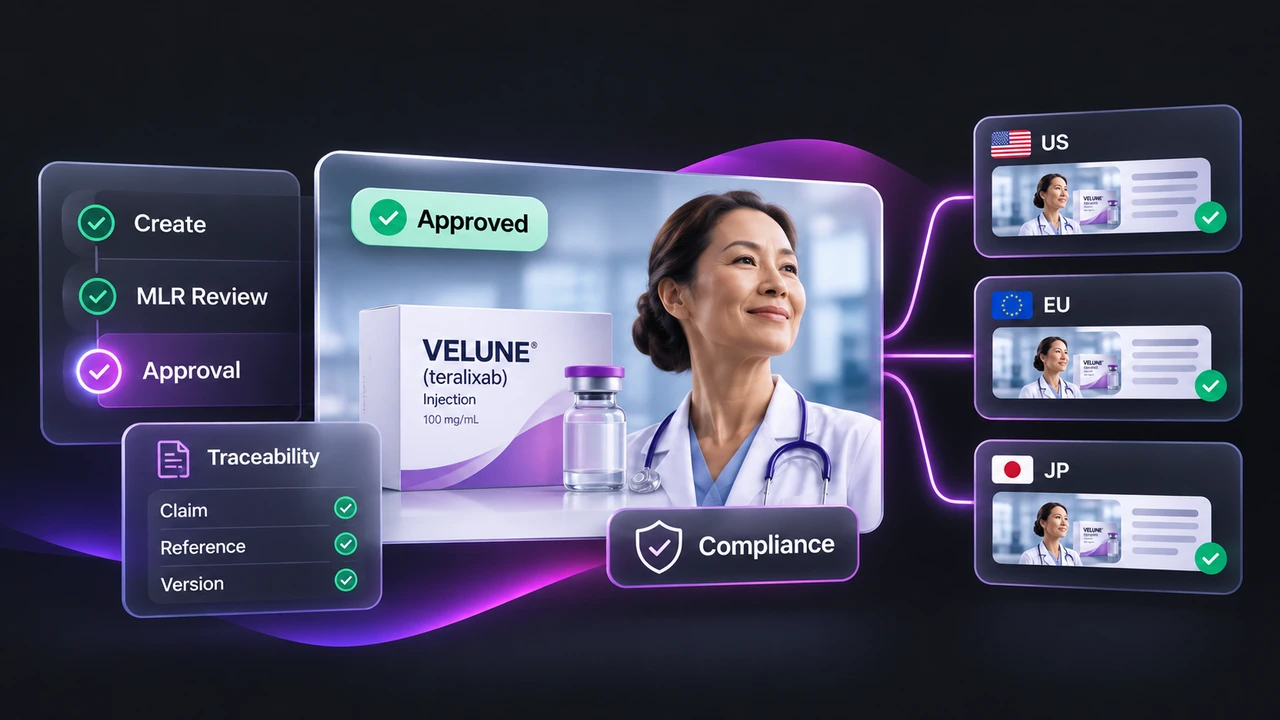
DAM compliance in life sciences is not a feature checklist. It is the ability to prove, at any moment, that every piece of content in circulation is accurate, approved, current, and traceable to its sources. Regulators, auditors, and internal quality teams all ask versions of the same question: what proves this asset is allowed to be live?
Answering that question is hard in a life sciences organization. Content flows through regulatory, medical, legal, commercial, and clinical teams. It crosses markets with different rules and languages. Claims depend on references that change. Approved versions must replace older ones everywhere. The record of who approved what must survive years of staff turnover and system change.
This guide explains how DAM compliance works for life sciences teams across regulated markets. It covers MLR review, claims traceability, audit controls, global-to-local flow, AI support, integrations, and maturity assessment. Most of the capability detail comes from Aprimo’s life sciences solution page. Aprimo delivers it through a Content Operations Platform that keeps workflow, assets, and governance together. Legal teams and regulatory teams should confirm requirements for each market, because obligations vary by jurisdiction and product type.
TL;DR
- DAM compliance in life sciences means proving that every live asset is accurate, approved, current, and traceable.
- Structured MLR workflows, version control, and documented approvals make regulated review more predictable.
- Claims and references must stay connected to the assets that use them across every version.
- Audit trails, permissions, expiry policies, and retention controls prepare teams for review.
- Global-to-local workflows let regions adapt approved content without losing traceability.
- AI should support human reviewers inside a governed, auditable environment, not replace them.
What is DAM compliance in life sciences?
DAM compliance in life sciences is the use of a digital asset management platform to control, document, and audit regulated content from planning through archival. It connects workflow, metadata, permissions, and records so that compliance becomes a property of the system.
Definition: DAM compliance is the capability of a digital asset management platform to enforce review, approval, rights, and retention rules on regulated content, while keeping an auditable record of every decision.
Generic platforms fall short for this work. Aprimo’s life sciences page states that generic platforms are not built for regulated content operations. It adds that life sciences teams need a governed environment for review, traceability, reuse, and control from planning through archival. The point holds across the industry: compliance depends on the structure around the asset, not only the asset itself.
Four teams usually share the work. Regulatory teams manage MLR workflows, claims traceability, and audit preparation. Marketing teams handle global-to-local reuse, and brand consistency. Field and medical affairs teams need access to the latest approved materials. Research and clinical teams manage sensitive scientific content with governed access.
Each team sees a different slice of the same lifecycle. A platform that serves only one slice leaves gaps at the handoffs, and those gaps are where compliance failures tend to occur.
Why is life sciences content harder to keep compliant?
Life sciences content is harder to keep compliant because strict medical, legal, and regulatory requirements apply to growing volumes across more channels. Every asset must be accurate, traceable, current, and audit-ready.
Aprimo’s life sciences page lists common challenges:
- Lengthy and fragmented MLR review cycles.
- Claims and references tracked manually or across multiple tools.
- Limited visibility into approved versions and current asset status.
- Slow localization and duplication across markets.
- Difficulty maintaining compliance across global teams and channels.
- Manual metadata work that reduces speed and discoverability.
- Risk from outdated, unsupported, or unapproved content in circulation.
The last item carries the highest consequence. Outdated or unapproved content that remains in circulation can reach healthcare professionals, patients, or regulators. Finding it requires knowing where it lives, which disconnected systems make difficult.
Regulation also keeps moving. According to Aprimo’s 2027 DAM trends report, California AB 3030 already requires disclosure on generative AI-produced patient communications, and EU AI Act Article 50 disclosure requirements took effect on August 2, 2026. The same report notes that compliance agents can evaluate content against industry-specific regulatory frameworks, including life sciences.
These pressures push teams toward structure. Manual tracking in spreadsheets and email breaks down as volume grows.
How does DAM compliance support MLR review?
DAM compliance supports MLR review through structured routing, version control, and documented approvals that make regulated review more predictable. Reviewers see the right version, in the right sequence, with a record of each decision.
Definition: MLR review is the medical, legal, andregulatory review that life sciences organizations apply to promotional content before release.
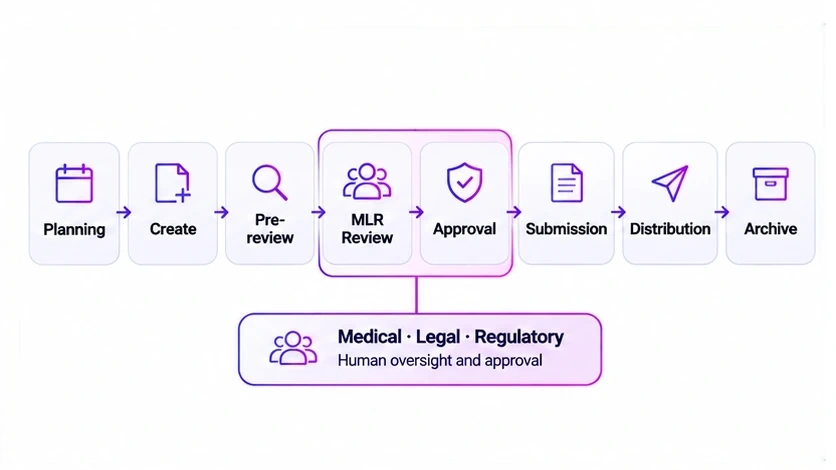
Aprimo’s life sciences page highlights these workflow capabilities: repeatable workflows for creation, review, approval, distribution, and archival. Structured routing then documented approvals reduce variability.
The regulated lifecycle runs through eight stages:
- Planning: Define the content need, audience, and market.
- Content creation: Produce drafts with approved components where possible.
- Pre-review checks: Catch missing information before formal review.
- MLR review: Route to medical, legal, and regulatory reviewers.
- Approval: Record decisions with version and reviewer details.
- Submission preparation: Assemble required artifacts.
- Distribution: Release approved content to the right teams, and the right channels.
- Archival and retention: Retain records according to policy.
Pre-review checks save time. A readiness check that flags missing references or inconsistent information before MLR submission reduces rework cycles. Reviewers then spend time on judgment, not on catching omissions.
Visibility also matters. When teams lack a view of status and bottlenecks, review ownership blurs. A central view of asset progress shows where items wait, so managers can intervene.
What does claims and reference traceability require?
Claims traceability requires that every approved claim stays linked to its supporting references. It must also link to every asset that uses it, across all versions. When a reference changes, the affected assets must be identifiable.
Manual tracking fails here. Teams that track claims in separate spreadsheets or disconnected tools must reconcile them by hand, which invites error. The common symptoms, from Aprimo’s MLR optimization checklist, include claims tracked manually, references disconnected from assets, and teams revisiting the same issues across review cycles.
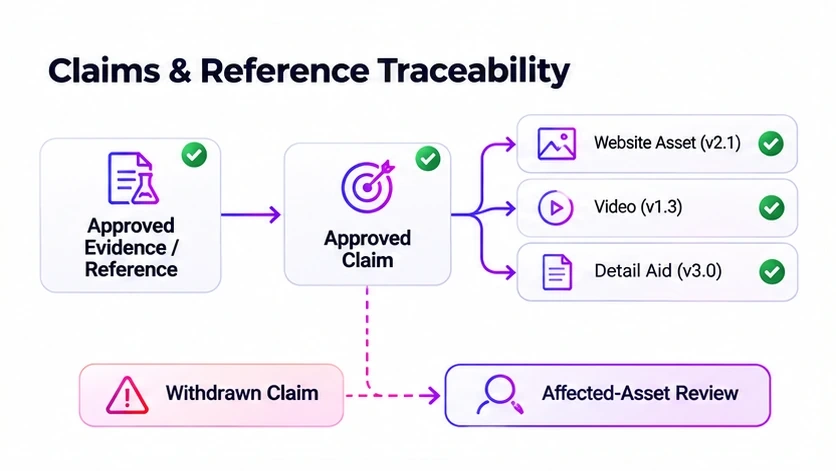
A connected approach keeps claims, references, metadata, and approval records attached to the content they support. Aprimo describes this as improved traceability, with visibility that reduces risk. Three practices support it:
- Link claims to assets: Each asset records the claims it contains.
- Link claims to evidence: Each claim points to its approved references.
- Track claim status: Approved, expired, or withdrawn status flows to every linked asset.
Version changes create alignment challenges. A new asset version may keep a claim while changing its context. The system should preserve the link, so reviewers can see what changed. Teams also need to know which versions remain in circulation after a claim changes.
This traceability supports submission readiness. Required artifacts stay connected, so teams do not rebuild documentation under time pressure.
Check a DAM against regulated content needs
Build a tailored DAM RFI from your own requirements, use cases, and business goals in minutes.
Which DAM compliance controls matter most to auditors?
The DAM compliance controls that matter most to auditors are audit trails, version history, role-based permissions, expiry policies, retention policies, and security certifications. Auditors want evidence, not assurances.
Aprimo’s life sciences page lists capabilities in each area:
- Audit trails: Every version, approval, decision, and update is tracked with clear histories.
- Access control: Role-based permissions, region-based permissions, expiration policies, and retention controls protect content integrity.
- Security support: Aprimo states that the platform includes SOC 2 Type II, ISO 27001 certification, encryption in transit then at rest, role-based access control, configurable governance policies, full audit trails for regulated assets, and support for 21 CFR Part 11 requirements.
- Lifecycle governance: Version control, metadata rules, expiration policies, purge policies, anddocumented review workflows keep control over content status.
Buyers should treat these statements as a starting point for diligence. IT, procurement, and quality teams should request current certifications. They should review the audit trail in a live demo, then confirm how each control maps to internal requirements. [Flag: confirm current certification wording with Aprimo security staff before publishing]
A useful audit test is reconstruction. Pick an asset in circulation, then ask the platform to show who created it, who reviewed it, which claims it contains, which version is live, and where it was distributed. Teams that can answer in minutes, without manual detective work, have strong controls.
Retention deserves planning. Policies should define how long records persist, who can purge content, and how legal holds work.
How should global-to-local content flow across regulated markets?
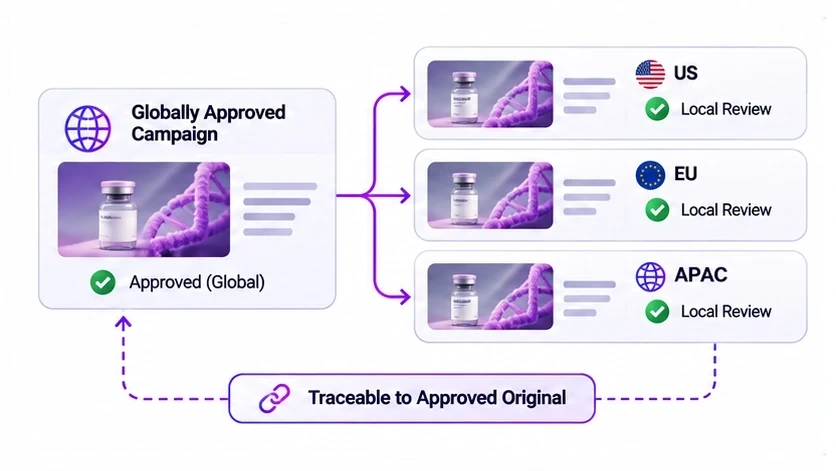
Global-to-local content flow should let global teams approve core content, then let regional teams adapt it within controlled workflows, with traceability back to the source. This balance keeps local relevance without weakening compliance.
A comparison shows the options:
- Duplicate-and-edit: Regions copy global assets, then change them freely. Alignment to approved claims drifts. Review effort repeats.
- Governed adaptation: Regions adapt approved components within defined workflows. Claims stay aligned, and each local variant links to its global source.
Aprimo’s life sciences page describes the governed model. Teams create approved global components. They manage localized adaptation in governed workflows, preserve claims alignment across versions, track localized review, then maintain traceability between global assets and local variants.
Modular content strengthens the model. Reusable, approved building blocks can be assembled, localized, and distributed across markets. The page lists benefits that include reduced duplication, improved consistency, faster localization, maintained claims alignment, and stronger review readiness.
Metadata and taxonomy make it work. Governed models classify content by indication, molecule, therapeutic area, market, channel, and more. That structure supports discoverability, reuse, and audit documentation.
Teams should define which elements regions may change, and which elements stay fixed. Written rules prevent disputes and speed local review.
How can AI support DAM compliance without replacing reviewers?
AI can support DAM compliance by handling metadata, readiness checks, and reuse guidance inside a governed, auditable environment, while human reviewers keep decision authority. Aprimo’s life sciences page states that AI should support human reviewers, not replace them.
The page describes practical applications. They include automated metadata tagging, OCR support, readiness checks before review, identification of missing information, recommendations for approved reusable content, and improved discoverability.
Evidence from deployment exists. Aprimo’s life sciences page reports a 130% increase in content discoverability after deploying its Predictive Metadata Agent across 100,000+ images. Buyers should ask for the conditions behind the figure, since results depend on library quality and configuration. Aprimo also offers a Librarian Agents interactive demo that shows predictive metadata in action.
Governance of the AI itself matters. According to the 2027 DAM trends report, regulated teams need audit trails for AI-generated content, including provenance tracking and automated disclosure workflows. Agents should act within policies, confidence thresholds, and human review gates, with every action logged.
Human oversight remains a strong expectation across industries. Bynder and Censuswide’s 2025 State of DAM report found that nine in ten respondents consider it essential for protecting brand identity, as cited in the trends report. In regulated work, the expectation is stronger still.
Which systems should a life sciences DAM connect to?
A life sciences DAM should connect to the systems involved in regulated content creation, review, approval, and downstream use. Fragmentation across those systems is a leading source of compliance risk.
Aprimo’s life sciences page lists integration with MLR platforms, regulatory review platforms, Veeva with related content repositories, submission systems, creative tools, field enablement platforms, single sign-on, identity management, analytics, and business intelligence systems.
Buyers should verify each connection that matters with a live test. “Supported” can mean a native integration, a configured connector, or a custom project. The checklist should cover data direction, metadata mapping, permissions, error handling, and ownership.
Rights and approval data must travel with assets. A connector that moves a file but drops its approval status or expiry date creates a gap. Verified metadata mapping prevents it.
Forrester’s June 2026 report found that 47% of DAM decision-makers rank integration with adjacent systems as their top priority, according to Forrester. Life sciences teams, with many specialized systems, have good reason to share that priority. Aprimo’s Integrations page lists available connections.
How can teams assess their content operations maturity?
Teams can assess maturity by scoring their workflows, governance, reuse, metadata, AI readiness, integration, and scale across the three stages that Aprimo describes: foundational, developing, and advanced. A clear view of the current stage guides priorities.
Aprimo’s life sciences page describes the stages. Foundational teams have core processes in place, often supported by manual work and disconnected systems. Developing teams have structured workflows and governance taking hold. Advanced teams have strong governance, defined workflows, and operational maturity. They focus on automation, reuse, and scale.
Aprimo’s Life Sciences Content Operations Assessment provides a maturity score, a breakdown across eight operational categories, strengths, opportunities, and three prioritized recommendations. The page lists areas such as regulatory workflows, governance controls, global-to-local reuse, metadata consistency, AI readiness, integration support, and operational scale.
A short self-check can also reveal friction. Signs that a review model needs stronger structure include review steps that vary by team, manual routing, unpredictable cycle times, claims tracked manually, multiple versions circulating, difficult-to-identify approved versions, audit trails that require manual reconstruction, and heavy rework before submission.
Teams that recognize several of these signs should prioritize workflow structure, documentation, and governance before adding more automation.
Building DAM compliance that survives an audit
DAM compliance in life sciences rests on structure that makes proof easy: connected claims, documented approvals, version history, governed access, and retention controls. Teams with that structure answer audit questions in minutes. Teams without it spend weeks reconstructing records.
The path forward combines workflow discipline with the right platform. Neither works alone, because a strong platform with loose process still produces inconsistent records. Structured MLR routing reduces variability. Global-to-local governance keeps markets aligned. AI handles routine checks and metadata, while reviewers keep the decisions. Integrations keep records consistent across systems.
Maturity assessment helps set the order of work. A foundational team should build structure first. A developing team should strengthen reuse and governance. An advanced team should extend automation. Each stage has a clear next step. That sequencing keeps investment tied to need, instead of chasing every capability at once.
Teams ready to see regulated workflows in practice can request a tailored demo built around their review process, claims model, and markets.
FAQ
What does MLR stand for?
MLR stands for medical, legal, and regulatory review. Life sciences organizations apply it to promotional and other regulated content before release. A DAM supports it with structured routing, version control, and documented approvals.
Can a DAM help with 21 CFR Part 11 requirements?
Aprimo states that its platform includes support for 21 CFR Part 11 requirements, along with audit trails and access controls. Quality and regulatory teams should confirm how each capability maps to their own validation approach.
How does a DAM keep claims aligned with references?
It keeps claims, references, metadata, and approval records connected to the content they support. When a claim or reference changes, teams can identify affected assets and versions.
Is AI appropriate for regulated content workflows?
Yes, when it operates inside a governed, auditable environment and supports human reviewers. Typical uses include metadata tagging, readiness checks, and reuse recommendations. Reviewers keep decision authority.
How should regional teams adapt global content?
Regional teams should adapt approved components within controlled workflows, with traceability to the global source. Written rules should define which elements may change and which stay fixed.
What should a team prepare for a life sciences DAM demo?
Teams should prepare a real review workflow, a sample claims set, and a list of connected systems. A scenario built from real content reveals more than a standard script.
Related reading: AI governance models for enterprise content operations, DAM governance for multi-brand teams.