

Regulated content in life sciences lives under pressure from two directions. Commercial teams need content to move fast, because market windows close, competitive dynamics shift, and healthcare professionals expect timely information. Compliance teams need content to be airtight, because a misattributed claim or an expired substantiation carries consequences well beyond a delayed campaign.
According to Indegene’s research across mid-sized to large pharmaceutical companies, the average Medical, Legal, and Regulatory (MLR) review cycle runs 50 to 60 days per job. Most of that time is not spent reviewing content. It is spent reconstructing the context that should have been built into the content from the start.
The question facing life sciences marketing and medical affairs leaders is not whether to modernize regulated content workflows. It is how to do it without fragmenting governance or creating new compliance risk. The answer is to treat compliance as infrastructure woven through the entire content lifecycle, not as a checkpoint at the end of content creation.
TL;DR
- Regulated content management (RCM) governs claims, evidence, obligations, and approvals as connected data throughout the content lifecycle. It replaces static documents reviewed at the end of production.
- Slow MLR cycles start upstream. Reviewers lose time reconstructing evidence relationships that claims management, authoring, and compliance context should have supplied.
- A DAM built for regulated environments attaches approved claims, evidence, channel obligations, and version history to every asset.
- AI works best as a compliance assistant. It matches claims, surfaces expiring substantiations, and flags obligation gaps before formal review.
- Integration compounds the return. Organizations that run RCM inside their broader content operations infrastructure gain efficiency in localization, reuse, and distribution.
What Regulated Content Management Actually Means
Regulated content management is the practice of governing every element that makes promotional or medical affairs content compliant: the claims it makes, the evidence behind them, the obligations it must meet, the approval history behind it. Unlike traditional document management, it holds all of this as structured, interconnected data instead of a static PDF or a folder of review emails.
Definition: Regulated content management (RCM) is the practice of treating claims, evidence, regulatory obligations, and approvals as governed, interconnected data. That data travels with the asset through creation, review, distribution, and lifecycle management, rather than being applied as metadata at the end of review.
When compliance context travels with the content, the lifecycle becomes more auditable, more efficient, and more resilient to regulatory change.
Urgency around RCM has grown for three reasons. Regulatory environments have become more complex, with region-specific obligations, channel-specific fair balance requirements, and audience-specific rules compounding the governance burden. Content volume has expanded as organizations pursue omnichannel engagement with healthcare professionals and patients. Speed expectations have risen while compliance requirements have not relaxed.
Most life sciences organizations manage this tension through headcount plus manual coordination. That approach has a ceiling, and most organizations are already near it.
Why Do MLR Review Cycles Stay Long Even When Teams Work Hard?
MLR cycles stay long because content reaches reviewers without the context they need to evaluate it. The cause sits upstream, not in reviewer availability or organizational risk aversion.
Content often arrives without complete evidence linkage, without clear documentation of which claims are pre-approved versus newly introduced, and without any indication of whether channel or region-specific obligations have been addressed. Reviewers must reconstruct this context before they can evaluate the content itself.
Volume compounds the problem. A single global campaign may generate dozens of channel variants, each with its own obligation set. When claims sit in one system, evidence in another, and locale requirements in a spreadsheet or a regulatory team member’s head, reviewers become the integration layer. They spend review cycles doing work that belonged in authoring.
The fix is not faster reviewers. It is content infrastructure where claims are governed objects linked to evidence and downstream assets, where obligations surface in the authoring environment before review, where reviewers see content alongside its full compliance context.
How Does Compliance Infrastructure Shorten Review Cycles?
Compliance infrastructure shortens review cycles by moving context upstream, so content arrives at MLR already review-ready.
When a content operations platform governs claims as structured data objects, each claim carries its approval status, supporting evidence, approved use parameters, and expiration date. Authors see which claims are pre-approved, which need new substantiation, and which carry channel or audience restrictions. When AI-assisted tools surface obligation requirements by content type, market, and channel during authoring, teams close gaps before submission.
Reviewers evaluate instead of reconstructing. Cycle times compress because the upstream work is complete, not because the process is rushed.
Ready to See How Aprimo Supports Regulated Content Operations?
Generate a tailored Digital Asset Management RFI based on your requirements, use cases, and business goals.
How Does Digital Asset Management Support Regulated Content Operations?
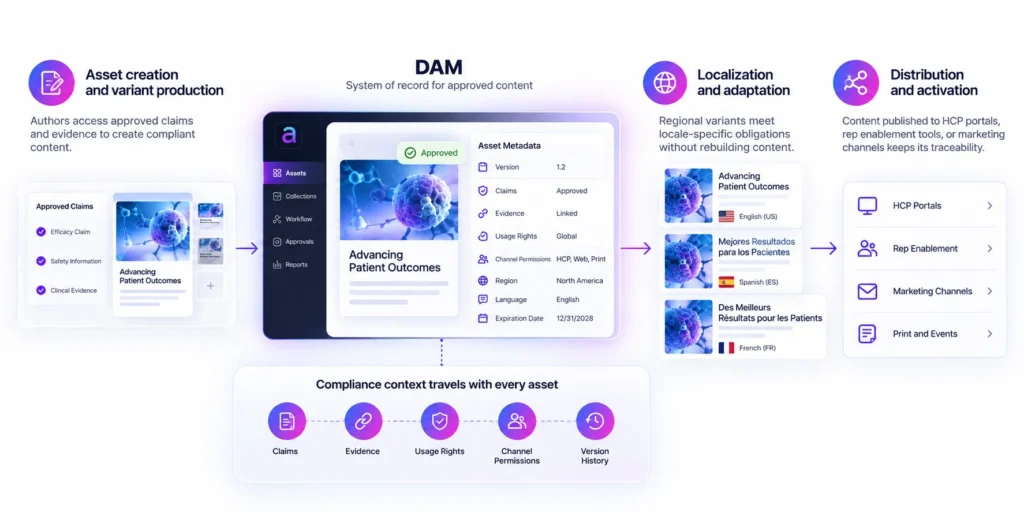
A DAM platform supports regulated content operations by serving as the system of record for approved content. It also carries the compliance context, usage rights, channel permissions, and version history attached to every asset. Teams can see how Aprimo supports life sciences organizations with this model.
The connection between DAM and regulated content management becomes critical at three points:
- Asset creation and variant production: a governed DAM gives authors access to approved claims and evidence instead of forcing manual lookup across systems.
- Localization and adaptation: regional variants meet locale-specific obligations without rebuilding compliant foundational content from scratch.
- Distribution and activation: content published to HCP portals, rep enablement tools, or marketing channels keeps its traceability to the approved version and its compliance record.
Governed Reuse Reduces the Compliance Tax on Localization
Localization is one of the highest-cost activities in regulated content operations. Every market variant must satisfy a distinct obligation set. When compliant foundational content is not structured for reuse, regional teams recreate work that already exists in approved form elsewhere in the organization.
A DAM that governs approved claims, reusable content modules, and locale-specific obligation libraries lets regional teams adapt content inside a governed framework. Less rework enters MLR. Evidence linkage holds. The compliance burden on regional teams drops without lowering the standard.
What Role Does AI Play in Regulated Content Workflows?
AI plays a bounded role in regulated content operations: it acts as a compliance assistant. It surfaces information, flags gaps, and reduces the manual effort of claims management. It is not an autonomous content generator, and treating it as one creates risk.
The most valuable applications fall into four categories:
- Claims matching: AI identifies relevant pre-approved claims from the content being authored, then calculates match scores so authors can assess alignment.
- Obligation surfacing: AI evaluates content type, audience, market, and channel to surface applicable requirements before review.
- Expiration monitoring: AI tracks substantiation and approval status across the asset library, then alerts teams when evidence nears expiration or regulatory updates affect downstream content.
- Variant impact analysis: AI identifies which assets need reassessment when a claim, reference, or regulatory requirement changes.
Each application reduces the manual burden on the people responsible for compliance without removing their accountability.
What AI Cannot Replace in Regulated Content Operations
Human accountability stays central. Electronic signatures, tiered review workflows, and audit trails exist because regulatory frameworks require human sign-off on promotional or medical affairs content. AI reduces friction and surfaces context, but it does not replace judgment.
Organizations that deploy AI well design the human-AI interaction carefully. Recommendations must be transparent, traceable, and open to human validation. They are inputs to a governed process, not outputs of one.
Why Regulated Content Management Belongs Inside the Content Operations Platform
Regulated content management works best when it is integrated into broader content operations infrastructure, not deployed as a standalone compliance system. Compliance context must be available wherever content is created, reviewed, adapted, or distributed. When RCM lives in a separate system, teams recreate the integration problem that makes review slow.
A content operations platform that unifies digital asset management, workflow automation, content planning, and compliance intelligence lets life sciences organizations manage the full regulated lifecycle in one governed environment. Authors work with compliance context present. Reviewers receive assets alongside their evidence and obligation documentation. Regional teams adapt content within a framework that preserves traceability. Distribution links approved assets to downstream channels while keeping the approval record attached.
The Compounding Return on Integrated Content Operations
Efficiency gains compound over time. An organization that governs approved claims as structured data builds a library of reusable, evidence-linked claims that speeds every later content effort. Localized variants produced inside a governed framework need less rework in review. Distribution with retained traceability reduces the audit burden when regulators ask questions.
Organizations that rely on disconnected point solutions never capture this return, because the integration work resets with every project.
How Should Life Sciences Teams Measure Compliance Efficiency?
Teams should track leading indicators of upstream compliance alongside the lagging indicators most organizations already use.
Most life sciences organizations measure regulated content through lagging indicators: MLR cycle time, revision rounds per asset, and volume of content rejected at review. These matter, but they show only where the process broke down, not why.
Leading indicators give a more useful picture:
- Claims coverage rate: the percentage of content submitted to MLR with complete evidence linkage.
- Obligation completion rate: whether applicable market and channel obligations were addressed before submission.
- Pre-approved claims utilization rate: how often authors draw on the governed claims library instead of introducing new claims that need fresh substantiation.
Tracking these upstream metrics shows where the process creates compliance debt long before it surfaces as a review delay. Teams can tie them to outcomes through content intelligence and performance reporting.
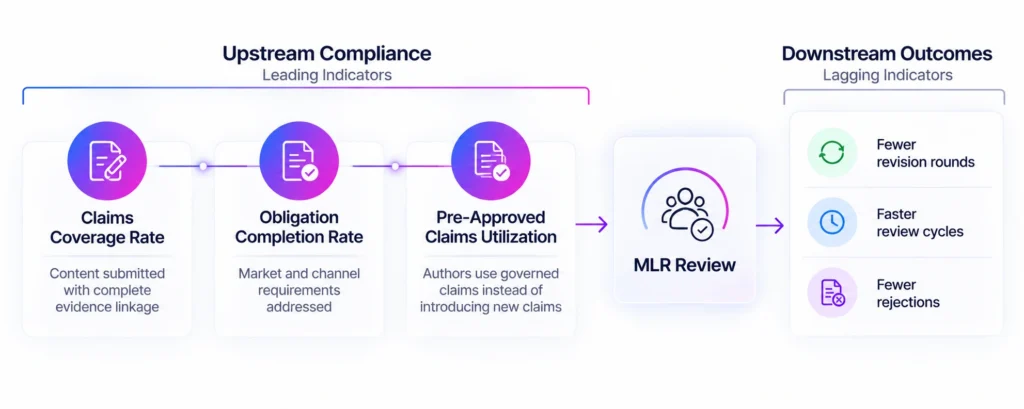
The organizations making the most progress connect upstream process metrics to downstream review outcomes, close the feedback loop between delay causes and what authors can change, then invest in the infrastructure that makes upstream compliance sustainable.
Compliance and Speed Become Conditions of the Same Process
Regulated content management is not a compliance project bolted onto a marketing workflow. It is a content operations capability. It determines how fast commercial teams reach market, how reliably regional teams meet local requirements, how confidently the organization responds when claims change, evidence expires, or regulations shift.
The MLR review cycle is the most visible symptom of whether that capability works, but the root causes run upstream, into authoring environments, claims governance, and the infrastructure connecting them. Pressuring reviewers to move faster treats the symptom. Building upstream compliance infrastructure treats the cause.
When claims are governed data, obligations surface during authoring, evidence travels with every asset, compliance and speed stop competing. They become conditions of the same well-built process. Life sciences organizations that build this infrastructure now will carry a structural advantage into every content challenge the market creates next.
FAQ
What is regulated content management in life sciences?
Regulated content management (RCM) in life sciences is the practice of governing claims, evidence, regulatory obligations, and approval records as structured, connected data throughout the content lifecycle. It covers how claims are authored, linked to evidence, reviewed, approved, then distributed across markets and channels. The goal is to make compliance context available during creation instead of reconstructing it during MLR review.
What causes long MLR review cycles in pharmaceutical and medical device companies?
The primary cause is missing compliance context in submitted content, not reviewer capacity. Claims arrive without complete evidence linkage. Applicable market and channel obligations go unaddressed upstream. Reviewers then rebuild the compliance record before they can evaluate the content, so timelines extend however efficiently the review team works. Resolving this requires shifting compliance context upstream into authoring and content governance workflows.
How does a digital asset management platform support regulated content compliance?
A DAM platform built for regulated environments stores approved assets with their compliance metadata: claim linkages, evidence references, approval records, usage rights, and channel permissions. This governance layer keeps distributed content traceable to its compliance record. It also ensures localized variants start from approved foundational content, then flags expiring substantiations or updated claims before they create exposure in distributed assets.
Can AI be used safely in regulated content workflows?
Yes, when AI works as a compliance assistant instead of an autonomous content generator. Effective uses include surfacing pre-approved claims, flagging applicable obligations by content type and market, identifying assets that need reassessment after evidence changes, plus monitoring claim expiration. Human review, electronic signatures, and audit trails remain required; AI reduces the manual burden on those humans without replacing their accountability.
What is the difference between a DAM built for regulated content and a general marketing DAM?
A general marketing DAM optimizes storage, retrieval, and distribution for brand consistency. A DAM built for regulated content adds governance layers: claims managed as structured data objects, evidence and obligation linkage, tiered approval workflows with audit trails, plus distribution controls that keep compliance traceability intact downstream. Teams on a general marketing DAM often hit compliance gaps at distribution, because the platform cannot enforce requirements at the asset level.
How should life sciences organizations measure regulated content efficiency?
Use both leading and lagging indicators. Claims coverage rate tracks whether content reaches MLR with complete evidence linkage. Obligation completion rate tracks whether market obligations were addressed before submission. Pre-approved claims utilization shows how often authors use governed claims. Lagging indicators such as MLR cycle time and revision rounds per asset remain relevant, but pairing them with upstream metrics shows where the process creates compliance debt before it becomes a review delay.
What does integrated regulated content management look like in practice?
Compliance context is present in every phase of the lifecycle, not just review. Authors work where pre-approved claims are accessible and obligations surface during drafting. Reviewers receive content with its evidence and obligation documentation. Regional teams adapt foundational content inside a governed framework. Distributed content keeps its link to the approval record. Integration across claims governance, digital asset management, workflow automation, and distribution infrastructure keeps individual teams from carrying the integration burden.