
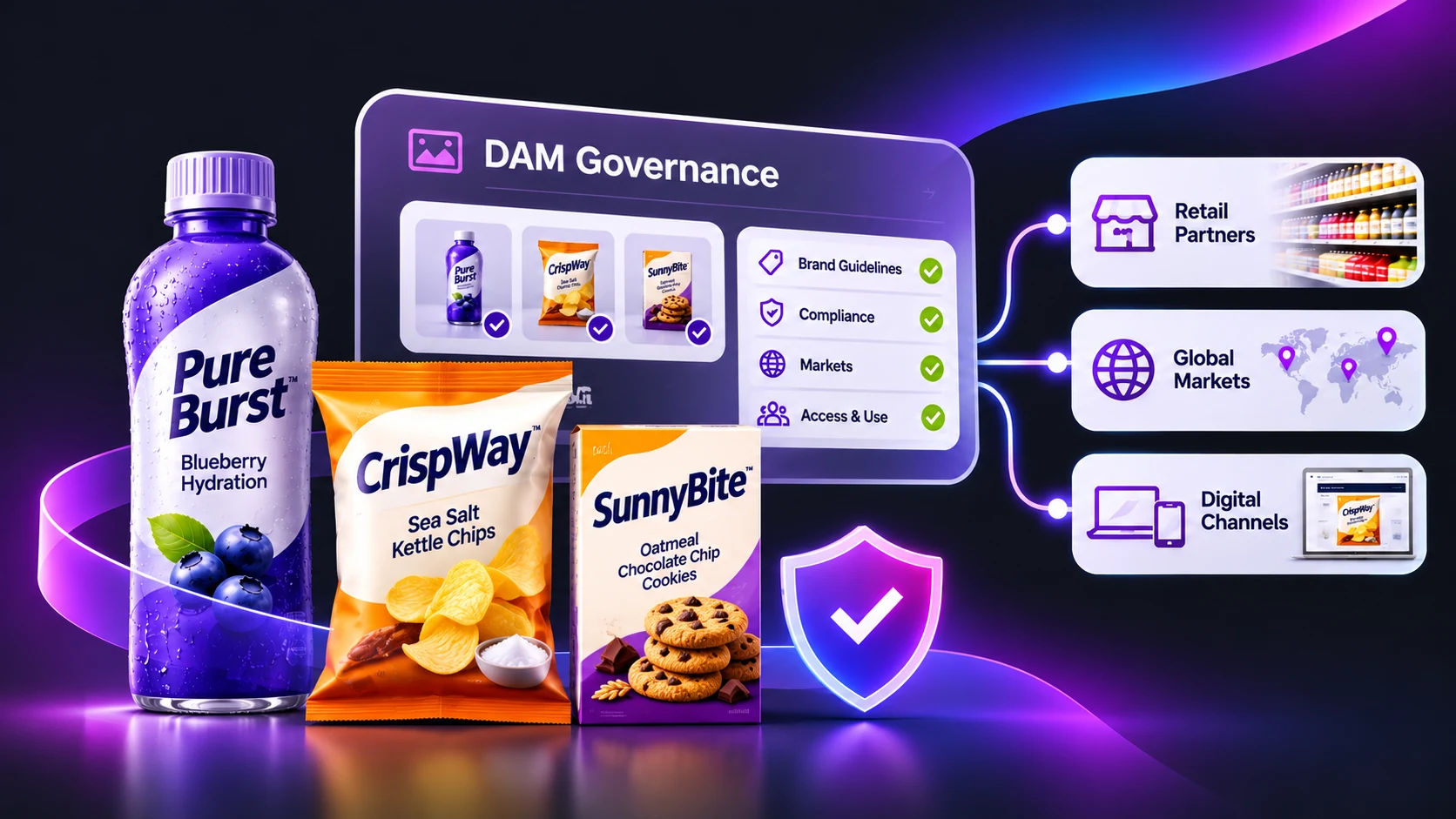
DAM governance sounds like an internal control problem, but for multi-brand enterprises it is a revenue problem. A logo with the wrong colors, an expired claim on a regional site, or an unapproved image in a partner campaign each carries a cost. The cost may be a legal review, a retraction, or lost trust. Multiplied across brands, markets, agencies, and channels, small lapses become a standing risk.
The difficulty grows with scale. Every brand has its own guidelines. Every market has its own rules. Every agency works in its own tools. Content spreads across file stores, websites, dealer networks, and social channels faster than any team can inspect it. Rules written in a brand book cannot enforce themselves.
This playbook explains how multi-brand enterprises build DAM governance that works across markets. It covers governance layers, roles, taxonomy, reach beyond the DAM, regulation, partner access, and measurement. The advice draws on patterns described in Aprimo’s 2027 DAM trends report and on Aprimo’s platform capabilities. The aim is a structure that protects brands without slowing the people who build them.
TL;DR
- DAM governance is the set of roles, rules, plus system controls that keep content accurate, approved, and on-brand.
- Multi-brand governance fails when rules depend on people remembering them instead of systems enforcing them.
- A layered model separates global rules, brand rules, market rules, and channel rules.
- Governance must reach content outside the DAM, because brand failures accumulate where content lands.
- Regulation now treats content governance as a legal duty, including AI disclosure and accessibility.
- Teams should measure governance with coverage, rework, and incident metrics, then review them regularly.
What is DAM governance?
DAM governance is the combination of policies, roles, workflows, plus system controls. Together they keep content in a digital asset management environment accurate, approved, rights-cleared, and on-brand. It turns guidelines into enforced behavior.
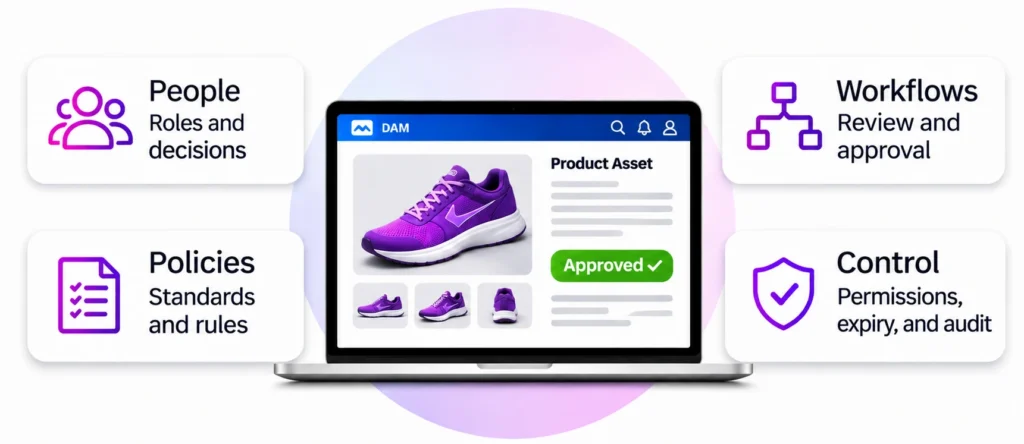
Definition: DAM governance is the set of policies, roles, plus automated controls that determine who may create, approve, use, or retire content. It also shows how the organization proves it followed those rules.
Governance has two halves. The human half assigns decision rights, defines standards, and handles exceptions. The system half enforces rules through permissions, workflows, metadata requirements, expiry dates, and audit trails. Strong programs build both. A policy without enforcement drifts. Enforcement without clear policy frustrates users.
For multi-brand enterprises, governance also has to flex. A parent company may require common standards for legal claims, rights, and disclosure. Each brand may add its own voice and visual rules. Each market may add local language, regulatory, and cultural requirements. The structure must hold all three without collapsing into either chaos or rigidity.
Aprimo’s brand safety and compliance page describes how the platform approaches this outcome. The sections below explain the playbook behind it.
Why does multi-brand DAM governance break down?
Multi-brand governance breaks down because content volume grows faster than the ability to review it, and content spreads beyond the systems that control it. Both trends are accelerating.
Research cited in the trends report shows the gap. Sixty-five percent of organizations report rising asset volumes year over year, while only 31% can consistently enforce brand guidelines, according to Gitnux and MARQ. Volume rises, but enforcement does not keep pace.
Dispersion compounds the problem. Enterprise content lives in agency file stores, CMS platforms, dealer networks, social channels, brand portals, and storage buckets left over from incomplete migrations. Brand and compliance failures accumulate in those places, not inside the DAM where controls are strongest.
Three failure patterns recur:
- Rules without enforcement: Guidelines exist, but nothing checks content against them before release.
- Visibility gaps: Nobody can say what is live across dealer sites, regional pages, or partner materials.
- Slow review: Manual approval creates queues, so teams bypass the process to meet deadlines.
The third pattern deserves attention. Governance that slows work gets avoided. A program that adds days to every approval invites shadow tools and unofficial copies, which defeat the purpose. Effective governance reduces friction for compliant work, so the easy path is also the right one.
Which governance layers does a multi-brand playbook need?
A multi-brand playbook needs four layers: global rules, brand rules, market rules, and channel rules. Each layer has an owner, a scope, and a limit on what it may override.
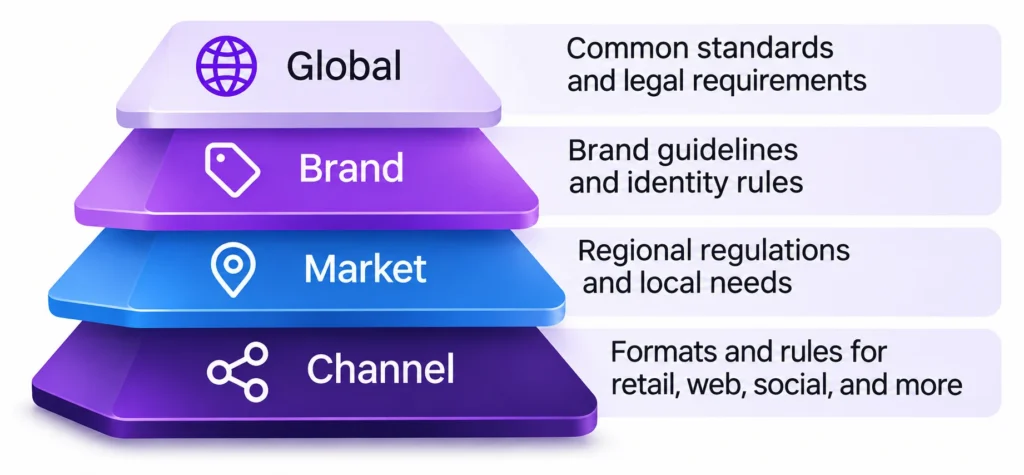
- Global layer: Non-negotiable standards for legal claims, rights, disclosure, accessibility, and security. Corporate legal or compliance owns it.
- Brand layer: Visual identity, tone, naming, and approved messaging for each brand. Brand teams own it.
- Market layer: Language, regulatory requirements, and cultural fit for each region. Regional leaders own it, within global limits.
- Channel layer: Format, size, and specification rules for each channel, such as web, social, print, or retail. Channel owners maintain it.
The hierarchy matters. Lower layers may add requirements, but they may not weaken higher ones. A market may require extra disclaimers. It may not drop a global rights rule. Writing that principle down prevents disputes.
A comparison shows why layering works better than a single rulebook:
- Single rulebook: One document covers everything. It grows long, conflicts appear, and nobody reads it.
- Layered model: Each layer covers one concern, with one owner. Conflicts resolve by precedence. Updates happen in one place.
Layering also helps systems. Workflows, permissions, and metadata requirements can map to layers. A global rule becomes a required field on every asset. A brand rule becomes a review step for that brand’s content. A market rule becomes a routing condition for local approval.
How should teams set roles and approval rules for DAM governance?
Teams should assign named owners to each layer, then design approval routes by risk. Low-risk content moves quickly, while high-risk content gets full review. Uniform approval for everything slows the business and protects little.
Five roles appear in most working programs:
- Governance lead: Maintains policies and resolves conflicts across layers.
- Brand owners: Define and update brand standards.
- Market owners: Adapt content to local needs, within global limits.
- Reviewers: Approve or reject content at defined gates.
- Asset managers: Maintain metadata, taxonomy, and library health.
Risk-based routing sets the pace. A social post that reuses approved components may need only automated checks. A regulated claim needs legal review. A campaign launching in a new market may need both. Matching effort to risk keeps queues short.
Automation supports the model. Aprimo’s Compliance agents check content for brand, legal, and regulatory risk before release. Critic agents evaluate quality and tone against defined standards. The agents handle routine checks, and human reviewers focus on exceptions.
Platform choice matters too. Aprimo’s Content Operations Platform keeps workflow, governance, and assets in one environment, so rules apply where work happens. Governance bolted on after the fact tends to create separate processes that users avoid.
Find the gaps in brand and content governance
Assess governance maturity, then prioritize the controls that matter most.
How do taxonomy and metadata keep brands consistent across markets?
Taxonomy keeps brands consistent by giving every asset the same descriptive, rights, plus status fields. Rules can then apply automatically. Without shared fields, governance depends on manual judgment.
Consistent metadata supports four governance functions:
- Routing: Fields such as brand, market, and content type decide which approval path applies.
- Rights enforcement: Expiry dates plus usage limits trigger alerts then takedowns.
- Reuse: Approved components become easy to find, so teams stop recreating them.
- Reporting: Governance coverage can be measured because the data exists.
Multi-market taxonomy needs care. Language, region, and channel fields should exist from the start. Shared terms should map to local variants, so a search in one language finds relevant content in another. A global-to-local model lets regional teams adapt approved content within controlled workflows, with traceability back to the source asset.
AI reduces the maintenance burden. Librarian agents classify assets and enrich metadata automatically. In The Forrester Wave™: Digital Asset Management Systems, Q1 2026, Forrester noted Aprimo’s strength in asset onboarding and metadata management, including AI-native metadata enrichment, according to Aprimo’s announcement. Aprimo received the highest possible score in the Governance criterion as well, based on the same source.
Metadata governance still needs an owner. Taxonomy changes ripple across routing, search, and reporting. A change process, with review and communication, keeps the system stable.
How can DAM governance reach content outside the DAM?
DAM governance reaches content outside the DAM through manage-in-place architecture, which discovers content where it lives and applies policy checks without forcing migration. Requiring every asset to enter the DAM first leaves most of the estate unchecked.
The trends report states the problem plainly. The DAM governs the content it contains and has historically had no visibility into the rest. Brand violations and compliance failures accumulate in the places content lands after leaving the DAM. Governance strategies built on the premise that all governed content must first come into the DAM will govern a shrinking fraction of the real estate.

A scalable DAM governance model keeps multiple brands, markets, and channels on-brand, compliant, and aligned.
Content Portfolio Management extends governance to websites, cloud storage, partner portals, and external systems. Three capabilities define it:
- Visibility: A view across the full estate, including content that never entered the DAM.
- Prioritization: AI-driven ranking of findings by severity and urgency.
- Coordinated action: Automated policy enforcement across thousands of assets.
The questions change as a result. Teams stop asking whether one asset is compliant. They ask for a brand health score across a dealer network, and for the sites with the highest-risk findings. Continuous monitoring replaces periodic audits.
Findings need prioritization, or teams drown in alerts. A ranked list, with the highest-risk items first, lets a small team act on what matters.
How should DAM governance handle regulation and AI content?
DAM governance should treat regulation as a design input, building disclosure, accessibility, and audit requirements into workflows before content ships. Retrofitting compliance after release costs more and misses cases.
The 2027 DAM trends report lists current obligations. EU AI Act Article 50 disclosure requirements took effect on August 2, 2026, requiring AI-generated content to be machine-readable, detectable, and disclosed. California SB 942 is in motion, and California AB 3030 already requires disclosure on generative AI patient communications. The EU Accessibility Act, in force since June 2025, sets accessibility standards for digital content. Broad green claims across the EU face a ban from September 2026 under the Empowering Consumers Directive.
Four governance capabilities respond:
- AI content detection: Flagging AI-influenced assets in the workflow.
- Provenance tracking: Recording which models produced content, using standards such as C2PA.
- Accessibility automation: Generating alt text, captions, and metadata.
- Immutable audit trails: Keeping records that meet regulatory traceability standards.
Human oversight remains central. Bynder and Censuswide’s 2025 State of DAM report found that nine in ten respondents consider human oversight essential for protecting brand identity in AI-generated content, according to the same trends report. AI-assisted governance makes oversight practical, since agents flag risk, score confidence, and route to reviewers only when the risk justifies it.
Legal teams should confirm which rules apply in each market. Obligations differ by jurisdiction, and the list will keep changing.
How should teams govern agencies and partners?
Teams should govern agencies and partners by providing controlled access to approved content, defined submission workflows, and clear rules on rights. External contributors are a major source of ungoverned content.
Four practices help:
- Scoped access: Partners see only the assets and brands they need, for the time they need them.
- Brand portals: Self-service portals deliver approved assets with usage guidance, so partners do not request files by email.
- Submission workflows: Agency work enters through defined review steps before it joins the library.
- Rights clarity: Usage terms, expiry dates, and regional limits travel with every asset.
Dealer and franchise networks need particular attention. One team in the trends report could not say what was live across 400 dealer sites. Manage-in-place scanning with brand portals addresses that gap. One controls what partners receive, while the other checks what they publish.
Contracts and onboarding complete the picture. Partners should receive brief training on brand standards and tools. Agreements should state expectations for approval, rights, and corrections. Clear terms reduce disputes when problems arise.
How can teams measure DAM governance?
Teams can measure DAM governance with coverage, rework, cycle time, and incident metrics, reviewed on a regular schedule. Measurement shows whether the program protects brands or only documents intent.
Six measures give a balanced view:
- Metadata completeness: The share of assets with required fields filled.
- Rights coverage: The share of assets with valid usage rights and expiry dates.
- Estate coverage: The share of known content locations scanned for policy compliance.
- Rework rate: The share of content returned after review.
- Approval cycle time: Days from submission to release, by risk tier.
- Incident count: Off-brand or non-compliant content that reached publication.
Each metric needs a baseline and an owner. Trends matter more than single readings. A falling rework rate with stable cycle time signals clearer rules. A rising incident count with falling coverage signals gaps.
A formal maturity assessment helps set priorities. Aprimo’s content governance maturity assessment offers a structured view of current practice. Results can guide which layers, controls, or integrations to strengthen first.
Building DAM governance that grows with the brand portfolio
DAM governance works for multi-brand enterprises when layers, owners, and system controls line up. Global rules protect what cannot fail. Brand rules protect identity. Market rules respect local needs. Channel rules keep output usable. Automation handles routine checks, and people handle judgment.
The structure must reach beyond the DAM. Brand failures accumulate in dealer sites, partner portals, and regional pages. Manage-in-place visibility, prioritized by risk, turns governance from a repository exercise into a portfolio discipline.
Regulation raises the stakes. AI disclosure, accessibility, and green claims rules make governance a legal duty. Teams that build compliance into workflows now will avoid costly retrofits later. The same investment also speeds approvals, because reviewers receive content that already meets the basic rules.
Teams that want to see the controls working on their own brands can book a demo, then compare results against the layered model above.
FAQ
How is DAM governance different from brand management?
Brand management defines how a brand should look and sound. DAM governance enforces those standards through roles, workflows, and system controls. Governance also covers rights, compliance, and audit records.
Who should own governance in a multi-brand company?
A central governance lead should maintain policies, with owners for each brand and market. Legal or compliance should own the global layer. Clear precedence rules prevent conflicts between layers.
Can governance slow down content production?
It can, if every asset follows the same heavy approval path. Risk-based routing keeps low-risk content moving, while regulated content gets full review. Automated checks reduce manual effort on routine items.
What is manage-in-place governance?
Manage-in-place governance applies policy checks to content where it already lives, without forcing migration into a central repository. It suits dealer sites, partner portals, and agency file stores.
How often should governance policies be reviewed?
Quarterly reviews suit most programs, with extra reviews when regulations change. Metrics such as rework rate and incident count show when policies need adjustment.
Does AI help with DAM governance?
Yes. Compliance agents plus critic agents check content against defined standards. They flag risk, then route exceptions to people. Audit logging records each action. Human reviewers still own the standards.
Related reading: AI governance models for enterprise content operations, introducing Content Portfolio Management.