

Enterprise AI agents are reshaping content operations from reactive task management into autonomous, goal-driven workflows that execute without constant human oversight.
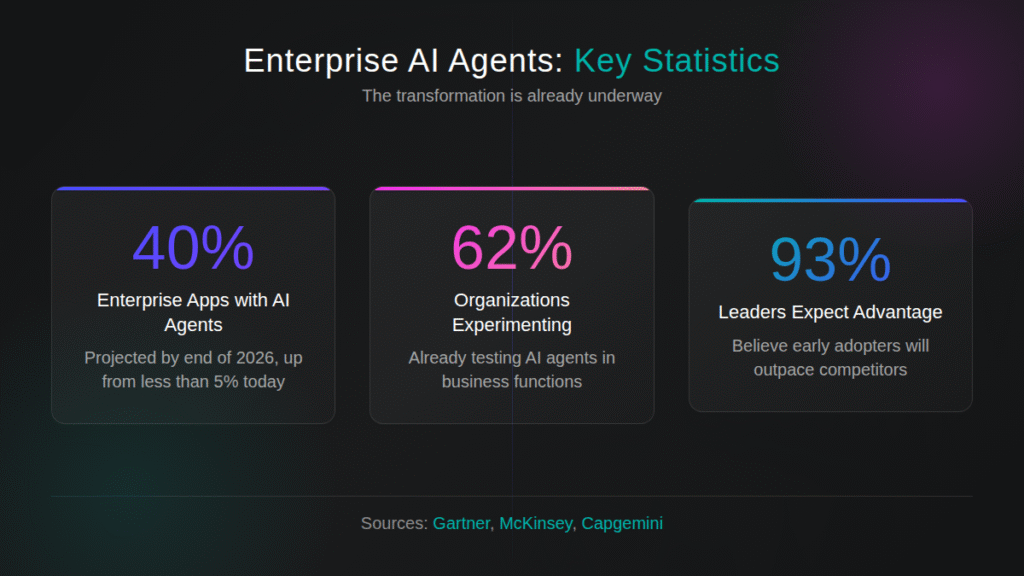
- 40% of enterprise applications will feature task-specific AI agents by the end of 2026, signaling a massive redirection for organizational operations.
- 62% of organizations are already experimenting with AI agents, with marketing and sales use cases driving the highest revenue increases.
- AI workflows in marketing deliver contextual decision-making, real-time adaptation, and multi-step execution that learns from every interaction.
- The difference between AI agents and automation determines whether your content team scales strategically or stays stuck in manual processes.
Organizations that embed AI agents into content workflows now will define the competitive standard for the next decade.
Marketing teams have entered unfamiliar territory. The volume of content required to compete across channels has outpaced what human teams can produce, review, and optimize manually. Traditional automation helped, but it hit a ceiling. Workflows built on if-then logic can’t adapt when audience behavior shifts, compliance requirements change, or campaign performance suggests a different approach mid-flight. By the end of 2026, 40% of enterprise applications will include task-specific AI agents, an eightfold increase from current levels.
Enterprise AI agents change what’s possible. These systems operate autonomously within defined parameters, making decisions, executing complex tasks, and improving their performance based on outcomes. Content operations teams can now shift from manually managing workflows to partnering with intelligent systems that handle execution while humans focus on strategy.
What Are Enterprise AI Agents, and How Do They Transform Marketing?
Before examining how AI agents reshape content operations, it’s important to understand what distinguishes them from the automation tools most teams already use. The terminology matters because many vendors have begun applying the “agent” label to systems that don’t actually qualify. The most common misconception is referring to AI assistants as agents, a misunderstanding known as “agentwashing.”
True AI agents for marketing possess specific characteristics that separate them from traditional automation. They demonstrate autonomy by operating independently within established guardrails. They exhibit learning behavior, improving their decisions based on feedback and outcomes. They maintain goal orientation, pursuing objectives rather than simply completing assigned tasks. And they show adaptability, adjusting strategies when conditions change rather than following the same predetermined path regardless of circumstances.
Agentic AI Capabilities
McKinsey’s research shows that 23% of organizations are already scaling agentic AI systems in at least one business function, with marketing and sales among the leading use cases. What makes these implementations different from previous AI tools is their capacity for autonomous action.
Consider how a traditional workflow handles content approval. A piece moves through a fixed sequence of reviewers regardless of what it contains or who’s available. An AI agent, by contrast, can assess the content’s risk level, route it to appropriate reviewers based on their expertise and availability, flag potential compliance issues before they reach human eyes, and adjust the timeline based on campaign priority. The difference is contextual intelligence applied to execution.
AI workflows in marketing built around agents can adapt in real time based on what’s happening rather than following predetermined routes. When campaign performance data suggests a different creative direction, agents can surface recommendations, trigger new asset creation workflows, and adjust distribution schedules without waiting for manual intervention at each step.
How Does Agentic AI vs Automation in Traditional Systems Compare?
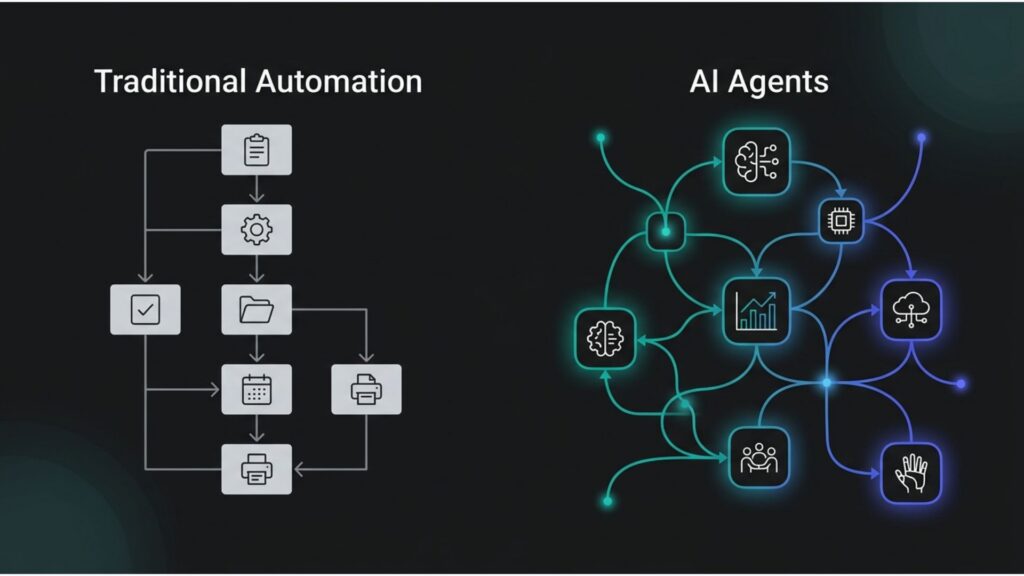
The distinction between AI workflows and traditional automation reflects how work gets done. Understanding this difference helps teams identify where agent-based approaches will deliver the greatest impact and where simpler automation remains appropriate.
Traditional automation excels at consistent, rule-based execution. When the task is clear, the sequence is fixed, and exceptions are rare, automation performs reliably at scale. Processing thousands of invoices, sending confirmation emails, or routing support tickets based on keywords all fit this model well. The system doesn’t need to think because thinking would slow it down.
AI agents handle a different category of work. They thrive in environments where context matters, where the optimal action depends on varying factors, and where learning from outcomes can improve future performance. Campaign orchestration, content optimization, personalization at scale, and compliance review all involve decisions that benefit from intelligence applied at the moment of execution.
Key Differentiators: AI Agents vs. Automation
The core differences in agentic AI vs automation come down to five factors: initiation, human involvement, learning, scalability, and complexity handling.
Regarding initiation, automation systems require human triggers to start. AI agents can identify opportunities and initiate actions independently. A traditional workflow begins when someone clicks a button or submits data. An agent monitoring content performance might notice declining engagement and automatically begin testing alternative creative approaches.
Human involvement differs as well. Automation depends on people to define every step and trigger actions. AI agents need initial setup and goal definition but operate independently within those parameters, making choices and taking action without constant oversight.
Learning capabilities clearly separate the two approaches. Workflows stay the same unless manually updated. AI agents grow more capable with each task, expanding their effectiveness through experience. They can handle increasingly complex work over time, while traditional automation maintains its original limitations.
Scalability follows different patterns. Both can handle high volumes, but agents scale intelligence alongside volume. Running a thousand personalization decisions through traditional automation means applying the same rules a thousand times. Running them through AI agents means making a thousand contextually appropriate decisions, each informed by relevant signals.
Complexity handling reveals the biggest gap. Traditional AI workflows follow a predefined sequence of steps, automating repetitive processes that require consistency and rule-based execution. AI agents enable dynamic automation by making context-aware decisions and adjusting actions in real time, making them suitable for tasks involving unpredictable scenarios.
What Types of AI Agents Improve Content Operations?
Understanding the categories of AI agents helps content leaders identify where autonomous capabilities deliver the most value. While implementations vary across platforms, enterprise solutions typically organize agents into specialized functional areas that address distinct aspects of content operations.
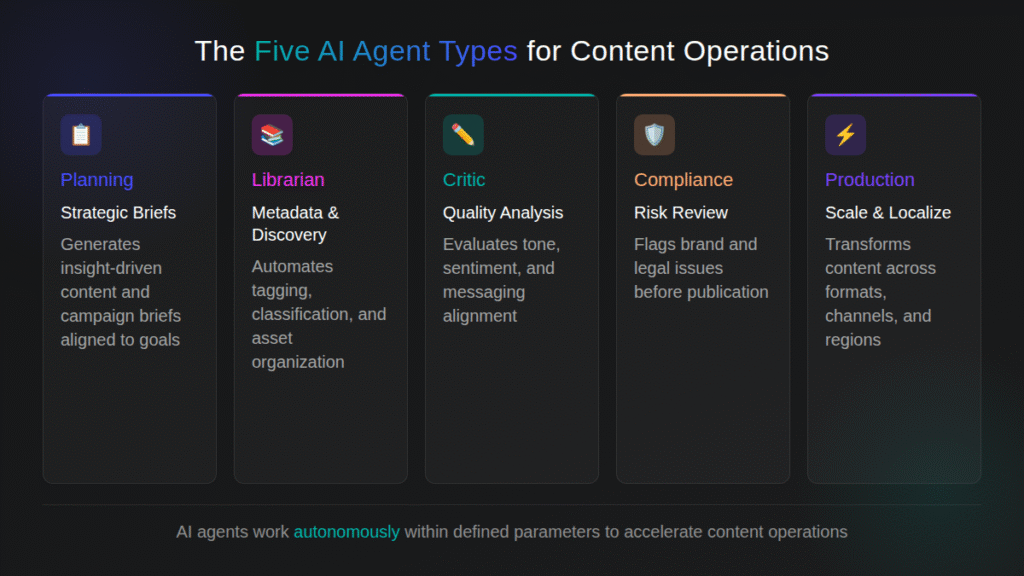
Each agent type handles specific challenges within the content lifecycle. Some focus on planning and strategy. Others handle the operational work of asset management and metadata. Still others provide quality control, compliance verification, or production scaling. Together, they create an ecosystem where intelligent automation covers the full span of content operations.
The Five Core Agent Categories
Planning Agents generate structured, insight-driven content and campaign briefs. They analyze performance data, audience signals, and brand guidelines to produce actionable recommendations that align creative work with business objectives. Instead of teams spending hours assembling briefs from scattered data sources, planning agents synthesize available information into ready-to-use starting points.
Librarian Agents automate the creation, enrichment, and management of metadata. They classify assets by identifying content types and applying custom taxonomies, ensuring assets remain consistently organized, discoverable, and reusable across the enterprise. Librarian agents address one of the most persistent pain points in content operations: teams spending more time searching for assets than creating them.
Critic Agents analyze content tone, sentiment, and clarity to help teams improve copy and creative quality. They apply subjective assessments to understand how well assets align with intended messaging goals, identify inconsistencies, and offer AI-generated suggestions for improvement before content reaches review stages.
Compliance Agents review content for brand and legal risks, automatically flagging non-compliant materials. For regulated industries like financial services or life sciences, these agents provide essential protection against costly violations while accelerating review cycles.
Production Agents generate, adapt, and localize content using intelligent automation trained on brand standards. They handle transformations across formats, channels, and regions, enabling teams to scale content personalization without proportionally increasing headcount.
Why Should Marketing Teams Prioritize AI Agents Now?
The business case for enterprise AI agents in content operations has moved beyond theoretical benefits. Organizations redesigning workflows around AI see the highest EBIT impact.
By 2028, at least 15% of day-to-day work decisions will be made autonomously through agentic AI. In business operations, AI agents will take on decision-making responsibilities that currently require human oversight. For content operations specifically, workflows will adapt in real time, assets will enrich themselves, and reviews will happen proactively rather than reactively.
The Competitive Advantage Window
According to research, 93% of leaders believe that those who successfully scale AI agents in the next year will gain an edge over their peers. This sense of urgency reflects both the maturity of current technology and the compounding nature of the advantages early adopters gain.
Organizations that deploy AI agents now benefit from several dynamics. Their agents learn and improve while competitors remain in planning phases. Their teams develop operational expertise that can’t be acquired quickly. Their content operations establish new performance baselines that redefine what’s possible. And their technology infrastructure evolves to support increasingly sophisticated AI capabilities.
The alternative is playing catch-up in an environment where leading organizations have accumulated months or years of optimization. Content operations built around AI agents work smarter with each iteration, widening the gap between early adopters and laggards.
What Outcomes Can Teams Expect from AI-Powered Workflows?
Measuring the impact of AI agents requires looking beyond efficiency metrics alone. While production velocity and cost savings matter, the full picture includes quality improvements, strategic capacity, and competitive positioning that traditional ROI calculations may undervalue.
Measuring AI Agent Impact
Operational metrics tell part of the story. Time-to-market for campaigns compresses as agents automatically handle routine decisions. Content production volume increases without proportional staffing growth. Asset reuse rates improve when intelligent systems make relevant content easier to find and adapt. Review cycle duration shrinks when compliance and quality checks happen automatically.
Business metrics connect content activities to revenue outcomes. Engagement rates improve when personalization happens at scale. Conversion rates increase when the right content reaches the right audience at the right moment. Customer lifetime value grows when consistent, relevant experiences build stronger relationships.
The organizations seeing meaningful results from content AI often report improvements across multiple dimensions simultaneously. Production timelines compress while quality improves. Volume increases while compliance incidents decrease. Teams shift focus from repetitive tasks to work that leverages their expertise and judgment.
How Should Organizations Successfully Implement AI Agents?
More than 40% of agent projects will fail by 2027, according to analysis. This sobering projection underscores the importance of thoughtful implementation rather than rushing to deploy technology without proper foundations.
The most successful implementations of AI agents for marketing begin with focused pilots rather than enterprise-wide rollouts. Teams identify specific pain points where autonomous capabilities can deliver quick wins, deploy solutions, measure results, and expand based on demonstrated value.
Implementation Best Practices
Start with high-impact, low-risk use cases. Metadata automation, content tagging, and initial quality screening are ideal starting points because they involve repetitive decisions with measurable outcomes and limited downside if agents make mistakes during the learning phase.
Ensure data quality before deployment. AI agents are only as effective as the data they can access. Organizations with fragmented, inconsistent, or poorly governed data will see disappointing results regardless of how sophisticated their AI technology may be.
Build governance frameworks early. Define how agents will make decisions, what boundaries they’ll operate within, when they should escalate to humans, and how their performance will be monitored and corrected.
Plan for change management. Teams need to understand what agents will handle, what they’ll continue doing themselves, and how their roles will evolve. Without this clarity, resistance undermines adoption.
Integrate agents into existing workflows. The goal isn’t to replace everything at once but to embed intelligent automation into processes that already work. Selective implementation reduces disruption while incrementally demonstrating value.
What Does the Future Hold for AI Agents in Marketing?
The single-purpose agent model is already outdated. Both Forrester and Gartner see 2026 as the breakthrough year for multi-agent systems, where specialized agents collaborate under central coordination. One agent qualifies leads, another drafts personalized outreach, and a third validates compliance requirements. They maintain shared context and hand off work without human intervention.
This evolution points toward content operations where human teams focus almost entirely on strategy, creativity, and judgment while interconnected agents handle execution across the entire content lifecycle. The shift amplifies human expertise by removing the operational burden that consumes so much of most marketing teams’ bandwidth today.
When AI is embedded in enterprise workplace applications, it reshapes how teams work, decide, and execute. For content operations, every tool in the marketing technology stack will likely incorporate some form of intelligent assistance or autonomous capability.
Frequently Asked Questions
What is the difference between AI agents and traditional marketing automation? Traditional automation follows predefined rules and sequences without adapting to changing conditions. AI agents operate autonomously within defined parameters, making contextual decisions, learning from outcomes, and adjusting their approach based on real-time signals. Automation executes tasks; agents pursue goals.
How quickly can organizations see ROI from AI agent implementations? Organizations report meaningful efficiency gains, with studies showing AI agents can reduce time spent on routine content tasks while improving quality and consistency. Exact ROI depends on implementation scope and organizational readiness.
Are AI agents reliable enough for enterprise content operations? Production-ready AI agents have been operating in enterprise environments since 2023. The key is implementing proper governance frameworks, including audit trails, confidence scoring, and automated escalation when agents encounter situations outside their trained parameters. This combination of autonomy and accountability builds the trust necessary for scaled deployment.
What skills do marketing teams need to work effectively with AI agents? Teams need to shift from task execution to strategic direction-setting. Skills include defining clear objectives for agents, interpreting performance data, making judgment calls that agents escalate, and continuously refining the parameters within which agents operate. The focus moves from “doing the work” to “directing intelligent systems that do the work.”
Get Started with Intelligent Content Operations
The transformation of content operations through AI agents is already underway. Organizations that embrace this shift position themselves to create more, move faster, and connect with audiences more effectively than those still relying on manual processes and traditional automation.
Aprimo’s Agentic DAM platform delivers the AI agents, intelligent workflows, and integrated capabilities that enterprise content teams need to compete. From Planning Agents that generate insight-driven briefs to Production Agents that scale content across formats and regions, Aprimo provides production-ready AI that’s been running in customer environments since 2023. Get a demo of Aprimo and discover what’s possible when intelligent automation meets enterprise content management.