

Key Takeaways
Your AI content strategy is only as strong as the infrastructure beneath it.
- Seventy-one percent of consumers expect personalized interactions, and 76% get frustrated when brands fall short.
- AI can generate content at scale, but without centralized digital asset management, that content becomes scattered, inconsistent, and impossible to optimize.
- The brands winning at personalization share one thing in common: a unified content foundation that connects assets, metadata, and workflows.
- If your content experience feels disconnected, the problem likely starts with your infrastructure, not your creativity.
Every marketing team has felt it: the moment when a brilliant campaign falls flat because the right asset couldn’t be found, the wrong version went live, or personalization efforts delivered generic results instead of tailored ones. These failures rarely stem from a lack of creativity or effort. They stem from a fractured content foundation that undermines everything built on top of it.
The promise of content operations has never been greater. AI can now generate copy, images, and video at unprecedented speed. Personalization engines can deliver individualized interactions across channels. Yet many organizations find their results still disappoint customers and exhaust teams. The disconnect reveals an uncomfortable truth: technology alone cannot fix a broken foundation.
According to McKinsey research, 71% of consumers expect companies to deliver personalized interactions, and 76% feel frustrated when this expectation goes unmet. Meeting these demands requires more than deploying the latest AI tools. It requires building the underlying infrastructure that makes personalization possible.
What Makes a Content Experience Succeed or Fail?
A content experience encompasses every interaction a customer has with your brand’s content, from the first ad impression to the post-purchase follow-up email. It includes the relevance of what they see, the consistency across channels, and the ease with which they can find what they need. When done well, these interactions feel seamless and personal. When done poorly, they feel disjointed and forgettable.
The difference between success and failure often comes down to infrastructure rather than strategy. Many organizations invest heavily in content creation while neglecting the systems that store, organize, and deliver that content. They build elaborate personalization strategies on foundations of scattered files, inconsistent metadata, and disconnected workflows. The result is a customer journey that promises personalization but delivers frustration.
Consider what happens when a global brand launches a campaign across twelve markets. Without centralized digital asset management, each regional team maintains separate file systems. Version control becomes impossible. Brand consistency erodes. The experience varies wildly depending on which market a customer encounters, and the brand’s promise of unified engagement rings hollow.
Why Does AI Content Fail Without Centralized Asset Management?
The explosion of AI content tools has created both opportunity and chaos. Marketing teams can now generate more content than ever before, but generation without organization leads to what industry experts call a “content graveyard,” a repository where assets go to be forgotten rather than leveraged.
AI excels at creating content variations, generating metadata suggestions, and personalizing messaging at scale. What AI cannot do is impose order on a fragmented ecosystem. When assets live in multiple systems, when metadata is inconsistent or missing, and when no single source of truth exists, even the most sophisticated AI struggles to deliver coherent results.
The challenge intensifies as personalization demands grow. Delivering AI-driven personalization requires connecting audience intent with the right assets at the right moment. This connection depends entirely on having organized, enriched, and accessible content. A personalization engine that cannot find the correct asset variation for a specific audience segment will default to generic content, defeating the entire purpose of the investment.
McKinsey’s research on personalized marketing emphasizes that digital assets should be stored in a single, centralized system that integrates with downstream channels. This integration enables easy search, reuse, and dynamic delivery of assets. Without this foundation, personalization remains theoretical rather than practical.
What Are the Three Pillars of a Strong Content Foundation?
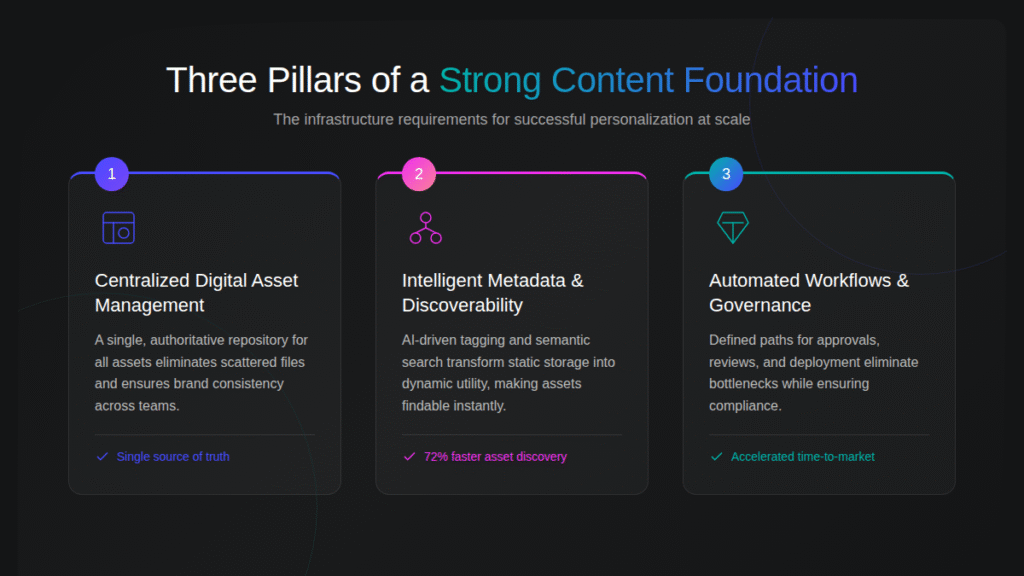
Building results that deliver requires attention to three interconnected elements. Each pillar supports the others, and weakness in any one area compromises the entire structure.
Centralized Digital Asset Management
The first pillar is a single, authoritative repository for all digital assets. This means images, videos, documents, templates, and every other content type living in one accessible location. Centralization eliminates the chaos of scattered files across shared drives, email attachments, and individual hard drives. It ensures that everyone works from the same approved assets and that outdated versions cannot accidentally reach customers.
Centralization also enables governance. When assets exist in one system, organizations can enforce brand guidelines, manage usage rights, and maintain compliance with regulatory requirements. For industries like financial services, healthcare, and pharmaceuticals, this governance is essential for avoiding legal and reputational risk.
Intelligent Metadata and Discoverability
The second pillar transforms static storage into dynamic utility. Assets are only valuable if people can find them when needed. Intelligent metadata, whether applied manually or through AI-driven predictive tagging, makes content discoverable through natural language search and contextual filters.
Modern content operations platforms use semantic search capabilities that understand intent rather than matching keywords alone. When a marketer searches for “summer campaign lifestyle images featuring families,” the system should surface relevant results even if those exact words do not appear in the file names. This discoverability directly impacts content reuse rates and time-to-market for campaigns.
Automated Workflows and Governance
The third pillar addresses the processes that move content from creation to deployment. Manual routing of approvals, ad-hoc review cycles, and inconsistent handoffs between teams create bottlenecks that slow campaigns and introduce errors. Automated workflows ensure that content follows defined paths, receives appropriate reviews, and reaches the right channels without unnecessary delays.
Governance automation also addresses the growing concern around AI-generated content. As organizations adopt AI for content creation, they need systems that can detect AI influence, trigger appropriate reviews, and ensure that generated content meets brand and compliance standards before publication.
How Does Personalization at Scale Depend on Your Content Infrastructure?
Personalization has evolved from a competitive advantage to a baseline expectation. According to Shopify’s analysis of personalization trends, 81% of customers prefer companies that offer personalized interactions. Meeting this preference requires understanding your audience and having the content infrastructure to act on that understanding.
Real-time personalization depends on the ability to match audience signals with appropriate content instantly. When a visitor arrives on your website, personalization engines analyze their behavior, demographics, and intent to determine what content will resonate most. This determination is meaningless if the system cannot then retrieve and serve the optimal asset within milliseconds.
The connection between personalization and infrastructure becomes clearer when examining common failure modes. Brands often struggle because their content exists in silos that personalization engines cannot access. Or metadata is too sparse to enable meaningful matching between audience segments and asset variations. Or the sheer volume of content makes it impossible for teams to maintain the organization required for effective personalization.
Successful personalization requires what some call content intelligence: the ability to understand how content performs, where gaps exist, and which assets drive the highest engagement for specific audiences. This intelligence emerges from systems that track content performance and feed insights back into creation and optimization decisions.

What Role Does Agentic AI Play in Delivering Better Results?
The next evolution in content operations moves beyond AI that assists to AI that acts autonomously. Agentic AI describes systems that can perceive their environment, make decisions, and execute multi-step processes without constant human intervention. In content operations, this means AI that can automatically enrich metadata, route assets through approval workflows, identify compliance issues, and optimize content placement based on performance data.
The impact on delivering consistent, personalized interactions is substantial. Rather than relying on manual processes that cannot scale, organizations can deploy intelligent automation that maintains quality and consistency across growing content volumes. A Librarian Agent, for example, might automatically categorize incoming assets, apply predictive metadata, and route content to appropriate collections based on predefined rules. A Compliance Agent might scan content for brand guideline adherence or regulatory issues before publication.
These capabilities only function effectively when built on a solid content foundation. Agentic AI requires training data, clear taxonomies, and connected systems to operate intelligently. Organizations that invest in AI automation without first addressing foundational infrastructure find that their agents make poor decisions based on incomplete or inconsistent information.
How Can You Measure Success?
Improving your results requires metrics that connect infrastructure investments to business outcomes. Traditional vanity metrics like page views or social shares offer limited insight. More meaningful measures focus on efficiency, reuse, and customer impact.
Content reuse rates indicate whether your organization is maximizing the value of created assets or constantly reinventing the wheel. Time-to-market metrics reveal whether workflows accelerate or impede campaign execution. Customer engagement patterns, analyzed at the content level, show which assets and variations drive meaningful interactions versus those that fall flat.
The most sophisticated organizations also track content gaps. They identify where personalization opportunities exist but appropriate content does not, using these insights to inform creation priorities. This approach shifts content strategy from reactive production to proactive planning based on measurable opportunity.

Frequently Asked Questions
What is a content experience? A content experience encompasses every interaction a customer has with your brand’s content across all channels and touchpoints. It includes the relevance, consistency, timing, and ease of access that shape how audiences perceive and engage with your content throughout their journey.
Why does AI-generated content often fail to deliver results? AI excels at generating content quickly but cannot organize, govern, or optimize that content without proper infrastructure. When assets are scattered across systems with inconsistent metadata, AI tools lack the context needed to deliver personalized, on-brand interactions at scale.
How does digital asset management improve personalization? Digital asset management provides the centralized, organized, and enriched content library that personalization engines need to function effectively. When assets are properly tagged, stored, and connected to audience data, personalization systems can match the right content to the right audience in real time.
Transform Your Content Experience Strategy
The gap between aspirations and reality often comes down to foundation. Organizations that invest in centralized digital asset management, intelligent metadata, and automated workflows create the conditions for personalization success. Those that chase the latest AI tools without addressing infrastructure find themselves generating more content that delivers less impact.
Building this foundation requires choosing partners who understand the full content lifecycle, from planning through performance measurement. Aprimo delivers an agentic digital asset management platform that unifies content operations, automates workflows, and enables personalization at scale. Schedule a demo to see how the right foundation can transform your results.