

Key Takeaways
AI-generated content is scaling faster than most organizations can govern it.
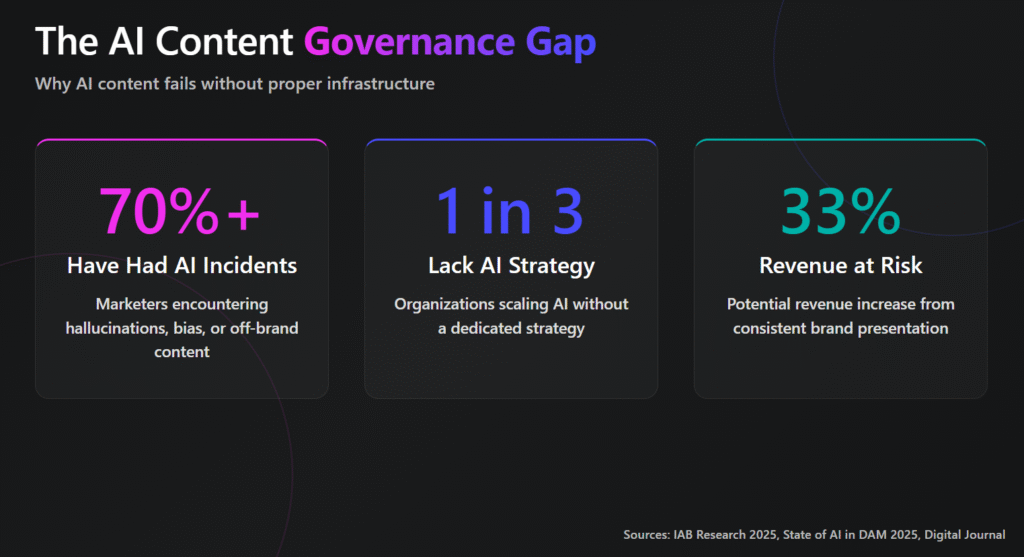
- Over 70% of marketers have already encountered AI-related incidents including hallucinations, bias, or off-brand content
- Without structured content infrastructure, AI amplifies existing problems rather than solving them
- DAM systems provide the governance, metadata, and workflows that AI needs to stay on-brand at scale
- Organizations with strong content foundations report measurable productivity gains and significant risk reduction
The solution isn’t better AI models. It’s a better content infrastructure.
Generative AI has unlocked unprecedented content production capabilities. Marketing teams can now produce blog posts, social media content, product descriptions, and campaign assets at speeds that would have seemed impossible just two years ago. Yet something unexpected is happening: the more content organizations generate with AI, the more problems they encounter. Off-brand messaging slips through. Inconsistent terminology confuses customers. Compliance violations pile up. The promise of AI efficiency gives way to a reality of manual cleanup, reputation risk, and frustrated teams.
The culprit isn’t the AI itself. According to research from the Interactive Advertising Bureau, over 70% of marketers have already encountered an AI-related incident in their advertising efforts, yet less than 35% plan to increase investment in AI governance. This gap reveals a fundamental misunderstanding about how content operations actually function when AI enters the picture. Organizations are investing heavily in generation capabilities while neglecting the infrastructure that makes those capabilities sustainable. The result is a content paradox: infinite generation capacity paired with finite governance ability. And when you feed chaos into an AI engine, you get chaos out at scale.
What Happens When AI Content Management Lacks Structure?
The challenges with ungoverned AI content extend far beyond occasional typos or awkward phrasing. When marketing teams deploy generative AI tools without proper content infrastructure, they create systemic vulnerabilities that compound over time. Each piece of AI-generated content that bypasses brand governance weakens the consistency that customers rely on. Each asset created without proper metadata becomes impossible to find, track, or reuse. Each workflow shortcut introduces compliance risk that may not surface until an audit or public incident.
Research on AI adoption in DAM found that one in three organizations still lack a dedicated AI strategy, even as they scale AI content production. This strategic gap creates a dangerous disconnect between what AI can produce and what organizations can safely publish. Teams generate thousands of content variations without systems to ensure brand alignment, track usage rights, or maintain version control. The efficiency gains from AI generation evaporate when content teams spend hours correcting errors, hunting for approved assets, or rebuilding governance frameworks from scratch.
The Hidden Costs of Ungoverned AI Content
Brand consistency has measurable financial impact. Industry research indicates that consistent brand presentation across all channels can increase revenue by up to 33 percent. Conversely, inconsistency actively damages the brand equity organizations have worked years to build. When AI-generated content sounds different across channels, when product descriptions contradict each other, when campaign messaging drifts from established positioning, customers lose confidence in what the brand actually represents.
The operational costs prove equally significant. Marketing teams report spending substantial time on content correction and quality control that could be redirected toward strategic work. Legal and compliance teams face growing review backlogs as AI-generated content volume outpaces human oversight capacity. And the risk of regulatory violations, particularly in industries like financial services, healthcare, and pharmaceuticals, can result in fines and reputational damage that far exceed any efficiency gains from faster content production.
How Does a DAM System Serve as Content Infrastructure for AI?
A digital asset management system functions as the foundational infrastructure that AI content tools require to operate effectively. Think of DAM as the backbone that gives AI-generated content structure, context, and governance. Without this backbone, AI produces isolated assets that lack the metadata, compliance verification, and workflow integration necessary for enterprise-scale content operations. With it, AI becomes a powerful extension of existing content capabilities rather than a chaotic addition to an already fragmented landscape.
The relationship between DAM and AI operates on multiple levels. At the most basic, DAM provides a single source of truth where all content assets live, ensuring that AI tools draw from approved, current, and properly licensed materials.
More sophisticated implementations connect AI generation directly to brand guidelines, compliance rules, and approval workflows embedded within the DAM platform. This integration means AI-generated content automatically inherits the governance framework that organizations have built over years of refining their content operations.
Why Metadata Is the Missing Link in Marketing AI Workflows
Metadata serves as the connective tissue that makes managing AI content possible at scale. Every piece of content requires context to be useful: what campaign does it belong to, which products does it feature, what channels is it approved for, when do usage rights expire, which version is current. Without rich, consistent metadata, content becomes invisible to search, unavailable for reuse, and impossible to govern effectively.
Marketing AI workflows depend on metadata quality more than most teams realize. When AI tools generate new content variations, metadata determines whether those assets integrate seamlessly into existing content libraries or create isolated fragments that teams cannot find or track.
When compliance systems scan content for brand adherence, metadata provides the rules against which AI output gets evaluated. When analytics platforms measure content performance, metadata enables the connections between creative assets and business outcomes. Organizations that treat metadata as an afterthought inevitably struggle with their AI content strategy, regardless of how sophisticated their generation tools may be.

What Are the Core Components of Effective AI Content Management?
Building a sustainable foundation for AI content requires attention to several interconnected systems. Each component reinforces the others, creating content infrastructure that scales with AI capabilities rather than crumbling under increased volume. Organizations that address these elements systematically report faster implementation success and better long-term results than those who attempt to solve AI content challenges through generation tools alone.
The following components form the essential framework:
- Centralized asset governance establishes clear ownership, access controls, and approval hierarchies that apply consistently across human-created and AI-generated content alike
- Automated metadata enrichment ensures every asset receives consistent tagging, classification, and contextual information without manual bottlenecks
- Integrated compliance checking scans content against brand guidelines, regulatory requirements, and usage rights before assets reach public channels
- Intelligent workflow routing directs content through appropriate review paths based on asset type, risk level, and business rules
- Performance intelligence connects content assets to engagement metrics and business outcomes, informing future content strategy
- Version control and audit trails maintain complete history of content changes, approvals, and usage for regulatory compliance and operational transparency
Building Content Integrity Into Your AI Workflows
Content integrity requires more than periodic audits or manual spot checks. Effective governance embeds integrity checks directly into production workflows, catching issues before they compound. This proactive approach proves especially critical as AI content volumes increase and human review capacity remains constant.
Modern content operations platforms can evaluate AI-generated content against brand governance rules in real time, flagging potential issues before assets enter approval queues. Automated systems can verify that required disclaimers appear on regulated content, that expired licenses do not result in unauthorized usage, and that brand elements meet established standards.
For organizations operating across multiple markets, intelligent compliance tools help navigate the complexity of regional requirements, from accessibility mandates to privacy regulations to cultural considerations that vary by geography.
How Do AI Agents Transform DAM Into an Active Partner?
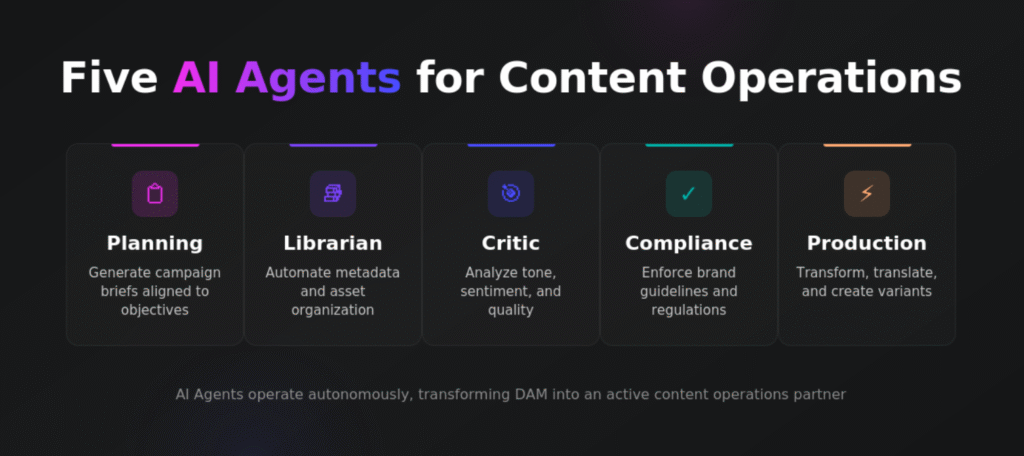
The evolution from assistive AI tools to autonomous AI Agents represents a fundamental shift in how organizations approach content operations. Traditional AI features wait for human direction, executing specific tasks when prompted. AI Agents operate autonomously within defined parameters, making decisions, executing multi-step processes, and adapting to context without constant human intervention. This agentic approach transforms digital asset management from a passive storage system into an active content operations partner.
In practical terms, AI Agents can handle entire content workflows independently. A Planning Agent might receive a campaign brief, analyze historical performance data, and generate structured content requirements aligned with business objectives. Librarian Agents automate the creation and enrichment of metadata, classifying assets and applying custom taxonomies to ensure consistent organization across the enterprise.
Critic Agents analyze content tone, sentiment, and clarity, offering suggestions that elevate quality while maintaining brand voice. Compliance Agents enforce brand guidelines and regulatory requirements automatically, validating content against approved claims libraries before publication. Production Agents handle transformations, translations, and format adaptations that enable content to reach global audiences without manual intervention.
The distinction matters enormously for organizations scaling AI content production. Rather than simply providing a repository where AI-generated content lands, modern platforms equipped with AI Agents can orchestrate the entire content lifecycle from planning through distribution, creating truly intelligent automation.
What Results Can Organizations Expect From Proper Content Infrastructure?
Organizations that build robust content infrastructure before scaling AI production report measurably different outcomes than those who prioritize generation speed over governance foundations. The differences appear across efficiency metrics, risk indicators, and strategic capabilities that compound over time.
Productivity improvements emerge quickly when teams can actually find and reuse existing assets rather than recreating content from scratch. Organizations with strong foundations for managing AI content report significant time savings on asset discovery and preparation. Compliance improvements prove equally substantial, with automated governance reducing instances of improper asset usage or rights violations. Speed to market accelerates as streamlined workflows and intelligent routing eliminate the bottlenecks that traditionally slow content deployment.
Perhaps most importantly, proper content infrastructure enables organizations to scale AI capabilities confidently. Teams can increase content production volume without proportionally increasing governance overhead. New AI tools integrate into established workflows rather than creating parallel processes. And content intelligence improves continuously as the system learns from performance data and user interactions.
FAQ
What is AI content management? AI content management refers to the systems, processes, and governance frameworks that organizations use to create, organize, distribute, and maintain content produced with artificial intelligence tools. Effective approaches combine generative AI capabilities with structured infrastructure like digital asset management, metadata automation, and compliance workflows to ensure content remains on-brand, discoverable, and compliant at scale.
Why does AI-generated content fail without governance? AI-generated content fails without governance because AI tools amplify whatever inputs they receive. When organizations lack structured metadata, brand guidelines, and compliance rules, AI produces content that drifts from brand standards, contains inconsistencies, or violates regulatory requirements. The speed and volume of AI generation means these problems compound rapidly, creating more cleanup work than the AI efficiency was meant to eliminate.
How does a DAM system support AI content workflows? A DAM system supports AI content workflows by providing centralized governance, consistent metadata, and integrated approval processes that AI tools can leverage during content creation. Modern DAM platforms connect directly to AI generation capabilities, automatically applying brand rules, routing content through appropriate reviews, and maintaining complete audit trails. This integration ensures AI-generated content inherits the same governance framework as human-created assets.
What are AI Agents in digital asset management? AI Agents are autonomous, intelligent tools that operate within DAM platforms to execute multi-step content processes without constant human intervention. Unlike traditional AI features that require prompting, AI Agents can independently route assets through workflows, enrich metadata, check compliance, and optimize content based on context and defined parameters.
Transform Content Operations With Intelligent Infrastructure
Managing AI content effectively succeeds or fails based on the infrastructure supporting it. Organizations that treat DAM as mere storage will continue struggling with brand consistency, compliance risk, and operational chaos regardless of how advanced their AI generation tools become. Those who recognize DAM as the essential backbone for content operations position themselves to scale confidently while maintaining the governance and quality their brands require.
Aprimo’s agentic digital asset management platform provides the content infrastructure that modern marketing teams need to harness AI effectively. With AI Agents operating autonomously across planning, metadata, compliance, and production workflows, Aprimo transforms content operations from reactive file management into proactive content intelligence. Request a demo to see how intelligent content infrastructure can power your AI content strategy.