

Industries that benefit from agentic AI are seeing transformative results, with 23% already implementing these systems.
- Marketing teams are boosting efficiency without compromising creativity.
- Pharmaceuticals benefit from enhanced compliance and robust security.
- Financial services are seeing massive improvements in productivity and analytics.
Start with single-agent implementations in high-impact use cases before scaling to enterprise-wide deployment.
While businesses spent years experimenting with chatbots and basic automation, a new category of AI is delivering the results everyone was promised. Agentic AI systems think, plan, and execute complex workflows autonomously.
Traditional AI tools require constant human oversight and direction. Agentic AI applications operate more like highly skilled team members who can handle entire projects from start to finish. According to Gartner research, 33% of enterprise software applications will include agentic AI by 2028. However, success depends on achieving definitive ROI.
But which industries that benefit from agentic AI are actually seeing measurable returns?
Which Industries Are Leading Agentic AI Adoption?
The industries that benefit from agentic AI most share three characteristics: they handle massive volumes of complex data, operate under strict regulatory requirements, and need to make rapid decisions based on changing conditions. Overall, 23% of organizations across all sectors have already adopted some form of agentic AI systems.
Healthcare and pharmaceutical companies aren’t treating AI as an experiment anymore. They’re deploying production systems that handle real patient interactions and critical business processes.
Within financial services, 93% of organizations plan to adopt agentic AI by 2027 due to reports of some of the strongest ROI metrics in any sector. From a research standpoint, agentic AI can deliver 3.5 to 6 times ROI compared to traditional AI tools, with some projects reaching break-even in less than 14 months.
Marketing and content operations are following their trend of early technology adoptions, with 19% already invested in agentic AI and an additional 33% planning to do so soon. The applications here look different with enhancements to both operations and customer engagement.
How Is AI in Marketing Transforming Content Operations?
Marketing teams face a unique challenge that makes them perfect candidates for agentic AI applications. They need to create massive volumes of personalized content while maintaining brand consistency, regulatory compliance, and creative quality across dozens of channels and markets.
Automated Workflows
Traditional marketing automation handles simple tasks like email scheduling or lead scoring. Agentic AI takes over entire campaign workflows. These systems analyze audience behavior, generate personalized content variations, optimize distribution timing, monitor performance metrics, and adjust strategies in real time without human intervention.
Higher Productivity
Organizations implementing AI in marketing operations report up to 50% efficiency improvements in content creation and campaign management. They’re seeing quality improvements alongside speed gains. AI agents trained on brand guidelines and historical performance data consistently produce content that outperforms human-only approaches.
Personalization at Scale
Content personalization is one of the most compelling use cases. Rather than creating generic campaigns and hoping for broad appeal, agentic AI systems analyze individual customer journeys and automatically generate tailored experiences for each interaction. They consider factors like browsing history, past purchases, device preferences, time zones, and seasonal patterns to deliver precisely the right message at the optimal moment.
The scale advantages are particularly dramatic for global organizations. A single agentic AI system can simultaneously manage campaigns across multiple markets, languages, and cultural contexts while maintaining local relevance and regulatory compliance in each region.
Brand Consistency
Compliance and brand governance become automated processes rather than manual bottlenecks. AI agents review every piece of content against brand standards, legal requirements, and industry regulations before publication. They flag potential issues, suggest corrections, and maintain detailed audit trails for regulatory compliance.
Why Is AI for Pharma Seeing Such Rapid Adoption?
Pharmaceutical companies operate in an environment where mistakes can have life-threatening consequences and regulatory violations carry massive financial penalties. These factors create the perfect conditions for agentic AI applications to deliver outsized value.

Managing Volume and Complexity
The industry generates enormous volumes of complex documentation. Clinical study reports, regulatory submissions, safety updates, and compliance documentation require precise formatting, comprehensive data integration, and strict adherence to evolving regulatory standards across multiple global markets. Agentic AI systems automatically handle these requirements.
Drug discovery and development are some of the most sophisticated agentic AI implementations anywhere. These systems analyze vast biomedical datasets to identify promising drug targets, predict molecular behavior, optimize compound structures, and design clinical trial protocols. They work continuously, processing new research data and adjusting recommendations as scientific understanding evolves.
Balancing Customer Needs with Compliance
Commercial operations benefit from intelligent customer relationship management systems that understand the unique needs of healthcare providers. AI for pharma can analyze prescribing patterns, identify educational opportunities, ensure compliance with promotional regulations, and deliver personalized content to medical professionals while maintaining strict adherence to industry guidelines.
Patient engagement and support programs leverage agentic AI to provide personalized treatment guidance, medication adherence support, and side effect monitoring. These systems coordinate care across multiple touchpoints while maintaining patient privacy and regulatory compliance.
The ROI metrics in pharmaceutical applications are particularly strong because the cost of errors is so high. Organizations report reductions in regulatory review cycles, faster time-to-market for new treatments, and improved compliance scores across all operational areas.
What Makes Financial Services Perfect for AI Productivity Gains?
Financial institutions deal with massive transaction volumes, complex regulatory requirements, and the constant need for real-time risk assessment. These operational demands create ideal conditions for agentic AI applications to deliver measurable productivity improvements.

Risk Management Applications
Fraud detection and risk management are highly sought-after implementations. Agentic AI systems continuously monitor transaction patterns, identifying anomalies that human analysts might miss while reducing false positive rates that frustrate customers. They adapt their detection models based on emerging fraud techniques and changing customer behavior patterns.
Investment and Portfolio Optimization
Investment management and portfolio optimization benefit from AI agents that can simultaneously process market data from thousands of sources. These systems identify opportunities, assess risk factors, execute trades within predefined parameters, and adjust strategies based on real-time market conditions. The speed advantage over human decision-making creates significant competitive benefits.
Better Customer Service
Customer service operations see dramatic efficiency improvements through agentic AI. Rather than simple chatbots that follow scripted responses, these systems understand complex financial situations, access relevant account information, resolve issues across multiple systems, and escalate appropriately when human expertise is required.
Adherence to Regulations
Regulatory compliance and reporting automation deliver cost savings while improving accuracy. AI agents continuously monitor regulatory changes across multiple jurisdictions, automatically update internal procedures, generate required reports, and maintain comprehensive audit trails for regulatory review.
The quantifiable benefits in financial services are compelling. Organizations report reductions in compliance data-gathering time, improvements in customer service resolution speeds, and decreased operational risk exposure.
5 Key Steps to Successfully Implement Agentic AI
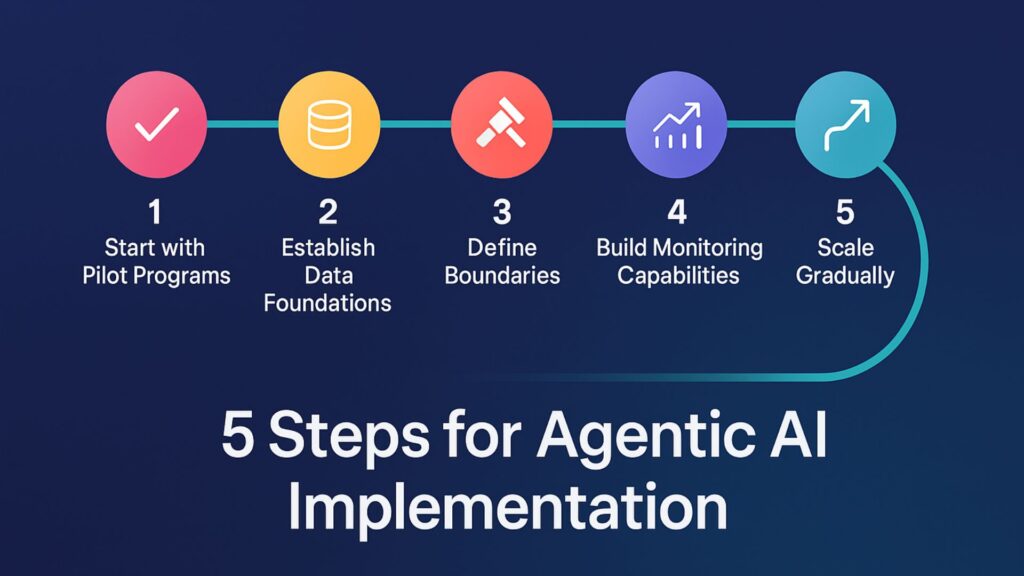
Getting started with agentic AI requires a balance between ambition and practicality. The most successful implementations follow a proven pattern to achieve AI productivity gains.
- Start with single-agent pilot programs. Choose one specific use case with clear success metrics and manageable complexity. Customer service inquiry handling, content metadata tagging, or document review processes work well for initial implementations.
- Establish robust data foundations. Agentic AI systems require clean, well-structured data to operate effectively. Invest in data quality improvements and integration infrastructure before deploying AI agents at scale.
- Define clear decision-making boundaries. Specify exactly which actions AI agents can take autonomously and which situations require human oversight. These guardrails ensure appropriate control while enabling autonomous operation within safe parameters.
- Build comprehensive monitoring capabilities. Track both operational metrics and business outcomes continuously. Monitor AI agent decisions, performance trends, error rates, and business impact to identify opportunities for improvement.
- Scale gradually across connected workflows. Once initial implementations prove successful, expand AI agents into related processes that share data sources or business objectives. This approach maximizes benefits while minimizing complexity.
The organizations seeing the strongest results treat agentic AI as an organizational capability rather than a technology deployment. They invest in change management, user training, and process optimization alongside technical implementation.
What Does the Future Hold for Agentic AI Applications?
The trajectory for agentic AI adoption points toward rapid enterprise adoption. McKinsey research projects that agentic AI has the potential to generate $450 billion to $650 billion in additional annual revenue by 2030, representing a 5–10% revenue boost.
Cross-industry integration will accelerate as AI agents become sophisticated enough to coordinate across different business functions and external systems. Marketing agents will collaborate with supply chain agents to optimize product launch timing. Financial agents will coordinate with compliance agents to ensure regulatory adherence while maximizing efficiency.
Industry-specific specialization will deepen as AI agents develop expertise in sector-specific regulations, terminology, and operational requirements. Healthcare agents will navigate complex medical terminology and regulatory requirements. Manufacturing agents will integrate with IoT sensors and production systems for real-time optimization.
Organizations that establish effective agentic AI capabilities early will build data advantages, operational efficiencies, and market positioning that become increasingly difficult for competitors to match. However, success requires more than technology adoption. The industries that benefit from agentic AI the most will redesign their operational processes, invest in employee capabilities, and maintain the human oversight necessary for smart decision-making.
Frequently Asked Questions
How can teams ensure agentic AI enhances creativity instead of replacing it? The most successful organizations treat agentic AI as a creative partner, not a replacement. When AI handles repetitive production tasks and data-heavy decision-making, human teams gain more time for creation and storytelling.
What governance practices are essential for agentic AI success? Governance is the foundation of sustainable AI adoption. Leading enterprises establish transparent approval workflows, automated compliance checks, and audit trails that make every AI-driven action accountable. Creativity and agility coexist with legal, ethical, and brand standards.
How does agentic AI influence long-term business resilience? Agentic AI strengthens organizational resilience by turning reactive processes into proactive systems. Agents continuously learn from performance data, adapt to shifting regulations or market conditions, and surface insights before issues arise. Every campaign, workflow, and decision improves the next, positioning enterprises to thrive amid constant change.
How Can Your Organization Get Started?
The industries that benefit from agentic AI share common characteristics, but the specific implementations vary based on operational requirements, regulatory constraints, and strategic objectives. The most successful deployments start with clear business objectives. Organizations that achieve the strongest ROI focus on specific use cases where agentic AI can deliver measurable improvements in efficiency, accuracy, or customer experience.Aprimo’s AI-powered platform provides the integrated foundation needed to deploy intelligent agents across the entire content lifecycle. From automated content creation and compliance reviews to predictive analytics and personalization at scale, our platform enables marketing teams to achieve unprecedented efficiency while maintaining the oversight that drives exceptional brand experiences. Contact Aprimo today to discover how agentic AI can transform your content operations.