

Metadata is the hidden engine behind every personalized content experience.
- Rich, consistent metadata allows brands to automatically match the right content to the right audience without manual intervention.
- AI-powered tagging reduces effort and scales personalization across millions of assets.
- Organizations with strong metadata strategies generate more revenue from personalization than slower growing competitors.
- Building a metadata content strategy requires taxonomy planning, AI automation, and behavioral tagging.
Consider metadata your personalization blueprint: invest in it now, or fall behind competitors who already have.
Personalized experiences have shifted from a competitive advantage to a baseline expectation. According to McKinsey’s research, 71% of consumers expect companies to deliver personalized interactions, and 76% get frustrated when that expectation goes unmet. For marketing and content teams, the pressure is real. Delivering the right message to the right person at the right moment sounds straightforward in theory. In practice, it requires a foundation that most organizations overlook: metadata.
Metadata personalization is the process of using structured, descriptive information about your content to automate how it gets matched, served, and optimized for individual audiences. Without it, personalization efforts stall at the pilot stage or collapse under the weight of manual processes. With it, brands can scale personalized content delivery across channels, segments, and markets without adding headcount or complexity.
This guide explores how metadata content strategy powers scalable personalization, why traditional approaches fall short, and what it takes to build a metadata framework that actually works.
What Role Does Metadata Play in Content Personalization?
Before diving into strategy, it helps to understand what metadata actually does in a content operations context. At its simplest, metadata is information about information. It describes your digital assets: what they contain, who created them, when they were made, where they should be used, and for whom they’re intended.
In personalization, metadata serves as the connective tissue between your content library and your audience data. When a visitor lands on your website, your personalization engine needs to make a decision: which piece of content should this person see? That decision happens in milliseconds, and it depends entirely on whether your content is tagged and classified in a way that makes matching possible.
Your customer data platform knows who the visitor is, their preferences, past behavior, and likely intent. Your digital asset management system holds thousands of assets. Metadata is what allows these two systems to communicate. Without descriptive, consistent, and machine-readable metadata, your personalization engine has nothing to work with.
Why Does Metadata Matter for Personalized Content Delivery?
The scale challenge is where most personalization initiatives hit a wall. Early-stage personalization often relies on manual curation: a marketer selects specific content for specific segments, builds rules, and monitors performance. This method works when you have a handful of segments and a modest content library. It breaks down quickly as both expand.
Consider a global brand with content in 15 languages, targeting dozens of audience segments across multiple product lines. The number of possible content combinations becomes astronomical. Manual curation can’t keep pace with the volume, velocity, and variety of modern content demands.
Metadata solves this problem by enabling automated content matching. Instead of a marketer manually selecting which banner image appears for which audience, the system can automatically surface the right asset based on metadata attributes that align with the visitor’s profile. The marketer’s job shifts from selecting individual assets to defining the rules and maintaining the metadata framework that powers those selections.
The Three Pillars of Metadata-Driven Personalization
Effective personalization sits at the intersection of three data types, often called the “three Cs” in content operations circles.
Customer data includes behavioral signals, demographic information, purchase history, and stated preferences. This data typically lives in your customer data platform or CRM and describes who your audience is and what they care about.
Content metadata describes your assets themselves: what they depict, what products they feature, what tone they convey, which campaigns they belong to, and what formats they’re available in. This data lives in your DAM or content management system.
Context captures the situational factors at play during a given interaction: what channel the visitor is using, what time of day it is, where they are in their journey, and what device they’re on.
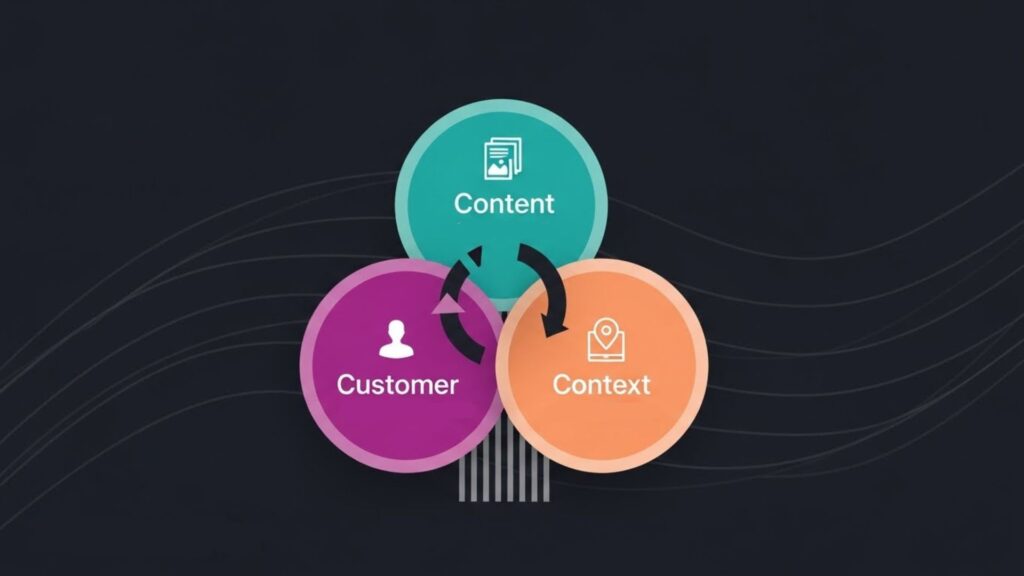
When all three align, personalization feels seamless and relevant. When any one is missing or incomplete, the experience breaks down. A visitor might see a summer campaign in December, a product image for an item they already purchased, or content in the wrong language. These failures usually trace back to metadata gaps.
How Does a Metadata Content Strategy Power Scale?
Building a metadata content strategy starts with taxonomy: the hierarchical structure that organizes your metadata into categories and relationships. A well-designed taxonomy reflects how your business thinks about content, how your customers search for it, and how your personalization rules need to access it.
For example, a retail brand might organize content by product category, season, target demographic, and campaign. A financial services firm might organize by product line, regulatory status, audience segment, and content type. The taxonomy should be specific enough to enable precise matching but flexible enough to accommodate new products, campaigns, and use cases over time.
Modular content architecture amplifies the power of metadata. Instead of creating finished assets for every possible audience and channel combination, teams create smaller content components that can be assembled dynamically. Each component carries its own metadata, allowing the system to mix and match pieces based on who’s viewing and where. This approach reduces production volume while increasing personalization coverage.
AI automation has become essential for applying metadata at scale. Manual tagging remains necessary for certain high-value or complex assets, but it can’t keep pace with the volume of content most organizations produce today. Predictive metadata uses machine learning to analyze assets upon upload and automatically suggest or apply relevant tags. Smart tagging learns your organization’s specific terminology, brand attributes, and product characteristics.
Five Types of Metadata That Enable Personalization
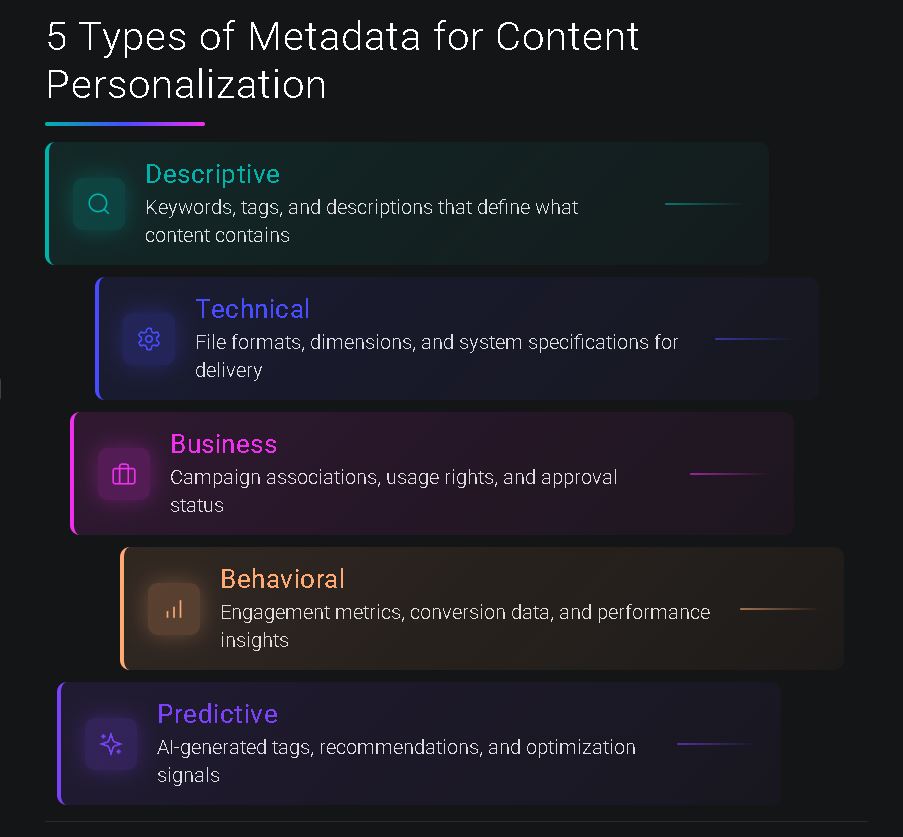
Understanding the different types of metadata helps teams prioritize what to capture and maintain. Here are the categories that matter most for personalization.
- Descriptive metadata captures what an asset contains: subjects, objects, colors, themes, and visual elements. This category enables content matching based on relevance and context.
- Technical metadata includes file type, dimensions, resolution, and format specifications. These details ensure assets render correctly across devices and channels.
- Business metadata connects assets to campaigns, products, brands, and internal workflows. This type enables filtering and governance at the organizational level.
- Behavioral metadata tracks how assets perform: views, clicks, conversions, and engagement rates. This metadata feeds optimization loops that improve personalization over time.
- Predictive metadata uses AI to infer attributes based on content analysis and historical patterns. This capability accelerates tagging and enriches assets that would otherwise go unclassified.
What Are the Benefits of Metadata for Personalization?
Organizations that invest in metadata-driven personalization see returns across multiple dimensions. The most immediate benefit is faster content discovery. When assets are richly tagged and consistently classified, teams spend less time searching and more time creating. Marketers waste hours each week hunting for assets that already exist somewhere in their systems. Strong metadata eliminates that friction.
Reduced duplication follows naturally. When content is easy to find, teams reuse it instead of recreating it. This efficiency reduces production costs, ensures brand consistency, and maximizes the return on creative investment. Organizations that improve metadata quality consistently report reductions in duplicate asset creation and wasted creative resources.
Real-time decisioning becomes possible when metadata is machine-readable and integrated with personalization engines. Instead of relying on static rules that marketers update manually, systems can make dynamic decisions based on live data. The right hero image, the right offer, the right call-to-action, all selected automatically based on metadata alignment with visitor attributes.
Content personalization backed by strong metadata improves ROI. Companies that excel at personalization generate 40% more revenue from those activities than average players. Personalization can improve performance, helping teams lower acquisition costs by as much as half while driving 5–15% stronger revenue outcomes and boosting marketing ROI by 10–30%. These gains depend on the ability to efficiently execute personalization at scale, which depends on metadata.
How Does AI Transform Metadata Personalization?
AI has changed what’s possible with metadata. Traditional approaches required human effort for every tag, every classification, and every relationship. AI flips that model, automating routine tasks while surfacing insights that humans would miss.

AI-powered DAM systems now apply predictive metadata upon upload, analyzing images, videos, and documents to suggest relevant tags based on visual recognition, speech-to-text transcription, and optical character recognition. The error rate for manual metadata entry hovers around 1%, which sounds small until you consider the impact across thousands of assets. AI reduces errors while maintaining consistency that human tagging struggles to achieve.
Behavioral tagging takes AI a step further by connecting content intelligence with personalization engines. The system tracks how assets perform with different audience segments and uses that data to refine future content recommendations. Over time, the metadata framework becomes smarter, automatically surfacing high-performing assets and flagging content gaps that need attention.
Building a Metadata Framework for Personalization
Implementing metadata personalization requires governance, alignment, and a commitment to continuous improvement.
Start with clear standards. Define which metadata fields are mandatory, which are optional, and what values are acceptable for each. Document naming conventions, taxonomy hierarchies, and tagging guidelines. Make these standards accessible to everyone who touches content, from creative teams to agency partners.
Align stakeholders across functions. Marketing, creative, IT, and compliance all have perspectives on how content should be organized and tagged. Building a metadata framework without input from all parties leads to adoption failures down the road. Cross-functional governance committees help maintain alignment and resolve conflicts as the framework evolves.
Invest in ongoing maintenance. Metadata quality degrades over time as products change, campaigns end, and terminology evolves. Regular audits, cleanup initiatives, and taxonomy updates keep the framework relevant. Automation helps here too: AI can flag inconsistencies, suggest updates, and identify assets that need re-tagging.

Frequently Asked Questions
What is metadata personalization? Metadata personalization is the practice of using structured descriptive information about content assets to automatically match and deliver relevant content to specific audiences. Instead of manually selecting which content each audience segment sees, metadata enables systems to make those decisions dynamically based on alignment between content attributes and visitor profiles.
How does metadata improve content discoverability? Metadata improves discoverability by making assets searchable across multiple dimensions. Users can find content by keyword, product, campaign, audience segment, visual characteristics, or any other tagged attribute. Rich metadata also enables similar-asset recommendations and AI-powered search that understands intent rather than just matching keywords.
What’s the difference between metadata and taxonomy? Taxonomy is the hierarchical structure that organizes metadata into categories and relationships. Metadata is the actual data applied to individual assets within that structure. Both are necessary for effective content organization and personalization.
Can AI automate metadata tagging for personalization? Yes. Modern AI can analyze images, videos, and documents upon upload to automatically suggest or apply relevant metadata. Features include visual recognition for identifying objects and scenes, speech-to-text transcription for video and audio content, and optical character recognition for extracting text from images. AI-powered tagging reduces manual effort while improving consistency and coverage.
Turning Metadata into Personalization at Scale
Metadata personalization is how modern organizations bridge the gap between what customers expect and what content teams can realistically deliver. It transforms static asset libraries into dynamic content engines that respond intelligently to audience signals. It reduces manual effort while improving precision. And it creates a foundation for AI-driven optimization that gets smarter over time.
Aprimo helps organizations build and activate metadata-driven personalization through AI-powered digital asset management, predictive metadata, and integrated content intelligence. Get a demo and discover how to turn your content into a personalization engine.