

Generative AI is reshaping how organizations protect and scale their brand identity.
- Marketing teams using AI branding tools report faster content creation, fewer compliance violations, and consistent messaging across every channel.
- The technology works by automatically enforcing guidelines, flagging off-brand content before publication, and learning your unique brand voice over time.
If you’re still relying on manual brand reviews and static PDF guidelines, you’re fighting a battle you can’t win at scale.
Brand consistency has always mattered. But maintaining it across dozens of channels, hundreds of assets, and global teams? That’s become nearly impossible using traditional methods. Content operations have grown exponentially more complex, and the old playbook of brand guidelines documents and manual review cycles can’t keep pace.
This is where generative AI brand management enters the picture. According to research, 80% of multinational brand owners have expressed concerns about how agencies use generative AI on their behalf, citing legal, ethical, and reputation risks. The irony? AI itself offers the most effective solution to these concerns when deployed strategically for brand governance rather than just content generation.
Let’s explore how this technology is transforming brand management and what it means for marketing teams.
Why Has Brand Management Become So Complex?
The demands placed on modern marketing teams would have seemed absurd just a decade ago. Content volume has exploded as brands compete for attention across social platforms, websites, email campaigns, mobile apps, and emerging channels. Each platform has its own specifications, audience expectations, and content requirements.
Global organizations face an additional layer of complexity. When you have teams in 15 countries adapting campaigns for local markets, how do you ensure the brand remains cohesive? Traditional approaches relied on training sessions, brand portals, and periodic audits. But these methods are reactive by nature. By the time a violation is caught, the off-brand content has often already gone live.
Industry research indicates that brand dilution costs mid-sized and large companies millions in lost revenue annually. Every inconsistent logo placement, incorrect color usage, or off-tone message chips away at the brand equity you’ve worked so hard to build. And with content production accelerating thanks to AI tools, the potential for brand drift has never been higher.
What Is Generative AI Brand Management?
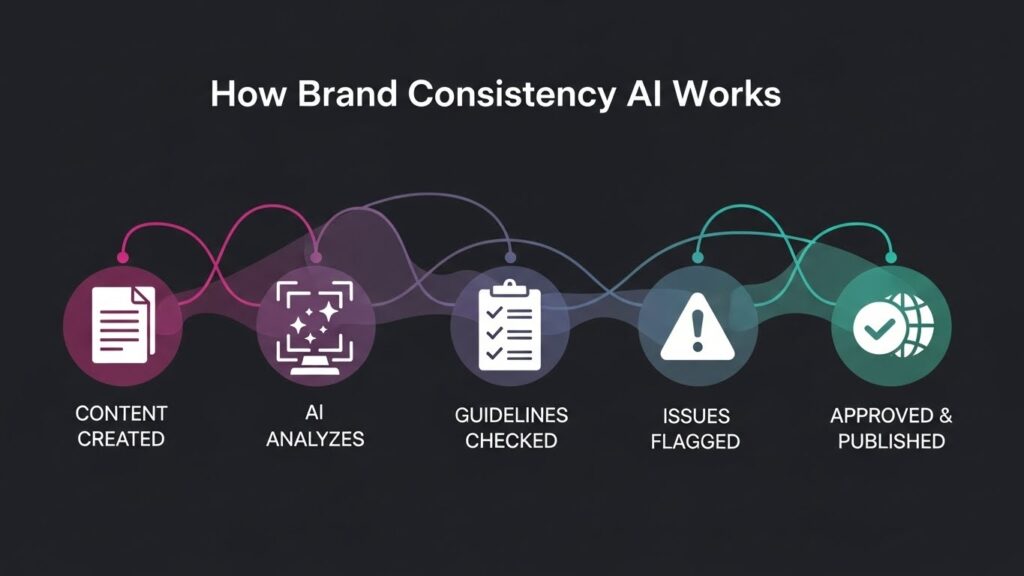
Generative AI brand management refers to the use of artificial intelligence to actively protect, enforce, and scale brand identity across all content and touchpoints. Unlike traditional brand management, which relies on human reviewers to catch violations after the fact, AI-powered systems work proactively. They analyze content in real time, flag potential issues before publication, and suggest corrections aligned with your brand standards.
Instead of hoping your teams remember the guidelines, AI enforces them automatically. This process amplifies human judgment by handling the repetitive compliance work so your creative team can focus on strategy and storytelling.
The technology learns from your existing brand assets, approved content, and documented guidelines. Over time, it develops an understanding of your brand’s visual identity, voice, and compliance requirements that becomes more refined with each interaction.
How Does AI Enforce Brand Guidelines Automatically?
Modern AI branding tools use computer vision and natural language processing to analyze content against established brand parameters. When a designer uploads a new asset, the system automatically checks logo placement, verifies color accuracy against approved palettes, and confirms typography meets specifications. Any deviations trigger immediate alerts with specific recommendations for correction.

AI can evaluate written content for tone, terminology, and messaging alignment. If your brand voice is “confident but approachable,” the system learns what that means through your approved examples and flags content that skews too formal or too casual. These automated checks can identify subtle compliance issues that might escape manual review, including inconsistent brand voice, inappropriate imagery for specific audiences, or missing required legal disclaimers.
For regulated industries like healthcare, financial services, and pharmaceuticals, this capability is transformative. Compliance review has traditionally been one of the most time-intensive aspects of content operations. AI streamlines these processes by automatically flagging potential issues before content reaches human reviewers, reducing review cycles while improving overall quality and consistency.
What Are the Key Benefits of AI Branding Tools?
The advantages of implementing brand consistency AI extend beyond time savings. Organizations that adopt governance-focused AI tools report improvements across multiple dimensions of their content operations.
Here are the primary benefits driving adoption:
- Consistency at unprecedented scale. AI ensures the same brand standards apply whether you’re producing 10 assets or 10,000. Every piece of content receives the same level of scrutiny, regardless of which team or region created it.
- Dramatically reduced review cycles. When AI handles initial compliance checks, human reviewers can focus on strategic and creative decisions rather than catching basic guideline violations. This proactive strategy accelerates time-to-market.
- Lower costs through reduced rework. Catching brand violations before publication eliminates the expensive process of pulling and replacing off-brand content after it goes live.
- Institutional knowledge preservation. AI systems capture and apply brand knowledge consistently, reducing dependency on individual team members who may leave the organization.
- Real-time adaptation. When brand guidelines update, AI systems can immediately apply new standards across workflows without requiring extensive retraining of human teams.
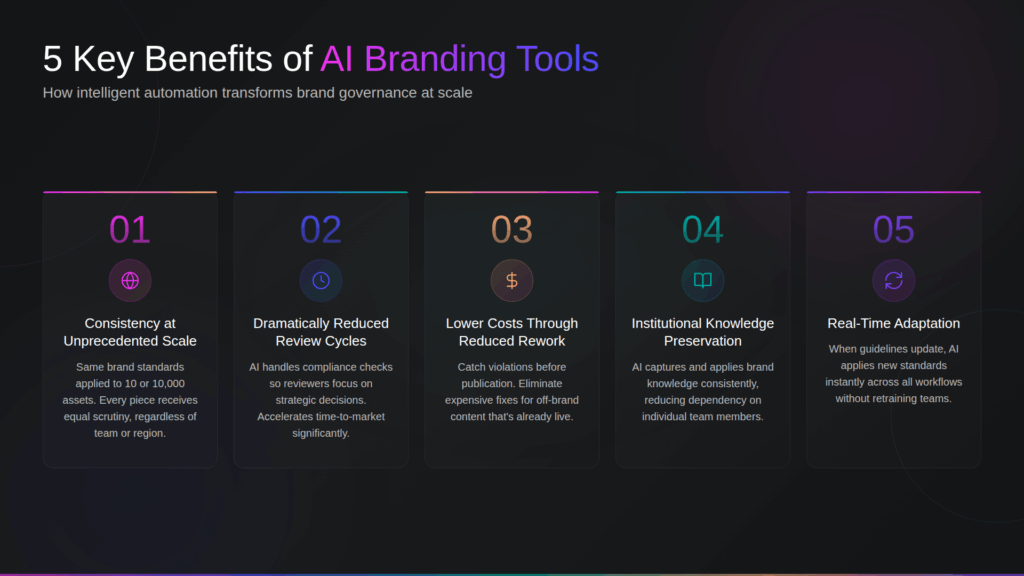
Marketing and sales remain the business functions where organizations often deploy AI, with revenue increases most commonly reported in marketing use cases. Organizations that push for transformative innovation via AI and redesign workflows around it are seeing compounding returns, reinforcing how brand consistency AI delivers value that grows over time.
Can AI Really Understand Your Brand Voice?
This question is a common skepticism leaders express about AI brand management. Voice and tone feel inherently human. Can an algorithm truly grasp the nuances that make your brand distinctive?
The answer is yes, but with an important caveat. AI doesn’t intuit your brand voice the way a seasoned copywriter might. Instead, it learns through pattern recognition across your approved content. Feed the system enough examples of on-brand copy, and it develops a statistical model of what your voice looks like in practice. By feeding AI with brand-specific data and insights, you constantly refine its understanding of your voice, goals, and customer segments.
This learning process works best when organizations invest time in curating quality training data. The AI is only as good as the examples it learns from. Companies that provide comprehensive libraries of approved content, voice documentation, and specific examples of on-brand versus off-brand messaging see better results than those who expect AI to figure things out independently.
The technology can also be trained on company-specific terminology, product names, and industry jargon. Generated content then consistently uses the correct terms, avoiding the embarrassing inconsistencies that sometimes plague global brands.
How Does GenAI for Marketers Change Daily Workflows?
The practical impact of generative AI brand management becomes clear when you examine how it reshapes everyday marketing tasks. Consider metadata tagging, a historically tedious but essential function. Traditional approaches required content managers to manually review each asset and assign appropriate tags, categories, and descriptions. This process was time-intensive, subjective, and prone to inconsistency.
AI-powered systems analyze visual and textual content to automatically generate comprehensive, relevant tags. This automation improves searchability while freeing team members for other work. Finding the right asset for a campaign takes seconds instead of minutes or hours.
Smart asset recommendations offer another workflow transformation. Rather than relying on memory or keyword searches, GenAI for marketers can suggest relevant assets based on context, audience, and campaign objectives. Creating a social campaign targeting Millennials? The system surfaces assets that have performed well with that demographic, complete with the metadata and usage rights information you need.
Workflow automation extends to approval routing, version control, and distribution. Content automatically moves through the appropriate review steps, with AI pre-checking compliance at each stage. By the time assets reach human reviewers, the basic guideline adherence is already confirmed, letting reviewers focus on strategic and creative considerations.
What About the Human Element?
A common concern about AI adoption in creative fields centers on displacement. Will AI replace the marketers, designers, and brand managers who currently handle these responsibilities?
The evidence suggests otherwise. AI excels at automating repetitive, rule-based tasks. It struggles with the strategic thinking, emotional intelligence, and creative judgment that humans bring to brand building. AI isn’t here to replace creative professionals; it’s here to empower them by handling tedious compliance work.
The most successful implementations position AI as a collaborative partner rather than an autonomous system. Human brand leaders set the strategy, define the guidelines, and make judgment calls on edge cases. AI handles the enforcement, monitoring, and scaling of those decisions. This division of labor amplifies human capability rather than diminishing it.

Organizations that attempt to fully automate brand management without human oversight consistently encounter problems. AI may flag something as technically compliant while missing contextual nuances that a human reviewer would catch immediately. The technology works best when it augments human judgment rather than replacing it entirely.
What Should You Look for in Brand Consistency AI Solutions?
When evaluating AI brand management tools, focus on governance capabilities rather than just content generation features. Many platforms emphasize flashy, creative AI while offering minimal support for the brand protection functions that deliver lasting value.
Look for these essential capabilities:
- Automated compliance checking that enforces your specific brand standards, not generic best practices
- Comprehensive audit trails that track every decision, approval, and content change for regulatory compliance
- Integration with existing creative tools so AI governance works within your current workflows rather than requiring process redesign
- Multi-brand and multi-region support for organizations managing complex brand architectures
- Scalable training capabilities that let you refine the AI’s understanding of your brand over time
Enterprise organizations should prioritize solutions that integrate with their broader technology ecosystem. AI-powered DAM systems that connect with creative tools, content management systems, and distribution channels create seamless workflows that maximize the value of governance automation.
Frequently Asked Questions
How does generative AI maintain brand consistency across channels? AI systems analyze content against your documented brand guidelines in real time, checking visual elements like logos, colors, and typography along with written content for voice and tone alignment. When inconsistencies are detected, the system flags them before publication and suggests corrections.
What’s the difference between AI brand management and traditional DAM? Traditional digital asset management systems store and organize assets but rely on humans to enforce brand guidelines. AI brand management actively monitors compliance, automatically tags and enriches assets, and proactively prevents off-brand content from reaching publication.
Can AI-generated content stay on-brand? Yes, when AI systems are properly trained on your brand’s approved content, voice documentation, and visual standards. The key is investing in quality training data and maintaining human oversight for strategic and creative decisions.
How do enterprises train AI on their specific brand guidelines? Organizations feed the AI system examples of approved content, brand documentation, terminology lists, and specific instances of on-brand versus off-brand messaging. The system learns through pattern recognition and improves over time with continued use and feedback.
Unlock the Full Potential of AI-Powered Brand Management
Generative AI brand management enhances how organizations protect and scale their brand identity. The technology enables consistency that would be impossible to achieve through human effort alone, while freeing creative teams to focus on the strategic work that actually moves the needle.
Aprimo’s AI-powered content operations platform helps enterprise marketing teams achieve exactly this balance. With intelligent governance, automated compliance, and seamless workflow integration, you can scale content production without sacrificing brand integrity. Request a demo to see how AI-driven brand management can transform your content operations.