
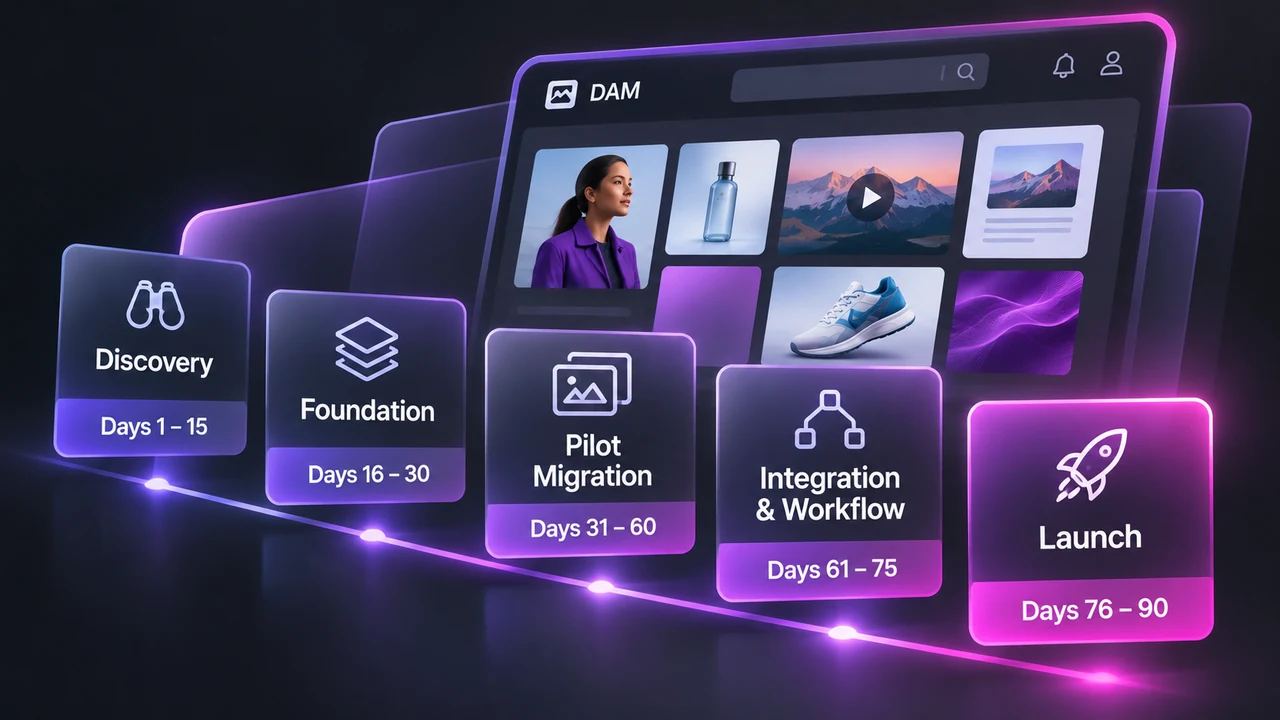
A DAM implementation timeline fails most often for reasons that have nothing to do with software. Scope stays vague, ownership stays shared, and taxonomy decisions wait until migration is already underway. By then, every delay compounds. A project planned for three months stretches to nine, and the business starts to doubt the platform instead of the plan.
A 90-day plan is realistic for many enterprise teams, as long as the work is sequenced correctly. Aprimo’s Content Operations Platform supports that sequence by keeping assets, workflow, and governance in one system. The sequence matters more than the speed. Teams that settle ownership, taxonomy, and success measures first can configure and migrate quickly. Teams that start with uploads discover the hard decisions late.
This guide lays out a practical DAM implementation timeline in five phases across 90 days. It explains what happens in each phase, which decisions cause the most delay, and how to measure success after launch. The plan serves as a planning model, not a guarantee. Actual timing depends on content volume, integration complexity, and how quickly stakeholders decide.
TL;DR
- A 90-day DAM implementation timeline works when scope, ownership, and taxonomy are settled in the first month.
- The five phases are discovery, foundation, pilot migration, integration work, and launch.
- Taxonomy design decides how well search, reuse, and AI features perform later.
- Integrations deserve early planning, because they often set the critical path.
- Delays usually come from unclear ownership and late decisions, not from technical limits.
- Success should be measured against a baseline recorded before launch.
What does a realistic DAM implementation timeline look like?
A realistic DAM implementation timeline runs about 90 days for a focused enterprise rollout, split into five phases. Larger content estates or complex integrations may extend it, but the phase order stays the same.
Definition: A DAM implementation timeline is a phased plan that moves a team from project kickoff to a live platform, covering scope, taxonomy, configuration, migration, integration, training, and launch.
The five phases run in order:
- Days 1 to 15, discovery: Define scope, owners, users, and success measures.
- Days 16 to 30, foundation: Design taxonomy, metadata, roles, and security settings.
- Days 31 to 60, pilot migration: Configure the platform, then migrate a defined set of assets.
- Days 61 to 75, integration and workflow: Connect adjacent systems, then build core workflows.
- Days 76 to 90, launch: Train users, release to the business, and support early adoption.
Each phase ends with a decision, not only a deliverable. Discovery ends with an approved scope. Foundation ends with an approved taxonomy. Pilot migration ends with a verified sample. The decision points keep the plan honest, because a missed decision shows up as a visible delay.
The plan assumes a core team with real time. A project lead, a taxonomy owner, an IT contact, and a business sponsor should each have protected hours. Part-time attention is the most common reason a plan slips.
What should happen in the first 30 days?
The first 30 days should settle scope, ownership, taxonomy, and security, so configuration can start without rework. This stretch contains the hardest decisions, and skipping them only moves the pain later.
Discovery covers four questions. Which teams and content types are in scope for launch? Who owns the DAM day to day? Which systems must connect first? What outcomes will prove the project worked?
A useful discovery output is a one-page scope statement. It lists in-scope content, out-of-scope content, owners, integration priorities, and success measures. Stakeholders sign it. Later changes then go through a visible change process instead of creeping in quietly.
Foundation work follows. Teams define user roles, permissions, and security requirements. They agree on naming rules, folder or collection structures, and the metadata model. Regulated teams add rights, expiry, and audit requirements, since these shape configuration.
Accelerators can shorten this phase. In The Forrester Wave™: Digital Asset Management Systems, Q1 2026, Forrester noted Aprimo’s blueprint starter packs for workflows and taxonomies, according to Aprimo’s announcement. Starting from a tested structure usually beats designing every field from scratch.
How should teams design taxonomy and metadata before migration?
Teams should design taxonomy before any asset moves, because the model decides how well search, reuse, and governance work afterward. Migrating first and organizing later multiplies the cleanup.
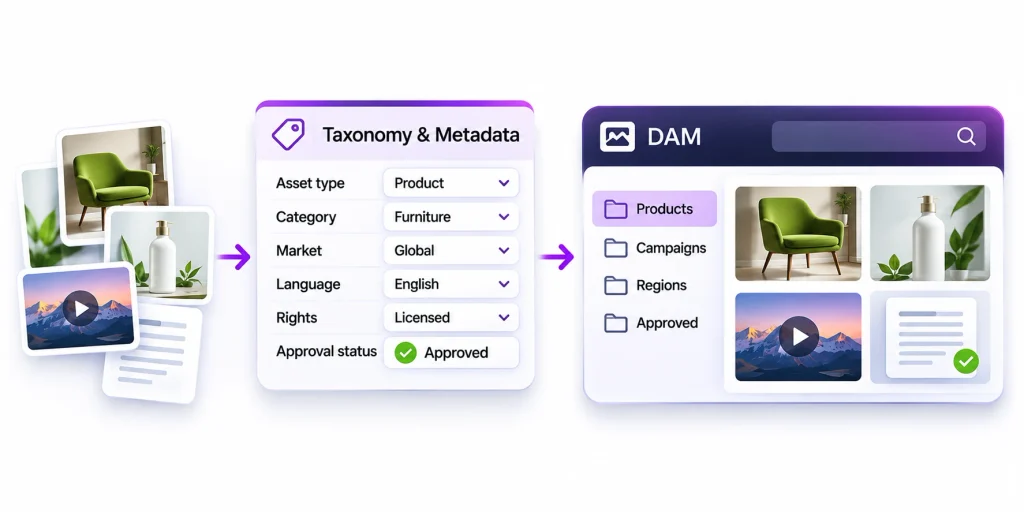
Three principles keep the design practical:
- Start from search behavior: List the questions users ask when they look for content. Build metadata fields that answer them.
- Keep required fields few: Every mandatory field slows ingestion. Require only what governance, rights, or search truly need.
- Plan for multiple markets: Language, region, and channel fields should exist from the start, even if the first launch covers one market.
AI changes the design conversation. Librarian agents can classify assets, enrich metadata, and power search automatically. Aprimo’s Librarian Agents interactive demo shows how agents generate context-aware metadata. A clear taxonomy gives those agents consistent targets, so their output improves.
Taxonomy also underpins governance. Rights data, expiry dates, and approval status are metadata. A model that captures them lets the platform enforce rules automatically. A model that omits them leaves governance to manual effort.
Teams should test the taxonomy on a sample before finalizing it. Twenty real assets, tagged by people who did not design the model, expose gaps quickly.
What happens between days 31 and 60?
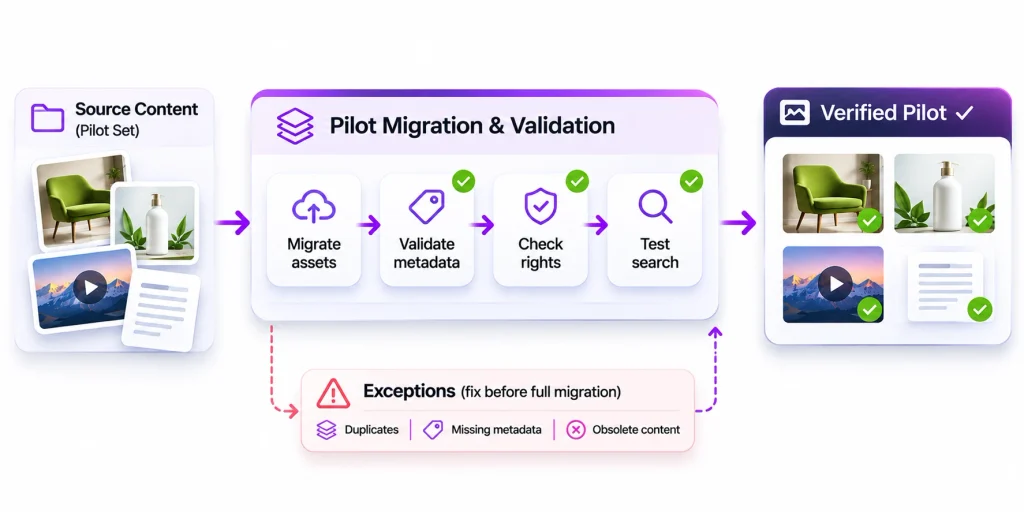
Days 31 to 60 cover platform configuration and a pilot migration of a defined asset set. The goal is a verified sample, not a full transfer.
Configuration turns the foundation decisions into settings. Teams build the roles, permissions, metadata schema, collections, and basic search behavior. They also set up single sign-on and security controls.
The pilot migration moves a representative slice of content. A good sample includes common asset types, edge cases, and content from more than one team. Teams check that metadata maps correctly, links work, and rights data carries over. They also confirm that search returns the expected results.
Pilot findings often reveal data problems that were invisible before. Duplicate files, missing metadata, and inconsistent naming surface quickly. Fixing them at pilot scale costs little. Fixing them after a full migration costs a great deal.
Teams should decide what not to migrate. Many libraries contain obsolete or duplicate assets. A retirement rule, such as excluding content older than a set date unless it has an owner, reduces volume and improves quality.
Plan the rollout before the contract
Build a tailored DAM RFI from your own requirements, use cases, and business goals in minutes.
How should integrations fit the DAM implementation timeline?
Integrations should enter the DAM implementation timeline during discovery, because they often set the critical path. A platform that cannot connect to the systems that use content delivers little value at launch.
Forrester’s June 2026 report, Digital Asset Management Anchors Modern Content Operations, found that 47% of DAM decision-makers rank integration with adjacent systems as their top priority. That priority reflects how many systems touch content, including creative tools, content management, commerce, and review platforms.
A practical approach ranks integrations by launch need. Some connections are essential on day one, such as single sign-on or the creative suite. Others can wait for a later release, such as analytics or a downstream distribution tool. Splitting the list keeps the first release focused.
Teams should verify each connector with a live test, not a datasheet. “Supported” can mean a native integration, a configured connector, or a custom project. Each carries different effort. Aprimo’s Integrations page lists available connections to review during discovery.
Ownership matters here too. Each integration needs an owner on the other system’s side. A connector blocked by an unavailable administrator can stall a project for weeks.
What happens between days 61 and 90?
Days 61 to 90 cover workflows, training, and launch. The aim is to release the business can use it, with support in place for the first weeks.
Workflow building starts with the highest-value process. Many teams choose asset requests and approvals, since it touches creative, brand, and compliance together. Teams define steps, owners, and service targets, then test with real assets. They add automation after the manual path works.
Training should match roles. Creators need to upload and tag. Reviewers need to approve and annotate. Administrators need to manage users and metadata. Short, role-specific sessions with real tasks work better than a single long demo.
Launch should be staged when possible. A first group of users adopts the platform, gives feedback, and exposes problems at small scale. Wider release follows once the first group is stable. Hypercare support, with a named contact and fast response, keeps early frustration from becoming lasting resistance.
Communication supports adoption. Users need to know what changes, what stays the same, and where to ask for help. Teams that announce the launch with clear dates and examples see faster uptake than those that simply flip a switch.
Which decisions slow a DAM implementation timeline the most?
Unclear ownership, late taxonomy decisions, scope creep, and unplanned integrations slow a DAM implementation timeline the most. Technical limits cause fewer delays than decisions that wait.
A comparison shows how plans diverge:
- Plan that holds: One owner approves scope and taxonomy in the first month. Changes follow a change process. Integrations are ranked early.
- Plan that drifts: Ownership is shared across several teams. Taxonomy changes during migration. New content types join midstream. Integrations surface as surprises.
Each delay compounds. A taxonomy change after migration forces rework on every asset affected. A missing owner on an integration blocks testing. A new content type in month two adds configuration and migration work that nobody budgeted.
Governance of the project itself helps. A weekly check-in with the sponsor, a visible decision log, and a short risk list keep problems small. Teams that review the log together catch drift early.
Executive sponsorship also matters. Decisions about ownership and scope often cross team boundaries. A sponsor who can settle them quickly prevents weeks of waiting.
How should teams measure success after launch?
Teams should measure success against a baseline recorded before launch, using search time, reuse, cycle time, and adoption. Launch is the beginning of value, not the end of the project.
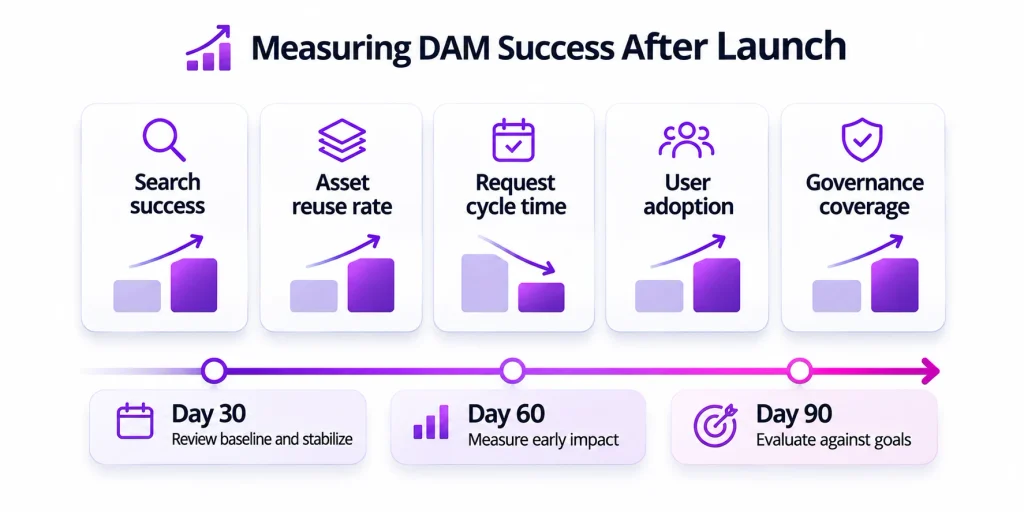
Five measures give a useful view:
- Search success: How quickly users find the asset they need.
- Reuse rate: How often existing assets replace new creation.
- Request cycle time: Hours or days from request to approval.
- Adoption: The share of in-scope teams using the platform as their source of truth.
- Governance coverage: The share of assets with complete rights and approval data.
A baseline is essential. Teams should record current numbers during discovery, even if they are rough. Without them, improvement is a feeling.
A post-launch review at 30, 60, and 90 days keeps momentum. Each review asks what works, what does not, and which next workflow or integration earns priority. The roadmap then reflects evidence instead of requests.
Scaling follows. Teams extend to additional content types, regions, and agents once the first release is stable. AI capabilities such as metadata enrichment and compliance checks fit well at this stage, since the foundation is in place.
Holding a DAM implementation timeline to 90 days
A DAM implementation timeline of 90 days is achievable when decisions come first and uploads come later. Discovery sets scope and ownership. Foundation settles taxonomy and security. Pilot migration proves the model. Integration and workflow work connect the platform to the business. Launch brings users in with training and support.
The pattern behind every delay is the same: a decision that waited. Teams that protect time for the core group, run a visible decision log, and test with real assets keep the plan intact. Teams that treat the project as a technical task find that the hard questions arrive at the worst moments.
A realistic plan also looks past launch. The first 90 days build the foundation, while later months add agents, workflows, and regions. A clean start makes every later step cheaper.
Teams planning a rollout can schedule an onboarding call to map the phases to their own content, systems, and deadlines.
FAQ
Can a DAM really go live in 90 days?
Often yes, for a focused scope. Timing depends on content volume, integration complexity, and how quickly stakeholders decide. Teams that settle scope, ownership, and taxonomy in the first month tend to hold the schedule.
Who should own a DAM implementation?
A single project lead should run day-to-day work, with an executive sponsor who can settle cross-team questions. A taxonomy owner and an IT contact complete the core group. Shared ownership without a named lead usually causes delay.
Should teams migrate every asset into the new DAM?
Not necessarily. Many libraries contain duplicate or obsolete files. A retirement rule reduces volume and improves quality. Teams should migrate a verified pilot first, then decide what else earns a move.
How much should teams plan for training?
Role-specific sessions work best, covering creators, reviewers, and administrators separately. Short sessions built around real tasks outperform a single long demo. Ongoing support through the first weeks matters as much as the sessions.
When should integrations be planned?
During discovery. Integrations often set the critical path, and each needs an owner on the connected system. Teams should rank them by launch need, then verify each with a live test.
How can AI features fit into the first 90 days?
Metadata enrichment is a common early fit, since a clear taxonomy gives agents consistent targets. More advanced agent workflows usually follow once the foundation is stable and governance settings are in place.
Related reading: DAM integration checklist, DAM governance for multi-brand teams.