

How to Select the Right DAM Vendor for Your Technology Company
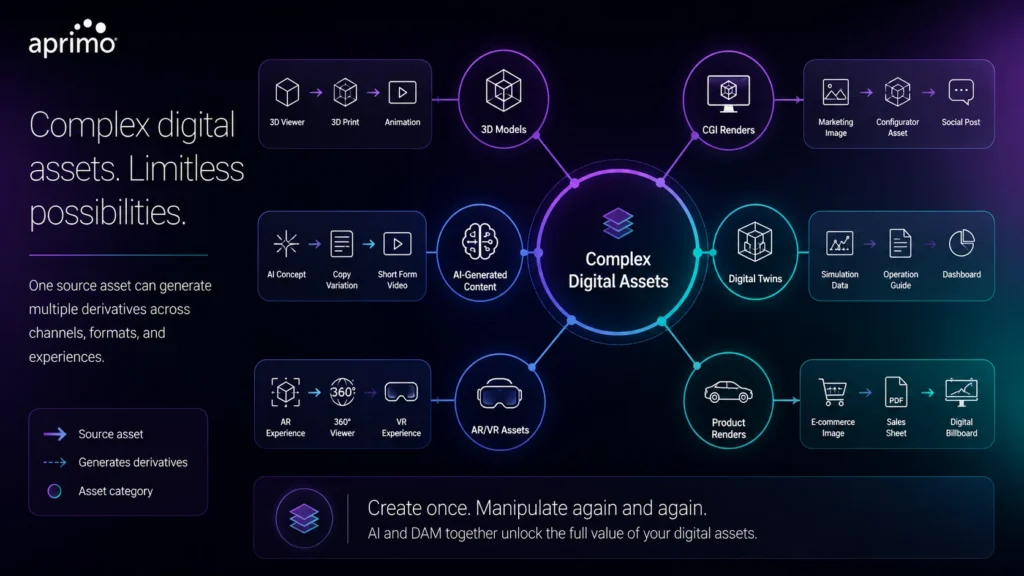
The definition of a digital asset is expanding rapidly. Not long ago, most enterprise DAM systems were primarily responsible for managing images, videos, presentations, and marketing collateral. Today, organizations are increasingly creating and managing far more sophisticated content types, including 3D models, CGI assets, product renders, digital twins, immersive experiences, and AI-generated content.
This evolution is being driven by multiple forces. According to McKinsey’s research on the economic potential of generative AI, AI-enabled applications across marketing and creative functions are fundamentally transforming content production. Recent analysis by CBInsights citing McKinsey data shows that generative AI is enabling retailers and marketers to rapidly create assets like 3D product images for e-commerce and personalized marketing content at scale. Meanwhile, McKinsey’s research on how AI is reinventing film and television production demonstrates how AI is accelerating preproduction and creative workflows across industries.
AI systems are generating new content variations at unprecedented speed, transforming how content is created, activated, and reused across the enterprise. The challenge is that these assets introduce a new level of complexity that traditional DAM approaches simply weren’t designed to handle. According to the Forrester Wave report on Digital Asset Management Systems (Q1 2024), organizations must look for DAM solutions that “integrate and perform at scale to drive precise consumer interactions, intelligently apply AI to manage the content deluge, and drive more enterprise value.” As Aprimo explains in its guide to digital asset management architecture, DAM provides the foundation for organizing, governing, and activating enterprise content at scale—a foundation that becomes increasingly valuable as content ecosystems become more sophisticated.
TL;DR
- Modern DAM platforms must support far more than images and videos, including 3D models, CGI assets, rendered content, digital twins, and AI-generated assets with complex metadata requirements.
- Governance becomes increasingly important as content complexity and volume grow, requiring structured metadata, taxonomy, workflows, and rights management throughout the asset lifecycle.
- DAM acts as the system of record that enables discoverability, compliance, content reuse, and version control across distributed teams and global markets.
- Organizations that build governance into their content operations today will be better positioned for future AI-driven workflows and rapid content scaling.
What Are Complex Digital Assets?
Complex digital assets go beyond traditional marketing files and often involve multiple layers of data, formats, and dependencies. Examples include:
- 3D product models and CAD files for product visualization
- CGI imagery and rendered assets for ecommerce and marketing campaigns
- Digital twins and augmented/virtual reality experiences for immersive engagement
- AI-generated images, video, and synthetic content variations scaled across channels
Unlike static assets, these content types frequently generate numerous derivatives and variations. A single 3D model may be used to create hundreds of product renders for ecommerce platforms, marketing campaigns, partner portals, and regional websites. Similarly, a single AI-generated image may evolve into dozens of audience-specific variations across channels. This complexity creates new challenges around governance, discoverability, and lifecycle management that demand more sophisticated systems and processes.
Why Traditional Asset Management Approaches Break Down
Many DAM strategies were originally designed around simpler content formats. Images and videos are relatively straightforward compared to modern 3D and AI-generated assets, typically having fewer dependencies, simpler metadata requirements, and more predictable workflows.
Complex digital assets introduce three critical operational challenges:
First, there is the issue of scale. A single product launch may generate hundreds of renders, animations, localized versions, and AI-generated variants. Managing these relationships manually quickly becomes impractical and error prone.
Second, there is the challenge of version control. Product updates, specification changes, and design revisions often affect multiple assets simultaneously. Without structured governance, organizations struggle to determine which assets remain current and approved—a critical issue when content is distributed globally.
Third, there is the issue of discoverability. Traditional file structures often fail when dealing with thousands of related assets spread across multiple systems and teams. Teams waste hours searching for the right asset rather than activating content.
The Rise of AI-Assisted Content Production
AI is dramatically increasing the volume of content organizations can produce. Marketing teams can now generate campaign imagery, localized content, product descriptions, video variants, and promotional assets with far less effort than traditional workflows required. Product teams are using generative AI to accelerate visualization and prototyping processes. Creative teams are leveraging AI to explore concepts and variations more quickly.
This shift creates tremendous opportunities. Organizations can deliver more personalized experiences, support more markets, and activate content across more channels than ever before. However, increased production also introduces increased risk. As Aprimo discusses in its article on whether your generative AI DAM is ready for modern workflows, AI success depends on integrating generation capabilities into structured content operations rather than treating them as standalone tools.
Without governance, AI-generated content can create duplication, inconsistencies, rights issues, and compliance concerns. Teams may struggle to identify approved assets, understand content lineage, or determine which versions should be activated across channels.
Why Governance Becomes More Important as Complexity Increases
Governance is often viewed as a constraint on creativity. In reality, governance is what allows organizations to scale content operations safely and efficiently. As content ecosystems expand, governance provides the structure needed to maintain quality, consistency, and compliance—managing permissions, approvals, rights, metadata, and workflow controls.
The importance of governance becomes even more apparent when dealing with AI-generated content and 3D assets. These assets often have complex usage requirements and may be distributed across numerous channels and markets. Without clear governance, organizations risk compliance violations, brand inconsistencies, and wasted resources on redundant content.
Metadata and Taxonomy: The Foundation for Complex Asset Governance
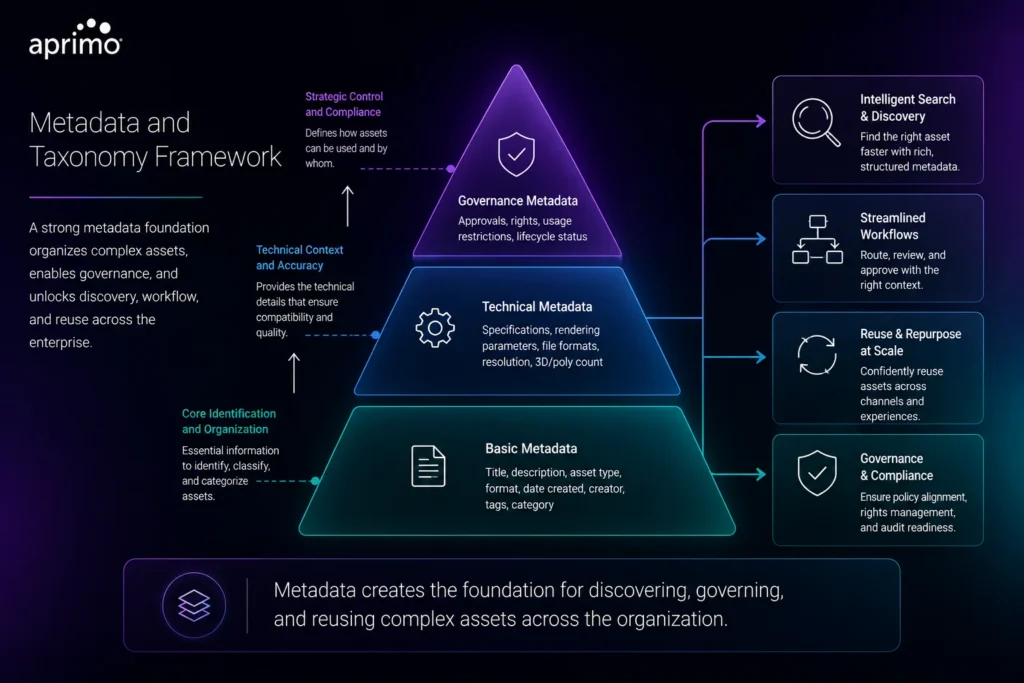
Managing complex digital assets requires more than storage. Organizations need structured metadata and taxonomy systems that describe assets at every level—from source files to derivatives. Unlike traditional marketing assets, complex digital assets demand richer metadata:
- Asset relationships: Connections between source models, renders, variations, and localized versions
- Technical specifications: File formats, rendering parameters, resolution requirements, color profiles
- Rights and usage: Licensing terms, geographic restrictions, channel-specific approvals
- Lineage and versioning: Which assets are current, approved, deprecated, or pending review
- Performance data: Usage analytics, engagement metrics, and channel-specific performance
A well-designed taxonomy becomes the operating system for content discovery and reuse. Teams can search not just by asset name, but by technical specifications, usage rights, approval status, and intended channels. As Aprimo explores in its article on organizing digital assets through metadata and taxonomy, the stronger your metadata foundation, the faster teams can find, reuse, and activate approved content.
Lifecycle Management and Content Reuse at Scale
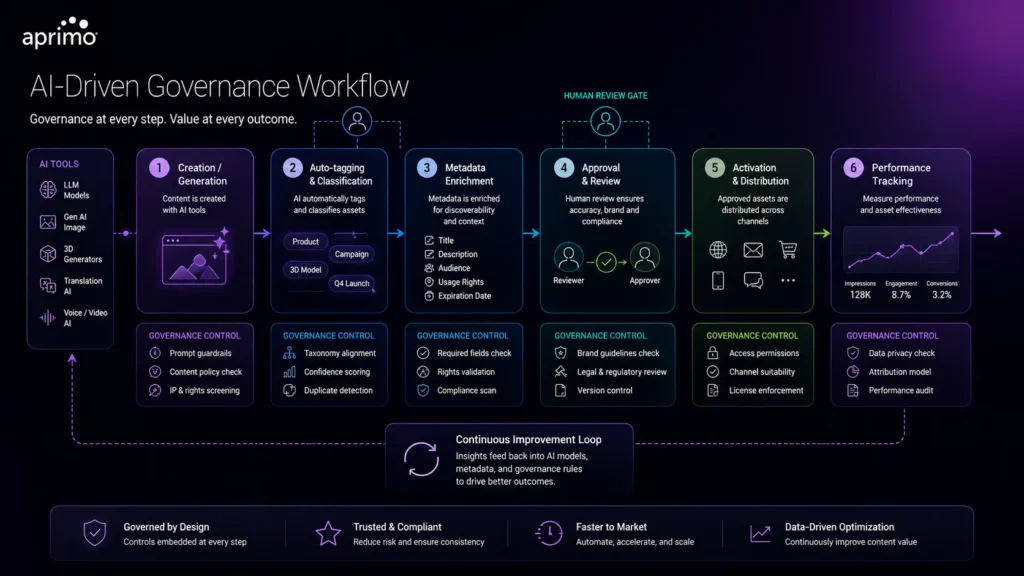
Managing the lifecycle of complex assets requires DAM systems that track status at every stage: creation, enrichment, approval, activation, and deprecation. This is especially important when a single 3D model generates hundreds of downstream assets.
A modern DAM enables:
- Centralized asset libraries accessible across product, marketing, creative, ecommerce, and regional teams
- Relationship mapping between source assets and derivatives, ensuring consistency across variations
- Workflow automation that moves assets through review and approval stages efficiently
- Usage tracking that shows where each asset is active, performing well, or underutilized
- Deprecation management that ensures outdated assets are removed from service without breaking downstream channels
Content reuse becomes a strategic advantage. Rather than recreating assets for each new campaign or market, teams reference approved source materials. This reduces production costs, accelerates time-to-market, and ensures consistency across regions. When teams know exactly which renders, localized versions, and AI-generated variations exist, they avoid duplication and make smarter decisions about resource allocation.
DAM as the System of Record for Complex Assets
Managing complex digital assets requires a central system that governs how assets are created, classified, approved, distributed, and reused. DAM provides that system of record. A modern DAM enables organizations to:
- Centralize complex asset libraries from multiple departments and workflows
- Manage relationships between source assets and their numerous derivatives
- Enforce metadata standards across the organization
- Support workflow automation that scales with content volume
- Govern usage rights, approvals, and channel-specific requirements
- Track content lifecycle status with full audit trails
- Enable collaboration across distributed teams without creating silos
This is particularly important for 3D and CGI content, where a single source model may generate hundreds of downstream assets. As outlined in Aprimo’s resources on enterprise DAM for brand consistency across global markets, centralized governance is the only way organizations maintain consistency while scaling operations globally.
A centralized DAM also improves collaboration across teams. Product, marketing, creative, ecommerce, and regional teams can all work from the same approved content repository rather than maintaining separate asset libraries—eliminating duplication, reducing risk, and accelerating content activation.
Future-Proofing Your DAM for AI and 3D Content
As AI-generated content and 3D assets become standard in enterprise workflows, DAM strategy must evolve. Organizations should consider:
Flexibility in asset formats and metadata
Your DAM should support emerging formats and allow metadata schemas to evolve without migration. AI generation tools and 3D rendering software introduce new asset types regularly.
Integration with creation and generation tools
Your DAM should connect seamlessly with AI platforms, 3D design software, product information management (PIM) systems, and content management systems (CMS). As Aprimo outlines in its guide to essential DAM integrations, a fragmented tech stack defeats the purpose of centralized governance.
Scalable infrastructure
AI workflows generate assets at unprecedented scale. Your DAM must handle millions of assets, complex relationships, and high-volume search and retrieval without performance degradation.
AI-assisted governance
Look for DAM platforms that use AI to auto-tag assets, detect duplicates, recommend optimal versions, and flag compliance risks. Governance itself becomes more intelligent and less manual as adoption grows.
Version control and rollback capabilities
With rapid iteration in AI-assisted workflows, teams need clear version histories and the ability to revert to previous asset states if needed.
Customer Perspective: How Leading Organizations Are Implementing This
Organizations that have implemented sophisticated DAM governance for complex assets report significant benefits. Teams move faster because they spend less time searching for approved content. Campaigns launch more consistently because all teams reference the same asset repository. Compliance improves because usage is tracked and auditable. And costs decrease because content is reused rather than recreated.
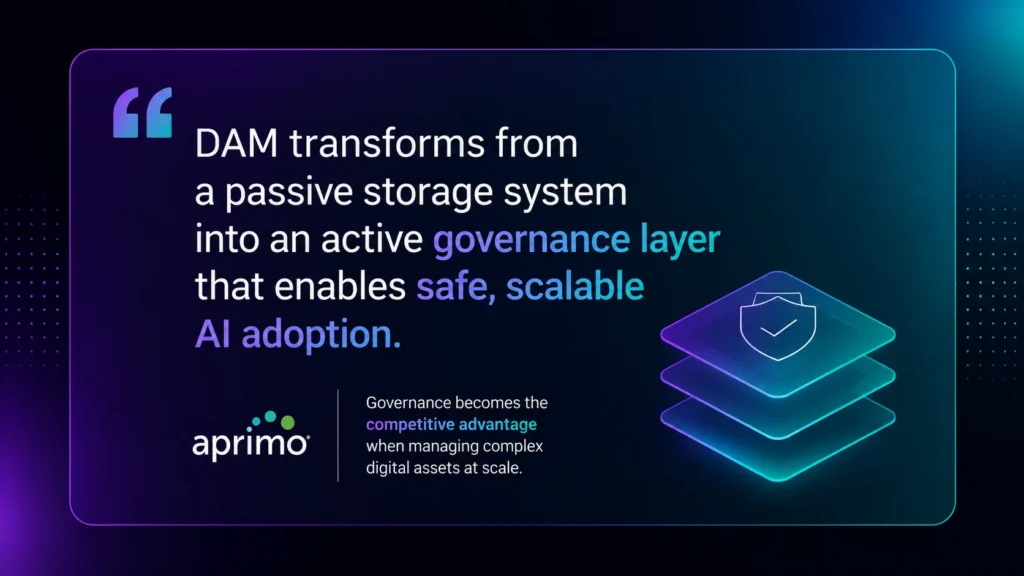
As content ecosystems become more sophisticated and AI adoption accelerates, the value of centralized content management only grows. DAM is no longer just a repository. It becomes the operational backbone that helps organizations maintain consistency, discoverability, and governance at scale. As AI-generated asset volumes continue to grow, these capabilities become increasingly important—not just for efficiency, but for maintaining brand integrity and managing risk across global operations.
Conclusion
The expanding definition of digital assets—from 3D models to AI-generated content—requires organizations to rethink their content operations strategy. Traditional DAM approaches cannot handle the complexity, scale, and interconnectedness of modern asset ecosystems. The organizations best positioned for AI-driven content workflows are those that build governance, metadata standards, and lifecycle management into their DAM strategy today.
By implementing structured content operations supported by a modern DAM platform, organizations can scale AI-assisted production safely, maintain brand consistency globally, and unlock the full value of their digital assets. The goal is not to slow innovation or constrain creativity. The goal is to help teams move faster with more confidence, less duplication, and stronger control over enterprise content operations.
FAQ
What is the difference between complex digital assets and traditional marketing assets?
Complex digital assets include 3D models, CGI renders, AI-generated content, and digital twins that often exist in multiple formats and generate numerous derivatives. Traditional assets like images and videos are static files with simpler metadata and fewer dependencies. Complex assets require richer metadata, version control, and relationship mapping across multiple downstream variations.
Why can’t traditional DAM systems manage complex digital assets?
Traditional DAM systems were designed around simpler file types with predictable workflows. Complex assets involve multiple formats, intricate dependencies, specialized metadata requirements, and complex approval processes that exceed the capabilities of systems built for basic image and video management. The scale and interconnectedness of modern asset ecosystems demands more sophisticated governance.
How does metadata support governance of AI-generated content?
Metadata creates a structured record of each asset’s origin, approval status, usage rights, performance, and relationships to other assets. For AI-generated content, metadata captures lineage (which AI model generated it), approval status, intended channels, and performance metrics. This enables teams to track, govern, and audit AI outputs at scale without manual oversight.
What role does DAM play in preventing AI governance risks?
DAM provides the system of record that tracks which assets are approved, who approved them, what rights they have, and where they’re active. This creates audit trails that satisfy compliance requirements and prevent unapproved content from reaching customers. DAM workflows also enforce approval gates that catch problematic content before activation.
How should organizations prioritize DAM improvements for AI adoption?
Start with metadata and taxonomy—define how you’ll describe and categorize assets so teams can find them consistently. Then implement workflow automation that moves assets through approval stages efficiently. Finally, ensure integrations between your DAM and AI generation tools so governance is built into the creation process from the start, not added afterward.