

Digital asset management software has transformed from passive storage into mission-critical content operations infrastructure.
- The global DAM market is projected to grow to $19.36 billion by 2034, driven by AI integration and cloud adoption.
- Organizations report reducing asset search time through agentic DAM platforms with automated tagging and intelligent discovery.
- Cloud-based DAM deployment is projected to capture nearly 80% of market share in 2026 as distributed workforces become standard.
- DAM systems have evolved into strategic orchestration platforms with autonomous AI capabilities that manage the entire content lifecycle.
For organizations questioning whether to invest in digital asset management, modern DAM platforms have become a competitive necessity.
The debate over whether digital asset management software remains relevant in 2026 misunderstands what these platforms have become. Organizations still thinking of DAM as file storage with search functionality are evaluating yesterday’s technology against today’s requirements. The transformation has been dramatic, and the market trajectory reflects enterprise recognition of this shift.
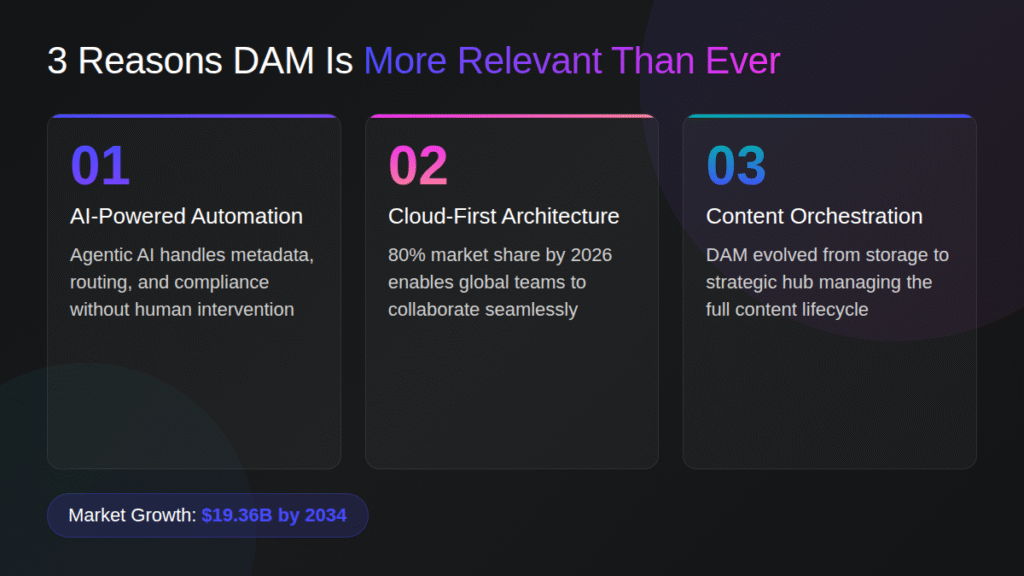
The global DAM market is projected to grow from $5.36 billion in 2025 to $19.36 billion by 2034, exhibiting a 15.10% CAGR. That growth rate doesn’t describe a fading technology category. It reflects organizations recognizing that content operations infrastructure has become foundational to competitive advantage across industries.
Why Are Organizations Asking Whether DAM Systems Still Matter?
The skepticism often stems from organizations that implemented first-generation DAM solutions, essentially glorified file servers with search functionality, and found them underwhelming. Those early systems required significant manual effort, delivered inconsistent search results, and created new bottlenecks rather than eliminating existing ones. Marketing teams spent hours tagging assets only to struggle finding them later. Creative departments watched productivity gains evaporate as they navigated clunky interfaces.
But 2026 DAMs bear almost no resemblance to those frustrating early experiences. Today’s platforms incorporate autonomous AI capabilities, sophisticated workflow automation, and intelligent content orchestration that transform how enterprises manage their expanding digital asset libraries.
What Has Changed About Digital Asset Management Software?
The evolution of DAM systems reflects broader shifts in how organizations approach content as a strategic asset. Where traditional platforms focused primarily on storage and retrieval, modern solutions address the entire content lifecycle from creation through distribution and performance measurement.
Cloud deployment has become the dominant model, with the cloud segment projected to capture nearly 80% of market share in 2026. This shift enables the scalability, accessibility, and real-time collaboration that distributed workforces require. Teams spread across continents can access the same assets, apply consistent brand standards, and contribute to shared workflows without geographic friction.
Artificial intelligence is now part of the core architecture. Machine learning algorithms power everything from automated metadata generation to predictive content recommendations. Natural language processing enables intuitive search experiences where users describe what they need rather than remembering exact file names or folder structures.
How Is AI Transforming the Relevance of DAM in 2026?
AI and DAM integration is the most transformative advancement in content operations infrastructure. Sixty-two percent of organizations are currently experimenting with AI agents, though only about one-third have begun scaling these capabilities enterprise-wide. The DAM category sits at the center of this transformation.
The term “agentic” describes AI systems that operate autonomously, making decisions and executing multi-step processes without constant human intervention. In DAM contexts, agentic AI means platforms that can independently route assets through workflows, make metadata decisions, trigger compliance checks, optimize content placement, and adapt processes in real time based on contextual signals.
Rather than serving as passive repositories where humans perform all organizational and distribution tasks, DAM systems with agentic AI actively participate in content operations. They anticipate needs, identify inefficiencies, and execute improvements without waiting for human initiation.
What Specific AI Capabilities Drive DAM Value?
Understanding the practical applications of AI in digital asset management helps clarify why these platforms have become indispensable for content-driven organizations.
Automated metadata generation eliminates one of the most tedious aspects of traditional DAM usage. Machine learning algorithms analyze visual, audio, and textual content to create comprehensive tags and descriptions. What once required hours of manual effort happens automatically at the moment of asset ingestion. More importantly, AI-generated metadata maintains consistency across thousands of assets in ways human taggers can’t match.
Intelligent search transforms how teams discover content. Natural language processing enables queries like “outdoor lifestyle shots from last quarter’s campaign” to surface relevant results even when those exact terms don’t appear in the metadata. Visual similarity search lets users upload a reference image and find assets with matching composition, color schemes, or visual elements.
Workflow automation accelerates content production by routing assets through review, approval, and distribution processes without manual handoffs. AI can evaluate assets against brand guidelines, flag potential compliance issues, and suggest optimization improvements before content reaches human reviewers. Rather than eliminating creative judgment, automation amplifies it by removing administrative friction from content operations.
Predictive analytics help organizations understand which assets drive engagement and why. By analyzing performance data across channels and campaigns, agentic DAM systems can recommend asset selection for specific audiences, suggest content gaps that new assets should address, and identify underutilized materials that deserve renewed attention.

What Business Outcomes Justify DAM Investment in 2026?
Organizations evaluating digital asset management software need concrete evidence of return. The data supporting DAM ROI has grown increasingly compelling as platforms have matured and enterprise deployments have accumulated measurable results.
Beyond pure efficiency metrics, DAM systems deliver value through improved brand consistency, reduced compliance risk, and enhanced content reuse. When every team member accesses the same approved assets through the same governed workflows, the scattered chaos of outdated logos, expired licensing, and off-brand materials diminishes.
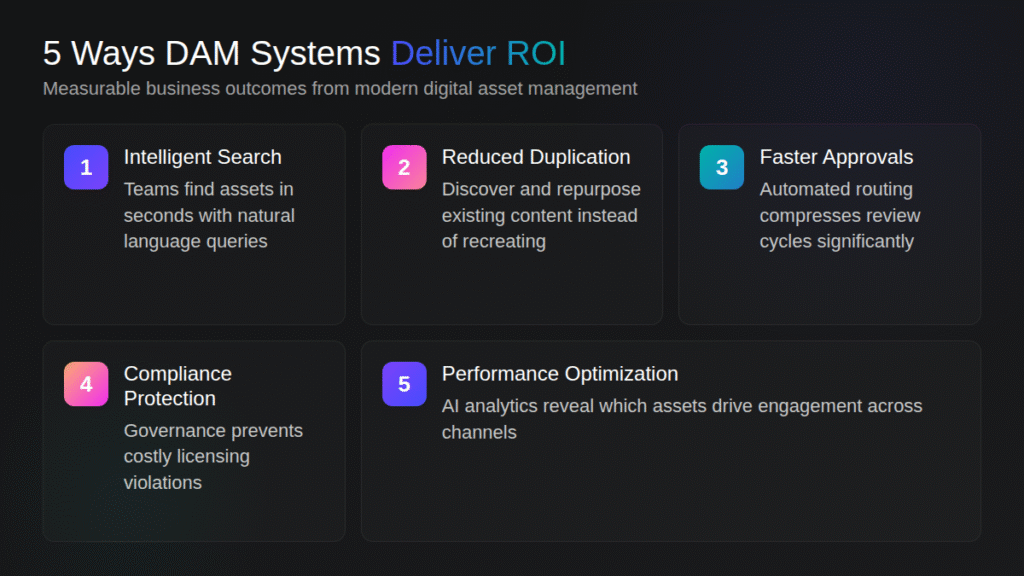
What Are the Top 5 Ways DAM Systems Deliver ROI?
- Time savings through intelligent search: Teams reclaim hours previously spent hunting through folder structures and shared sites. Natural language queries and AI-powered discovery mean relevant assets surface in seconds.
- Reduced content duplication: Without centralized visibility, organizations often recreate assets that already exist somewhere in their ecosystem. DAM platforms with comprehensive search and recommendation capabilities help teams discover and repurpose existing content rather than commissioning redundant work.
- Accelerated approval workflows: Automated routing, version control, and collaborative review tools compress review cycles that once stretched across weeks. Stakeholders can review and approve assets from any device, eliminating bottlenecks caused by geographic distribution or scheduling conflicts.
- Compliance cost avoidance: Using expired licenses, unauthorized modifications of approved assets, or outdated materials in regulated communications creates legal and reputational risk. DAM governance features track usage rights, enforce approval requirements, and prevent non-compliant content from reaching distribution.
- Content performance optimization: AI-powered analytics reveal which assets drive engagement across different channels and audiences. Organizations can shift creative investment toward formats and styles that demonstrate measurable impact rather than relying on intuition alone.
How Does the Relevance of DAM Connect to Broader Content Operations?
Digital asset management software no longer exists as a standalone tool. The most successful implementations position DAM as the central hub within a connected content ecosystem. This integration-first approach explains why market growth continues accelerating even as organizations scrutinize technology spending.
Modern DAM platforms seamlessly connect with creative tools like Adobe Creative Suite, enabling designers to access and place approved assets without leaving their preferred applications. Marketing automation integrations ensure campaigns pull from current, approved materials while tracking which assets perform best across audience segments. Content management systems receive assets formatted and optimized for specific publishing requirements.
This ecosystem makes DAM indispensable. When AI transforms digital asset management workflows while simultaneously connecting to every other content-related system, the platform becomes infrastructure rather than software.
Why Does Integration Matter for DAM Relevance?
The value of any technology multiplies when it connects with surrounding systems. DAM platforms that require manual export and import for every workflow quickly become bottlenecks rather than accelerators.
Integration eliminates friction from creative workflows. Designers pull assets directly into their projects without downloading, searching through local files, and uploading again. Marketers schedule social content using assets that automatically format for each platform’s specifications. Sales teams access the latest product imagery and collateral through tools they already use daily.
AI and DAM integration enables automation that would otherwise require human intervention. When a product image updates in the DAM, connected systems can automatically refresh that image everywhere it appears, from e-commerce platforms to printed collateral templates and partner portals. This automated synchronization ensures consistency while eliminating tedious manual updates.
What Makes AI-Powered DAM Essential for Distributed Workforces?
The workplace transformation has altered expectations for content collaboration. Cloud-based DAM deployment has become standard precisely because creative and marketing teams span multiple locations, time zones, and organizational boundaries.
Traditional approaches to file sharing collapse under distributed workforce demands. Email attachments create version confusion. Cloud storage without governance leads to asset sprawl. Collaboration tools designed for communication struggle with large media files and complex approval workflows.
DAM systems purpose-built for content operations at scale directly address these challenges. Centralized repositories ensure everyone accesses the same source of truth. Role-based permissions protect sensitive materials while enabling appropriate access. Commenting and annotation tools facilitate asynchronous collaboration across time zones.
Mobile access has become vital as more DAM users access systems from mobile devices. This shift toward device-agnostic workflows means platforms must deliver consistent experiences regardless of how team members connect.
How Should Organizations Evaluate DAM Solutions for Future Readiness?
Organizations questioning whether DAM remains relevant should redirect that inquiry toward evaluating which platforms will deliver value over the coming decade.
The distinction between AI-assisted features and truly autonomous AI capabilities deserves careful attention. Many platforms offer basic image recognition and automated tagging, valuable features that have become table stakes. Fewer platforms provide sophisticated AI agents capable of executing complex workflows, making contextual decisions, and continuously improving based on organizational patterns.
Scalability considerations extend beyond storage capacity to processing capability, concurrent user support, and integration throughput. Organizations whose content operations are expanding should evaluate how platforms perform under increased load, not just current requirements.
Compliance and governance capabilities matter as regulatory environments evolve and content authenticity concerns intensify. Platforms should support detailed audit trails, rights management, version control, and emerging standards for content provenance verification.
What Questions Reveal DAM Platform Maturity?
When evaluating digital asset management platforms, several questions help distinguish genuinely advanced solutions from marketing promises.
How does the platform handle AI capability development? Look for vendors that train models on customer-specific content and terminology rather than relying solely on generic external services. Industry-specific and brand-specific understanding improves metadata accuracy and search relevance.
What integration ecosystem does the platform support? Count pre-built connectors, but also evaluate API completeness and developer documentation. The specific tools your organization uses matter more than total integration numbers.
How does the platform demonstrate production-readiness versus experimental capability? Ask for customer references using AI features at scale, implementation timelines for advanced functionality, and concrete evidence of enterprise deployment success.
What Does the DAM Solutions Future Hold Beyond 2026?
The trajectory of digital asset management software points toward increasingly intelligent, autonomous, and integrated platforms. Several emerging trends will shape how organizations approach content operations infrastructure.
Content authenticity verification is gaining urgency as AI-generated materials proliferate. Trust frameworks that document content provenance, creation methods, and modification history will become standard DAM capabilities. Organizations will need to demonstrate that published content is genuine, properly licensed, and appropriately authorized.
Personalization at scale requires DAM systems that can rapidly generate and manage asset variants for different audiences, channels, and contexts. AI capabilities that create localized versions, adjust imagery for demographic relevance, and optimize content format for specific platforms will become essential for organizations competing on customer experience.
Sustainability considerations are entering DAM strategies as organizations recognize the environmental impact of digital content operations. Platforms that help minimize unnecessary content creation, identify redundant assets, and optimize storage efficiency align with broader corporate responsibility commitments.
Frequently Asked Questions
Is digital asset management software necessary for small businesses?
While enterprise organizations generate the largest volumes of digital assets, small and mid-sized businesses still benefit from DAM systems. Cloud-based deployment models have made professional-grade DAM accessible without significant upfront infrastructure investment, enabling smaller teams to achieve the efficiency gains and brand consistency that larger competitors have long enjoyed.
How does AI and DAM integration impact complexity?
AI capabilities in modern DAM platforms actually reduce implementation complexity rather than increasing it. Automated metadata generation eliminates the need for extensive manual tagging during migration. Intelligent categorization helps establish organizational structures based on content analysis rather than requiring predetermined taxonomy development. Machine learning models improve accuracy over time with minimal ongoing configuration, meaning the system becomes more useful through normal operation rather than requiring constant administrative attention.
What security considerations apply to cloud-based DAM systems?
Cloud DAM platforms address security through encryption, role-based access controls, audit logging, and compliance certifications. Leading vendors maintain certifications including SOC 2, GDPR compliance, and industry-specific standards for healthcare, financial services, and government applications. Organizations should evaluate vendor security practices, data residency options, and incident response procedures during platform selection.
How long does a typical DAM implementation require?
Implementation timelines vary based on organizational complexity, content migration scope, and integration requirements. Basic deployments can achieve initial functionality within weeks, while enterprise implementations with extensive integrations and large content migrations may extend across several months. The most successful implementations follow phased approaches that deliver early value while building toward comprehensive capability.
Why DAM Is a Strategic Advantage in 2026
As content volumes expand, distributed workforces become standard, and AI transforms operational efficiency, platforms that orchestrate content operations become essential infrastructure.
Organizations that invested in first-generation DAM solutions may carry residual skepticism based on underwhelming experiences. Those historical frustrations reflect the immaturity of early platforms, not inherent limitations of the category. Today’s agentic DAM systems bear about as much resemblance to early file repositories as modern smartphones bear to rotary telephones.
For marketing and creative leaders evaluating where to direct technology investment, digital asset management software delivers measurable ROI through efficiency gains, brand consistency, compliance protection, and content optimization. The platforms driving the most value combine sophisticated AI capabilities with robust integration ecosystems and proven enterprise scalability.
Aprimo’s Agentic DAM platform exemplifies this evolution, combining autonomous AI agents for content orchestration with comprehensive workflow automation and enterprise-grade governance. Schedule a demonstration to experience these capabilities firsthand.