

Several teams shipped new web pages last month. One person spent 45 minutes hunting for the latest brand guidelines. Another used an old copy saved on a laptop. A third cloned an existing page and swapped the images without checking brand standards. Meanwhile, the CEO wants to know why content costs keep climbing when AI has made creation faster than ever. Ungoverned content is the answer, and it is a structural problem rather than a people problem.
McKinsey research on marketing workflows describes the approval bottleneck as real and costly, with decentralized processes pulling teams toward administration instead of strategy. Forbes reports that cutting an approval workflow from six steps to three shortened delivery timelines by nearly 30%. Most organizations still run disconnected workflows that drain budgets and slow delivery.
The missing piece is structure. Governance gives content effort a direction, a set of owners, and a way to measure results.
TL;DR
- Faster delivery: Cutting approvals from six steps to three shortened delivery timelines by nearly 30% in one Forbes example.
- Revenue upside: McKinsey reports that companies moving from linear workflows to agentic marketing see 3% to 15% revenue growth.
- AI needs guardrails: Forbes reports that AI-supported workflows with clear approval stages cut content delivery time by more than 70%. Without governance, AI multiplies waste instead.
- More time for strategy: Clear roles free marketers from chasing sign-offs. They spend that time on strategy instead.
The Real Cost of Decentralized Content Workflows
Brand Inconsistency Compounds Across Every Channel
Without content governance, brand consistency becomes a suggestion instead of a standard. One team uses outdated messaging. Another invents new taglines. A third never saw the new voice guidelines.
The result is brand dilution that builds across every touchpoint, and customers notice. Inconsistent messaging erodes trust and adds friction to the buyer’s journey. For enterprises operating across regions, departments, and channels, that erosion can cost millions in lost brand equity.
The operational cost: Teams burn energy recreating brand assets instead of reusing them. Translation costs spike. Design cycles repeat. Each department builds its own approval workflow, which creates silos that block collaboration and slow delivery. When the CMO asks how many versions of a product page exist across web, email, and social, the honest answer is often “we don’t know.” That is an expensive governance failure.
Approval Delays Cost Agility and Revenue
Time-to-market matters. A campaign delayed by a week can miss a seasonal window. A product announcement stuck in review for two weeks loses momentum. Ungoverned content workflows create these delays routinely.
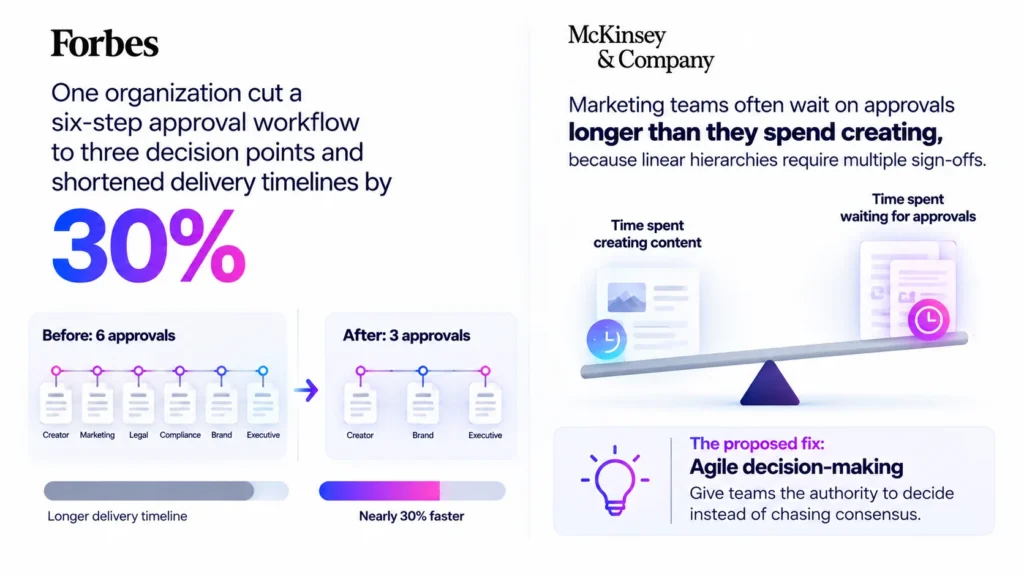
According to Forbes, long approval chains are meant to reduce risk but slow execution, so too many checkpoints become a hidden cost. The same article describes one organization that cut a six-step approval workflow to three clear decision points. It shortened delivery timelines by nearly 30%.
McKinsey research finds that marketing teams often wait on approvals longer than they spend creating, because linear hierarchies require multiple sign-offs. The proposed fix is agile decision-making, where teams hold the authority to decide instead of chasing consensus.
The core issue: Without defined roles, approval authority, and timelines, every decision turns into consensus-building. Consensus is slow.
The AI Acceleration Paradox: More Content, Less Control
Generative AI made content creation frictionless. One marketer can draft 50 blog posts, hundreds of email variants, and thousands of ad copy iterations in an afternoon. That is a real advantage, but only if the output is governed.
Without governance, AI amplifies existing problems. Instead of cutting waste, teams create more of it faster. Instead of consistency, they multiply the variations someone has to manage. Teams then spend their time organizing and deduplicating AI-generated content instead of using it for competitive advantage.
Your team is creating without direction, oversight, or standards.
Why Decentralized Workflows Fail: The Structural Breakdown
Fragmented Tools Create Fragmented Workflows
When approvals live in email, versions live in shared drives, assets sit in scattered folders, and status updates happen in Slack, chaos follows.
Team members lose time switching between tools, searching for the latest file, chasing approvals across channels, and rebuilding work they could not find. A CMO may have a dashboard of campaign performance but no view of which content is approved, in review, or blocked. An operations manager cannot enforce brand guidelines at the point of creation. A creative team cannot see which assets are already approved for reuse.
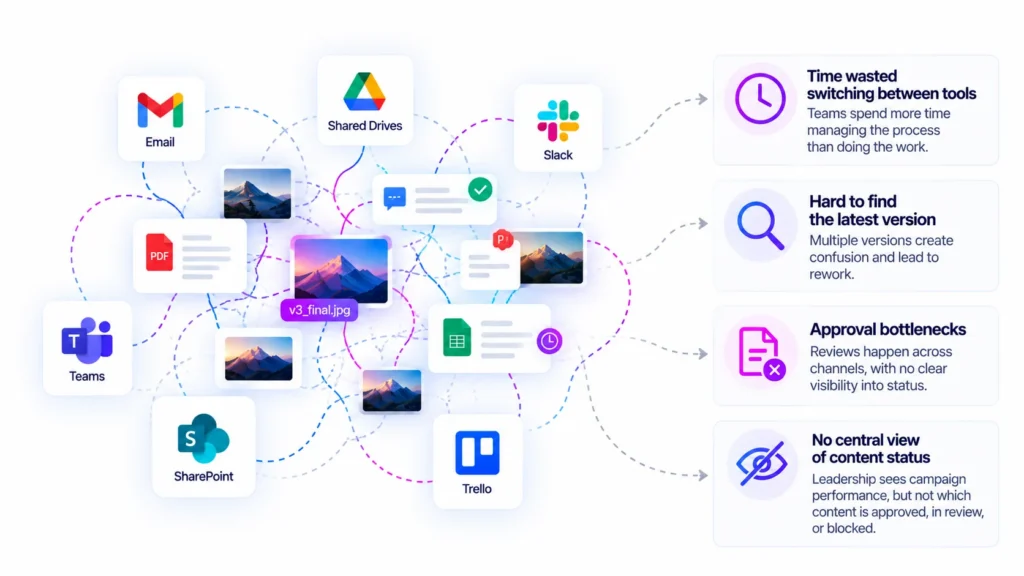
Forbes reports that siloed workflows and approval bottlenecks reduce a team’s ability to hit deadlines, grow output, or reach strategic goals. Teams end up managing the approval process more than doing the work.When content, approvals, and status updates are scattered across disconnected tools, teams lose visibility into workflows, creating delays, version confusion, and unnecessary rework.
This is not a motivation problem. Your team wants to move faster. The structure around them makes that nearly impossible.
Version Control Becomes a Version Nightmare
Without governance, file management slides into chaos. You end up with:
- Multiple versions of the same asset across folders and systems
- Uncertainty about which version is approved
- Translation repeated for content that was already translated
- Outdated content that stays accessible and gets reused
- Legal and compliance risk from unapproved messaging that stays in circulation
The problem compounds as teams grow. A team of five can manage chaos through conversation. A team of 50 cannot. Tracking versions, approvals, and assets becomes a real productivity drag.
Governance Gaps Create Compliance Risk
Without clear governance, compliance is reactive instead of preventative. Brand guidelines exist but nobody enforces them. Legal requirements go unchecked before publishing. Regional regulations apply unevenly.
When something goes wrong, such as a product claim that violates FTC guidelines, messaging that contradicts brand standards, or content that breaks data privacy rules, the team investigates after the fact. Remediation, legal review, and reputation repair cost far more than governance infrastructure.
How Mature Is Your Content Governance?
Benchmark where your content governance program stands today, then see where to focus first.
Building Governance: From Chaos to Control
Define Roles, Authorities, and Approval Timelines
Effective governance starts with structure. Define each of the following:
- Who creates: content creators and subject matter experts
- Who reviews: brand, legal, and compliance stakeholders
- Who approves: final decision-makers with clear authority
- Timeline expectations: the maximum review time at each stage
- Escalation paths: what happens when approval is blocked
When everyone knows their role and the timeline, approvals speed up. Teams shift from seeking consensus to making informed decisions.
Enforce Brand Standards Where Content Is Created
Document your brand standards: voice, visual guidelines, messaging frameworks, and approved terminology. Then make them accessible at the point of creation. When creators can check guidelines while they build, they do not wait for feedback to learn the rules. Content reaches review closer to standard.
Reusable brand assets should be tagged, organized, and easy to find. Instead of recreating a layout, a team member pulls the approved template. Instead of rewriting product positioning, they open the current messaging framework. That saves time and protects consistency.
Implement Centralized Content Governance
Centralized governance does not mean centralizing creativity or moving every asset into one store. It means building a single source of truth visibility layer where:
- All content assets are searchable
- Metadata such as status, brand, region, campaign, and language can be added
- Teams can find existing assets before creating new ones
- Governance rules apply systematically, including brand compliance checks and legal review routing
The result is faster decisions, plus the ability to find and reuse assets instead of recreating them.
How Aprimo Content Portfolio Management (CPM) enables this: CPM surfaces content wherever it is stored or used, which makes it discoverable and reduces duplication. AI agents enforce brand and compliance guidelines automatically. Exceptions are ranked by criticality, so teams fix the highest-impact issues first.
Track Metrics That Matter
Ungoverned content produces invisible waste, and you cannot optimize what you do not measure. Start tracking:
- Approval cycle time: days from submission to approval
- Content duplication rate: share of assets that are near-duplicates
- Time-to-market: days from concept to publish
- Approval time versus creation time: how the team splits its effort
- Brand compliance rate: share of content that meets standards on first review
- Content reuse rate: share of new content that could have reused an existing asset
These metrics create visibility and accountability. Over time, they show whether governance investment is paying off.
The ROI of Content Governance: What Your CFO Needs to See
Organizations with sound content governance see measurable returns. Those returns come from five places:
- Faster time-to-market: Structured approvals shorten decision cycles, so campaigns launch weeks earlier.
- Lower approval overhead: Marketing spends less time chasing sign-offs, more on strategy.
- Better resource allocation: Clear roles and decision authority prevent bottlenecks.
- Room to grow: Teams raise content output without raising headcount in proportion.
- Less compliance exposure: Preventing governance failures avoids costly remediation and legal risk.
As an illustration, consider a marketing team with a $5M annual content budget. A 10% reduction in time wasted on approvals and administration is worth about $500K a year. McKinsey research suggests the real impact is often higher when AI joins the workflow, with revenue gains that outweigh the operational savings.
Governance in Action: What Success Looks Like
When governance works, the dynamic shifts.
Campaign deployment: A team member builds a landing page with images from the CMS. The governance layer flags images that are off-brand or carry expired usage rights. Instead of waiting for an escalation or a cease-and-desist letter, the stakeholder sees the issue, then swaps in compliant images.
Content discovery: A social media manager searches the central repository for product messaging. Rather than writing copy from scratch, they find the approved messaging framework and adapt it. A second check on the social platform confirms the adapted copy stays on-brand. Time to market drops sharply.
Regional compliance: A new regional requirement means every asset in one market needs review. Instead of reviewing each web asset by hand, governance rules apply to all of them automatically, and non-compliant content is flagged. The team catches the problem in real time instead of waiting for an audit.
Leadership visibility: The CMO opens a dashboard that shows where the main governance issues sit. She sees which pieces are blocked, which wait on specific stakeholders, and where bottlenecks form. That visibility lets her clear delays deliberately.
Mature governance frameworks make these outcomes routine.
Getting Started: Your 90-Day Governance Plan
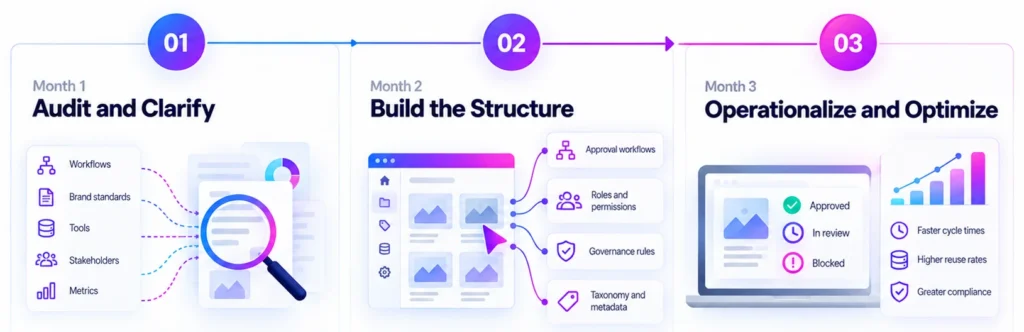
Month 1: Audit and Clarify
- Map current workflows and identify pain points
- Document existing brand standards and governance requirements
- Identify the tools in use along with their limits
- Interview stakeholders about their biggest frustrations with content creation
- Calculate current approval cycle times and content duplication rates
Month 2: Build the Structure
- Define approval workflows, roles, and authorities
- Document governance rules for brand compliance and legal requirements
- Select a centralized content management platform
- Create content taxonomy and metadata standards
- Set up the initial repository, then scan critical assets stored elsewhere
Month 3: Operationalize and Optimize
- Train the team on new workflows and the platform
- Run the first campaigns under the new governance process
- Measure cycle times, reuse rates, and compliance metrics
- Find bottlenecks and iterate on workflows
- Plan ongoing governance as the team grows
FAQ
Won’t content governance slow down our fast-moving team?
The opposite. Governance clarifies decision-making, which removes the back-and-forth that slows approvals. Forbes reports that cutting an approval workflow from six steps to three shortened delivery timelines by nearly 30%. The slowdown people expect comes from initial setup. After that, speed increases.
How do we enforce governance without stifling creativity?
Governance guides creativity instead of restricting it. Clear brand standards let creators focus on strategy instead of debating whether something fits the brand. Guidelines paired with clear authority structures produce faster, better decisions.
How does content governance differ from project management?
Project management tracks tasks and deadlines. Governance defines standards, authorities, and decision processes. Teams need both: governance protects quality and consistency, while project management protects timely delivery.
How long does it take to see ROI from content governance?
Organizations typically see measurable improvements in approval cycle times within 30 to 60 days. McKinsey research shows that companies with optimized marketing operating models achieve 3% to 15% revenue uplift. It also reports 10% to 20% sales ROI improvement as workflows mature.
Can we implement governance without new tools?
Partly. Clear processes and documented standards help. Durable governance, however, needs a centralized view of your content wherever it is stored or deployed. You cannot enforce governance on content you cannot see or find.
Related reading: brand governance for 50+ content creators, content compliance in regulated industries.