
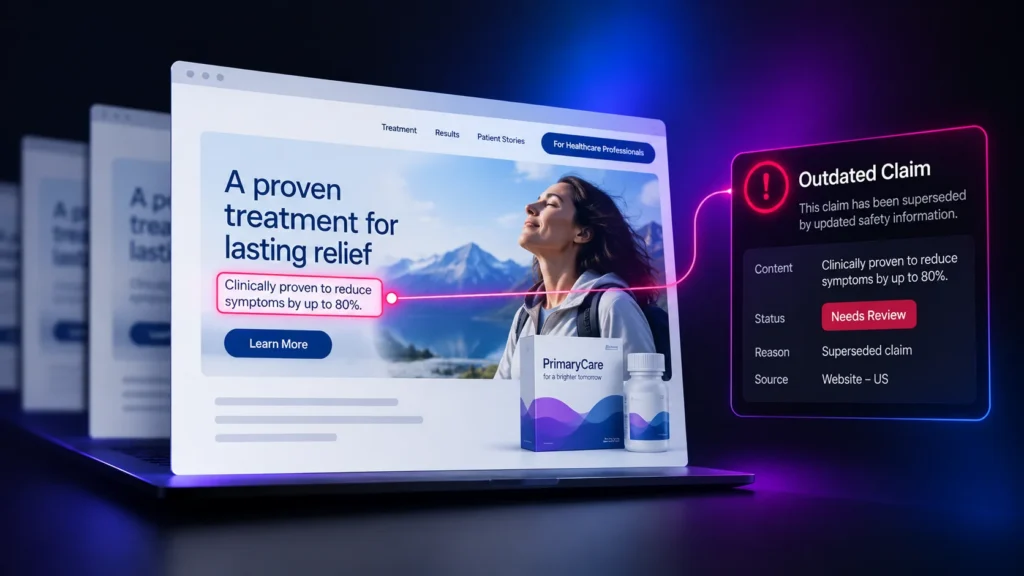
Imagine a pharmaceutical company launching a new treatment campaign. Every claim is validated, every disclaimer is reviewed, every asset passes Medical, Legal, Regulatory (MLR) approval. The campaign goes live across websites, healthcare professional portals, and regional marketing channels. On launch day, content compliance looks complete.
Six months later, new safety information requires updated messaging. The central marketing team revises the materials and sends them through another round of MLR review.
But an older version is still live on a regional website. Another copy sits in an agency’s SharePoint folder. A healthcare professional portal still shows the original claims.
All three assets were approved when created. Are they still compliant?
This is one of the most overlooked challenges in regulated content management. Approval is a point-in-time decision, but compliance is an ongoing responsibility.
The same problem exists in financial services, where outdated investment disclosures can linger on advisor websites. It exists in healthcare, where older patient communications may keep circulating after policies change. For regulated enterprises, compliance risk does not end at approval. It continues wherever content is stored, shared, or published. That is why organizations need to move from one-time approval to continuous content compliance: the process of discovering, monitoring, and revalidating content throughout its lifecycle, wherever it lives.
TL;DR
- Approval is not permanent: Approved content can become non-compliant when regulations, claims, disclosures, or approval periods change.
- Compliance extends beyond the DAM: Assets spread across websites, SharePoint, partner portals, and regional repositories where oversight is limited.
- Expired approvals require action: MLR-approved assets can be flagged for re-review when their approval periods expire.
- AI reduces manual monitoring: Automated checks can identify outdated claims, missing disclosures, expired assets, and potential policy violations.
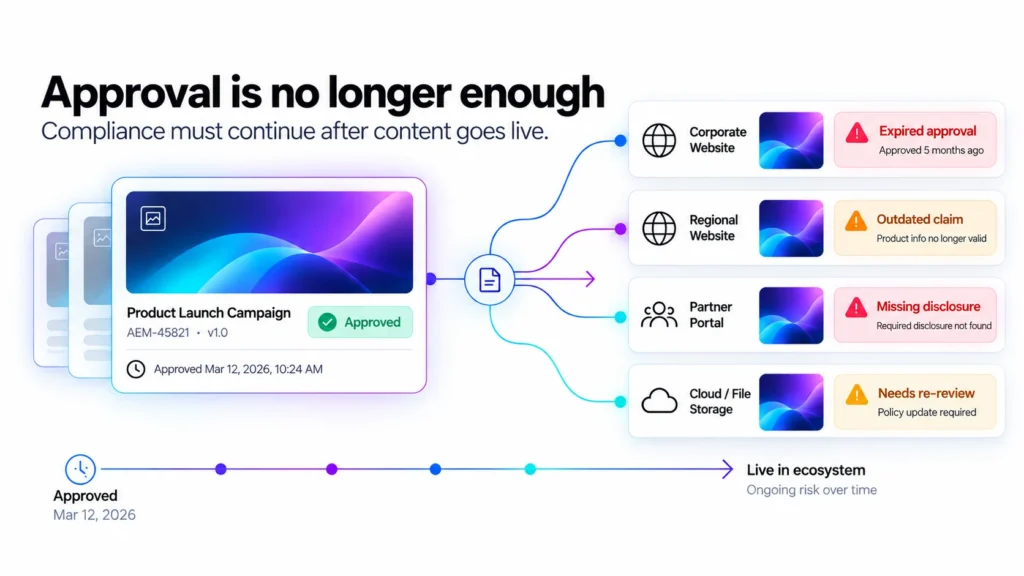
The Compliance Challenge: When Approved Content Becomes a Liability
Why Traditional Approval Processes Fall Short
In regulated industries, content approval is already rigorous. Pharmaceutical companies use MLR reviews to validate promotional claims, scientific accuracy, and regulatory requirements. Financial institutions review marketing communications for appropriate disclosures and substantiated claims. Healthcare organizations must ensure patient-facing content meets advertising, privacy, and other requirements.
These processes are essential, but they focus on one asset version at one moment. Once content is published, several things can change:
- Regulations evolve: New guidance or internal policies may require previously published content to be reassessed.
- Claims become outdated: Product information, supporting evidence, or approved messaging may change.
- Approvals expire: Assets may stay accessible after permitted usage or review periods end.
- Content is repurposed: Regional teams, agencies, and partners adapt approved materials, sometimes altering claims or removing required disclosures.
- Assets leave controlled environments: Content downloaded from a DAM can be duplicated across systems with no central oversight.
The core problem is that most organizations lack equivalent controls for monitoring content after approval.
Different Industries, Similar Compliance Risks
The challenge shows up across regulated sectors.
- Pharmaceuticals and life sciences: A company updates prescribing information after new safety findings. Approved promotional materials are revised centrally, but older copies remain on regional websites and healthcare professional portals. Those assets may carry outdated risk information or claims that need reassessment.
- Financial services and insurance: An investment firm updates a product’s required disclosures. The latest materials sit in a central location, but advisors keep using previously approved brochures and website content. The firm must identify and address outdated versions across distributed channels.
- Healthcare: A provider changes eligibility requirements or treatment information. Its official website reflects the update, but older brochures and regional pages keep giving patients outdated information.
In each case, the original content may have been compliant. The risk emerges because it stays in circulation after circumstances change. The real challenge is making sure previously approved content remains appropriate for continued use.
The Visibility Gap: Compliance Does Not Stop at the DAM
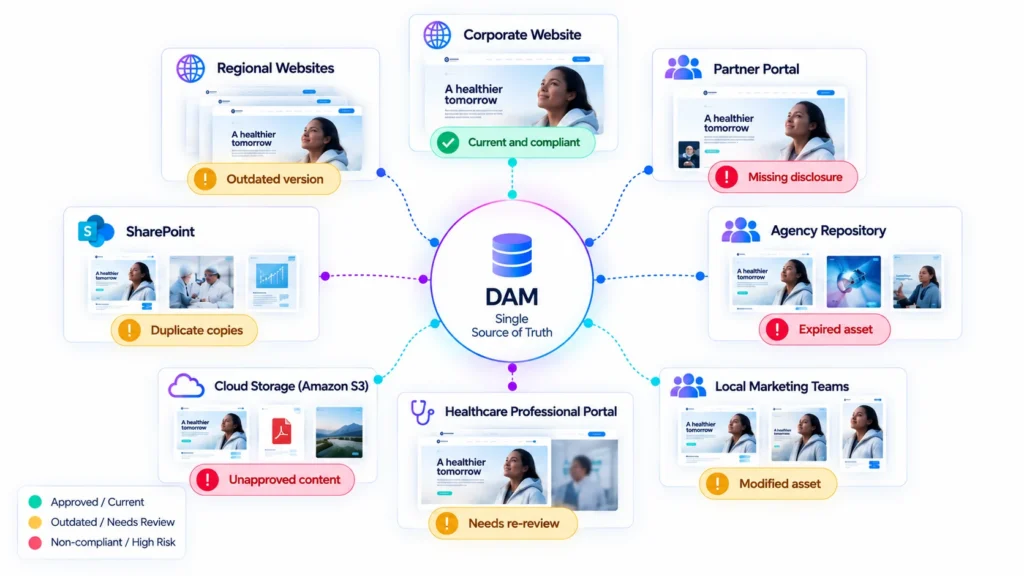
Digital Asset Management (DAM) platforms play an important role in regulated content operations. They help organizations manage approved assets, metadata, permissions, versions, and content lifecycles. But the enterprise content footprint extends well beyond the DAM.
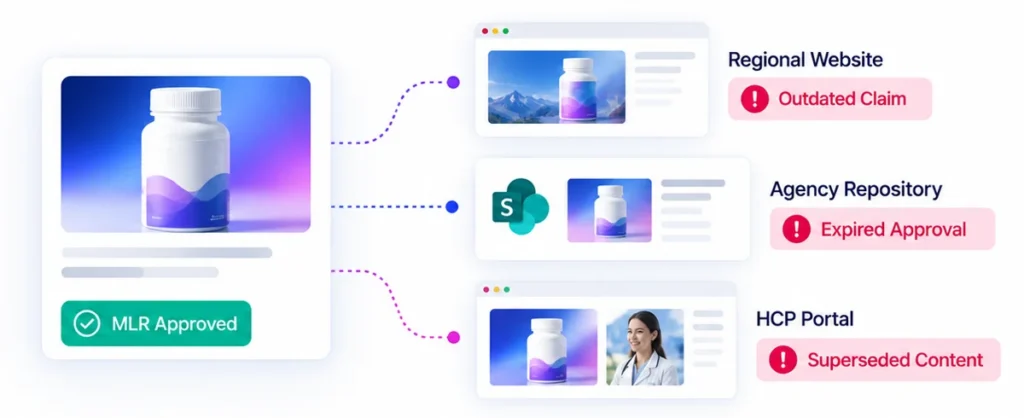
Once approved assets are downloaded, they can appear in SharePoint folders, agency repositories, websites, partner portals, sales enablement systems, and regional marketing platforms. A DAM may correctly mark an asset as expired or superseded. What happens to the copies distributed outside that environment? Can the organization locate every instance of an outdated promotional claim? Can it identify an expired asset embedded in a partner website? Can it find content adapted from an older approved version?
This creates a critical distinction between governing content inside a repository and governing content across the enterprise. Without visibility into distributed assets, compliance teams face three challenges:
- Undetected exposure: Outdated or non-compliant assets stay in circulation because nobody knows where they are.
- Delayed remediation: Issues surface during periodic audits or after complaints instead of through ongoing monitoring.
- Incomplete traceability: Teams struggle to determine where affected content exists and what corrective actions have been taken.
The solution is not necessarily consolidating every asset into one repository. It is extending visibility and governance to content wherever it resides.
Evaluating a DAM for Regulated Content?
Generate a tailored DAM RFI based on your requirements, use cases, and business goals in minutes.
From One-Time Approval to Continuous Content Compliance
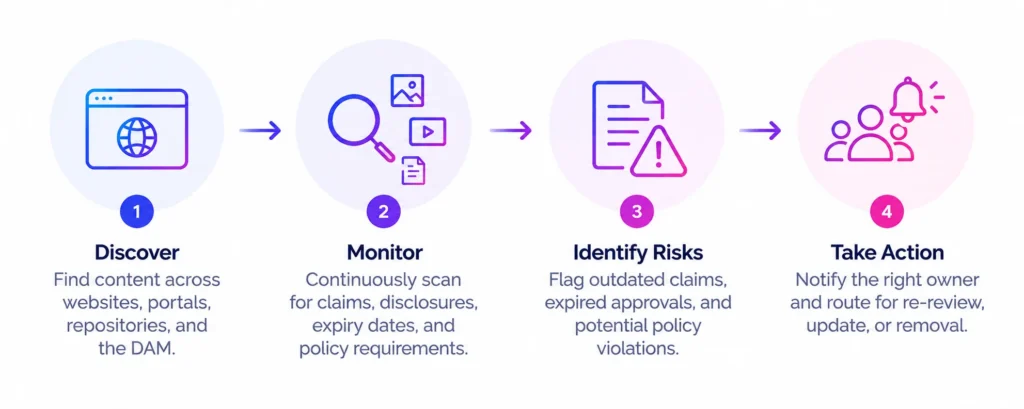
Continuous content compliance is the ongoing work of discovering, monitoring, evaluating, and revalidating content against current legal, regulatory, or organizational requirements. Instead of treating approval as the final checkpoint, organizations reassess content as requirements change. Four capabilities make this possible.
1. Continuously Discover Content Across Enterprise Systems
Organizations cannot assess content they cannot find. The first step is visibility across DAM platforms, SharePoint, CMS platforms, websites, agency repositories, and partner environments. Discovery must go beyond filenames. Organizations also need to understand relationships between assets, including duplicates, derivatives, and versions.
For example, when a pharmaceutical company withdraws an approved claim, it should find the original promotional asset and the related content distributed across monitored locations. That lets compliance teams understand the potential scope of a problem before deciding on action.
2. Monitor Content Against Current Compliance Policies
Finding assets is only the beginning. Organizations must evaluate whether those assets still satisfy applicable requirements. AI-powered compliance checks can help identify issues such as:
- Outdated or unsupported product claims
- Missing or incorrect regulatory disclosures
- Expired approval periods or usage rights
- Messaging inconsistent with approved references
- Content that violates configured organizational policies
Automated checks should identify potential violations, not replace regulatory judgment. Medical, legal, and compliance professionals remain responsible for evaluating findings. They also decide on the response. This approach lets organizations monitor larger content portfolios while directing human attention to meaningful exceptions.
3. Automatically Flag Expired Assets for MLR Re-Review
One valuable use of continuous compliance is managing approved content once its approval period expires. Consider a pharmaceutical company whose promotional assets passed MLR review and were distributed across multiple channels. In a traditional process, an asset may be marked expired in the DAM while copies on external websites or shared repositories remain accessible. Compliance teams must then locate those copies by hand, then decide whether to update, remove, or reapprove them.
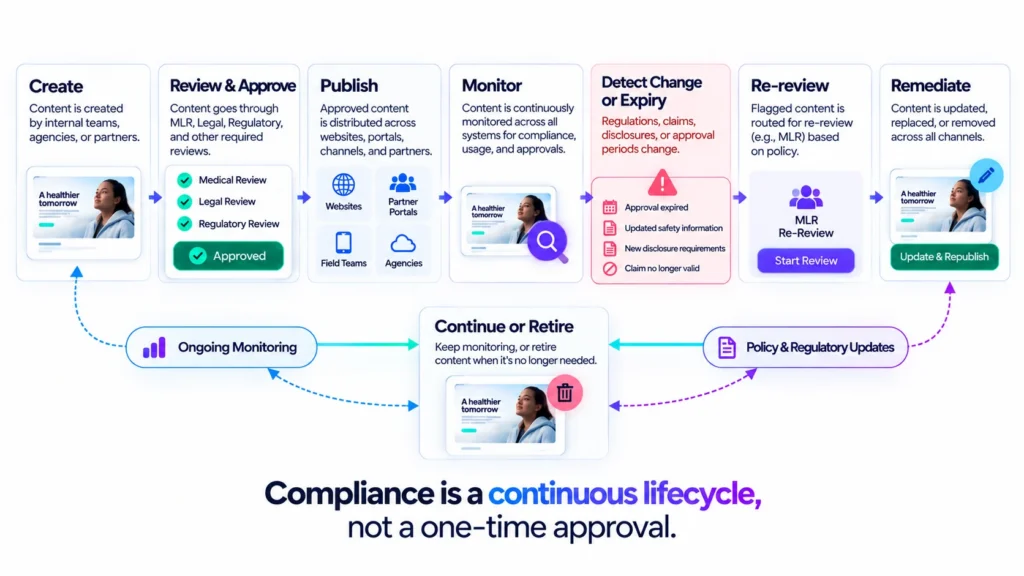
With continuous monitoring, organizations can connect approval metadata with distributed asset discovery. When an approval expires, the system flags affected assets and identifies known copies across connected locations. Through configured workflow integrations, those findings can trigger another MLR review, a remediation assignment, or a withdrawal process. The same approach applies when new evidence emerges, approved claims change, or regulatory updates require reassessment.
Instead of treating MLR approval as a one-time milestone, organizations can make revalidation an active part of lifecycle management. Not every expired asset needs the same response, because the right action depends on internal policies, regulatory requirements, and the nature of the content. But expiration should never go unnoticed simply because an asset left the DAM.
4. Prioritize Compliance Issues by Business Risk
Not all violations carry the same consequences. An outdated safety claim on a public pharmaceutical website warrants more urgency than an expired internal presentation. An incorrect investment disclosure on a customer-facing page may matter more than a minor brand formatting issue.
Organizations should rank findings by factors such as regulatory severity, public exposure, audience impact, geography, and issue type. Risk-based prioritization lets compliance teams focus on the most significant concerns instead of reviewing every detected exception. It also links compliance monitoring to corrective action more clearly.
How Aprimo CPM Enables Continuous Compliance Beyond the DAM

Aprimo Content Portfolio Management (CPM) extends compliance governance beyond the DAM. It helps regulated enterprises continuously discover, monitor, and manage content across distributed systems without centralizing every asset.
- Aprimo Mesh, discover content everywhere: Scans DAMs, SharePoint, CMS platforms, and other repositories to find assets, duplicates, or relationships. It gives visibility into distributed content.
- AI Agents, monitor compliance continuously: Flag outdated claims, missing disclosures, expired approvals, and policy violations. Route expired MLR-approved assets for re-review through integrated workflows.
- Risk-based remediation, prioritize critical issues: Surfaces high-risk violations so teams can prioritize corrective action. It streamlines remediation through existing workflows.
Building a Continuous Content Compliance Strategy
Moving to continuous compliance does not mean replacing established approval processes. It means extending them across the content lifecycle. A practical approach has three stages.
Stage 1: Establish Visibility
Identify the systems where regulated content is created, stored, or published. Prioritize high-risk locations such as public websites, advisor portals, healthcare professional portals, and external partner repositories. Map relationships between approved master assets and distributed copies wherever possible.
Stage 2: Define Policies and Revalidation Triggers
Translate existing compliance requirements into operational checks. Start with high-impact scenarios such as expired approvals, outdated product claims, incorrect disclosures, or unauthorized content changes. Define what happens when each issue is detected, including escalation, removal, updates, or formal re-review.
Stage 3: Automate Monitoring and Measure Results
Use automated discovery and policy checks to reduce dependence on periodic manual audits. Track metrics such as:
- Expired or potentially non-compliant assets detected
- Time from issue detection to remediation
- Share of high-risk findings resolved within target timelines
- Previously approved assets that required revalidation
- Coverage across monitored repositories and channels
These measurements show how well compliance holds after publication, not just whether content passed its initial review.
The Future of Regulated Content Management: Compliance That Never Stops
Regulated enterprises have invested heavily in approval processes that are rigorous, traceable, and efficient. Those investments remain essential. But approval alone cannot address every risk created when content moves across enterprise systems and stays active for months or years.
Regulations evolve. Claims change. Approvals expire. Assets are duplicated and adapted.
Organizations need strong pre-publication controls plus continuous discovery, compliance monitoring, and lifecycle revalidation. With Aprimo Content Portfolio Management, enterprises can extend governance beyond the DAM, identify potential violations across distributed content, and prioritize corrective action.
In regulated industries, the most important compliance question is not simply whether content was approved. It is whether that content is still compliant today.
FAQ
What is content compliance in a regulated industry?
Content compliance ensures business content, including marketing, meets applicable legal, regulatory, industry, and organizational requirements. That can include substantiated claims, required disclosures, approved messaging, usage rights, and documented review processes.
Can previously approved content become non-compliant?
Yes. Content can become non-compliant when regulations change, supporting evidence is updated, required disclosures are revised, or approval periods expire. Organizations need ongoing monitoring to identify content that needs reassessment after publication.
What happens when an MLR-approved asset expires?
When an MLR approval period expires, the asset may need to be updated, withdrawn, or submitted for re-review, depending on organizational and regulatory requirements. Automated monitoring can identify expired assets and distributed copies. Workflow integrations can then start the appropriate review process.
How does continuous content compliance differ from DAM governance?
DAM governance manages assets inside a controlled repository, including approvals, versions, metadata, and permissions. Continuous content compliance extends oversight to assets stored or published across connected websites, cloud storage, partner portals, and other enterprise systems.
How does Aprimo CPM help regulated organizations?
Aprimo CPM uses Aprimo Mesh to discover distributed content and AI agents to identify potential compliance violations. It helps organizations detect outdated or expired assets, prioritize risks, and connect findings to remediation workflows. Every asset does not need to reside in the DAM.
Ready to extend compliance beyond the DAM? Discover how Aprimo Content Portfolio Management helps regulated enterprises continuously monitor content wherever it lives.
Related reading: the hidden cost of ungoverned content, brand governance for 50+ content creators.