
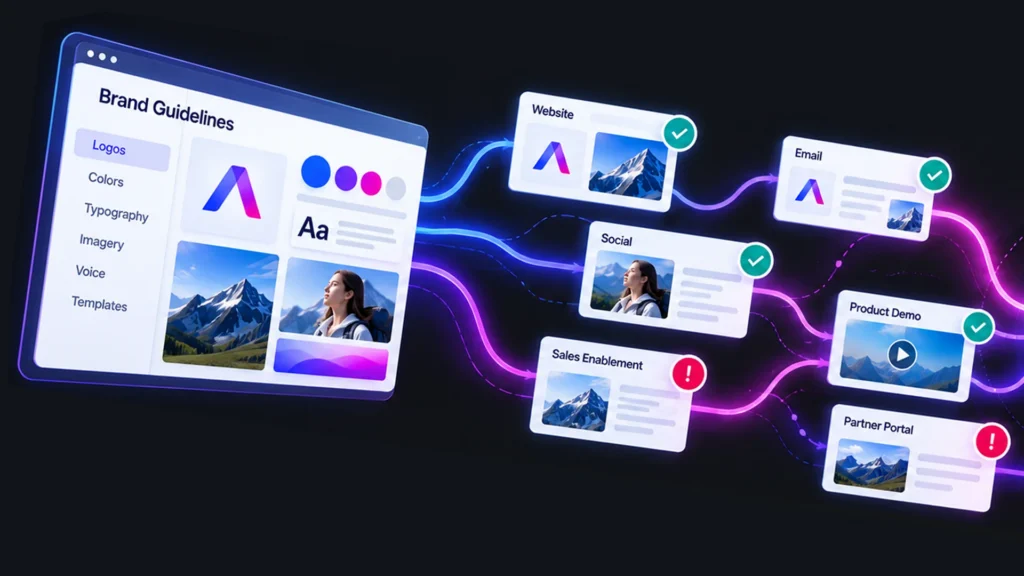
Picture a customer who walks into a store and sees an outdated logo. She visits the website and finds new branding. The email she receives uses different colors. The product demo she watches sounds nothing like the website copy. Each gap looks small, but together they signal weak brand governance.
That inconsistency confuses customers and erodes trust. Maintaining consistency gets harder with every creator you add, and AI has multiplied the creator count. According to HubSpot’s 2026 State of Marketing report, 80% of marketers use AI directly for content creation, and 94% plan to use it in their content processes.
The governance gap is wider than it has ever been. Your teams still care about consistency. Without a systematic approach, though, consistency is nearly impossible to maintain.
TL;DR
- Enforcement gap: 85% of organizations have brand guidelines, but only 31% enforce them consistently across teams, according to Forbes.
- The gap keeps widening: As teams grow and AI adoption rises, the link to the original brand vision weakens without systematic reinforcement.
- Customer experience suffers: Inconsistent messaging across touchpoints creates confusion. It also reduces brand trust.
- Growth raises the risk: Every new team, market, and product line adds complexity to maintaining one brand identity.
The Challenge of Brand Consistency Across 50+ Creators
The Consistency Paradox: Guidelines Without Enforcement
You have brand guidelines. They are documented. They sit in a folder somewhere. Are teams actually following them?
Forbes research found that 85% of organizations have established brand guidelines, yet only 31% enforce them consistently across all teams and channels. That gap between intention and execution is the core brand governance problem.
Why does it happen? With 50+ creators, three things break down at once:
Visibility disappears: The CMO cannot see what every regional team creates. The central brand team does not know what sales enablement just published. Marketing operations cannot audit every asset. You cannot enforce standards on content you cannot see.
Context decays: New hires do not absorb brand philosophy by osmosis. Junior designers do not know why a particular blue matters. Departments decide in isolation, each believing it follows the guidelines while interpreting them differently.
Urgency overrides consistency: When a deadline lands tomorrow, teams take shortcuts. They reuse assets from other campaigns because it is faster. They tweak messaging because it feels more relevant locally. Each shortcut looks small, but together they dilute the brand.
The result: Your brand exists as an idea instead of a consistently applied standard.
The Growing Governance Gap: When Distributed Teams Drift
HBR research on brand alignment across sales teams found that inconsistent brand messaging directly affects customer confidence and business outcomes. The same principle applies to any distributed function. Teams that operate independently drift from core brand principles.
The drift accelerates as teams grow and AI use for content creation expands. Five people in one office can stay consistent through shared context and daily conversation. Fifty people across regions and departments, working alongside hundreds of AI agents, cannot. Regional teams favor local relevance over global consistency. An AI agent may shift a tone so it no longer matches the brand guidelines.
Together, these changes fragment the brand. Without governance that defines what can adapt and what must stay fixed, distributed teams create inconsistency by default.
The AI Acceleration Problem
Generative AI democratized content creation. Sales can generate email copy. Product can draft customer case studies. Customer success can write social posts. Anyone with an AI tool is now a content creator.
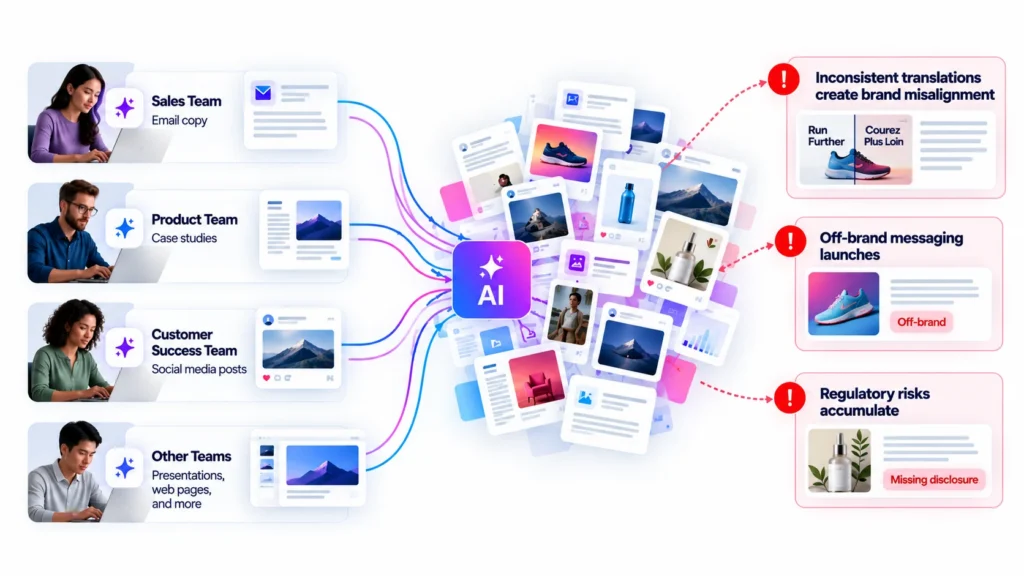
That is powerful, but without brand governance it is risky. AI content growth is outpacing brand governance, because companies produce content faster than they can monitor it for compliance. Outdated assets stay in circulation, off-brand messaging launches, and regulatory risk accumulates.
Your 50 content creators just became 500 once AI tools joined them. Your governance problem grew tenfold without anyone adding structure.
Why Brand Governance Fails Without Systems
The Knowledge Problem: Guidelines as Documents
Brand guidelines communicate standards. Documents do not enforce them. A 40-page PDF in a shared folder gets read once, maybe twice, then forgotten.
A designer in the flow of work is not checking a PDF. A marketer adapting campaign copy is working from memory. When AI generates content, it has never read your brand guidelines at all.
Publish an accessible guidelines document that every team and AI tool can reach, then back it with systematic governance processes instead of relying on the document alone. Documents inform. Systems enforce.
The Visibility Problem: You Cannot Govern What You Cannot See
Without a centralized view of what is created and stored across locations, you cannot enforce standards. A regional team publishes to its local website. Product marketing launches through a different system. Sales enablement uploads decks to a repository nobody monitors. Customer success builds resources in yet another tool.
Your brand exists in fragments across disconnected systems, and your central brand team cannot see what the organization publishes. That blind spot makes enforcement impossible. You cannot flag off-brand content you never see. You cannot prevent regulatory violations you do not know about. You cannot repeat successful brand applications you cannot find.
The Coordination Problem: Brand Without Authority
As teams grow, brand governance needs coordination across functions, regions, and departments. Distributed teams often lack a clear authority structure for who decides what.
Can a regional team adapt messaging? How far? Which decisions must escalate?
Successful large organizations define decision rights. The global brand team sets core principles, and regional teams execute within defined boundaries. Without that clarity, every decision becomes consensus-seeking, and governance stalls.
How Mature Is Your Content Governance?
Benchmark where your brand and content governance program stands today, then see where to focus first.
How to Build Brand Governance for 50+ Creators
Step 1: Separate Fixed Elements From Flexible Ones
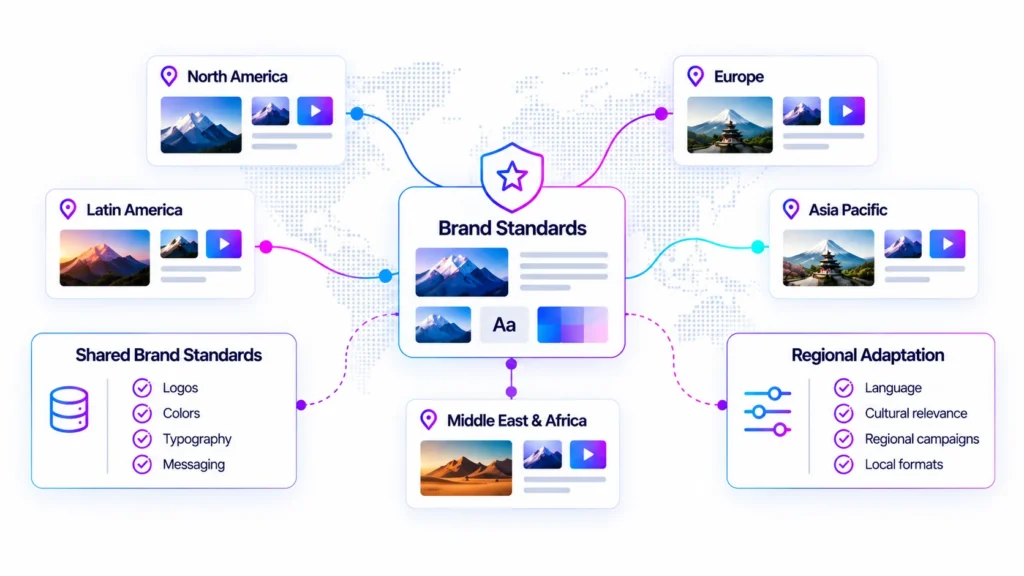
Brand governance requires a line between elements that must be consistent everywhere and elements that can adapt locally.
Non-negotiable elements might include:
- Logo usage, sizing, and spacing
- Core brand colors (accent colors may vary)
- Brand voice and tone principles
- Core messaging pillars and positioning
- Legal and compliance language requirements
- Visual hierarchy and layout principles
Adaptable elements might include:
- Campaign messaging adapted for regional relevance
- Product positioning adapted for different audiences
- Asset formats adapted for different channels
- Examples and case studies adapted for local context
This clarity prevents two problems. Teams do not violate standards by accident, and local teams can innovate within guardrails.
Step 2: Centralize Asset Discovery and Reuse
Many brand inconsistencies start when teams recreate work because they do not know existing assets exist. A regional team designs a template while the global team already has one. Product marketing builds a messaging framework that sales enablement has already built. Customer success makes a one-pager that marketing already made.
Central content hubs support consistent visual messaging, reduce content production costs, and spare local teams from creating assets from scratch.
Create a central repository where approved brand assets live, tagged with metadata so teams can find them. Include templates for common asset types, messaging frameworks teams can adapt, and design components they can reuse.
This does two things. It reduces work because teams reuse instead of recreating. It enforces consistency because everyone starts from the same approved base.
Step 3: Implement Systematic Brand Compliance
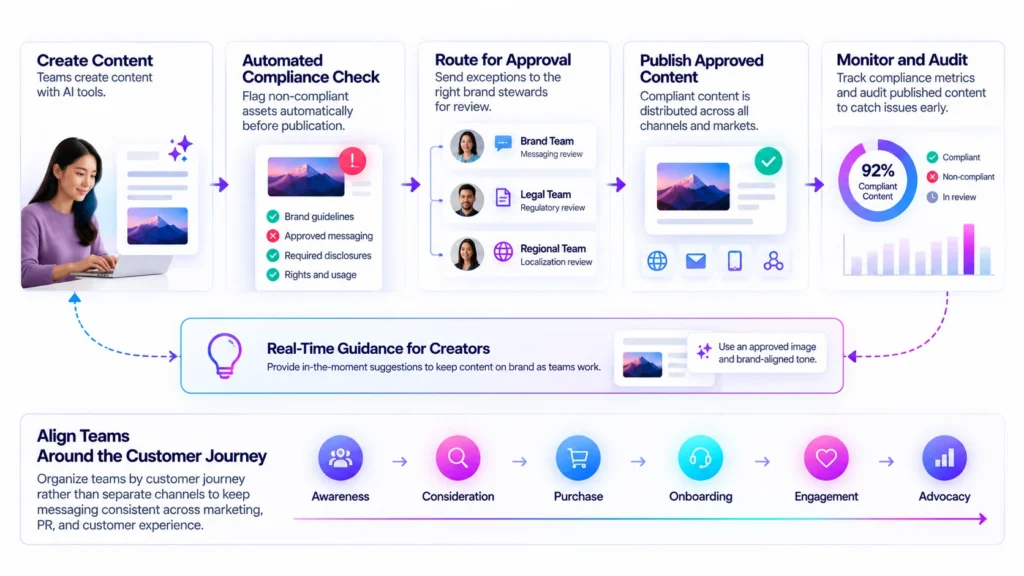
Guidelines are passive. Compliance systems are active. You need systems that:
- Flag non-compliant assets automatically before publication
- Route exceptions to the right brand stewards
- Track compliance metrics, so you know what share of content meets standards
- Audit published content to catch issues before they grow
- Guide creators in real time as they work instead of after the fact
Organizing teams around the customer journey instead of separate channels helps marketing, PR, and customer experience messaging stay aligned. It still requires systematic coordination mechanisms.
How Aprimo Content Portfolio Management (CPM) enables this: CPM surfaces brand compliance issues as content is created or used, applying AI to flag off-brand messaging, visual inconsistencies, and regulatory risks. It routes exceptions to the right approvers by severity and type. It tracks compliance metrics, so you can see what share of content meets brand standards. It also ranks the highest-impact issues, so your brand team focuses on what matters most.
Step 4: Assign Clear Brand Governance Roles
With 50+ creators, brand governance needs defined roles:
- Global brand steward: Owns brand strategy, core guidelines, and compliance standards. Sets the non-negotiable elements. Approves major exceptions.
- Regional brand leads: Own local relevance. They adapt messaging and assets within defined boundaries, then escalate major decisions.
- Functional brand contacts: One person in each department, such as product, sales, or customer success, makes sure the team follows brand standards.
- Creators and contributors: The people doing the work. They need clear guidance on what is required and what is flexible.
This structure prevents two problems. Unclear decision-making stalls governance, and no accountability means no one owns consistency.
Step 5: Build Feedback Loops
Brand governance is continuous improvement, not a one-time launch. Measure what matters:
- What share of content meets brand standards on first review?
- What are the most common compliance violations?
- Where are the biggest gaps by region or department?
- How much time goes to brand-related rework?
Then use those insights to:
- Update guidelines based on what teams get wrong
- Provide targeted training on the most common issues
- Refine the central asset library to fill gaps
- Adjust governance processes based on what works
Growing Without Losing Brand Identity
When brand governance works across a large organization, teams can grow production dramatically without growing brand debt. Instead of every team managing consistency alone, which does not work, you have:
- Centralized brand intelligence: what is created, its compliance status, and where the gaps are
- Distributed creation: every team can create with confidence that the work is on-brand
- Systematic enforcement: standards are checked instead of hoped for
- Clear authority: people know who decides what
Brand debt builds when products, customer experiences, policies, or messaging drift out of sync with what customers expect. Companies that govern their brand systematically carry less of it as they grow, which supports stronger customer perception and business performance.
FAQ
How do we keep brand consistency across distributed, autonomous teams?
Define non-negotiable elements globally. Give regional and functional teams authority to adapt within boundaries. Use centralized systems to enforce compliance instead of relying on guidelines alone. Monitor compliance metrics to catch drift before it compounds.
How do we decide what is non-negotiable and what can adapt?
Non-negotiable elements protect core identity: logo usage, core colors, brand voice, and compliance language. Adaptable elements allow local relevance: specific campaigns, product messaging, and examples. Work with brand stakeholders to define the line explicitly.
Which metrics matter for brand governance?
Track the share of content that meets standards on first review. Add the most common violations by type, brand quality by region, time spent on brand rework, and reuse rates for central assets.
How does brand governance work with AI-generated content?
Content volume grows quickly with AI, so governance cannot stay manual. You need monitoring that flags compliance issues automatically, routes exceptions efficiently, and guides creators who use AI tools in real time.
Related reading: the hidden cost of ungoverned content, content compliance in regulated industries.