

Retail brands face mounting pressure to manage thousands of digital assets across multiple channels while maintaining brand consistency. Key challenges include:
- Disorganized content libraries that lead to chaos.
- Inconsistent branding across touchpoints, creating disjointed experiences for customers.
- Time-wasting asset searches that take away from creative efforts.
- Integration complexities that put strain on limited resources.
Modern DAM for retail brands eliminates these bottlenecks through AI-powered organization, automated workflows, and seamless integrations.
Managing digital content has become one of the most complex operational challenges facing retail brands. With the average retailer juggling thousands of product images, seasonal campaigns, and promotional materials across dozens of channels, traditional file management has reached a breaking point.
Digital asset management (DAM) has evolved into mission-critical infrastructure for retailers who want to compete effectively. Companies must adopt technology-driven solutions, such as DAM for retail brands, to overcome common challenges prevalent in the industry.
Many retail brands continue to wrestle with fundamental content management problems that slow down their entire operation. Teams waste hours searching for assets, outdated product images appear on websites, and brand inconsistencies emerge across channels. These challenges quickly become vulnerabilities that directly impact revenue and customer experience.
Why Do Retail Brands Struggle with Digital Asset Management?
The industry creates unique pressures that make DAM for retail brands especially challenging. Unlike other sectors that might manage a few hundred assets annually, retailers often handle tens of thousands of images, videos, and documents that change seasonally, regionally, and by product line.
Take the complexity facing a typical fashion retailer, for example. They need product shots for spring, summer, fall, and winter collections. Each item requires multiple angles, lifestyle images, and detail shots. Multiply this volume across different regions, each with localized pricing, sizing information, and compliance requirements. Add promotional materials, social media content, and in-store displays, and the amount becomes staggering.
The traditional approach of storing assets in shared drives or basic cloud storage can’t handle this complexity. Teams end up creating workarounds that compound the problem: duplicate files scattered across different systems, inconsistent naming conventions, and no clear source of truth for the latest approved assets.
Research from Forrester indicates that 70% of digital content goes unused due to poor organization. For retailers operating on tight margins, traditional management creates massive waste in both financial investment and opportunity cost.
Challenge #1: The Asset Discovery Nightmare
How many times have your teams spent 30 minutes searching for a product image that should take 30 seconds to find? Asset discovery is the most immediate and frustrating challenge facing retail brands.
High-Volume Chaos
The problem starts with volume. Retailers manage thousands of SKUs, each requiring multiple asset variations for different channels and purposes. A single product might need high-resolution images for print catalogs, web-optimized versions for ecommerce, square crops for social media, and video content for digital advertising.
Without proper digital asset management for retail, teams resort to descriptive but inconsistent file naming. One person might save a file as “BlueJeans_FrontView_Spring2025.jpg” while another uses “S25_Denim_Blue_Front.jpg” for similar content. These inconsistencies make searches nearly impossible.

When teams can’t quickly find existing assets, they often unnecessarily recreate content. Duplication wastes creative resources and leads to version control problems where multiple versions of similar assets exist without a clear indication of which is current or approved.
Streamlining Search with AI
Visual search capabilities have emerged as a game-changing solution. Modern systems can identify similar images, recognize colors and objects, and suggest related content based on visual characteristics rather than relying solely on text-based metadata. This approach aligns with how creative teams naturally think about assets, dramatically reducing search time.
DAM challenges also include the need for predictive asset recommendations. AI-powered systems can analyze usage patterns and suggest which assets are likely to perform well for specific campaigns or channels, helping teams make more strategic content decisions.
Challenge #2: Brand Inconsistency Across Channels
Maintaining consistent brand presentation across multiple touchpoints has become exponentially more difficult as retail brands expand their presence. The average retailer now manages content for ecommerce websites, mobile apps, social media platforms, email campaigns, in-store displays, and third-party marketplaces.
Omnichannel Variation Requirements
Each channel has specific requirements for image dimensions, file formats, and content guidelines. Social media platforms favor square or vertical formats, while ecommerce sites typically require horizontal product shots with specific background requirements. Email campaigns need smaller file sizes for faster loading, but print materials require high-resolution images.
The challenge intensifies for retail brands with franchise locations or dealer networks. Corporate marketing teams create assets that local operators must adapt for their specific markets while maintaining brand standards. Without centralized control, local teams often modify logos, use outdated color schemes, or create entirely new materials that dilute brand recognition.
Maintaining Consistency with Brand Management Tools
Brand management tools within modern DAM systems address these challenges through automated brand compliance checking. These solutions can detect when assets deviate from brand guidelines, flagging incorrect logo usage, non-standard color palettes, or inappropriate fonts before content reaches customers.
Successful retailers implement automated workflows that generate channel-specific asset variations from master files. When a new product image is uploaded, the system automatically creates optimized versions for web, social media, email, and print applications, ensuring consistency while saving time.
Version control is vital in this environment. Teams need confidence that they’re always accessing the most current, approved version of any asset. Advanced systems maintain detailed audit trails showing who modified assets, when changes occurred, and which versions are approved for specific uses.
Challenge #3: Team Collaboration Breakdowns
Retail content creation involves multiple stakeholders across different departments, time zones, and organizations. Marketing teams develop campaign concepts, creative departments produce assets, merchandising teams provide product information, and external agencies contribute specialized content.
File-Sharing Problems
Traditional file-sharing approaches create collaboration bottlenecks. Email attachments have size limitations and quickly become outdated. Shared drives require VPN access and complex permission management. Cloud storage lacks the specialized features needed for creative collaboration, such as commenting, approval workflows, and version comparison tools.
The review and approval process presents challenges for retail brands. Products must meet legal requirements, brand standards, and channel-specific guidelines. A single product image might require approval from brand managers, legal teams, merchandising departments, and external partners before publication.
Delays in this process directly impact time-to-market for new products and promotional campaigns. Missing launch deadlines can mean lost sales opportunities and reduced competitive advantage.
Real-Time Collaboration and Integration
Modern collaboration features provide real-time commenting, approval routing, and stakeholder notifications. Teams can review assets in context, provide specific feedback tied to particular elements, and track approval status across complex workflows.
Integration with creative tools allows designers to access approved assets directly within their preferred software environments. They can eliminate the download-edit-upload cycle that slows creative workflows while reducing the risk of working with outdated or unapproved content.

Challenge #4: Integration and Tech Stack Chaos
Retail brands typically operate complex technology ecosystems that include ecommerce platforms, product information management systems, content management systems, marketing automation tools, and creative software applications. Each system serves a specific purpose, but integration between them often creates operational challenges.
Uphill Battles with Data Silos
The lack of seamless integration forces teams to manually move assets between systems, creating opportunities for errors and version control problems. Product images uploaded to the ecommerce platform might not automatically sync with the email marketing system, leading to inconsistencies when campaigns launch.
Data silos compound these integration challenges. Product information lives in PIM systems, creative assets exist in design tools, and marketing materials reside in campaign management platforms. Teams waste time switching between systems and struggle to maintain consistency across touchpoints.
API limitations and custom integration costs can make connecting disparate systems prohibitively expensive, especially for mid-market retailers. Many organizations end up with manual workarounds that increase operational complexity and error rates.
Seamless Integrations with Centralized DAM
Advanced DAM solutions offer extensive integration capabilities that connect directly with major retail technology platforms. These integrations enable automatic asset synchronization, eliminating manual file transfers and reducing the risk of outdated content appearing in customer-facing applications.
Workflow automation is possible when systems communicate. New product images can automatically trigger updates across ecommerce sites, marketing campaigns, and social media accounts, ensuring consistent presentation without manual intervention.
Challenge #5: Compliance and Rights Management Complexities
Retail brands must navigate increasingly complex regulatory and legal requirements around digital content usage. Product images need to comply with advertising standards, promotional materials must meet regional regulations, and all content requires proper rights clearance.
Auditing Complexity and Lack of Control
Rights management is challenging when working with external photographers, models, and creative agencies. Each asset may have specific usage restrictions, expiration dates, and geographic limitations that teams must track and enforce.
The rise of AI-generated content adds new complexity to rights management. Teams need to identify which assets were created using artificial intelligence tools and ensure proper disclosure when required by platform policies or regulatory guidelines.
Unauthorized asset usage can result in legal and financial consequences. When teams can’t easily verify usage rights or track asset permissions, organizations face potential copyright violations and licensing disputes.
Compliance requirements vary by region and channel, making it difficult to maintain consistent standards across global operations. Content approved for use in one market might not meet requirements in another, requiring careful tracking and management of regional variations.
Built-In Compliance
Automated rights management features help retail brands maintain compliance by associating usage permissions with each asset. These systems can flag potential violations, track expiration dates, and ensure that content usage aligns with licensing agreements.
The Strategic Solution: Modern DAM for Retail Brands
The most successful brands are transforming their content operations through advanced digital asset management for retail. These solutions address the challenges outlined above while providing the foundation for scalable, efficient content operations.

Modern DAM for retail brands offers key capabilities that directly address operational pain points:
- AI-powered organization automatically categorizes assets, suggests metadata, and identifies similar content, eliminating manual tagging and improving discoverability.
- Automated workflow routing moves content through review and approval processes efficiently, reducing time-to-market for new products and campaigns.
- Channel-specific optimization automatically generates asset variations optimized for different platforms and uses, ensuring consistency while saving time.
- Real-time collaboration tools enable teams to effectively work together regardless of location or time zone, streamlining creative processes.
Integration capabilities allow DAM systems to connect with existing retail technology stacks. PIM and DAM integration creates powerful synergies that enhance both product information management and content operations.
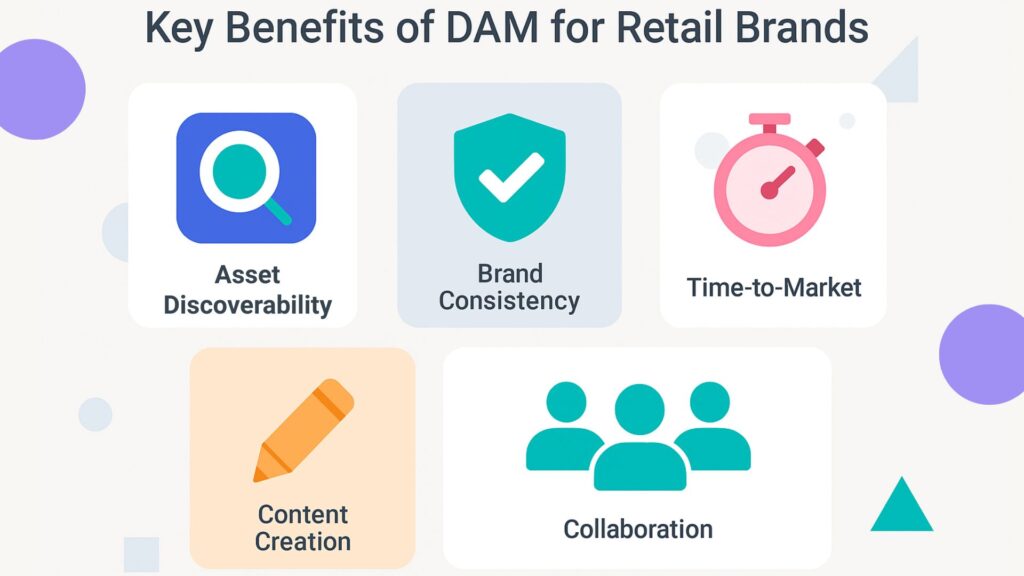
Top 5 DAM Benefits for Retail Brands
Retailers implementing comprehensive DAM solutions featuring brand management tools typically see measurable improvements in campaign performance, asset reuse rates, and time-to-market for new products.
- Improved Asset Discoverability: Teams find the right content in seconds rather than minutes or hours.
- Enhanced Brand Consistency: Automated compliance checking ensures all content meets brand standards.
- Faster Time-to-Market: Streamlined workflows accelerate product launches and campaign delivery.
- Reduced Content Creation Costs: Higher asset reuse rates eliminate unnecessary duplication.
- Better Collaboration: Real-time tools connect teams across departments and organizations.
Performance analytics provide additional value by showing which assets drive the best engagement and conversion rates across different channels. This data enables more strategic content investments and helps teams focus on creating assets that deliver results.
DAM for retail brands offers a comprehensive solution for organizations serious about scaling their content operations while maintaining quality and consistency.
Frequently Asked Questions
What makes digital asset management for retail different from regular cloud storage?
DAM systems include specialized features for content operations, such as automated metadata tagging, brand compliance checking, approval workflows, and channel-specific optimization. Cloud storage simply provides file access without the tools needed for professional content management.
How quickly can retail teams see ROI from DAM implementation?
Retail brands typically see immediate productivity improvements once teams begin using centralized asset libraries and streamlined workflows. The timeline for measurable ROI varies depending on organization size and implementation scope.
Can DAM for retail brands integrate with existing technology stacks?
Modern DAM platforms offer extensive integration capabilities with ecommerce platforms, PIM systems, marketing automation tools, and creative software. These integrations eliminate manual file transfers and maintain consistency across systems.
What size retail organization benefits most from DAM?
Organizations managing large volumes of digital assets or operating across multiple channels typically see the most benefits from DAM implementation. Even smaller retailers with complex brand requirements can achieve substantial operational improvements.
How does DAM for retail brands help with seasonal campaigns?
DAM systems streamline seasonal content management through automated asset organization, template-based campaign creation, and workflow automation that accelerates campaign development and deployment across all channels.
Transform Your Retail Content Operations
The retail brands that thrive understand that content operations are a strategic differentiator. Teams that can quickly find the right assets, maintain brand consistency across channels, and launch campaigns faster gain competitive advantages.
The challenges outlined here are intensifying as retail continues to evolve. Brands that wait to address these operational issues will find themselves at a disadvantage compared to competitors who have invested in modern content management capabilities.Aprimo’s content operations platform provides the comprehensive solution needed to effectively compete. Retail brands use our AI-powered digital asset management to centralize product imagery, accelerate seasonal content launches, and maintain on-brand consistency across every channel. Book a demo today to eliminate content chaos and unlock your full creative potential.