

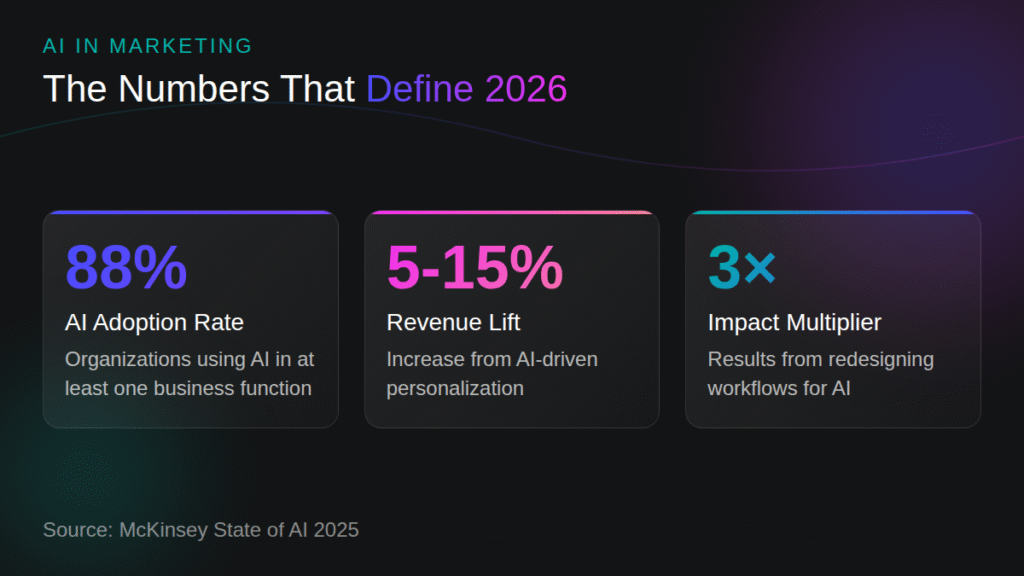
AI in marketing has evolved from an experimental tool to an operational backbone, with 88% of organizations now using AI across business functions.
- Machine learning for marketing enables real-time personalization, predictive analytics, and autonomous workflow execution.
- Marketing intelligence powered by AI agents delivers measurable outcomes: personalization drives 5–15% revenue lift for most companies, with leaders generating 10–30% greater marketing efficiency.
- The shift from reactive automation to agentic AI means marketing teams orchestrate intelligent systems rather than execute repetitive tasks.
To stay competitive, marketing leaders must move beyond piloting AI tools toward redesigning workflows around autonomous, intelligent systems.
The volume of marketing content required to compete keeps growing, but budgets and headcount do not. According to McKinsey’s 2025 State of AI survey, 88% of organizations now use AI in at least one business function, and marketing consistently ranks among the top areas for adoption. But how deeply should organizations integrate AI in marketing into content operations and strategy?
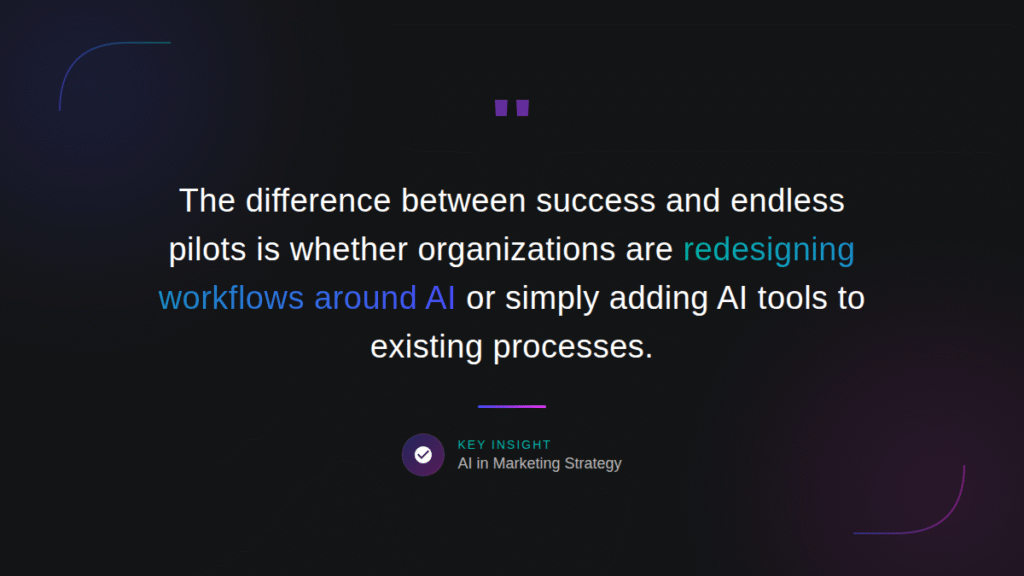
Some companies are seeing real results, while others are stuck in endless pilots. The difference is whether they’re redesigning marketing workflows around machine learning or simply adding AI tools to existing workflows. Understanding current AI marketing trends and effectively implementing machine learning applications separates market leaders from those still experimenting.
What Is Marketing Intelligence in the Age of Agentic AI?
Marketing intelligence encompasses the entire ecosystem of data collection, analysis, and automated action that drives marketing decisions.
How Has Marketing Intelligence Changed?
Traditional marketing intelligence relied on historical data analysis and human interpretation. Teams would gather performance metrics, identify trends, and manually adjust campaigns based on what they learned. This approach worked when content needs were modest and customer journeys were relatively linear.
Today’s marketing intelligence operates differently. Machine learning algorithms process customer interactions across dozens of touchpoints simultaneously. They identify patterns humans would miss, predict behaviors before they occur, and recommend optimizations in real time. The intelligence itself has become predictive rather than retrospective, enabling teams to anticipate customer needs rather than react to them.
Organizations using advanced marketing intelligence report notable improvements in campaign performance. Companies with faster growth rates derive 40% more of their revenue from personalization activities than slower-growing counterparts.
What Role Do AI Agents Play in Marketing Intelligence?
AI agents are the operational layer that transforms marketing intelligence from insight into action. Unlike traditional automation that follows predetermined rules, AI agents make contextual decisions, adapt to changing conditions, and autonomously execute complex multi-step processes.
Consider the difference between scheduled email automation and an AI agent managing customer engagement. Traditional automation sends messages at fixed intervals regardless of recipient behavior. An AI agent analyzes engagement patterns, adjusts timing based on individual preferences, modifies content based on recent interactions, and continuously optimizes without human intervention.
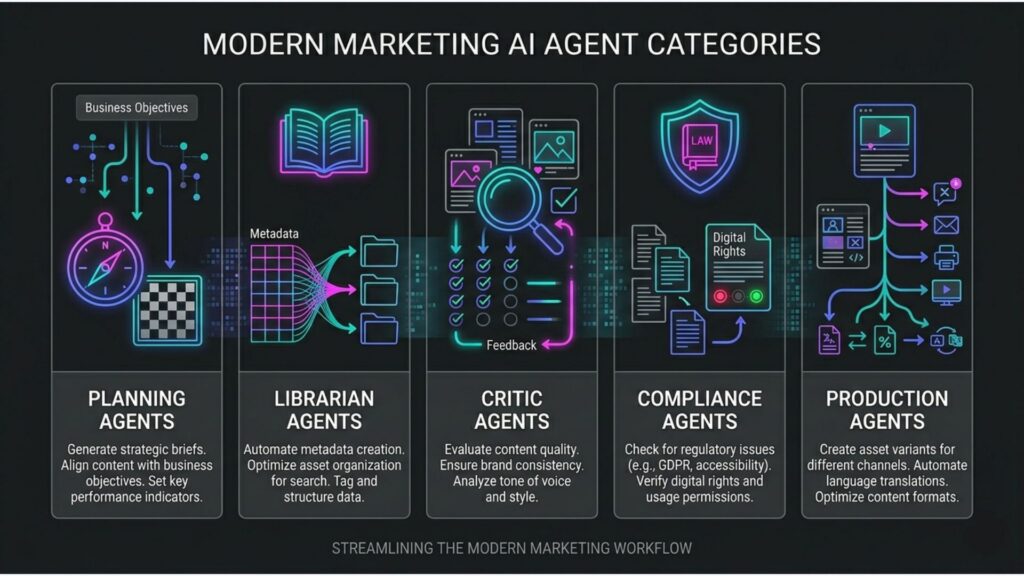
These agents operate across five key categories across the content lifecycle. Planning Agents generate strategic briefs aligned with business objectives. Librarian Agents automate metadata creation and asset organization. Critic Agents evaluate content quality and brand consistency. Compliance Agents check for regulatory issues and rights management. Production Agents create asset variants, handle translations, and optimize formats for different channels.
The compound effect of these agents working together transforms content operations from reactive task management to proactive intelligent orchestration.
How Does Machine Learning for Marketing Drive Personalization?
Personalization has become a baseline expectation. When 71% of consumers expect personalized interactions from brands, and 76% get frustrated when those expectations go unmet, machine learning makes meeting these expectations at scale economically viable.
What Makes AI-Driven Personalization Different?
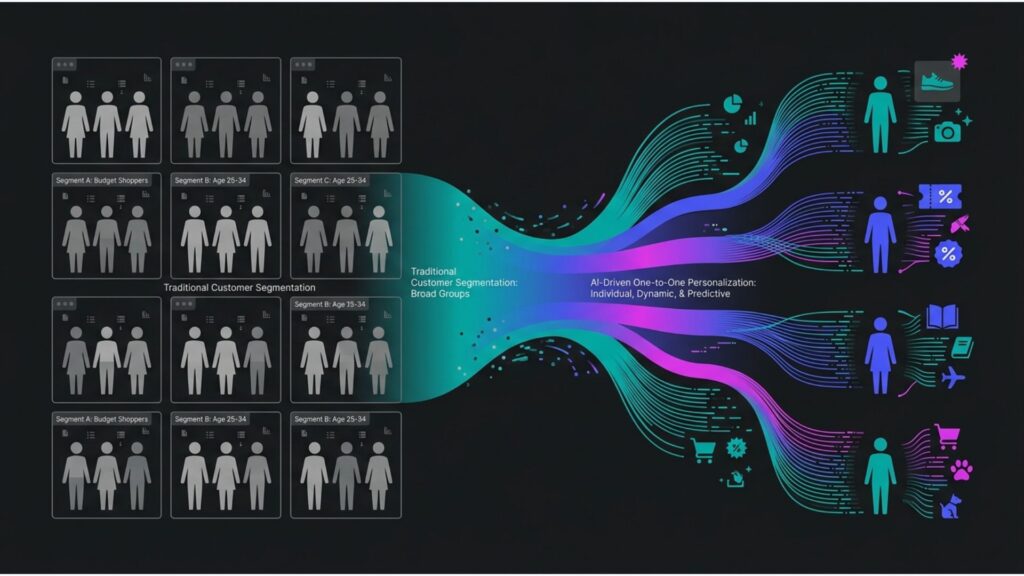
Traditional personalization relied on segment-based approaches: group customers by demographic characteristics, then serve each group with tailored content. This method worked well when companies had dozens of segments and hundreds of content variations. It breaks down entirely when true personalization requires thousands of variations delivered across dozens of channels in real time.
Machine learning for marketing enables one-to-one personalization by continuously processing behavioral signals and instantly generating recommendations. Rather than assigning customers to static segments, algorithms build dynamic profiles that update with every interaction. Each customer becomes their own segment of one.
Organizations implementing AI-driven personalization report 5–15% revenue increases and 10–30% improvements in marketing efficiency, with the potential to reduce customer acquisition costs by up to 50%. The gains come from both increased conversion rates and reduced waste from irrelevant messaging.
How Does Predictive Analytics Transform Marketing Strategy?
Predictive analytics shifts marketing from reactive optimization to proactive planning. Instead of analyzing what happened last quarter and adjusting accordingly, teams can anticipate customer behaviors, market shifts, and competitive dynamics before they materialize.
Machine learning models analyze historical patterns, current signals, and external factors to forecast future outcomes. Marketing teams use these predictions to allocate budgets more effectively, time campaigns for maximum impact, and identify opportunities competitors haven’t yet recognized.
Practical machine learning applications span every aspect of marketing operations. Content teams predict which topics will resonate before investing in production. Campaign managers forecast performance before launch and adjust creative accordingly. Channel strategists anticipate where audiences will engage and pre-position content appropriately.
5 Ways AI in Marketing Strategy Reshapes Team Structures
Implementing the right AI marketing strategy changes how teams operate at every level. Roles evolve, workflows are redesigned, and success metrics shift toward outcomes rather than activities.
1. From Execution to Orchestration: Marketing teams increasingly function as orchestrators of intelligent systems rather than executors of individual tasks. This shift requires new skills, including understanding AI capabilities and limitations, designing effective prompts and parameters, and knowing when human judgment adds value versus when automation performs better.
2. Creative Focus Intensifies: As AI handles routine execution, human creativity becomes the primary competitive differentiator. Teams spend more time on strategy, storytelling, and emotional resonance while AI manages production, distribution, and optimization.
3. Data Literacy Becomes Essential: Every marketing role now requires comfort with data. Understanding how algorithms make decisions, interpreting model outputs, and identifying when AI recommendations need human override are entry-level expectations rather than specialized skills.
4. Cross-Functional Integration Accelerates: AI in marketing requires tight integration with technology, data, and product teams. The most effective organizations build collaborative structures that span traditional functional boundaries.
5. Continuous Learning Replaces Periodic Training: AI capabilities evolve rapidly, making continuous learning mandatory. Organizations that build learning into daily workflows rather than scheduling periodic training maintain an advantage as technology advances.
What Content Operations Infrastructure Supports AI in Marketing?
AI marketing trends are leaning heavily toward intelligent automation. Without the right foundation, organizations accumulate disconnected tools that create new problems rather than solving existing ones.
Why Does Digital Asset Management Matter for AI?
Digital asset management provides the foundation for AI-driven content operations. When assets are organized, tagged, and connected to performance data, AI agents can make intelligent decisions about creation, distribution, and optimization. Without this foundation, AI tools operate in isolation, unable to access the context needed for effective automation.
Modern DAM platforms integrate AI capabilities directly into asset workflows. Automated tagging eliminates manual metadata creation. Semantic search enables natural language queries that return relevant results regardless of how assets were originally categorized. Content intelligence surfaces insights about what performs, what gets reused, and where gaps exist.
The value gained from AI depends entirely on data quality and accessibility. Organizations with clean, connected asset repositories see better results from AI investments than those with fragmented systems and inconsistent metadata.
How Do Workflows Need to Change?
Organizations that redesign workflows around AI capabilities are nearly three times more likely to see meaningful business impact than those that add AI to existing processes.
Workflow redesign starts with identifying where human judgment adds unique value versus where consistent execution matters more. Creative strategy, brand voice decisions, and emotional storytelling require human insight. Asset formatting, compliance checking, and distribution timing can be automated entirely.
The best workflows combine human creativity with AI execution through clear handoff points. Humans define objectives and constraints. AI generates options and recommendations. Humans make final decisions on brand-critical elements. AI handles everything downstream. This hybrid approach captures the benefits of both human insight and machine efficiency.
How Should Marketing Leaders Measure Success?
Measurement frameworks need to evolve alongside AI capabilities. Traditional metrics focused on outputs, such as campaigns launched, assets created, and emails sent. AI-driven marketing requires metrics that capture outcomes, such as revenue influenced, efficiency gains, and improved customer lifetime value.
What Metrics Matter Most?
Leading organizations track three categories of AI marketing metrics.
- Efficiency metrics capture how much faster and cheaper operations run (time to launch campaigns, cost per asset created, and hours saved through automation).
- Quality metrics measure whether AI maintains or improves standards (brand consistency scores, compliance rates, and creative performance benchmarks).
- Business impact metrics connect AI investments to bottom-line results (revenue attributable to personalization, customer acquisition cost improvements, and market share gains).
This third category proves most important for sustained investment but requires clear attribution frameworks that link AI activities to business outcomes.
The balance between these categories depends on organizational maturity. Teams early in AI adoption focus primarily on efficiency gains to build confidence and capability. Mature organizations shift their attention to business-impact metrics that justify expanded investment.
What Leading Indicators Predict Success?
Several factors predict which organizations will successfully scale AI in marketing. Senior leadership commitment shows the strongest correlation with success. Organizations where executives actively champion and role-model AI use see better results than those where AI remains a technology team initiative.
The depth of your workflow redesign also predicts outcomes. Organizations that fundamentally rethink processes around AI capabilities outperform those that just add AI tools without changing how teams operate. Finally, high performers typically allocate more of their digital budgets to AI technologies than average organizations.
FAQ
How long does it take to see results from AI marketing investments?
Organizations typically see efficiency gains within 3–6 months of implementing AI tools. Meaningful business impact usually takes 12–18 months as teams develop capabilities, refine workflows, and accumulate enough data for models to optimize. The timeline accelerates when organizations start with clear objectives and invest in proper infrastructure rather than adding AI incrementally.
Can smaller marketing teams benefit from AI, or is it only for enterprises?
AI tools are now accessible to businesses of all sizes. Cloud-based platforms eliminate the need for massive infrastructure investments. Pre-trained models reduce the data requirements for getting started. Smaller teams often see proportionally larger benefits because AI handles tasks they couldn’t otherwise afford to staff. The key is selecting tools that match team capabilities and starting with focused use cases rather than attempting enterprise-wide transformation immediately.
What skills do marketing teams need to work effectively with AI?
Foundational data literacy matters most: understanding how algorithms work, interpreting model outputs, and recognizing when results require human review. Strategic thinking becomes more important as AI handles tactical execution. Prompt engineering skills help teams get better results from generative AI tools. Teams need comfort with continuous learning since AI capabilities evolve rapidly.
How do AI agents differ from traditional marketing automation?
Traditional automation follows predetermined rules: if X happens, do Y. AI agents make contextual decisions based on multiple factors, adapt to changing conditions, and learn from outcomes over time. This difference shows most clearly in personalization: automation serves the same content to everyone who matches specific criteria, whereas AI agents customize experiences for individuals based on their unique behavioral patterns.
Drive Measurable Marketing Results with Intelligent Content Operations
AI in marketing has matured from experimental technology to operational necessity. Organizations that treat AI as a strategic capability rather than a set of point solutions are capturing outsized returns through personalization at scale, predictive optimization, and autonomous workflow execution.
The path forward requires redesigning workflows, developing capabilities, and securing leadership commitment. Marketing teams that build these foundations position themselves to capture ongoing advantages as AI capabilities continue advancing.
Aprimo’s Agentic DAM platform provides the intelligent infrastructure that makes these transformations possible, with AI Agents that automate content operations from planning through distribution while maintaining brand consistency and compliance. Explore how Aprimo enables marketing teams to work smarter and deliver measurable results.