
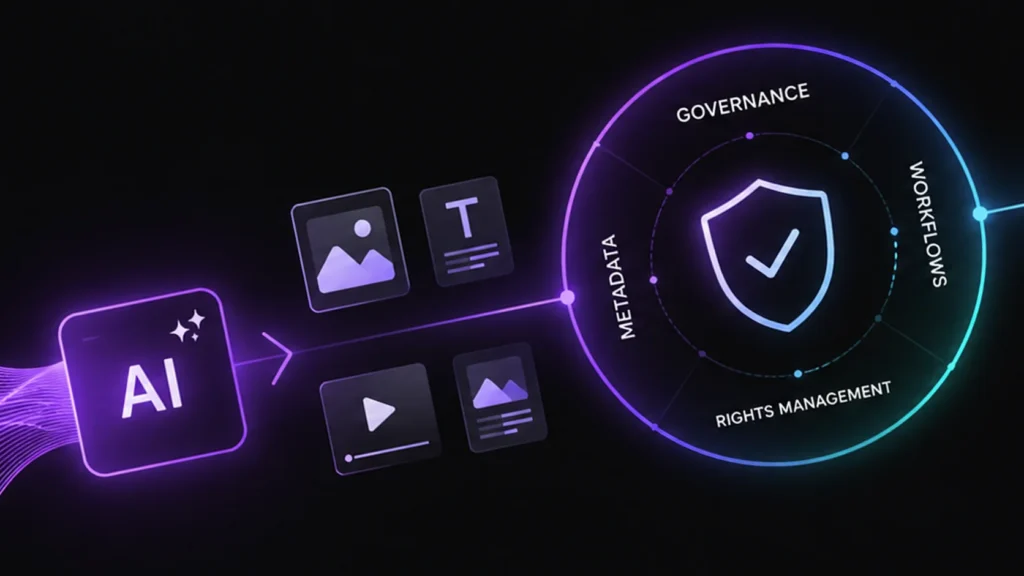
AI is changing the economics of content creation.
Marketing teams can now generate campaign copy, images, videos, translations, product descriptions, and content variations in a fraction of the time required by traditional workflows. This increase in content velocity creates enormous opportunities for personalization, localization, and customer engagement.
However, increased production does not automatically lead to better content operations.
As content volume grows, organizations face new challenges around governance, consistency, compliance, rights management, and reuse. Content can quickly become fragmented across systems, duplicated across teams, or disconnected from the workflows that ensure quality and control.
This is why enterprise organizations need a governed content supply chain for AI-generated assets.
Just as manufacturers rely on supply chains to move products from creation to delivery, content operations teams need structured systems that govern how AI-generated content moves from generation to activation. Without that structure, content operations become increasingly difficult to scale.
As Aprimo discusses in its article on future-ready content operations, the organizations that succeed with AI are not necessarily the ones generating the most content. They are the ones that can govern, manage, and activate content effectively across the enterprise.
TL;DR
- AI can dramatically increase content production, but without governance it can also increase risk, duplication, and operational complexity.
- A governed content supply chain ensures AI-generated assets move through structured workflows, approvals, metadata, and lifecycle controls.
- DAM serves as the system of record that enables governance, discoverability, reuse, and compliance.
- Metadata, workflow automation, content intelligence, and rights management are critical components of an AI-ready content supply chain.
- Organizations that treat AI-generated content as part of a governed content operation will scale faster and more safely than those relying on disconnected AI tools.
What Is a Content Supply Chain?
A content supply chain is the end-to-end process through which content is planned, created, reviewed, managed, distributed, and optimized. It encompasses the people, processes, systems, and governance mechanisms that move content through its lifecycle.
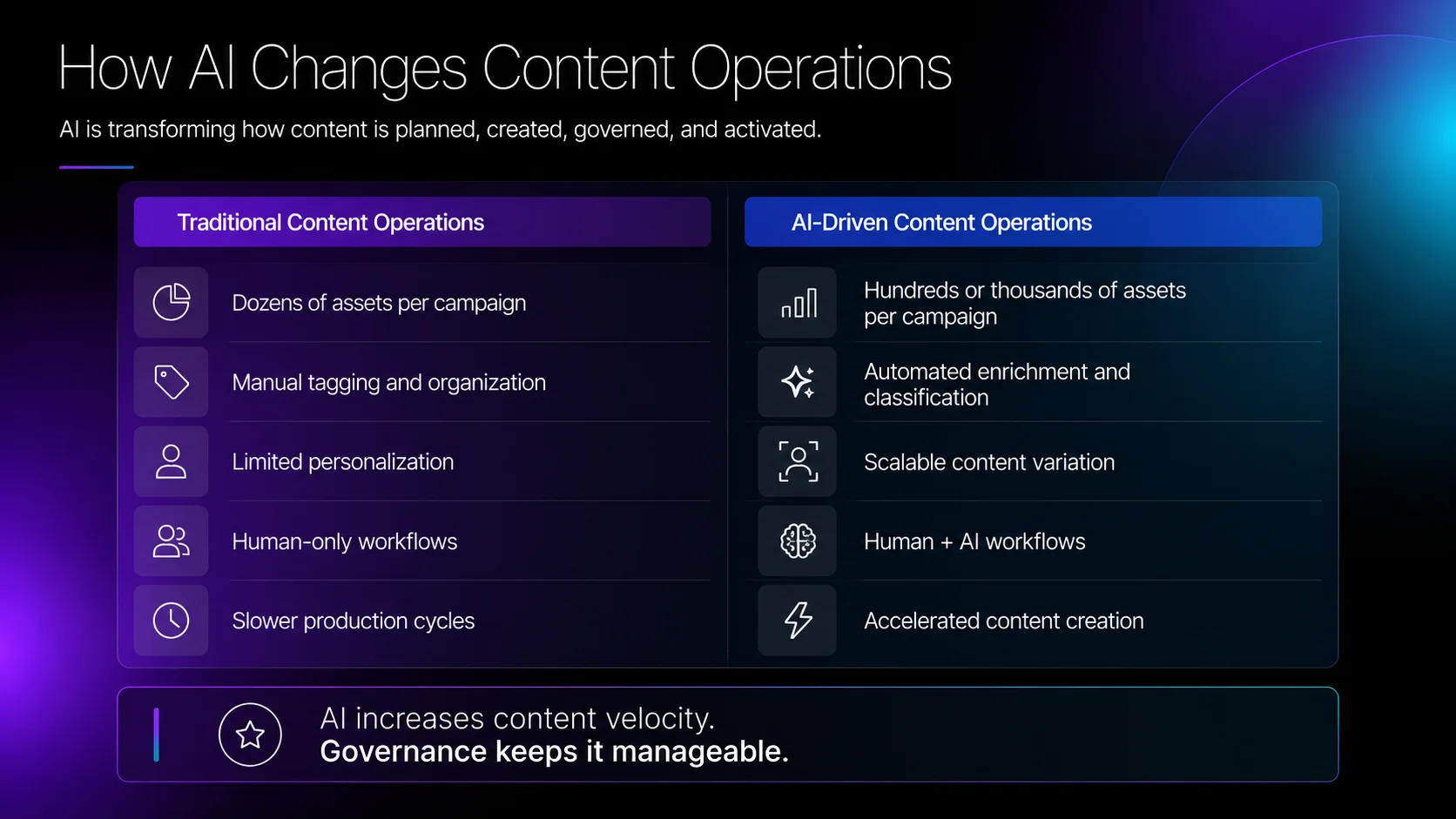
Historically, content supply chains were largely designed around human-created content. Creative teams produced assets, marketers reviewed them, legal teams approved them, and publishing teams distributed them across channels.
AI changes that model.
Instead of producing dozens of assets per campaign, organizations may now generate hundreds or even thousands of content variations. This increase in volume creates new operational demands. The challenge is no longer just creating content. It is managing and governing it at scale.
A governed content supply chain ensures that AI-generated assets remain subject to the same standards of quality, compliance, brand consistency, and lifecycle management as any other enterprise content.
Why AI Requires a Governed Content Supply Chain
The promise of AI is speed.
The risk of AI is scale without control.
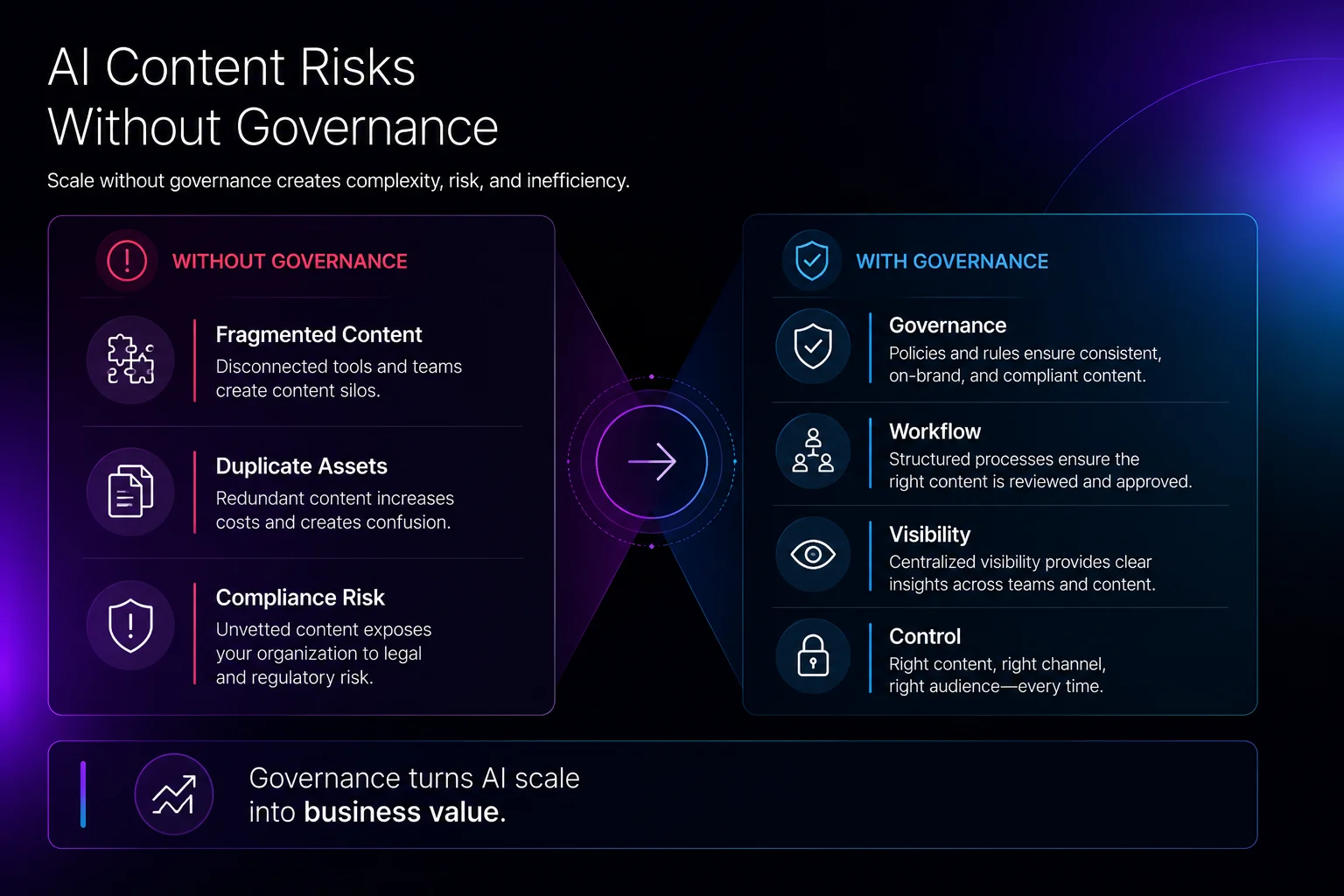
Many organizations begin their AI journey with isolated tools that generate content outside established workflows. Teams experiment with prompts, create assets in disconnected environments, and distribute content without clear visibility into approvals, rights, or governance requirements.
This approach may work for small-scale experimentation, but it becomes problematic as adoption grows.
Without governance, organizations often encounter challenges such as:
- Duplicate content being created because existing assets cannot be found.
- Inconsistent brand messaging across channels and markets.
- Unapproved or inaccurate content reaching customers.
- Rights and licensing issues associated with generated assets.
- Difficulty understanding which content is current, approved, or reusable.
These challenges highlight why governance must evolve alongside AI adoption.
As Aprimo explains in its blog on using AI safely for brand governance and compliance, successful AI adoption depends on embedding governance directly into content operations rather than treating it as a separate process.
The Five Core Components of a Governed AI Content Supply Chain
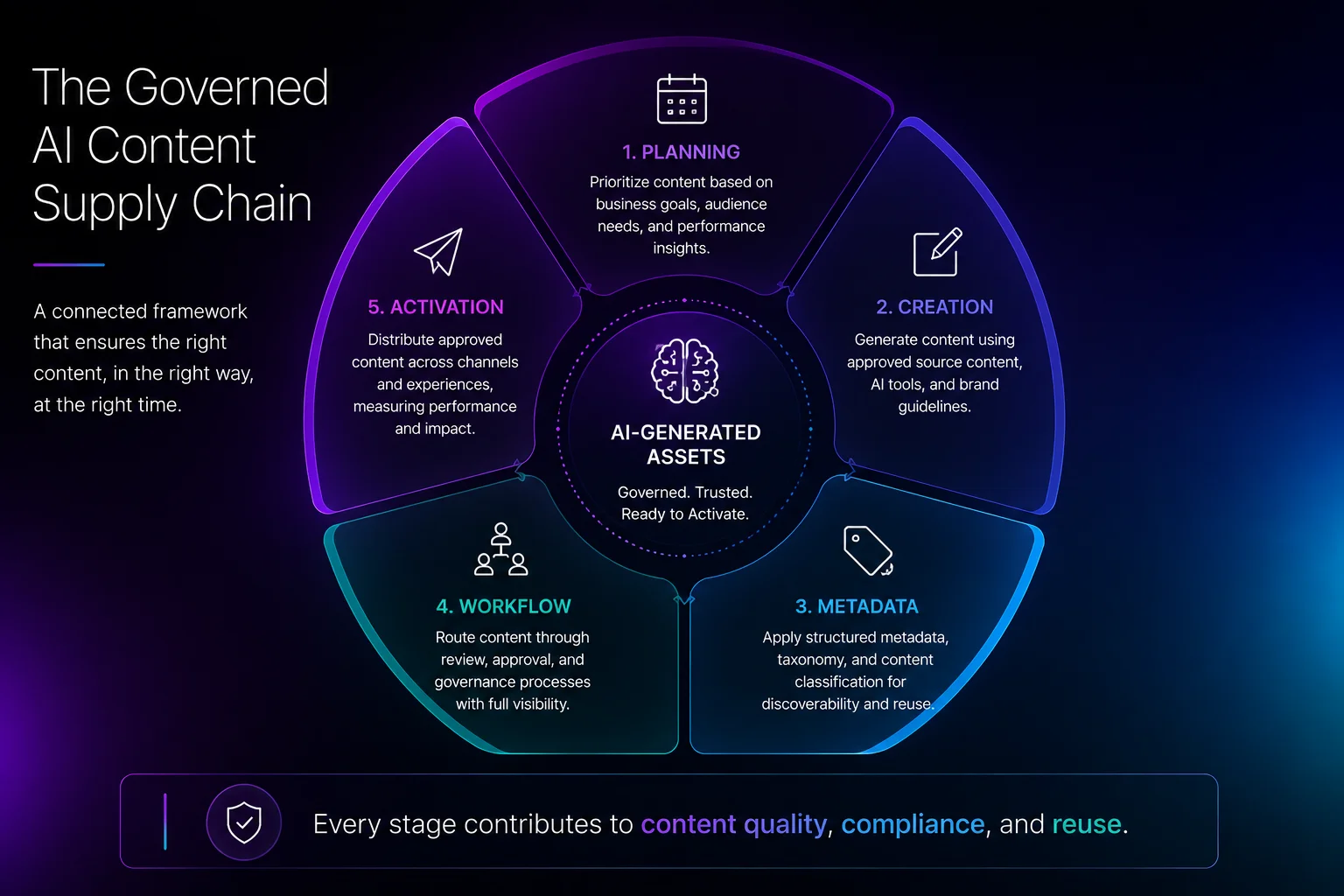
Structured Content Planning
Governance begins before content is created.
Organizations need a systematic approach to determining what content should be generated, why it is needed, and how it aligns with business objectives. This planning process becomes even more important as AI increases content production capacity.
Content intelligence can help identify content gaps, audience needs, and performance trends. These insights provide the foundation for planning initiatives that are grounded in data rather than assumptions.
When planning is connected to AI generation workflows, teams can ensure that content creation remains aligned with brand priorities, campaign objectives, and customer needs.
Governed Content Creation
AI-generated content should not exist outside enterprise workflows.
Instead, generation should occur within governed systems that provide visibility into prompts, source content, model outputs, and approval requirements. This allows organizations to maintain accountability and traceability throughout the creation process.
Governed creation also helps ensure consistency. By grounding AI generation in approved assets, messaging frameworks, and brand guidelines, organizations reduce the likelihood of off-brand or inaccurate outputs.
This is particularly important for enterprise brands operating across multiple markets, products, and business units.
Metadata and Content Enrichment
Metadata becomes even more important in an AI-driven environment.
As content volumes increase, discoverability depends on the ability to classify, organize, and retrieve assets effectively. Metadata provides the context needed to understand what content is, how it should be used, and where it belongs in the broader content ecosystem.
AI can support this process by automatically tagging assets, enriching metadata, and applying taxonomy structures.
As discussed in Aprimo’s article on organizing digital assets using metadata and taxonomy, strong metadata practices are essential for making DAM systems scalable and useful.
Workflow and Approval Controls
Workflow is where governance becomes operational.
AI-generated content should move through structured review and approval processes that reflect organizational requirements. Different content types may require different levels of oversight, depending on factors such as risk, regulatory exposure, and brand sensitivity.
Workflow automation helps ensure consistency while reducing manual effort.
Instead of relying on email chains or ad hoc reviews, organizations can route assets through predefined approval paths that align with governance policies.
Content Activation and Lifecycle Management
Governance does not end when content is approved.
Organizations need visibility into where assets are used, how they perform, and when they should be updated or retired. This requires lifecycle management capabilities that track content from creation through activation and eventual archival.
DAM plays a critical role in this process by providing a centralized source of truth for approved assets.
The Role of DAM in the AI Content Supply Chain
DAM is one of the most important components of a governed content supply chain.
In traditional content operations, DAM serves as a repository for approved assets. In AI-driven content operations, its role expands significantly.
DAM becomes the system of record that governs how AI-generated assets are stored, classified, approved, reused, and activated. It provides the structure that allows organizations to manage increasing content volumes without losing visibility or control.
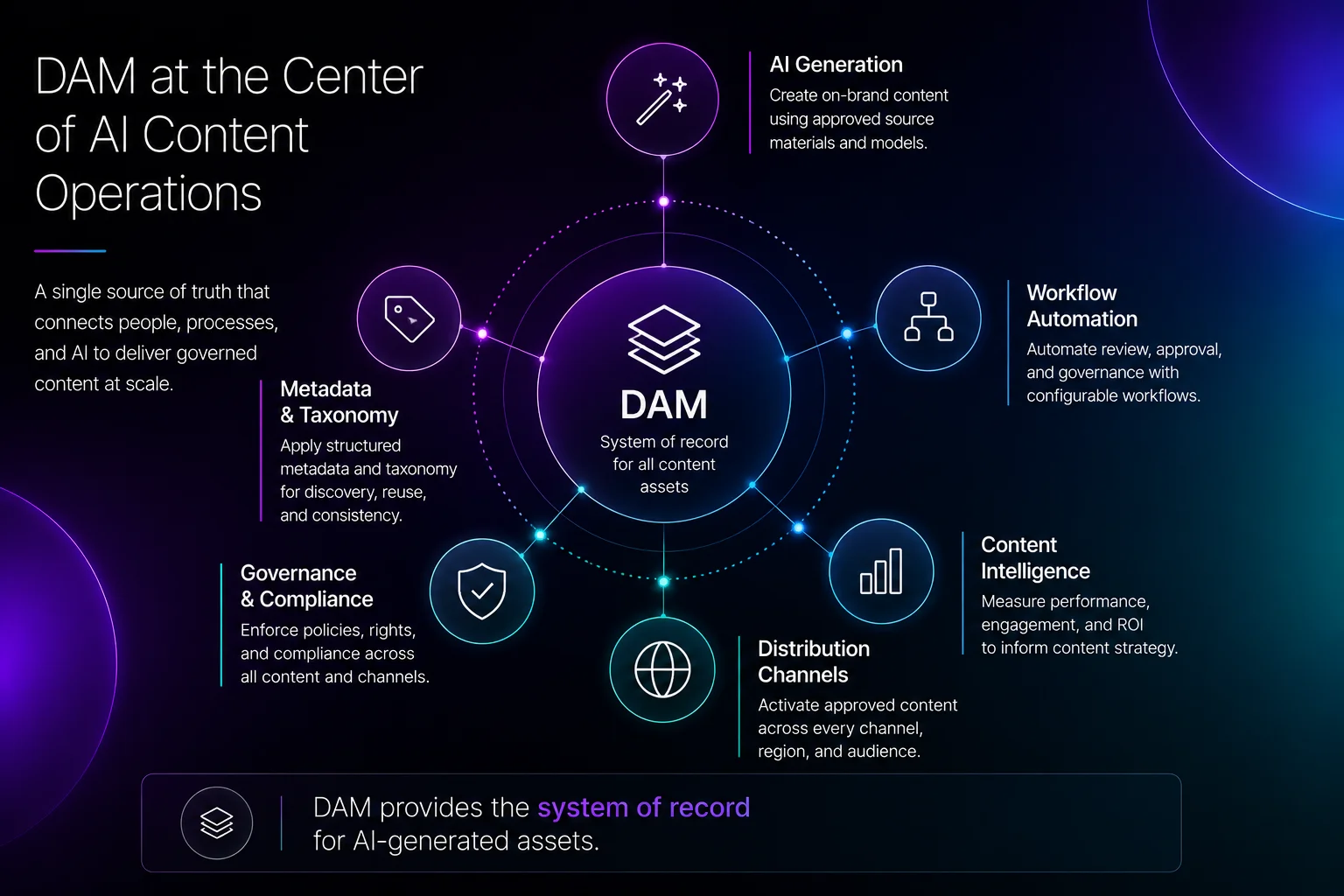
Key DAM capabilities that support AI-generated assets include:
- Centralized asset management.
- Metadata and taxonomy governance.
- Rights and usage management.
- Workflow automation.
- Content lifecycle visibility.
- Integration with content creation and activation systems.
As Aprimo outlines in its article on digital asset management architecture, a strong DAM foundation is essential for supporting modern content operations.
Building a Future-Ready Content Supply Chain
The future of content operations will not be defined by how much content organizations can generate.
It will be defined by how effectively they can govern, manage, and activate that content.
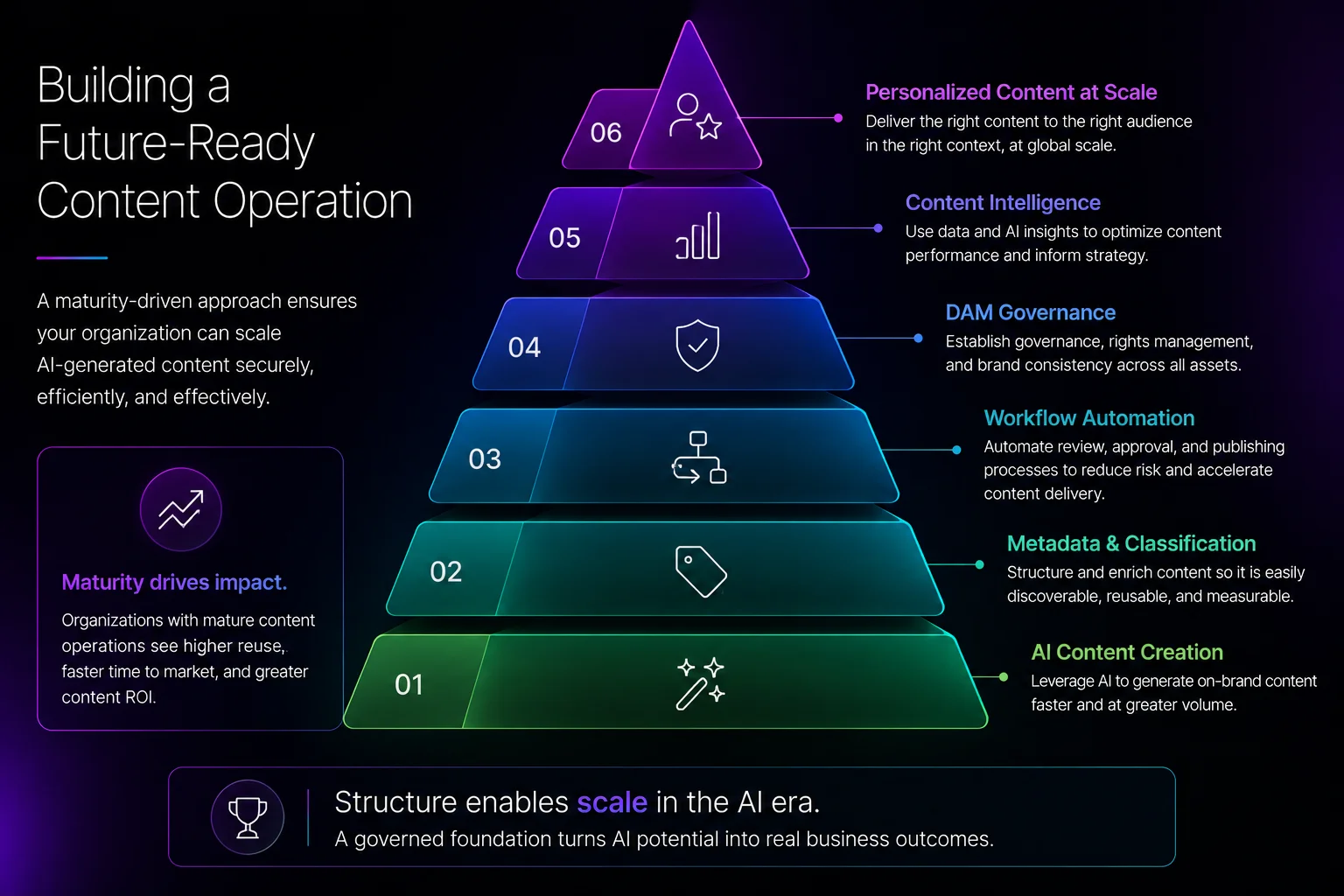
A future-ready content supply chain combines AI, workflows, DAM, content intelligence, metadata, and governance into a single operating model. This model enables organizations to scale content production while maintaining consistency, compliance, and operational efficiency.
Organizations that invest in this foundation today will be better positioned to support personalization, AI agents, answer engine optimization, and emerging content experiences in the future.
Conclusion
AI-generated assets have the potential to transform content operations, but only when supported by a governed content supply chain.
Without governance, AI can increase complexity and risk. With governance, it becomes a powerful tool for scaling content production, improving efficiency, and delivering more relevant customer experiences.
The key is to treat AI-generated content as part of a broader content operation rather than as an isolated capability.
When planning, creation, metadata, workflow, DAM, and content intelligence work together, organizations can build a content supply chain that is both scalable and controlled.
FAQ
What is a governed content supply chain?
A governed content supply chain is the structured process through which content moves from planning and creation to distribution and optimization. It includes workflows, governance controls, metadata, and systems that ensure content remains accurate, compliant, and aligned with business objectives.
Why do AI-generated assets require governance?
AI-generated assets can be created at a much higher volume than traditional content, which increases the risk of duplication, inconsistency, and compliance issues. Governance ensures that these assets follow the same standards and workflows as other enterprise content.
How does DAM support AI-generated content?
DAM provides a centralized system for managing, governing, and activating AI-generated assets. It ensures that content is organized, searchable, approved, and reusable across the enterprise.
What role does metadata play in AI content operations?
Metadata provides the context needed to classify, discover, and govern content at scale. As AI-generated content volumes increase, metadata becomes essential for maintaining visibility and control.
How can organizations build a future-ready content supply chain?
Organizations can build a future-ready content supply chain by combining AI capabilities with DAM, workflow automation, content intelligence, and governance. This integrated approach allows them to scale content operations while maintaining quality, compliance, and operational efficiency.