
DAM vs. CMS: How to Build a Scalable Content Foundation
Digital asset management (DAM) platforms provide enterprises with a governed way to organize, secure, and distribute rich media across a global brand portfolio. Unlike standard content management systems (CMS), a DAM combines advanced metadata management, digital rights enforcement, and automated transformations to ensure assets are ready for any channel.
The stakes for choosing the right architecture are high. As organizations scale their content production to meet the demands of omnichannel personalization, relying solely on a CMS for asset storage often leads to silos and compliance risks. Understanding the functional differences between these two systems is the first step in building a resilient content operations foundation that supports both human creativity and AI-powered automation.
TL;DR
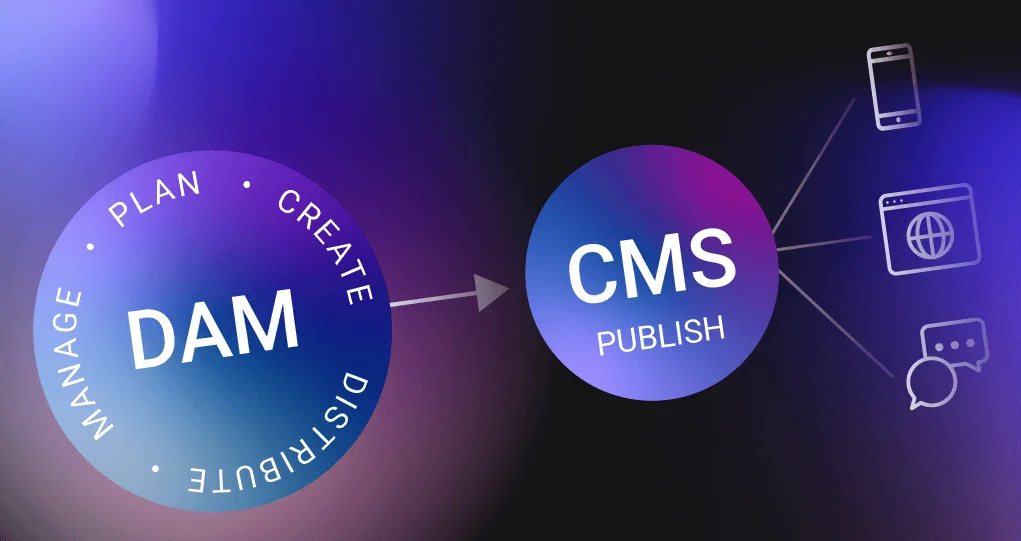
While a CMS manages the presentation of a website, a DAM serves as the authoritative source for all digital assets. Integrating these systems allows enterprises to maintain brand consistency, enforce global compliance, and accelerate content delivery across every digital channel.
What Is the Difference Between DAM and CMS?
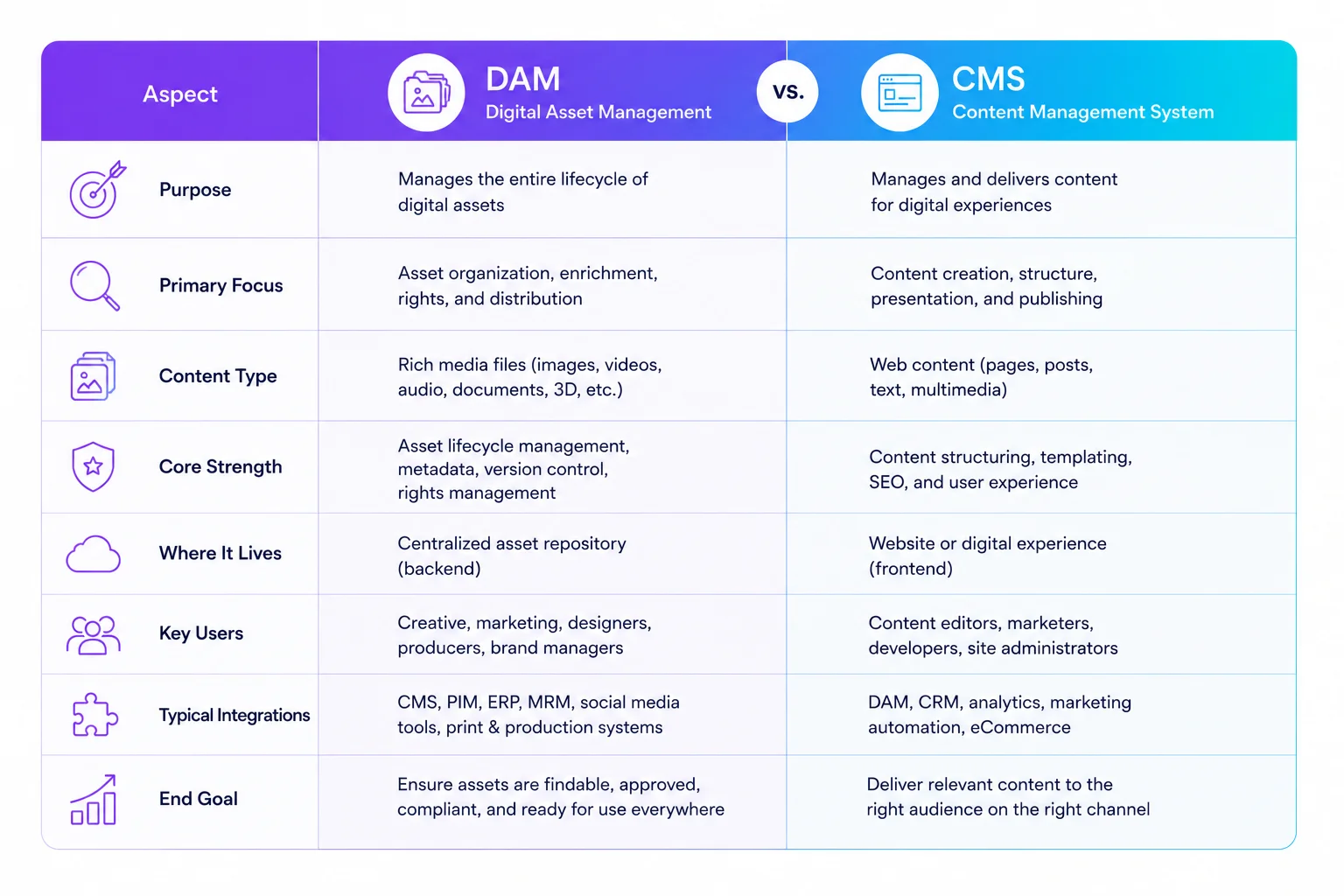
Digital asset management (DAM) platforms serve as the definitive source of truth for an organization’s rich media library, providing deep version control and rights management. While a content management system (CMS) focuses on the presentation and layout of a website, a DAM focuses on the lifecycle of the asset itself before it ever reaches a page. These systems are often confused because both store files, but their underlying architectures are built for different goals. A CMS is primarily a delivery vehicle for digital experiences, optimizing how text and media appear to an end user, whereas a DAM is an operational engine designed to manage the complexity of asset production, metadata enrichment, and global distribution across multiple platforms.
The distinction becomes clear when looking at asset utility. In a CMS, an image is typically tied to a specific page or post. In a DAM, that same image exists as a master file with associated metadata, usage rights, and transformation history that can be pushed to a CMS, a social media management tool, and a print production workflow simultaneously. Strategic organizations use a DAM to ensure that assets remain consistent and compliant, regardless of which downstream channel eventually hosts them. This separation of concerns allows creative teams to work in a dedicated environment without cluttering the web production environment with work-in-progress files or unapproved drafts.
DAM vs. Cloud File Sharing and CMS Libraries: Understanding the Gap
The primary trade-off between a DAM and a CMS lies in the depth of asset metadata and the breadth of distribution. A typical CMS provides basic file storage and simple tagging, which works well for small teams managing a single website. However, as organizations scale, they often find that simple cloud file sharing and CMS media libraries lack the governance required for enterprise operations. Basic systems rarely offer digital rights management (DRM), automated optical character recognition (OCR), or complex permissioning by role and region. This leads to broken workflows where marketing teams cannot find approved content and legal teams cannot track where expired assets are still being displayed.
In contrast, enterprise DAM solutions provide a sophisticated layer of content intelligence. They are built to handle massive volumes of high-resolution files, including video and 3D assets, which would often bloat a standard CMS database. While a CMS might offer basic image resizing, a DAM provides advanced renditions and smart crops that are automatically generated based on brand guidelines. For companies prioritizing a composable architecture, the DAM acts as the foundational content layer, providing a single point of integration for the entire marketing stack, including PIM, CRM, and creative tools. This ensures that the CMS remains lean and focused on performance while the DAM handles the heavy lifting of asset governance and transformation.
How Integrated Workflows Improve Content Velocity
For many enterprises, the goal is not to choose between these systems but to integrate them into a unified content operations workflow. Platforms like Aprimo bridge the gap between creation and distribution by combining secure digital asset management, metadata governance, rights management, and AI-powered discovery into a single environment. By connecting Aprimo to a CMS, marketing teams can browse the full library of approved assets directly from their web editing interface. This integration ensures that only the most recent, approved versions of a file are published, automatically syncing metadata and usage restrictions to prevent compliance errors.
This connectivity extends beyond just pushing a file to a page. When an asset is managed within Aprimo, the system can track its performance across various channels and notify teams when a license is about to expire. This level of oversight is rarely possible within a standalone CMS. By implementing a system that prioritizes findability and enrichment, organizations can reduce the time spent searching for assets by over 70 percent. This creates a more efficient path from the creative suite to the customer, where the DAM handles the complexity of the asset and the CMS handles the complexity of the digital experience.
What Role Does AI Agents in Modern DAM and CMS Ecosystems Play?
As generative AI changes the volume of content being produced, the role of a DAM has shifted from a passive repository to an active participant in the content lifecycle. Modern systems now utilize AI agents to automate the most tedious parts of asset management. For example, librarian agents can automatically fill and enrich metadata fields during ingestion, making search more effective without manual data entry. Production agents can then take those assets and automate channel transformations, increasing the production of personalized and localized variants for different global markets.
Aprimo facilitates this evolution through its agentic DAM capabilities, which include compliance agents that check content for brand and legal alignment before it ever reaches the CMS. This proactive governance is essential in industries like pharma or financial services, where regulatory errors can lead to significant fines. Instead of relying on manual routing, these AI-focused platforms use objective, rule-based checks to ensure that every asset served to a public link meets the necessary high-resolution and high-compliance standards. This integration of AI agents allows human teams to move away from administrative tasks and focus on the strategic planning and creative experimentation that drives brand growth.
Choosing the Right Foundation for Your Content Stack
Deciding when to implement a dedicated DAM usually depends on three factors: the volume of assets, the complexity of your distribution channels, and your need for strict governance. If your team is managing a single website with a small set of static images, a CMS media library may suffice. However, once you move into omnichannel personalization, you will find that a CMS lacks the functional breadth to manage assets across email, social, mobile apps, and third-party marketplaces. A DAM becomes necessary when you need to manage digital rights expiration, complex approval workflows, and multi-brand portfolios from a central location.
Strategic architecture involves using the DAM as the system of record and the CMS as a system of delivery. This approach supports a composable ecosystem where you can swap or update your CMS without losing the rich history and metadata of your asset library. Organizations that adopt this model often see improved brand consistency and a significant reduction in content waste, as existing assets are more easily discovered and reused. By positioning a platform like Aprimo at the center of the stack, enterprises ensure that their content remains compliant, findable, and ready for the next generation of AI-driven digital experiences.
Conclusion
The choice between a DAM and a CMS is not an either-or proposition but a question of how to balance governance with delivery. By establishing a dedicated digital asset management platform as your source of truth, you provide your CMS with a reliable stream of approved, high-quality content that is always in compliance. To see how a governed content operation can transform your digital strategy, explore how Aprimo integrates with your existing CMS and creative tools to support both human and AI-powered workflows.
FAQ
Can a CMS act as a DAM?
A CMS is designed to manage the layout and delivery of web pages, while a DAM is designed to manage the entire lifecycle of assets including metadata, rights, and distribution across multiple channels.
When should an enterprise move from a CMS to a DAM?
Use a DAM when you have a high volume of assets, need to manage complex usage rights, require advanced version control, or distribute content to multiple platforms beyond a single website.
Do DAM and CMS systems work together?
Yes, most enterprise DAM platforms like Aprimo are designed to integrate directly with leading CMS solutions, allowing editors to access the asset library without leaving their web environment.
What features does a DAM have that a CMS does not?
A DAM offers features like digital rights management, automated metadata enrichment, smart cropping, and audit trails that are typically missing from WordPress, Drupal, or other standard CMS media libraries.