

Organizations that connect digital asset management to broader digital transformation efforts achieve measurable improvements in content velocity, personalization, and operational efficiency.
- The global DAM market is projected to grow from $5.72 billion in 2025 to over $21 billion by 2033, driven by AI integration and enterprise content demands.
- Companies with strong digital and AI capabilities earn two to six times higher shareholder returns than competitors.
- Agentic AI transforms DAM from passive storage into active content orchestration, with worthwhile productivity improvements.
The question is no longer whether to integrate DAM into your digital transformation strategy, but how quickly you can make the connection work.
Content is the foundation of every brand’s ability to connect with customers and drive business growth. Yet as digital content volumes surge, organizations face new challenges in managing, optimizing, and reusing their assets. Nine out of ten executives acknowledge the critical role of digital initiatives in business success.
Without a strategic approach, valuable content gets lost in outdated processes, leading to wasted resources and missed opportunities. The solution lies in embracing DAM and digital transformation as interconnected disciplines rather than separate initiatives.
From agentic AI and autonomous workflows to cloud-based collaboration and real-time personalization, modern digital asset management systems serve as intelligent platforms that enhance operational efficiency and enable organizations to maximize content ROI. This guide explores the latest innovations shaping DAM, the strategies forward-thinking brands are adopting, and how you can position your organization for content success.
How Is DAM and Digital Transformation Reshaping Content Strategy?
Digital transformation changes how brands operate, engage with customers, and deliver value. As content becomes central to these efforts, companies must rethink the way they manage and distribute digital assets. Understanding how these changes intersect with digital asset management capabilities helps organizations build content operations that support growth rather than constrain it.
Why Has DAM Become Mission-Critical for Modern Workflows?
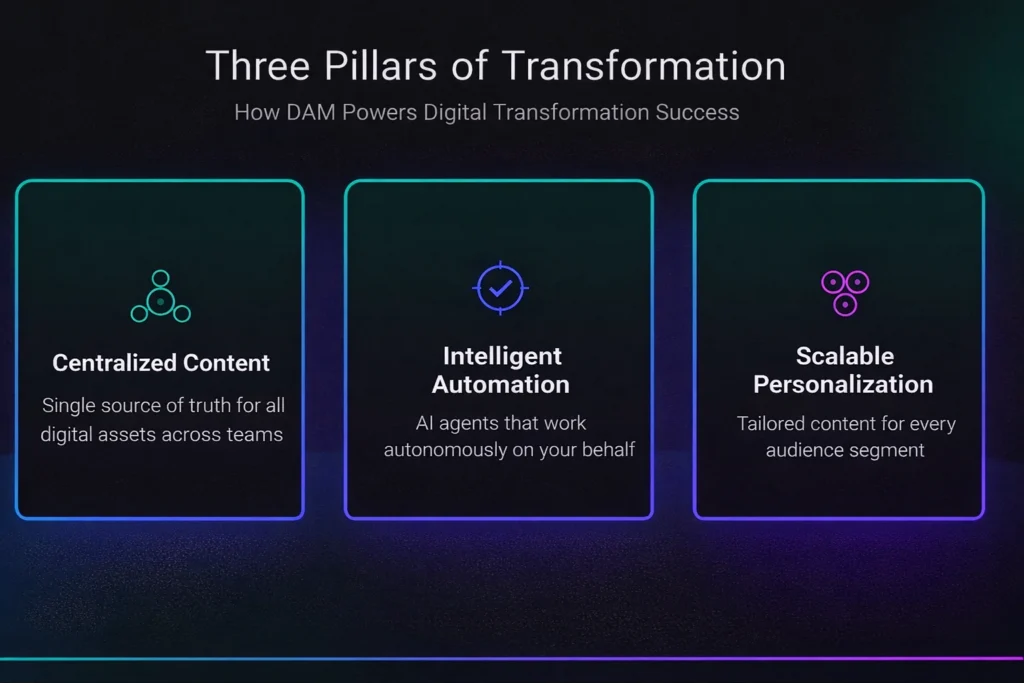
Marketing teams used to contend with scattered content stored in disconnected systems, making it difficult to find, reuse, and optimize assets. Modern DAM platforms power efficient operations, allowing organizations to centralize content, apply metadata for searchability, and integrate with other digital technologies.
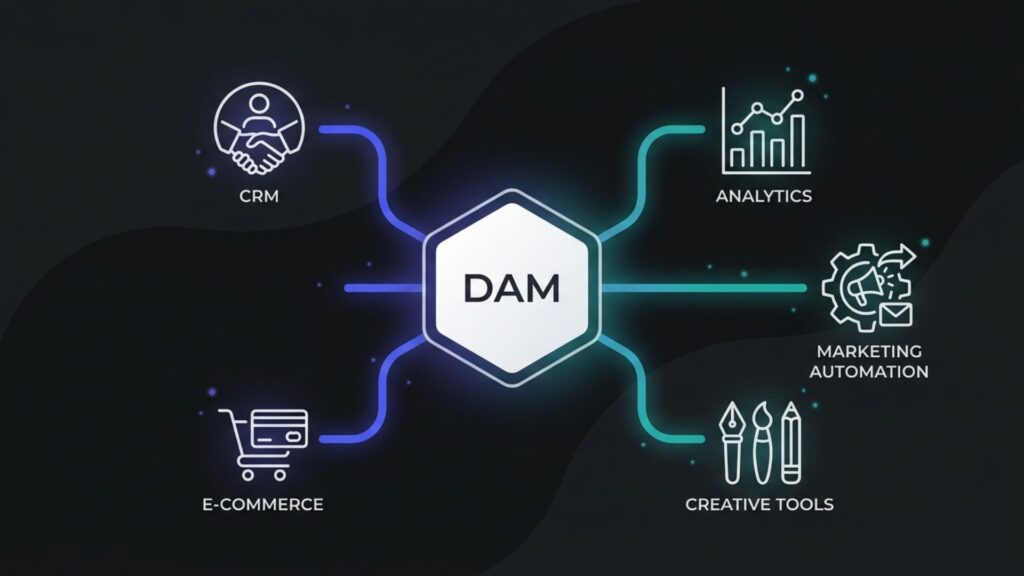
Today’s DAM systems connect directly to marketing automation platforms, customer data systems, creative tools, and content delivery networks. This integration enables teams to streamline workflows, improve collaboration, and ensure content is accessible when and where it’s needed. Digital retail professionals cite organizational silos as a primary challenge in executing digital strategy, underscoring the need for centralized content management.
What Makes Content the Foundation of Digital Transformation?
Digital transformation enables businesses to work smarter, not harder. But without a strong content foundation, even the most advanced initiatives fall short.
Content fuels customer interactions, supports personalized marketing campaigns, and shapes customer experiences across multiple touchpoints. Companies that leverage personalization drive 40% more revenue than those that don’t. Leading organizations prioritize content management as a key pillar of their digital transformation journey.
How Are Brands Responding to the Content Explosion?
With the rise of digital channels, brands produce more content than ever before. The challenge is that more content doesn’t always mean better results. Many companies struggle with redundancy, duplication, and inefficiencies that slow production and increase costs.
To remain competitive, businesses are shifting toward content atomization, breaking larger assets into modular components that can be repurposed across channels and campaigns. When combined with automation and AI-driven tagging, this approach allows brands to extract more value from every piece of content.
What Technologies Are Driving DAM and Digital Transformation Forward?
As businesses scale content production while maintaining consistency and efficiency, digital technologies sit at the heart of transformation efforts. From artificial intelligence to cloud computing, these innovations reshape how teams create, store, and distribute digital assets.
How Do AI Agents Transform Content Discovery and Management?
One of the biggest challenges in content management is finding the right asset at the right time. Traditional keyword-based searches often fall short, leading to wasted time and effort. Agentic AI revolutionizes DAM by enabling automated tagging, metadata enrichment, and predictive search capabilities that go far beyond filename matching.
Unlike basic AI features that respond to prompts, AI Agents function as autonomous assistants that actively interact with systems, make real-time decisions, and execute tasks without constant human intervention.
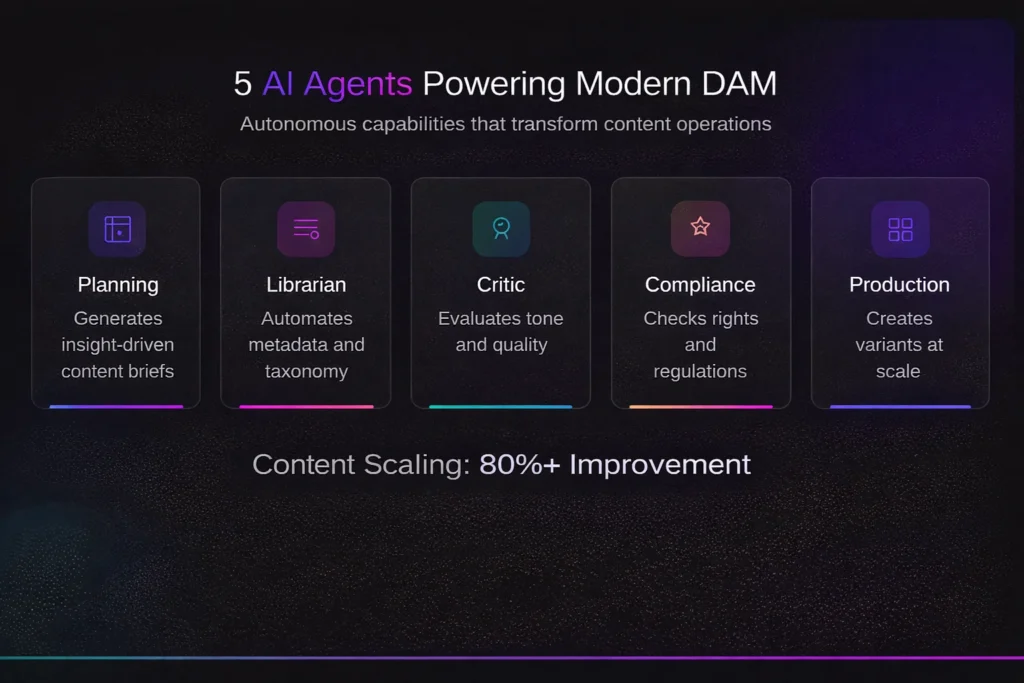
Modern platforms organize these capabilities into specialized agent categories:
- Planning Agents generate structured, insight-driven content briefs aligned to business objectives
- Librarian Agents handle metadata automation, applying predictive tags and organizing files based on proprietary taxonomies
- Critic Agents evaluate content quality by analyzing tone, sentiment, and language
- Compliance Agents check for AI-generated content detection, digital rights, and regulatory requirements
- Production Agents create variants, handling resizing, reformatting, and localization at scale
Organizations using these agentic capabilities have scaled content creation by over 80% while achieving measurable increases in content engagement.
Why Are Cloud-Based Systems Essential for Modern DAM?
In the past, content storage was fragmented across on-premises servers, making it difficult for distributed teams to collaborate effectively. Cloud technologies have transformed DAM by providing a scalable, centralized hub for managing and accessing digital assets from anywhere.
Cloud-based DAM solutions offer enhanced data security while ensuring compliance with industry regulations. As businesses continue their digital transformation journey, moving content management to the cloud has become a business imperative for agility, scalability, and long-term success. The benefits extend beyond accessibility, enabling continuous AI capability updates and seamless integrations with evolving marketing technology stacks.
How Does Real-Time Collaboration Support Global Content Teams?
With remote and hybrid work becoming standard, businesses need tools that facilitate real-time collaboration across geographic boundaries. Modern DAM systems integrate with business processes like project management platforms, creative software, and customer data systems, enabling teams to work together regardless of location. This shift from sequential handoffs to parallel collaboration accelerates content production while maintaining quality standards.
5 Essential Strategies for Maximizing Content ROI Through Digital Transformation
Organizations that take a strategic approach to content operations consistently outperform those focused solely on technology adoption. These five approaches help businesses extract maximum value from their content investments.
1. Implement Content Atomization for Multi-Channel Efficiency
Most marketing teams spend significant time producing content, only for it to be used once. Content atomization changes this inefficiency by breaking larger assets into smaller, reusable components. A single product demo video transforms into social clips, blog posts, interactive guides, and email headers.
2. Deploy Intelligent Workflows to Eliminate Manual Bottlenecks
Outdated manual workflows remain one of the biggest barriers to successful digital transformation. Organizations implementing intelligent workflows powered by AI and automation eliminate inefficiencies, ensuring content moves seamlessly from ideation to deployment.
3. Leverage Data Analytics to Drive Content Decisions
Many organizations struggle to measure content performance. By integrating data analytics into content strategies, businesses make informed choices about which assets to create, modify, or retire. Advanced DAM platforms offer AI-powered insights that identify trends, spot content gaps, and adjust strategies in real time.
4. Build Governance Frameworks That Scale
As content volumes grow, maintaining brand consistency and regulatory compliance becomes increasingly complex. Effective governance frameworks automate compliance checks, restrict access to sensitive assets, and ensure content meets legal and brand standards across all channels.
5. Connect DAM to the Broader Marketing Technology Ecosystem
DAM systems deliver maximum value when they integrate with content management systems, personalization engines, analytics tools, and CRM systems. Through robust APIs and pre-built connectors, content flows across platforms while maintaining metadata and performance visibility.
What Trends Will Shape DAM and Digital Transformation Moving Forward?
As organizations prioritize operational efficiency and customer experience, they need scalable, intelligent solutions to keep pace with growing content demands.
How Are Experience Building Blocks Changing Content Strategy?
One of the most transformative shifts in DAM is the move toward experience building blocks. This modular approach enables teams to create, store, and reuse content in smaller, adaptable units that can be dynamically reassembled for different campaigns, platforms, and customer segments.
This approach allows brands to achieve higher customer satisfaction by delivering more relevant, contextual experiences. With the right digital transformation initiatives, teams can leverage AI-driven metadata tagging and automation to efficiently organize and repurpose content, ensuring faster time-to-market and improved consistency.
Why Does Personalization at Scale Require Modern DAM?
Consumer expectations continue to rise, making personalization a business imperative. Studies consistently show that consumers strongly prefer purchasing from companies that offer personalized experiences.
Businesses are integrating customer data platforms with DAM systems, enabling real-time content personalization across multiple touchpoints. By leveraging machine learning and data science, organizations can analyze customer insights, track engagement patterns, and automate hyper-personalized content delivery at scale.
How Are Compliance Requirements Evolving?
With cloud technologies, remote collaboration, and global content distribution, ensuring data security and compliance is vital. AI-driven DAM platforms automatically apply governance policies, restrict access to sensitive assets, and ensure that content meets regulatory requirements. Features like AI-generated content detection help organizations navigate emerging concerns around synthetic media and maintain transparency in their content operations.
What Barriers Prevent Organizations From Adopting Modern DAM?
Even the most advanced DAM systems can’t drive impact if they aren’t widely adopted. Common barriers include lack of technical expertise, resistance to change, and outdated business practices. Organizations that successfully overcome these challenges focus on providing hands-on training that demonstrates clear value, aligning DAM adoption with broader business strategies, and building a culture of content reusability across teams.
The shift toward content operations is a mindset change as much as a technology adoption. Teams that embrace this logic position themselves to adapt as customer expectations evolve.
Frequently Asked Questions
What is the relationship between DAM and digital transformation?
Digital asset management serves as a foundational component of digital transformation by centralizing content, enabling automation, and providing the infrastructure needed to scale personalized customer experiences. Organizations that integrate DAM into their transformation strategy achieve faster content production, better asset utilization, and improved collaboration.
How does agentic AI differ from traditional AI in DAM systems?
Traditional AI in DAM focuses on specific tasks like auto-tagging or basic search improvements. Agentic AI operates autonomously, making decisions and executing multi-step processes without constant human oversight. AI agents orchestrate entire workflows, combining content enrichment, compliance checking, and distribution into coordinated actions that adapt based on context.
What ROI can organizations expect from modernizing their DAM systems?
Organizations implementing AI-powered DAM report productivity improvements, faster asset creation, and improved content reuse rates. Time savings on asset-related tasks free teams to focus on strategic work rather than manual processes.
How do cloud-based DAM systems improve security?
Cloud-based DAM platforms provide continuous security updates, automated compliance monitoring, and enterprise-grade encryption. They enable granular access controls, comprehensive audit trails, and geographic redundancy. Leading platforms maintain certifications, including GDPR compliance and FedRAMP authorization.
What should organizations prioritize when selecting a DAM platform?
Focus on platforms with native AI capabilities, robust integration with your existing technology stack, and proven scalability. Evaluate workflow automation flexibility, governance features, and the vendor’s track record in your industry. Choose a partner committed to continuous innovation as content operations requirements evolve.
Start Building the Future of Your Content Operations
The future of content management is already here. DAM and digital transformation together reshape how organizations create, manage, and optimize their digital assets. AI-powered automation makes content discovery faster. Cloud-based systems drive seamless collaboration. Personalization at scale redefines customer engagement. And intelligent workflows eliminate inefficiencies, allowing teams to focus on creative work.
Aprimo empowers businesses to take full control of their digital assets, optimize workflows, and drive real impact. With AI agents, intelligent metadata tagging, and experience building blocks, teams break down silos and enhance customer experiences across every touchpoint. Cloud-based DAM ensures secure, scalable access to content from anywhere, while data analytics allow brands to refine their content strategy with confidence. Request a demo today to see how Aprimo can help you build content operations ready for whatever comes next.