

Marketing teams that master analytics gain a competitive edge in demonstrating ROI and optimizing content performance.
- Only 36% of marketers can accurately measure content ROI, creating a massive opportunity for data-driven organizations to outperform competitors.
- A content intelligence platform transforms scattered metrics into actionable insights that connect creative efforts to business outcomes.
- AI-powered analytics enable real-time optimization, predictive performance modeling, and automated content recommendations at enterprise scale.
Winning organizations are using content analytics to anticipate trends rather than just respond to them.
Marketing teams pour countless resources into creating blogs, videos, case studies, and landing pages. Yet a persistent challenge remains: understanding what actually performs and why. Content performance analytics bridges this gap by revealing how audiences engage with content across every touchpoint, from first interaction to conversion.
According to research, 40% of marketing teams cited measurement and reporting as a factor that improved their effectiveness over the past year. Meanwhile, 33% of B2B marketers still identify measuring content effectiveness as a challenge. This disconnect is both a problem and an opportunity, but teams that figure out measurement gain a real competitive edge.
This guide explores what content performance analytics means today, which metrics actually matter, how to build a measurement framework, and how AI-powered content intelligence platforms are reshaping how enterprises approach optimizing content performance.
What Is Content Performance Analytics?
Content performance analytics is the systematic process of collecting, measuring, and analyzing data about how your content performs across channels, audiences, and business objectives. Rather than guessing whether content resonates, analytics provides concrete evidence about audience behavior, engagement patterns, and measurable business outcomes.
The discipline has evolved from its early days. Traditional approaches focused heavily on vanity metrics like page views, social shares, and follower counts. These numbers looked impressive in reports but rarely connected to actual business results. Modern content performance analytics emphasizes meaningful metrics that tie directly to revenue: conversions, lead quality, customer acquisition cost, and lifetime value.
The Shift from Vanity Metrics to Business Outcomes
Understanding the difference between activity and outcome metrics is fundamental to effective content analytics. Activity metrics tell you what happened. Outcome metrics tell you whether what happened mattered.
Page views indicate traffic, but they reveal nothing about whether visitors found value or took action. Time on page suggests engagement, but someone might stay on a page because they found it useful or because they were confused. The metrics that matter connect content consumption to pipeline, revenue, and customer retention.
Consider the difference between knowing that a blog post received 10,000 views versus knowing that particular post generated 150 qualified leads, contributed to 12 closed deals, and influenced $480,000 in pipeline. Both represent content performance data, but only one connects to business outcomes.
Building Blocks of a Content Analytics Framework
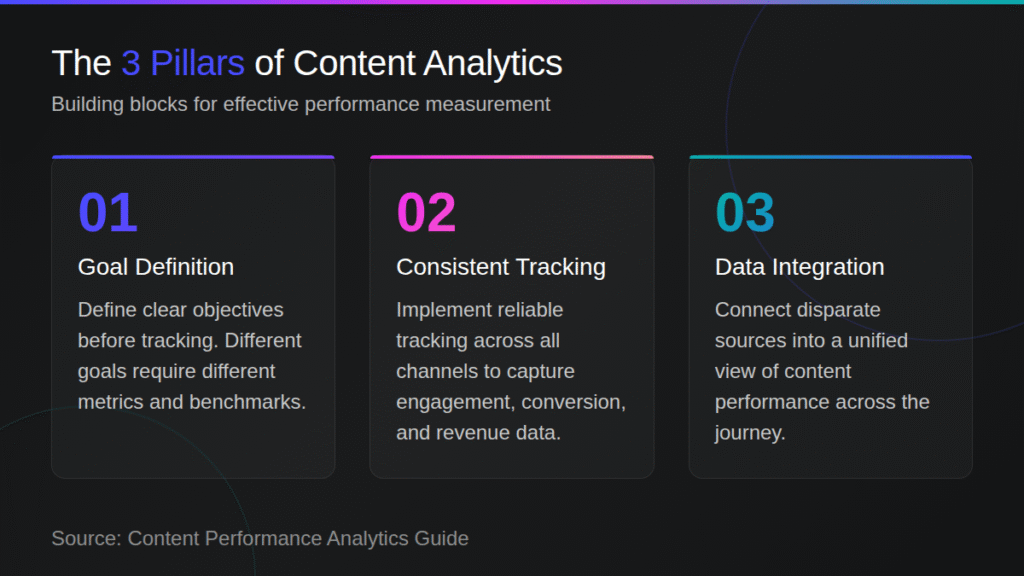
Every effective measurement system requires several foundational elements working together. Consider clear goal definition, consistent tracking, reliable data sources, and a framework for interpretation and action.
The goal-setting process deserves particular attention. Before tracking anything, teams need clarity on what they want their content to achieve. Are you trying to generate leads, support sales conversations, drive product adoption, or build brand awareness? Each objective requires different metrics, tracking approaches, and success benchmarks.
Data sources typically span multiple platforms: website analytics for traffic and behavior patterns, marketing automation for lead tracking, CRM systems for revenue attribution, and social platforms for engagement metrics. The challenge is connecting these disparate sources into a coherent view of content performance.
How Do You Effectively Measure Content Performance?
Measuring content performance requires understanding the full impact of content across the customer journey. This knowledge involves tracking engagement depth, conversion influence, and revenue attribution.
Start by establishing baseline measurements for your current content. What does typical performance look like for different content types, topics, and channels? Without baselines, you can’t distinguish between content that genuinely performs well and content that simply matches your normal patterns.
Essential Metrics for Content Analytics
Several categories of metrics provide a comprehensive view of content performance. Traffic and visibility metrics show reach: unique visitors, page views, organic search impressions, and share of voice. Engagement metrics reveal whether content holds attention: average engagement time, scroll depth, pages per session, and return visitor rate.
Conversion metrics connect content to business action: form submissions, downloads, demo requests, and purchase completions. Revenue metrics quantify business impact: pipeline influenced, deals closed, and customer lifetime value of content-sourced customers.
Successful teams also track content efficiency metrics that reveal operational performance. These measurements include cost per asset, time from brief to publication, and content reuse rates. When you understand how content performs in the market and how efficiently you create it, you can optimize the full content lifecycle.
Attribution Models and Multi-Touch Analysis
Content rarely operates in isolation. A customer might discover your brand through an organic search result, engage with several blog posts over weeks, download a whitepaper, attend a webinar, and finally request a demo. Which touchpoint deserves credit for that conversion?
First-touch attribution credits the initial discovery, often organic content or paid advertising. Last-touch attribution credits the final touchpoint before conversion, frequently a bottom-funnel asset like a pricing page or demo request form. Neither approach tells the complete story.
Multi-touch attribution models distribute credit across the entire journey, recognizing that different content types play roles at various stages. Data-driven attribution can improve ROI measurement accuracy compared to single-touch models by identifying which content combinations actually drive results.
Connecting Content to Revenue
The ultimate measurement challenge involves connecting content consumption to actual revenue generation. Companies must integrate content analytics, marketing automation, and CRM systems.
Implement content tracking that follows prospects through the entire buying journey. Tag leads with the touchpoints they consumed before conversion. Track which assets influence deals at various stages of the sales cycle. Over time, this data reveals patterns about which content types, topics, and formats contribute most to closed business.
Return on effort (ROE) calculations provide faster feedback than traditional ROI by connecting content-level production costs and effort to immediate performance indicators. You can see how much a particular asset costs to make, how many hours went into creating it, and how it performs relative to that investment.
Why Does Content Performance Analytics Matter Now?
The importance of content analytics has intensified as marketing budgets face increased scrutiny and content production volumes continue climbing. Leaders expect accountability, and content teams need data to justify investments and guide strategy.
According to research, 83% of marketing leaders consider demonstrating ROI their top priority. Content marketing generates an average of three dollars for every dollar spent, but only when properly optimized. Without measurement, teams can’t identify which content drives returns and which represents wasted investment.
The Measurement Gap and Competitive Advantage
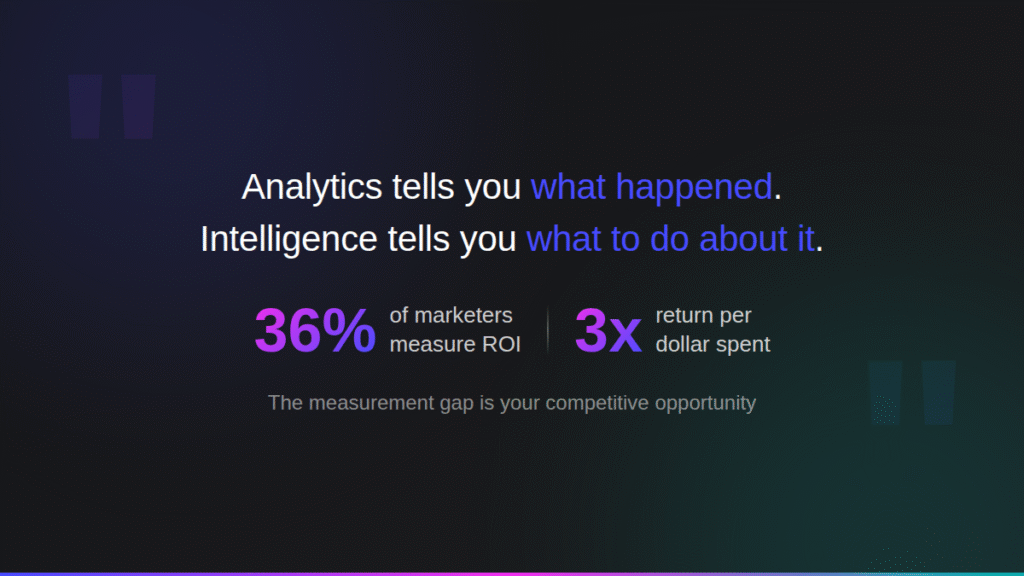
Despite the recognized importance of measurement, capability gaps persist. Only about 36% of marketers report they can accurately measure content ROI.
Teams with systematic measurement identify underperforming content early and redirect resources toward high-impact work. They discover unexpected content successes and double down on what works. They build institutional knowledge about what resonates with their specific audiences rather than relying on generic best practices.
The measurement gap often stems from organizational rather than technical challenges. Teams may lack clear ROI targets, operate with disconnected technology stacks, or prioritize production over analysis. Organizations using comprehensive content intelligence tools gain advantages through data-driven decision-making that compounds over time.

Rising Expectations from Leadership
Marketing investment continues to increase, and leadership expects accountability. According to CMI research, AI-powered marketing tools topped the list of areas where B2B marketers expect to increase investment in 2026, with 45% selecting it as a top-three priority. As budgets shift toward technology-enabled content operations, the pressure to demonstrate what each investment produces intensifies.
Content performance tracking transforms retrospective reporting into forward-looking guidance. Rather than documenting what happened, analytics should inform what to do next. Which content types should receive more investment? Which topics resonate most with prospects? Where do content gaps exist in the buyer journey?
What Makes a Content Intelligence Platform Valuable?
A content intelligence platform combines AI-powered analysis with strategic guidance, helping teams understand what content exists, what should be created, how it should be optimized, and where opportunities exist.
Content intelligence leverages AI to analyze performance data, audience behavior, and content gaps to inform strategic decisions. Unlike production tools focused solely on creation speed, intelligence platforms provide the strategic brain behind content operations.
Core Capabilities of Content Intelligence Solutions
Predictive performance modeling uses historical data to forecast how new content will perform before publication. Content gap analysis identifies topics and formats missing from your library that audience data suggests would perform well.
Automated recommendation engines suggest improvements to existing content based on performance patterns. Audience segmentation reveals which content types resonate with different buyer personas, industries, or journey stages. Competitive intelligence shows how your content portfolio compares to market alternatives.
The most sophisticated platforms integrate content intelligence with production workflows. AI-driven content analytics capabilities identify personalization gaps, suggest improvements, and provide actionable insights to ensure your most impactful assets receive prioritization for maximum ROI.
From Reactive Measurement to Proactive Guidance
Traditional analytics tells you what happened after the fact. A content intelligence platform anticipates what will work and guides proactive decisions.
Consider the difference between reviewing last quarter’s content performance versus receiving real-time recommendations about which assets need updating, which topics are trending with your target audience, and which content gaps are costing you competitive positioning.
AI Agents extend intelligence capabilities even further. Planning Agents generate structured, insight-driven content briefs aligned to business objectives. Critic Agents evaluate content quality by analyzing tone, sentiment, and compositional elements. These AI-powered capabilities transform content operations from reactive production to strategic orchestration.
What Are 7 Metrics Every Content Team Should Track?
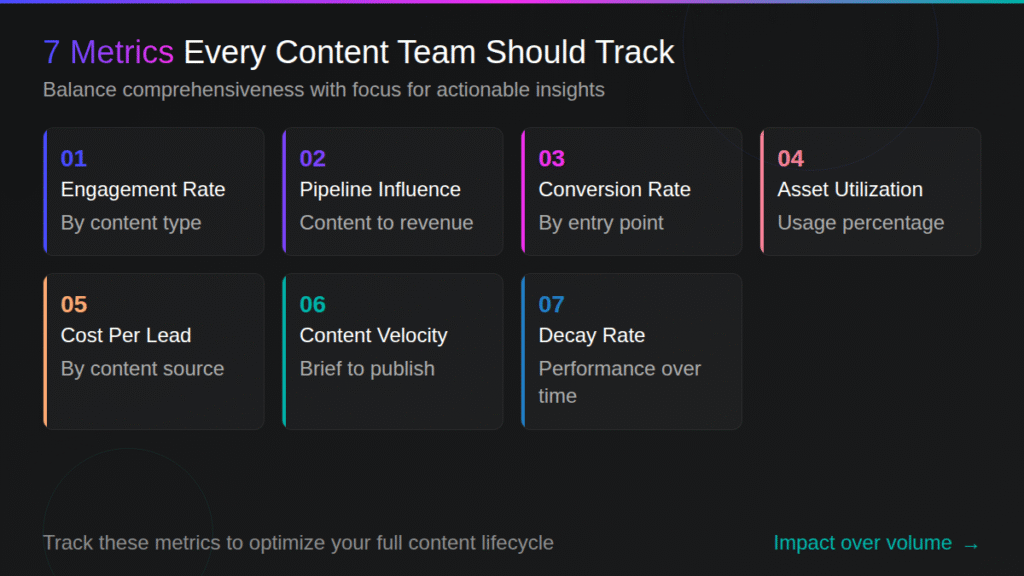
Selecting the right metrics requires balancing comprehensiveness with focus. Tracking everything creates noise. Tracking too little leaves blind spots. These seven metrics provide a balanced view of content performance across the full lifecycle.
1. Engagement Rate by Content Type: Understanding which formats generate the deepest engagement guides production investments. Compare average engagement time, scroll depth, and interaction rates across blogs, videos, interactive content, and downloads. The formats that hold attention longest often drive the strongest business outcomes.
2. Content-Influenced Pipeline: Track which content assets prospects engage with during their buying journey and connect that engagement to pipeline value. This metric reveals which content actually contributes to revenue generation versus which content gets consumed but doesn’t move buyers forward.
3. Conversion Rate by Entry Point: Different content attracts different audience intent. Measure conversion rates for visitors who enter through organic search, social channels, email campaigns, and direct traffic. These variations reveal which content successfully attracts ready-to-act audiences.
4. Asset Utilization Rate: Of all the content you create, what percentage actually gets used in campaigns, sales conversations, and customer communications? Low utilization rates often indicate disconnects between production and actual business needs. Organizations implementing comprehensive content management strategies report reductions in asset duplication and waste.
5. Cost Per Qualified Lead by Content Source: Understanding acquisition economics at the content level enables efficient resource allocation. Calculate the fully loaded cost of content production and distribution divided by the qualified leads generated. Compare across content types to identify the most efficient lead-generation approaches.
6. Content Velocity Metrics: Track time from brief to publication, revision cycles per asset, and speed of content personalization for different audience segments. Operational efficiency directly impacts your ability to respond to market opportunities and competitive threats. Teams with higher content velocity can capture seasonal opportunities faster and respond more effectively to competition.
7. Content Decay Rate: Measure how quickly content performance degrades over time. Some content remains valuable for years. Other assets peak and decline rapidly. Understanding decay patterns helps prioritize refresh efforts and predict when evergreen content will need updating.
How Can AI Transform Your Content Analytics Approach?
Artificial intelligence has changed what’s possible in content performance analytics. Capabilities that required teams of analysts and weeks of work now happen automatically in real time.
Machine learning algorithms identify patterns in vast datasets that human analysts would miss. Natural language processing understands content at semantic levels, recognizing topical relationships, sentiment variations, and audience intent signals. Predictive models forecast performance before content even publishes.
AI-Powered Performance Prediction
Predictive analytics is one of the most valuable AI applications for content teams. By analyzing historical performance patterns, audience behavior, and competitive signals, AI models predict how new content will perform.
These predictions enable smarter production decisions. If an AI model predicts that a particular topic will underperform based on audience interest patterns and competitive saturation, teams can redirect effort toward higher-potential content. If predictions suggest strong performance, teams can allocate additional promotion resources.
AI productivity measurements help demonstrate ROI to stakeholders and identify areas for continuous improvement. When organizations can predict and prove content impact, they move from defending budgets to strategically allocating them.
Automated Content Optimization
AI enables optimization at scale that would be impossible through manual processes. Automated systems continuously test content variations, adjust headlines, modify metadata, and refine distribution timing based on performance data.
A/B testing that traditionally required weeks or months now happens continuously. AI systems implement multi-armed bandit approaches that automatically route traffic toward higher-performing content variations while still gathering data on alternatives.
Personalization can increase marketing ROI by eliminating wasteful spending on underperforming content while doubling down on what works. AI makes this level of continuous optimization practical at enterprise scale.
Intelligent Content Recommendations
AI-powered content intelligence identifies content gaps where audience demand exists but your library lacks relevant assets. It suggests content updates based on performance decay patterns. And these platforms recommend personalization opportunities where audience segments show distinct preferences.
A content intelligence platform identifies content gaps, suggests improvements, and provides actionable insights to ensure your most impactful assets receive prioritization for maximum ROI.
What Are Common Mistakes in Content Analytics?
Even sophisticated marketing teams make measurement mistakes that undermine their analytics programs. Recognizing these common pitfalls helps teams build more effective measurement practices.
Focusing on Volume Over Impact
Tracking how much content you produce reveals nothing about whether that content creates value. Some teams celebrate hitting production quotas while their content graveyard grows with unused, unviewed assets.
The shift from volume metrics to impact metrics requires changing both measurement systems and organizational incentives. When teams get evaluated on content output, they optimize for output. When teams get evaluated on content performance, they optimize for quality and relevance.
Measuring in Silos
Content performance data scattered across disconnected platforms creates incomplete pictures. Your analytics platform shows traffic. Your marketing automation shows leads. Your CRM shows revenue. But without integration, you can’t connect the full journey from content consumption to business outcome.
Building unified measurement requires integrating technology and aligning processes. Systems need to share data. Teams need to align on consistent definitions, tagging conventions, and attribution models.
Ignoring Content Efficiency
Performance metrics tell only half the story. A piece of content might generate results while consuming resources that could have produced even greater returns if allocated differently.
ROE calculations that account for production cost, time investment, and resource utilization reveal whether high-performing content represents efficient investment. Sometimes medium-performing content produced at low cost delivers better returns than high-performing content that consumed disproportionate resources.
Analysis Without Action
Some teams build impressive dashboards and generate comprehensive reports but never translate insights into changed behavior. Data has no value unless it drives decisions.
Build explicit feedback loops between analytics and planning. Review performance insights during content planning sessions. Set specific criteria for when analytics insights should trigger content updates, retirement, or amplification decisions.
FAQ
What’s the difference between content analytics and content intelligence? Content analytics refers to the measurement and analysis of how content performs, focusing on data collection, metric tracking, and performance reporting. A content intelligence platform extends analytics into strategic guidance, using AI to identify patterns, predict performance, recommend optimizations, and identify content gaps. Analytics tells you what happened. Intelligence tells you what to do about it.
How often should teams review content performance data? The optimal frequency depends on content type and channel. Fast-moving social content warrants daily monitoring. Blog and web content benefit from weekly reviews. Comprehensive portfolio analysis typically happens monthly or quarterly. The key is matching review cadence to the rate at which meaningful patterns emerge in the data. Real-time dashboards help teams spot urgent issues while scheduled reviews enable strategic analysis.
What tools integrate with content performance analytics platforms? Modern analytics platforms typically integrate with CMS platforms, marketing automation systems, CRM databases, social media management tools, advertising platforms, and business intelligence dashboards. The goal is to create unified visibility across all content touchpoints. Look for platforms offering pre-built integrations with your existing technology stack, plus APIs for custom connections.
How do you calculate content marketing ROI? Content marketing ROI compares the revenue generated or influenced by content against the fully loaded cost of producing and distributing that content. The formula is: (Revenue Attributed to Content minus Content Investment) divided by Content Investment, multiplied by 100 for a percentage. The challenge lies in accurate attribution since content often influences revenue across multiple touchpoints rather than driving single-touch conversions.
What’s the biggest barrier to effective content analytics? Most organizations cite disconnected technology systems as their primary barrier. When data lives in separate platforms that don’t communicate, building a complete performance picture becomes extremely difficult. The second major barrier is unclear goal definition. Without specific, measurable objectives, teams don’t know what to track or how to evaluate success.
Turn Content Data Into Competitive Advantage
Content performance analytics has evolved into a strategic imperative. As content production scales and marketing budgets face increased scrutiny, the ability to prove impact and optimize performance separates high-performing teams from those struggling to justify their investments.
The organizations succeeding in 2026 track metrics that connect to business outcomes. They integrate data across platforms to see complete performance pictures. They use AI-powered content intelligence platforms to move from reactive reporting to proactive optimization.
Aprimo’s Agentic DAM and content operations platform provides the infrastructure for enterprise content performance analytics. From AI-powered content intelligence that identifies optimization opportunities to comprehensive workflow automation that tracks performance from creation through deployment, Aprimo enables teams to understand content impact and act on those insights. Schedule a demo to see how intelligent content operations can transform your measurement capabilities.