
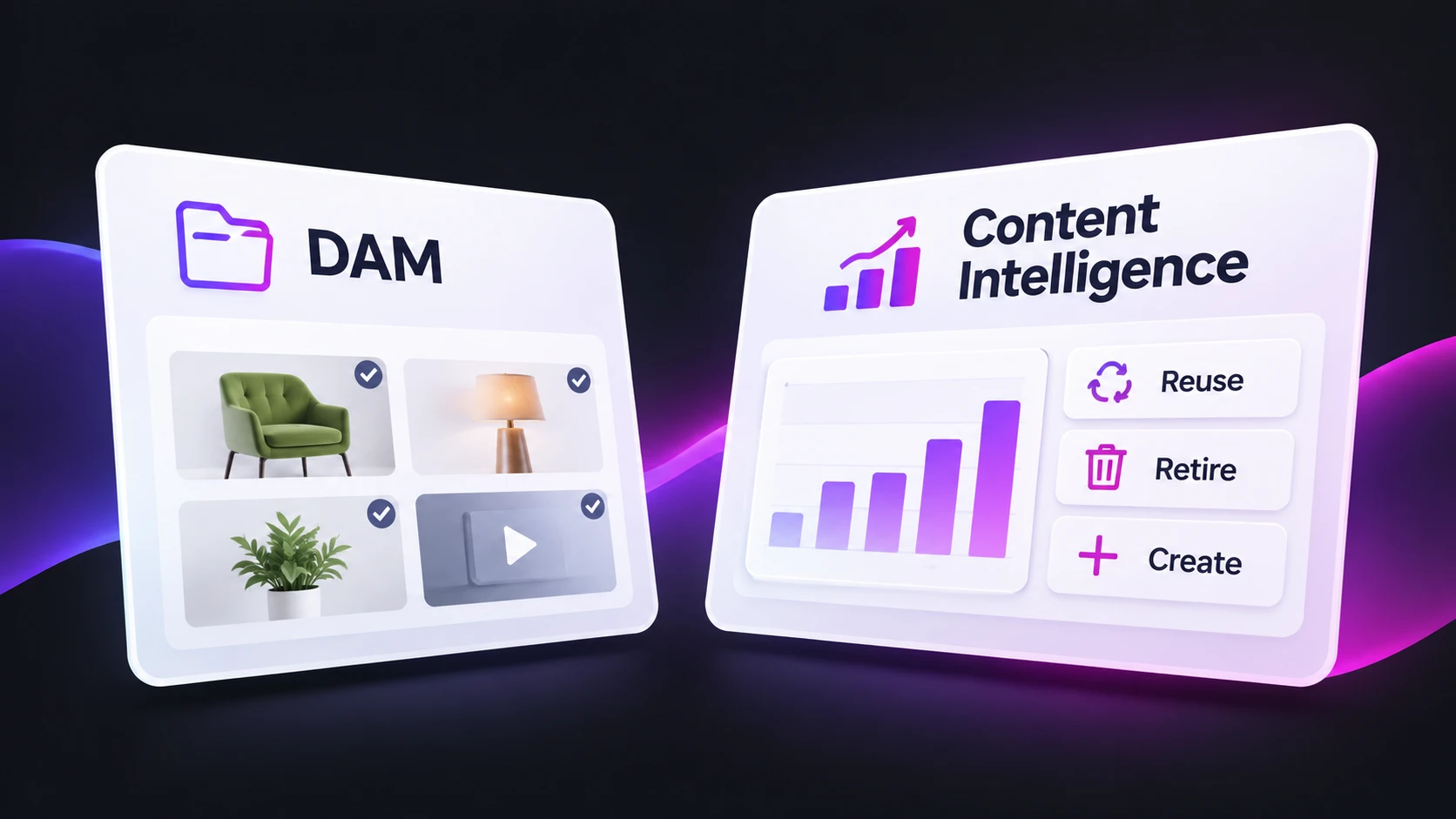
The content intelligence vs DAM debate persists because buyers often compare the two as if one replaces the other. In fact, a content intelligence platform and a DAM solve different problems. The confusion is understandable. Both work with content. Both use metadata, and both claim to improve how teams find and use assets. The overlap in language hides a real difference in purpose.
A DAM manages content. It stores assets, organizes them, governs rights, and routes work through approval. A content intelligence platform analyzes content. It studies how assets perform, finds gaps in the library, and recommends what to reuse, retire, or create. One answers where content is and whether it is approved. The other answers what to do with it next.
This guide explains the differences, the overlap, and the decision logic for teams choosing between the two or deciding how to combine them. It draws on Aprimo’s 2027 DAM trends report, which argues that the shift from dashboards to decisions is one of the defining changes in content operations. The aim is a clear view of each category, so buyers fund the right capability.
TL;DR
- A DAM manages, governs, and delivers content, while a content intelligence platform analyzes performance then recommends actions.
- Dashboards report what happened, but content intelligence surfaces what to do next.
- The two categories overlap in metadata, but they differ in purpose and output.
- Content intelligence works best when it draws on clean metadata and rights data from a governed DAM.
- Most enterprises need both capabilities, connected in one operating model.
- Buyers should test whether a platform delivers recommendations as actions or as tables that need manual interpretation.
What is a content intelligence platform?
A content intelligence platform is software that analyzes how content performs, identifies gaps against planned needs, and recommends actions such as reuse, retirement, or new production. Its output is a decision, not only a report.
Definition: A content intelligence platform is a system that uses machine learning to analyze audience behavior and content performance, then recommends which assets to reuse, retire, or create.
First-generation content analytics answered a reporting question: what did the content do? Downloads, views, and channel engagement all belong to that era. The information has value, but it leaves the hard questions open. It does not show which gap exists in the library, what to produce next, or which existing assets to reuse before commissioning new work.
Aprimo’s trends report describes the difference as whether a tool surfaces the next action. AI-driven content intelligence closes the loop between what performed and what to do about it. It compares available assets against campaign and audience requirements. It then flags gaps, and points to where new production investment is justified.
The category matters because production capacity is the constraint. Teams rarely lack ideas. They lack time, budget, and people to make everything the business wants. Intelligence that directs scarce capacity to the highest-value work changes how teams plan.
What does a DAM do that a content intelligence platform does not?
A DAM stores, organizes, governs, and delivers assets, while a content intelligence platform does not manage the asset lifecycle. The DAM holds the source of truth for approved content.
Core DAM functions include:
- Storage: A central library with metadata, collections, and search.
- Rights management: Usage rights, expiry dates, and takedown controls attached to each asset.
- Workflow: Briefing, review, and approval routes that keep content moving.
- Governance: Brand and compliance rules applied before release.
- Distribution: Delivery of approved assets to channels and systems.
A content intelligence platform depends on those functions. It needs accurate metadata to analyze content. It needs rights data to avoid recommending an expired asset. It needs approval status to avoid recommending content that has not cleared review.
That dependency explains why the two categories work best together. Intelligence layered on a disorganized library produces recommendations nobody can trust. Intelligence layered on a governed library produces recommendations people can act on.
Aprimo positions its Digital Asset Management as the single source of truth for the full content lifecycle, and its Content Intelligence capability as the layer that optimizes content strategy based on engagement insights.
Content intelligence vs DAM: how do they differ?
A content intelligence platform differs from a DAM in purpose, primary question, main output, and typical users. The categories share data, but they serve different decisions.
- Purpose: The DAM manages and governs content. The intelligence platform analyzes and advises.
- Primary question: The DAM asks where the content is and whether it is approved. The intelligence platform asks what the content did and what to do next.
- Main output: The DAM produces a governed library and delivered assets. The intelligence platform produces recommendations and priorities.
- Typical users: Creative teams, brand managers, and digital asset managers use the DAM daily. Content strategists, marketing leaders, and planners use the intelligence platform to direct work.
- Time orientation: The DAM focuses on the current state of content. The intelligence platform looks at past performance to shape future production.
These differences matter during purchasing. A buyer who expects a DAM to recommend what to create will be disappointed. A buyer who expects an intelligence tool to govern rights will be disappointed too.
The best way to separate them is by the verb. DAM verbs include store, tag, approve, govern, and deliver. Intelligence verbs include measure, detect, recommend, prioritize, and forecast.
Where do the two categories overlap?
The two categories overlap in metadata, performance data, and personalization. Both rely on well-structured information about content, which is why integration between them pays off.
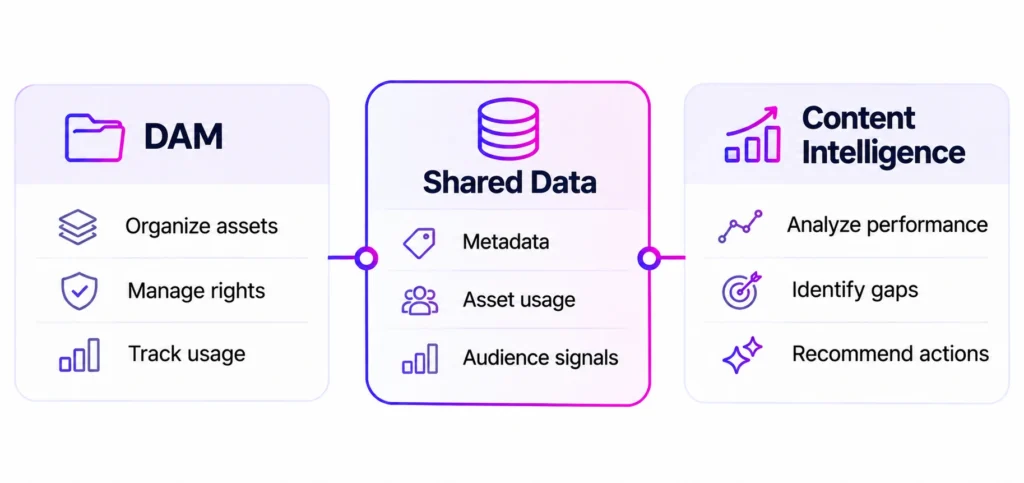
Metadata is the largest overlap. A DAM uses metadata to organize and find assets. An intelligence platform uses it to group content, compare performance, and detect gaps. Consistent taxonomy serves both.
Performance data is a second overlap. Some DAM platforms track asset usage and downloads. Intelligence platforms extend that data with engagement signals from channels, then connect it to outcomes such as conversion.
Personalization is a third. Aprimo’s personalization capability uses behavior signals to help match content to audiences. That function sits between management and intelligence, since it relies on a governed library with performance insight.
Overlap creates a buying risk. Vendors in each category may claim the other’s territory. A DAM vendor may describe basic usage reports as intelligence. An intelligence vendor may describe a content library as a DAM. Buyers should test claims against the verbs above.
Check how a DAM supports content intelligence
Build a tailored DAM RFI from your own requirements, use cases, and business goals in minutes.
Why do dashboards fall short of decisions in content intelligence?
Dashboards fall short because they report what happened without saying what to do about it. Teams still have to interpret charts, decide on actions, and coordinate work manually.
A dashboard might show that a product video performed well in email last quarter. That fact does not reveal whether the library has a gap for a new campaign, whether a similar asset already exists, or whether a different audience would respond better to another format. A person must investigate each question.
Aprimo’s trends report calls this the shift from dashboards to decisions. Performance dashboards show what happened. Content intelligence shows what to do next. For teams managing large content estates, the second capability has more value, because it changes how production capacity gets allocated.
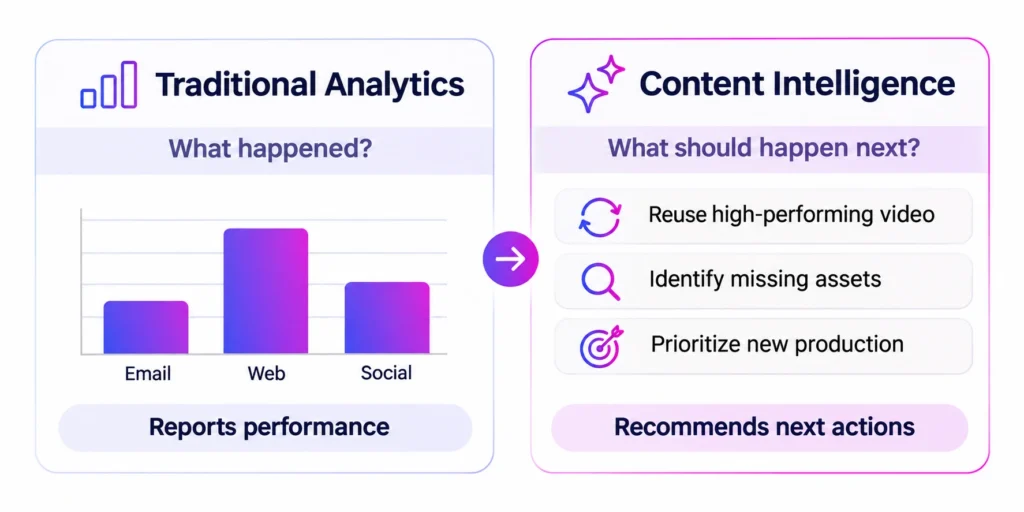
Three practical gains follow:
- Reuse before creation: Reusing a high-performing asset costs less and moves faster than commissioning a new one.
- Gap detection before launch: Spotting a missing asset early prevents a last-minute scramble.
- Informed bets on conversion: Knowing which content is likely to convert for a specific audience improves planning before anything is published.
The Gartner forecast points in the same direction. Gartner predicts that 75% of new analytics content will be contextualized for intelligent applications through generative AI by 2027, according to a Gartner press release. Insight and action are moving closer together.
What should a content intelligence platform recommend?
A content intelligence platform should recommend actions in four categories: reuse, amplify, retire, and create. Each recommendation needs a reason that a person can check.
- Reuse: Surface existing assets that fit a planned campaign, so teams avoid duplicate production.
- Amplify: Identify high-performing content that deserves wider distribution or localization.
- Retire: Flag low-performing, outdated, or expired assets for removal from circulation.
- Create: Point to gaps where new production investment is justified.
The Aprimo launch messaging for Content Intelligence and Personalization describes similar goals. AI prioritizes asset creation based on revenue potential. Smart location insights boost content use on marketing channels. Behavior-based personalization increases conversions.
Quality of explanation matters as much as the recommendation. A suggestion to retire an asset needs a visible rationale, such as low usage over twelve months. A suggestion to create new content needs the gap it fills. Recommendations without reasons breed distrust, and teams stop reading them.
Delivery format matters too. Recommendations should arrive as actions inside the workflow, not as data tables that require manual interpretation. A planner who sees a suggested asset in the campaign brief will act. A planner who must open a separate report may not.
Do teams need both a DAM and a content intelligence platform?
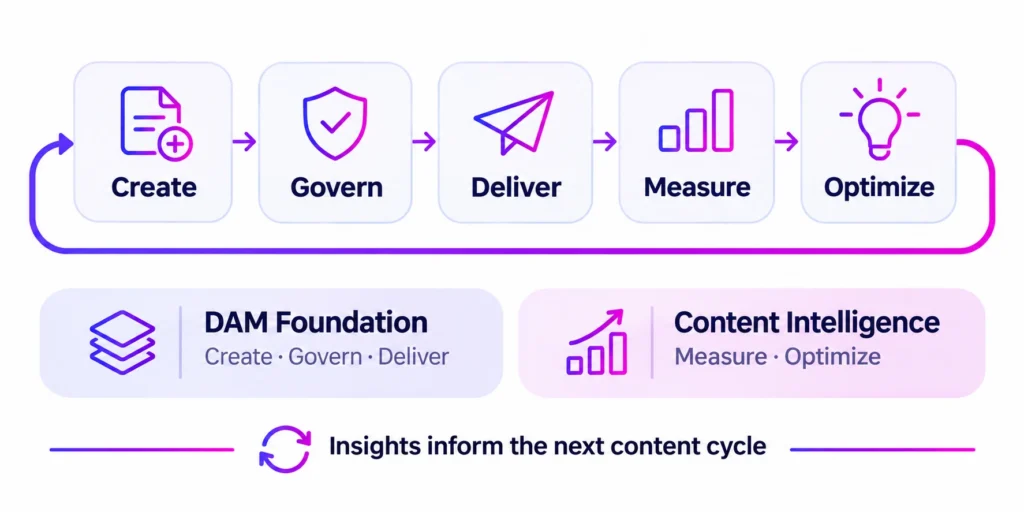
Most enterprises need both capabilities, connected in one operating model. The DAM supplies governed content and clean metadata. Intelligence supplies the direction for what to make, reuse, and retire.
A decision guide helps teams sort their situation:
- Library is disorganized or ungoverned: Start with the DAM. Intelligence built on weak data will mislead.
- Library is governed, but planning relies on guesswork: Add intelligence to direct production and reuse.
- Content lives across many systems: Add portfolio visibility, so intelligence sees content beyond the DAM.
- Teams personalize at volume: Connect intelligence to personalization, so performance data shapes delivery.
Aprimo’s Content Portfolio Management addresses the third case by discovering, governing, and optimizing content wherever it lives. Enterprise content estates rarely sit in one repository, so intelligence that sees only the DAM works with partial data.
Integration quality decides the outcome. Forrester’s June 2026 report found that 47% of DAM decision-makers rank integration with adjacent systems as their top priority, according to Forrester. A connected DAM with an intelligence layer shares metadata, performance data, and approval status without manual exports.
Buying both from one platform offers a shorter path. Aprimo’s Content Operations Platform combines DAM, intelligence, and related capabilities, so data moves between them without custom integration.
How should buyers evaluate a content intelligence platform?
Buyers should evaluate a content intelligence platform by testing recommendations, data sources, explanation quality, and workflow fit. A strong demo uses the buyer’s own content, not sample data.
Six questions separate real intelligence from reporting:
- Recommendations: Does the platform produce prescriptive actions, or only charts?
- Gap detection: Can it compare available assets against campaign and audience needs?
- Data sources: Which performance signals does it use, and how does it connect to channels?
- Explanations: Does each recommendation include a reason that a person can verify?
- ROI linkage: Can it connect creation cost to engagement, and approval time to conversion?
- Workflow fit: Do recommendations appear where planners and creators already work?
Closed-loop ROI analytics deserve special attention. Without them, teams cannot prove that intelligence changed outcomes. A platform that ties production cost to downstream results gives marketing leaders evidence for budget decisions.
Pilot design helps. A team can test intelligence on one campaign or one content category, then compare reuse rates, production spend, and cycle time with a baseline. The results either justify wider use or show where the data needs work.
Choosing between a content intelligence platform and a DAM
A content intelligence platform and a DAM answer different questions. The DAM governs content and keeps it ready for use. Intelligence analyzes performance and directs what to do next. Treating them as substitutes leads to gaps, because each depends on the other. A buyer who funds only one will usually find the missing half within a year.
The practical path starts with the foundation. A governed library, consistent taxonomy, and accurate rights data make intelligence trustworthy. Intelligence then turns that foundation into decisions about reuse, retirement, and creation.
Teams that connect the two build a loop: content is created, governed, delivered, measured, and informed by what worked. Each cycle improves the next. That loop is the real value of combining the categories. It also gives leadership a way to see how content investment connects to results, which budget conversations increasingly demand.
Teams ready to see how governed content works with intelligence can book a demo built around one live campaign.
FAQ
Is a content intelligence platform the same as content analytics?
No. Content analytics reports what content did. A content intelligence platform goes further, using machine learning to recommend what to reuse, retire, or create. The difference is whether the tool surfaces the next action.
Can a DAM replace a content intelligence platform?
Not usually. A DAM manages and governs content. Basic usage reports may exist, but prescriptive recommendations require analysis of performance against planned needs. Some platforms combine both capabilities.
What data does a content intelligence platform need?
It needs asset metadata, usage signals, engagement signals, campaign information, plus audience information. Clean metadata and rights data from a DAM improve the quality of recommendations.
Who uses a content intelligence platform?
Content strategists, campaign planners, marketing leaders, and creative operations teams use it to direct production. Creators benefit from the recommendations to reuse content. Asset managers benefit from the recommendations to retire it.
How does content intelligence relate to personalization?
Intelligence identifies which content performs for which audience. Personalization uses that insight to deliver the right content to each person. Both depend on a governed, well-tagged library.
How can a team prove the value of content intelligence?
Teams should record baseline reuse rates, production spending, and cycle times before a pilot. Comparing those numbers after the pilot shows whether recommendations changed outcomes.
Related reading: content marketing ROI from asset use to pipeline, introducing Content Portfolio Management.