
A marketing budget reset for 2027 usually starts from last year’s numbers. Forrester’s Mark Ogne argues that this habit is the problem: “The traditional assumption that more budget is necessary to achieve better outcomes no longer holds.” Forrester’s own 2027 budget survey finds that more than 80 percent of leaders expect overall budgets to rise. Its analysts warn that more spend will not fix inefficiency on its own. The real question for 2027 is where the money goes, and whether the organization can see that clearly enough to move it.
McKinsey’s State of Organizations 2026 shows how far most companies must go. Only 30 percent of organizations reallocate resources enterprise-wide. Forty-seven percent of leaders review budget and talent only annually or less.
This guide explains why budget resets stall. It covers what a single view of plans, resources and spend should show. It also shows how to use that view to move money toward the work that matters.
TL;DR
- Budget resets stall when campaign plans, resource capacity and spend live in separate systems, so no one can see the trade-offs.
- Forrester and McKinsey both point to the same shift: fund strategic bets and change, not equal increases across every function.
- Tie every campaign to a budget line, an owner, a capacity estimate and a measurable outcome before approving next year’s spend.
- Aprimo Plan connects planning views to resource capacity, while Aprimo Spend tracks the money behind them, so reallocation decisions rest on current data instead of last year’s spreadsheet.
Why budget resets keep repeating last year
Most marketing budgets are built incrementally. Teams take last year’s allocation, add a percentage for inflation or new programs, and send the result to finance. The process feels orderly, but it locks in past decisions. Forrester describes the result: incremental planning “spreads investment too thinly” and fragments effort rather than concentrating impact.
The problem is not only the method. It is the information available during the process. Campaign plans sit in one tool. Creative and production capacity sit in another. Spend lives in finance systems that update after the fact.
A marketing operations lead may know that a regional team is overloaded but cannot see how much that team’s planned campaigns cost. A CMO may see a strong pipeline contribution from one channel but cannot tell whether the budget behind it is still committed to a campaign that has already changed.
When those views are disconnected, the cycle favors whatever is easiest to defend. Programs with clear line items survive. Shared resources, agency fees and experiments tend to get cut or absorbed. The budget reset becomes a negotiation about history rather than a decision about priorities.
What a single view of plan, resources and spend should answer
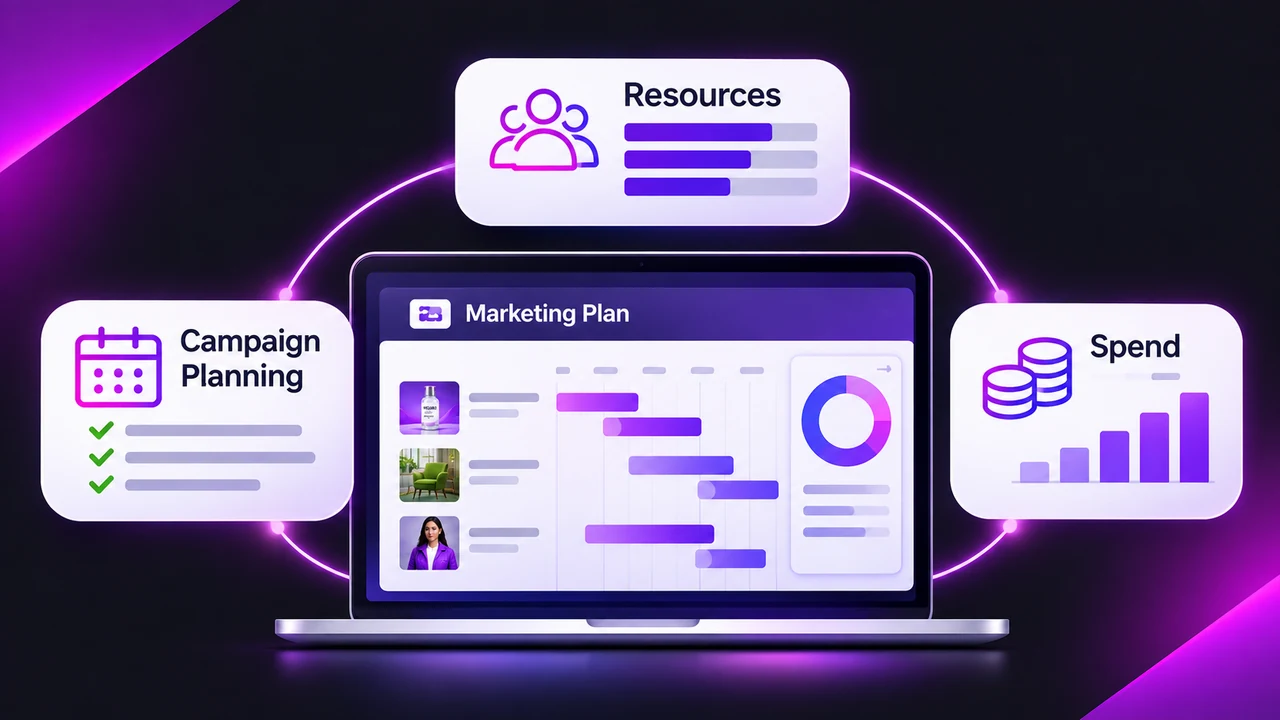
A useful view answers three questions at once. The first is what the organization intends to do: which goals, programs and campaigns the budget is supposed to fund. The second is what capacity exists to deliver them: people, agencies, production hours and content volume by market and channel. The third is what has been committed and spent, compared with what was planned.
When those three answers sit side by side, the trade-offs become visible. A campaign that looks essential may depend on a production team already at capacity. A regional budget may be fully committed to activities that were removed from the plan months ago. A channel may be receiving money while its results decline. None of these questions is hard in isolation. They are hard when the answers live in different places.
Aprimo’s approach to this problem has two parts.
- Aprimo Plan covers strategic planning: It connects marketing goals to programs and campaign plans. It breaks global campaign briefs into regional and channel sub-briefs. It offers a calendar that shows campaign timelines for each team or market. Its Activity and Campaign Insights dashboards are designed to show team activity, plus resource utilization across the board.
- Aprimo Spend covers the financial side: It tracks expenses against budgets and purchase orders at the line-item level. It monitors planned versus actual spend across programs, channels and geographies.
A marketing budget reset follows four steps.
- Connect every campaign to a budget line and an owner.
- Make capacity part of planning.
- Fund change deliberately.
- Review spend against plan every month.
Step one: connect every campaign to a budget line and an owner
Reallocation requires a common unit. If a campaign cannot be traced to a budget line, a cost center and a named owner, it cannot be compared with anything else. The first step in a 2027 reset is to make that link mandatory.
Forrester recommends that leaders make “explicit decisions” about where to concentrate investment, what to expand, and what to stop funding entirely. Those decisions are only possible when each program has a visible cost and an accountable owner.
In practice, this means every campaign brief carries its budget allocation from the start. Aprimo’s Intelligent Content Brief can generate structured briefs quickly. Spend lets teams track those allocations against purchase orders and invoices as the work progresses. A campaign that begins with a clear budget line is far easier to review, adjust or stop in mid-year.
Useful resources:
- Teams that want to tighten this link further can build on the thinking in this Aprimo post on maximizing marketing ROI through intelligent spend management.
- For a more detailed look at how budgets for content are set and tracked, the content budgeting guide covers the cost side of the work.
Step two: make capacity a planning input, not an afterthought
Budgets are often approved before anyone checks whether the team can deliver the work. The result is a plan that is funded but not staffed. Spend rises when deadlines slip, and agencies get brought in to catch up.
McKinsey’s State of Organizations survey suggests that reallocation is difficult because organizations do not revisit it often enough. Organizations that reallocate quickly reduce inefficiencies and accelerate innovation. They also improve employee and customer satisfaction.
Speed depends on knowing capacity in advance. If a team’s capacity is visible next to its planned campaigns, a shift in priorities can be tested before money is committed.
This is also where resource optimization becomes concrete. Aprimo Plan provides real-time visibility into versions, allocations and strategic goals, so a planning lead can see when a regional or channel plan has drifted from the allocation it was approved against.
Useful resource: For teams managing high-volume agency and production work, the marketing resource management guide explains how capacity planning connects to the broader workflow.
Build your 2027 budget on one view
Map your planning, capacity and spend requirements before you choose a platform.
Step three: fund change deliberately
Instead of distributing increases evenly across marketing functions, high-performing CMOs make strategic bets that align with business priorities. They fund change by setting aside dedicated budget for experimentation.
A test budget that sits inside a general program line tends to be the first thing cut when the numbers tighten. Give experiments a separate allocation, a named owner and a defined success measure. Then the spend can be reviewed on the same basis as every other program.
Divestment also needs to be part of the plan. It is important to eliminate underperforming segments and stop AI initiatives that are misaligned or premature. Cutting a program is harder than starting one. It gets easier when the data behind the decision is shared across finance and marketing.
Aprimo Spend offers budget planning with forecasting and ROI modeling tools, including Return on Effort modeling, so teams can project the financial effect of a shift before they make it. Aprimo AI can help teams work faster through planning and briefing. Decisions still need to rest on plan and spend data.
Step four: review spend against plan every month
An annual budget cannot be managed once and forgotten. In McKinsey’s survey, nearly half of leaders review budget and talent annually or less. For marketing, that cadence is too slow. Campaigns move, markets change, and spend leaks through purchase orders that nobody reconciles until quarter end.
A monthly review should compare three things: planned versus committed spend, committed versus actual spend, and actual spend versus the outcome each program was meant to deliver. Aprimo Spend’s reporting on planned versus actual spend across programs, channels and geographies supports the first two comparisons. The third depends on the performance data connected to each campaign. That is why many teams link their plan and spend records to the analytics they already use.
The most useful output of that review is not a report. It is a short list of decisions: which programs get more money, which get less, and which need a closer look before the next cycle. If the view is shared across marketing, finance and regional leaders, those decisions can be made in one meeting rather than three.
Useful resource: For a broader look at how spend and ROI connect, the Aprimo post on addressing spend optimization challenges covers the operational side in more detail.
Bringing plans, resources and spend into one conversation
A 2027 budget reset works when the plan, the capacity and the spend can be read together. The benefit is not simply better reporting. It is faster, more confident reallocation, which is the main thing the current research says organizations struggle to do.
Marketing leaders who are preparing this cycle can use the framework in this article to test their own process.
- Can you trace each major campaign to a budget line and an owner?
- Do you know current team capacity before approving the next wave of work?
- Can you see planned versus actual spend by market within a month?
If the answer to any of those is no, the reset will probably look like last year’s budget with a new label.
For a view of how Aprimo connects planning and financial control, the Aprimo Plan page and the Aprimo Spend page describe the platform in more detail. If you want to see how these views would work for your budget structure, request a demo.
FAQ
What is a marketing budget reset?
A marketing budget reset reviews where money goes, not just how much it grows. It asks which programs to fund, expand, reduce or stop, based on current goals.
Why do marketing budgets stay the same from year to year?
Most budgets are built incrementally from prior-year spend. Without a shared view of plans, capacity and spend, teams keep the existing allocation because it is easiest to defend.
How does Aprimo help align campaign planning with spend?
Aprimo Plan links goals, campaigns and briefs to allocations. Aprimo Spend tracks planned versus actual spend against budgets and purchase orders, using the same budget lines.
How often should marketing review budget against plan?
Monthly reviews work best for most teams. They compare planned, committed and actual spend, then decide which programs to fund, reduce or review next.
Should marketing reduce spend or reallocate it in 2027?
Forrester recommends reallocating deliberately rather than applying across-the-board cuts. Fund strategic bets. Stop underperforming programs. Move money to the priorities the plan supports.
Related reading: Explore the content budgeting guide and the marketing resource management guide.