

Agentic AI is redefining how marketing teams plan, allocate, and optimize budgets in 2026.
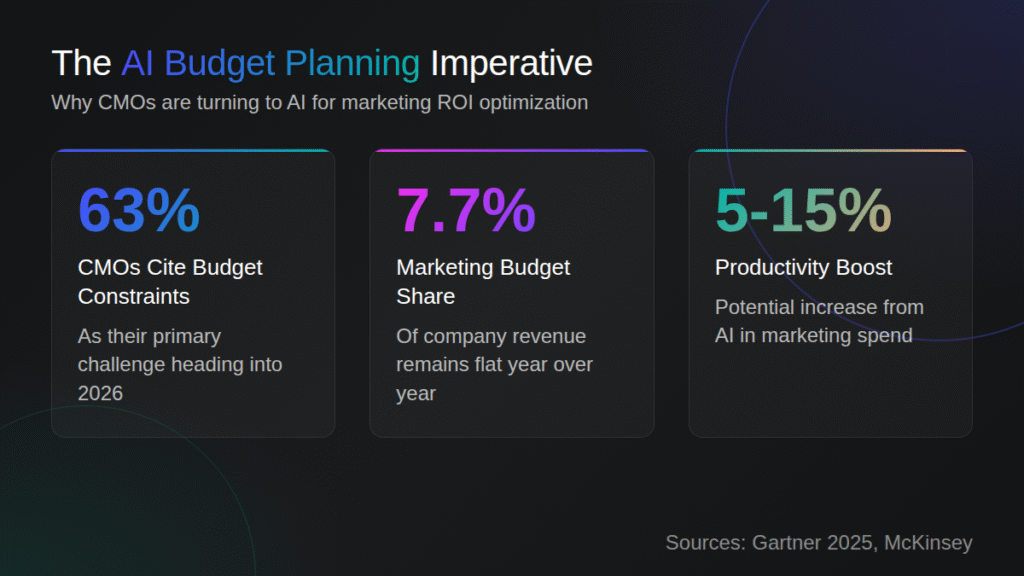
- Marketing budgets remain flat while pressure to prove ROI intensifies. With 63% of CMOs citing budget constraints as their top challenge, AI-driven marketing planning helps teams demonstrate measurable value and secure continued investment.
- Agentic AI moves beyond analysis to autonomous execution. Unlike traditional tools that generate recommendations for humans to act on, agentic systems can model scenarios, reallocate spend, and optimize campaigns without constant oversight.
- Breaking down data silos is the foundation of effective AI planning. AI can only deliver accurate forecasts when it has access to unified data across marketing, sales, finance, and customer touchpoints.
- Continuous, real-time budget optimization outperforms annual planning cycles. Organizations using AI for dynamic budget reallocation capture opportunities faster and reduce wasted spend on underperforming channels.
To maximize marketing ROI in 2026, invest in platforms that unify your data, automate scenario planning, and empower your team to focus on strategy rather than spreadsheets.
Marketers know the annual budget cycle all too well: weeks of gathering data from disconnected systems, debating allocations based on incomplete insights, and presenting forecasts to leadership that rely more on intuition than evidence. With finance teams demanding greater accountability and marketing budgets remaining flat at 7.7% of company revenue, the pressure to prove ROI is immense.
AI in marketing planning offers a way forward. By automating data aggregation, uncovering hidden performance patterns, and enabling sophisticated scenario modeling, AI transforms budgeting from a tedious annual exercise into a dynamic, continuously optimized process. And with agentic AI systems that can act autonomously on planning decisions, marketing teams are gaining capabilities that were unimaginable just a few years ago.
This guide explores how to effectively leverage budgeting with AI, from building the right data foundation to running predictive scenarios that give your CFO confidence in every dollar you request.
Why Is AI in Marketing Planning Essential for 2026?
Marketing has always been accountable for results, but the scrutiny has intensified. A Gartner survey of senior marketing leaders found that 63% of CMOs identify budget and resource constraints as their primary challenge, while half report that short-term demands impede their ability to execute long-term strategy. The cycle continues as limited budgets force tactical thinking, which produces short-term results, reinforcing demands for immediate ROI proof.
Traditional planning methods can’t keep pace with these pressures. Spreadsheets and manual analysis were designed for campaigns running on quarterly cycles and performance data arriving in monthly reports. Customer behavior quickly shifts across channels, competitive threats emerge overnight, and market conditions change faster than annual budget reviews can accommodate.
AI-driven marketing planning addresses these challenges by processing more data than human analysts can manage, identifying patterns across campaigns and customer segments, and generating forecasts grounded in statistical models rather than gut instinct. Organizations that have embraced AI for content operations and workflow automation report notable productivity gains, and those same capabilities extend to financial planning and budget optimization.
The Shift from Assistive AI to Agentic AI
Until recently, most AI tools in marketing functioned as assistants. They analyzed data when prompted, generated recommendations for human review, and required manual intervention to implement changes. This model delivered value, but it also created bottlenecks. Every insight required someone to evaluate, approve, and act on it.
Agentic AI operates autonomously within defined parameters, making decisions and taking actions to achieve specified goals without constant human oversight. In the context of marketing planning, an agentic system continuously monitors campaign performance, identifies underperforming channels, reallocates budget to higher-performing initiatives, and adjusts forecasts based on emerging trends. Humans set objectives and guardrails; the AI handles execution.
This distinction matters for budget optimization because the velocity of modern marketing exceeds human capacity for continuous monitoring and adjustment. An agentic approach enables real-time optimization at scale, capturing opportunities that would otherwise be missed during traditional review cycles.
How Does AI Transform the Budget Planning Process?
Effective AI-driven budget planning builds on several interconnected capabilities. Each element reinforces the others, creating a system that improves over time as it accumulates data and refines its models.
Building a Unified Data Foundation
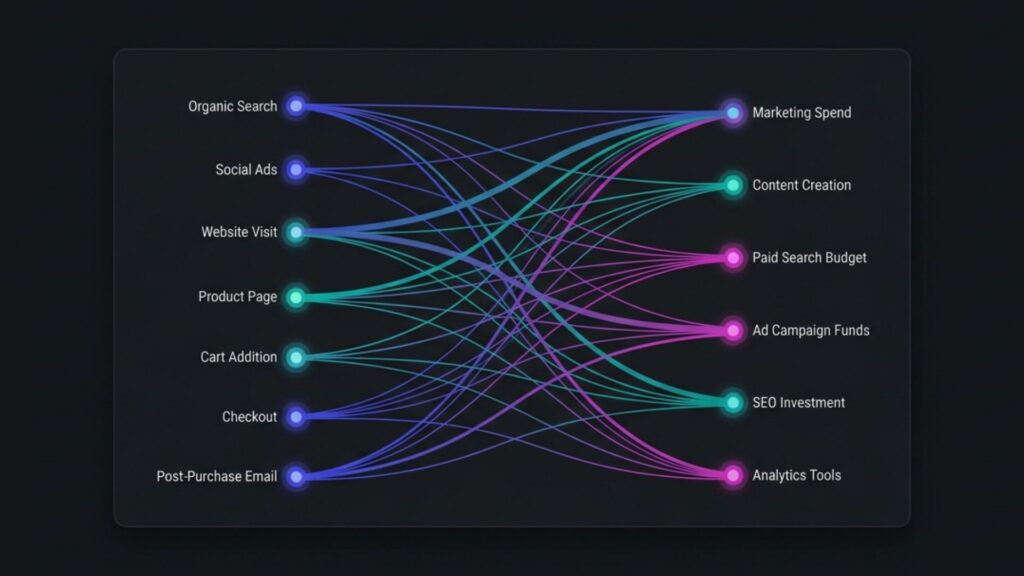
AI can only be as effective as the data it accesses. When marketing data lives in silos across campaign platforms, CRM systems, finance applications, and agency dashboards, any analysis will be incomplete and potentially misleading. Building a unified data foundation is the essential first step toward AI-powered planning.
Marketing teams must integrate data from every touchpoint in the customer journey: website analytics, social engagement, email performance, advertising platforms, sales interactions, and customer service records. Marketing data should connect to financial systems so that spend can be tracked against outcomes and forecasts can be validated against actual results.
Organizations that have implemented content intelligence platforms understand this principle well. When all content assets live in a central repository with rich metadata, AI can analyze performance patterns, recommend optimizations, and predict which assets will drive engagement. The same logic applies to financial and operational data: centralization enables intelligence.
Analyzing Past Performance with Precision
Knowing which campaigns delivered results against last year’s budget is critical for planning the next cycle. But “knowing” in the traditional sense often meant reviewing summary reports, remembering anecdotes from team meetings, and making educated guesses about what worked and why.
AI changes this equation by analyzing granular performance data across every campaign, channel, and audience segment. It can identify which creative variations drove conversions, which customer cohorts responded to different messages, and which timing strategies produced the best engagement. These insights form the basis for replicable success patterns and highlight mistakes worth avoiding.
More importantly, AI can surface non-obvious correlations that human analysts would miss. Perhaps campaigns launched on certain days consistently outperform others, or specific messaging themes resonate with high-value customer segments. These hidden patterns offer invaluable direction for budget allocation.
What Capabilities Should You Expect from AI Budget Tools?
Modern AI planning tools offer a range of capabilities that directly support budget optimization. Understanding what to expect helps organizations evaluate solutions and set realistic goals.
Predictive Scenario Modeling
One of the most powerful applications of AI in marketing planning is the ability to run “what if” scenarios at scale. Rather than building a single budget proposal and defending it, marketers can model dozens of allocation scenarios, compare projected outcomes, and present leadership with data-driven options.
Scenario modeling with AI incorporates historical performance, market trends, competitive dynamics, seasonality, customer behavior patterns, and economic indicators. The AI can adjust these variables independently or in combination, revealing how changes in one area affect overall performance.
The CFO conversation becomes something different. Instead of presenting a budget request backed by intuition, marketing leaders can show projected ROI under different scenarios, explain the assumptions behind each model, and demonstrate the analytical rigor supporting their recommendations.
Real-Time Performance Monitoring
Static budgets assume the future will resemble the plan. Reality rarely cooperates. Campaigns underperform expectations, new opportunities emerge, competitors launch disruptive initiatives, and customer preferences shift without warning.
AI enables continuous monitoring against expectations, flagging deviations as they occur and recommending adjustments. When a channel underperforms, the system can suggest reallocating spend to alternatives. When a campaign exceeds targets, it can identify opportunities to scale successful approaches.
This real-time capability offers a path to dynamic, ongoing optimization. Organizations that embrace this model report faster campaign adjustments and improved overall ROI.
5 Steps to Optimize AI for Marketing Budget Planning
Implementing AI-driven budget planning requires a structured approach. The following steps outline a path from foundation-building to autonomous optimization.
- Audit and unify your data sources. Identify every system that holds marketing, sales, and financial data. Map data flows and integration points. Prioritize connecting systems that contain high-value performance and spend data.
- Establish clear performance metrics. Define which outcomes matter most for your organization: revenue attribution, customer acquisition cost, lifetime value, pipeline contribution, brand awareness, or other KPIs. AI needs clear targets to optimize against.
- Start with descriptive analytics before moving to predictive. Ensure your AI tools can accurately report what happened before trusting them to forecast what will happen. Validate historical analysis against known results.
- Run scenario models for upcoming budget cycles. Use AI to generate multiple allocation scenarios and compare projected outcomes. Present options to leadership rather than single proposals.
- Implement continuous monitoring and adjustment. Move from annual budget reviews to quarterly, monthly, or even real-time optimization cycles. Establish guardrails that define acceptable variance ranges and trigger alerts when performance deviates.
How Does Customer Behavior Analysis Support Budget Decisions?
Effective budgeting with AI incorporates a deep understanding of customer behavior. AI systems can analyze vast quantities of customer interaction data to reveal preferences, predict future actions, and identify opportunities for marketing investment.
Customer behavior analysis powered by AI examines patterns across the entire journey: which content engages prospects, which messages drive conversions, which touchpoints influence purchasing decisions, and which factors contribute to loyalty and retention. This analysis informs budget allocation by highlighting where investment will generate the greatest return.
For example, AI might reveal that customers who engage with educational content early in their journey convert at higher rates than those who receive promotional messages first. This insight would support shifting the budget toward content development and away from direct response advertising for certain audience segments.
Organizations using AI agents for content personalization already leverage these capabilities. The same behavioral intelligence that powers personalization can inform strategic budget decisions by revealing which investments drive meaningful customer outcomes.
What Role Do AI Agents Play in Budget Optimization?
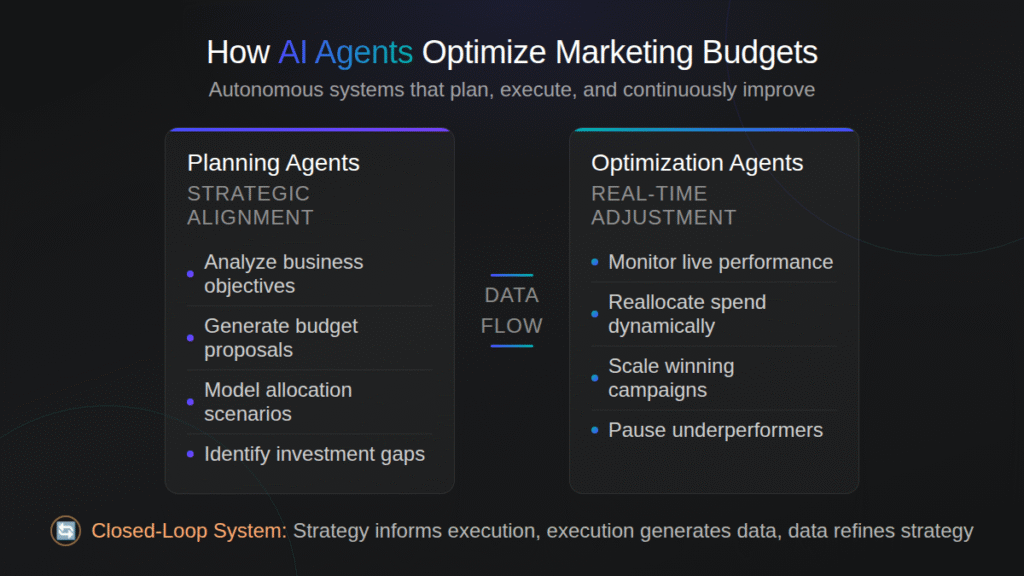
Agentic AI introduces new possibilities for autonomous budget management. Rather than simply analyzing data and generating recommendations, AI agents can execute multi-step planning processes, make allocation decisions within defined parameters, and continuously optimize without waiting for human intervention.
Planning Agents for Strategic Alignment
Planning Agents analyze business objectives, market conditions, and historical performance to generate recommendations. They can create budget proposals aligned to corporate goals, break down allocations by channel, campaign type, and audience segment, and identify gaps between planned investments and expected outcomes.
Optimization Agents for Real-Time Adjustment
Optimization Agents monitor live campaign performance and make automatic adjustments to improve results. They can shift spend between channels, pause underperforming initiatives, and scale successful campaigns based on predefined rules and performance thresholds.
The combination of planning and optimization agents creates a closed-loop system where strategy informs execution, execution generates data, and data refines strategy. This agentic approach to marketing is the future of budget management: intelligent systems that learn continuously and improve automatically.
Maximizing Marketing ROI with AI: Continuous Optimization in Action
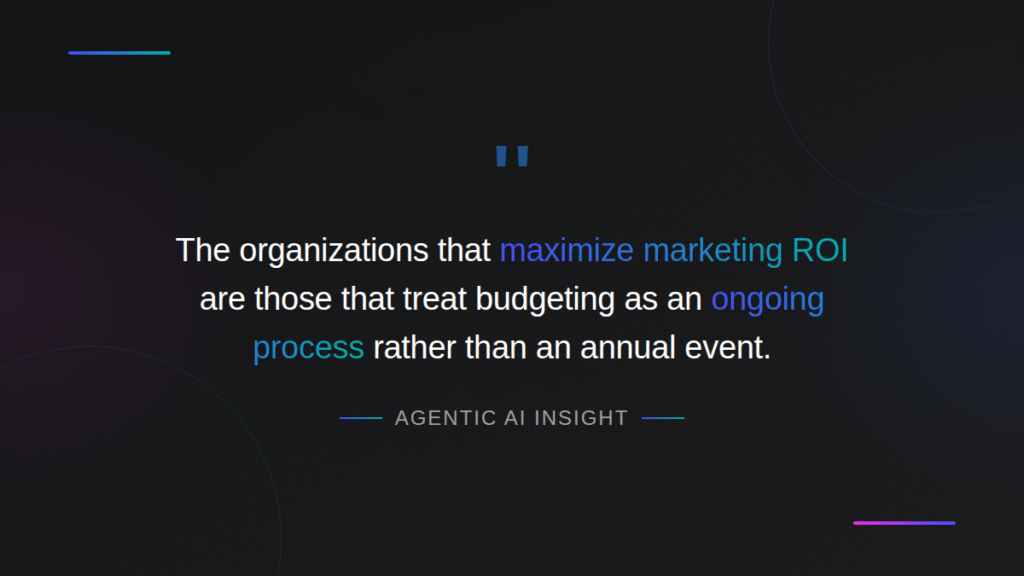
No matter how sophisticated the planning process, campaigns won’t always perform as expected. Maximizing marketing ROI requires treating budgeting as an ongoing process rather than an annual event.
AI empowers this continuous optimization by analyzing real-time data, measuring actual performance against projections, identifying emerging patterns, and recommending adjustments. When a campaign underperforms, AI can diagnose the issue, suggest modifications, and automatically implement changes within approved guardrails.
This agility gives marketing teams confidence to experiment, knowing they can detect problems quickly and redirect resources before significant budget is wasted. It also provides finance leaders with transparency into how marketing dollars are being deployed and the results they generate.
McKinsey estimates that AI can boost marketing productivity by 5–15% of total marketing spend through improved efficiency and effectiveness. For organizations under pressure to prove ROI with flat or declining budgets, these gains can make the difference between strategic retreat and competitive advantage.
FAQs
How does AI improve marketing budget accuracy? AI improves accuracy by analyzing larger datasets than humans can process, identifying patterns across campaigns and customer segments, and generating forecasts based on statistical models rather than intuition. It also enables scenario modeling that reveals how different allocation decisions might affect outcomes.
What data do I need to implement AI-driven budget planning? Effective AI planning requires unified data from marketing platforms, CRM systems, financial applications, and customer touchpoints. The more comprehensive and integrated your data, the more accurate your AI analysis will be.
Can AI completely automate budget decisions? Agentic AI can automate many budget optimization tasks within defined parameters, but human oversight remains essential for strategic direction, guardrail setting, and complex judgment calls. The most effective approach combines AI execution with human strategy.
How quickly can organizations see ROI from AI budget tools? Organizations with mature data infrastructure can see productivity gains within weeks of implementation. Full value realization typically requires 3–6 months as AI systems accumulate data and refine their models.
Transform Your Planning Process with Agentic AI
The days of defending marketing budgets with intuition and anecdotes are ending. Finance leaders expect data-driven proposals backed by sophisticated analysis. Customers expect personalized experiences that require precise resource allocation. And competitive pressures demand agility that annual planning cycles can’t deliver.
AI in marketing planning offers the capabilities to meet these challenges: unified data foundations that enable accurate analysis, predictive scenario modeling that supports confident decision-making, and continuous optimization that maximizes ROI throughout the budget cycle. Agentic AI takes these capabilities further, enabling autonomous execution that frees marketing teams to focus on strategy and creativity.
Aprimo’s Agentic DAM and content operations platform provides the integrated foundation marketers need to leverage AI across planning, creation, and delivery. By connecting financial planning to content performance and workflow automation, we enable organizations to move from reactive budgeting to proactive optimization. Get a demo of Aprimo and discover what’s possible.