

Governing your web content requires a set of rules, review cycles, approval standards, and monitoring that can keep every page accurate, on-brand, and compliant. It works when each page has a named owner, a review date, and an approved source for every image, claim, and disclaimer it contains.
Most enterprise websites have grown faster than their governance. Pages are built by central marketing, regional teams, agencies, and product owners, often inside a content management system that makes publishing easy and review optional. Over time, an old logo survives a rebrand, a promotion runs past its end date, and a claim remains live long after its expiration date. Nobody decided to let this happen. The site simply has no system for noticing.
Forrester’s February 2026 analysis, Machines Are Your Content’s New Audience, makes the same point about AI. It warns that generated content “exacerbates the potential for misinformation, brand inconsistency, privacy breaches, and compliance failures.” McKinsey reached a similar conclusion in its research on marketing operations: modern marketing operations depends on “the thoughtful, deliberate development of new processes, coordination, and governance.” For organizations that sell into the European Union, the stakes are also legal. The European Accessibility Act has applied since June 28, 2025, extending accessibility requirements to many consumer-facing websites and digital services.
TL;DR
- Website governance fails at ownership before it fails at tooling. Every page needs a named owner and a review date.
- Start with a complete page inventory, then rank pages by risk, such as pricing, regulated claims, legal pages, and campaign landing pages.
- Pair written standards with automated checks against approved assets and expiry dates, rather than relying on periodic manual audits.
- Aprimo Content Portfolio Management (CPM) can enforce these standards across the live site without requiring you to migrate content.
Why website governance is a different problem from DAM governance
A digital asset management (DAM) system governs assets while they are stored and approved inside it. A website is where those assets go live, and it is also where copy, offers, images, and legal text change constantly. A DAM can tell you that a product image is approved. It cannot, on its own, tell you that the same image is still live on a regional product page six months after it was recalled.
Our article on the ultimate guide to content governance covers the broader policy framework. The website adds three pressures: publishing is decentralized, changes are frequent, and the audience sees the output directly, with no review step in between. Content governance risk grows with each of those pressures.
The four failure points
Most website governance problems fall into four patterns.
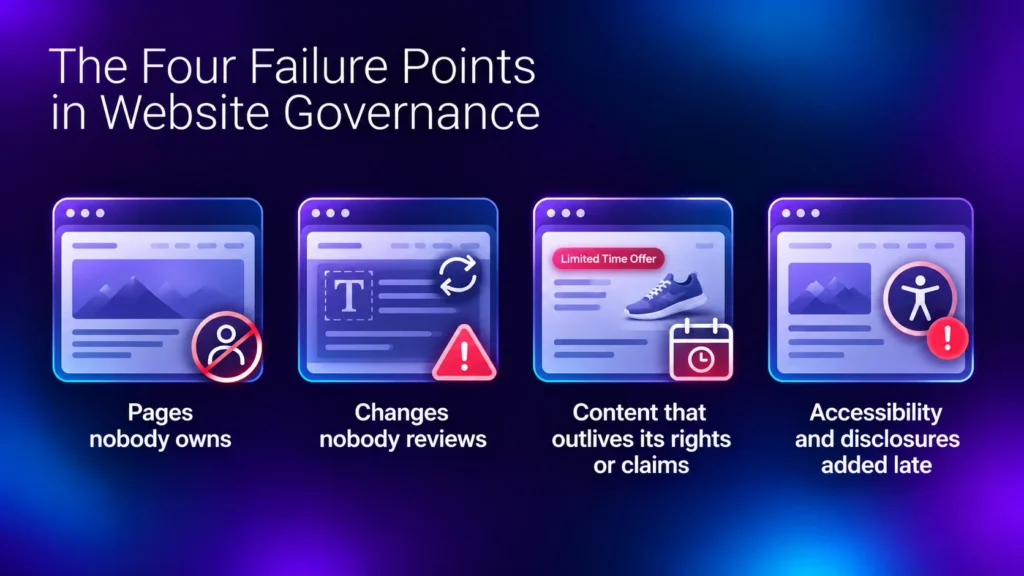
Pages nobody owns
Orphaned pages are the most common source of risk. A campaign microsite launched two years ago, a product page for a discontinued line, or a regional landing page built by an agency that is no longer engaged will often remain live without an owner. When an issue is discovered, no one is responsible for fixing it.
Changes nobody reviews
Editors in a CMS can often publish changes instantly. Without a defined approval path, a headline change, a new price, or a claim can go live without checks for brand, legal, or accessibility requirements. The review step may exist on paper but not in the workflow.
Content that outlives its rights or claims
An image licensed for one campaign, a testimonial with an expired release, or a statistic that has since been superseded can all remain on a page long after they should have been removed. Rights and claims rarely have expiry dates attached to the page where they appear, so nothing triggers a review.
Accessibility and disclosures added late
Accessibility fixes and required disclosures are often handled as one-off projects instead of standards that apply to all pages. As regulations cover more digital content, this approach becomes harder to defend.
Helen of Troy, a multi-brand business, recently shared that automated compliance agents are changing how the team flags accessibility and ADA compliance risks across its content ecosystem, letting it govern compliance “at the scale and speed our business demands across all our brands.”
Five components of a website governance model
A workable model has five parts. None of them require new technology to start, although tools make each one easier to sustain.

1. A complete page inventory
You cannot govern pages you have not counted. Start with a crawl of the live site, plus a list of pages held in the CMS, including drafts, archived sections, and microsites. Record the URL, the owner, the last reviewed date, and the content type. Many organizations find that the inventory is two to three times larger than they expected.
2. Clear ownership
Each page needs three roles: an owner who is accountable for accuracy, an approver who signs off on changes, and a governor who sets the standards that apply. In a large organization, the governor is usually central brand or marketing operations. The owner is often a product or regional lead. Assigning all three roles to a named person or team removes the most common excuse for stale content.
3. Standards that cover more than brand
Brand guidelines are necessary but insufficient. A website standard should also cover claims substantiation, legal disclaimers, image or video rights, accessibility requirements, and metadata. Keep the standard short enough that editors will read it. A one-page checklist for each page type works better than a 60-page policy document.
4. Risk-tiered review cycles
Not every page needs the same review frequency. Pages with pricing, regulated claims, legal terms or time-limited offers should be reviewed monthly or on every change. Evergreen informational pages can be reviewed annually. Tie each review cycle to a risk tier, and make expiry dates a required field for campaign pages.
5. Monitoring and reporting
Governance only works if someone sees the exceptions. Track the number of pages overdue for review, the number of assets live on the site that are no longer approved, and the time it takes to fix a flagged issue. Report these metrics to the owners and governors every month.
For more details on how version history supports this reporting, read Mastering Content Version Control and Reporting for Modern Marketing.
AI exacerbates the need for website governance
I has introduced new challenges for website governance. Generative tools make it faster to create new pages, variants, and localized copy, which multiplies the number of pages that need governance. Personalization engines serve different content to different visitors, so a single page may have many live versions.
AI search has also raised the stakes. Answer engines increasingly summarize and cite website pages when buyers ask questions. A stale or inaccurate page can become the answer a buyer sees, even when the organization has already moved on. Governance therefore supports discoverability as well as compliance.

How CPM supports website governance
Most governance programs stop at the edge of the DAM. Aprimo Content Portfolio Management extends governance to the rest of the content estate, including the live website. Its discovery layer, called Mesh, scans content sources, including websites, and maps each asset to its source location. CPM then compares what is live against the approved versions in your DAM, which serves as the reference point for approved content.
Three Aprimo agent types handle the checks. Librarian agents enrich discovered content with metadata so it can be searched. Critic agents flag quality issues. Compliance agents identify brand and legal violations on live content. The portfolio risk dashboard ranks findings by region, brand, and severity, so owners can fix the highest-risk issues first. Because CPM governs content where it lives, teams do not need to move pages or assets into a new repository. Read more about CPM here.

Use CPM as the enforcement layer, not the governance model itself. Ownership, standards, and review cycles still need to be decided by people. CPM makes it possible to check them continuously.
FAQ
What is website content governance?
Website content governance is the set of rules and processes that keep pages accurate, compliant, and on-brand. It covers page ownership, approval workflows, review cycles, and monitoring of live content.
How is website governance different from DAM governance?
DAM governance controls assets stored and approved inside the DAM. Website governance controls how those assets and copy appear on live pages. Govern both together.
Who should own website content governance?
Brand or marketing operations usually sets the standards. Each page needs an owner, typically a product or regional lead, who is accountable for accuracy. An approver signs off on changes.
How often should website pages be reviewed?
Review frequency should match risk. Pages with pricing, regulated claims, or time-limited offers should be reviewed monthly or on every change. Evergreen pages can be reviewed annually.
Can CPM govern a website without a migration?
Yes. CPM discovers website content where it lives and checks it against approved DAM assets, without moving pages or files. Teams can start with one site section.