

A regional microsite still displays a logo that the brand retired two years ago. A product page carries a claim that legal withdrew last spring. A campaign landing page, built by an agency that no longer holds the contract, keeps running with image licenses that lapsed in January. None of these pages sit in a content repository, so none of them trigger an alert.
This pattern is common in organizations with more than a few web properties. Brand teams publish guidelines, legal teams publish rules, and the DAM holds the approved assets. The gap sits between those approved versions and what is actually live. Most organizations learn about a violation from a customer, a regulator, or a competitor, which is the most expensive way to find one.
Closing that gap requires a different kind of audit from the ones most teams run today. This guide explains what a web content audit must detect, how to run one in sequence, which approaches work at which scope, and how to rank the results so that the right problems get fixed first.
TL;DR
- The most reliable way to find expired, off-brand, or non-compliant content on web properties is to compare what is live against an approved source of truth, then check each match against brand and compliance rules.
- Manual sampling reviews a small share of live pages, and standard site crawlers detect technical errors rather than brand violations.
- An effective audit discovers every asset on every owned property, relates each one to an approved version, runs automated policy checks, and ranks findings by risk.
- Running that cycle continuously shortens the time a violation stays live.
Why Do Manual Content Audits Miss So Much Live Content?
Manual audits miss content because the volume, the number of owners, and the speed of change all exceed what a reviewer can inspect. A team can sample a few hundred pages per quarter, but a large organization may publish thousands of assets a month across dozens of sites.
Three structural problems explain the misses. First, ownership is scattered. Regional teams, agencies, product groups, and partners publish to separate properties with separate credentials, so no one person can see everything. Second, a manual audit captures a single moment. A page that passes review in March can drift by June when someone edits a banner or swaps an image. Third, reviewers check what they know to look for. A subtle issue such as a slightly altered logo or a low-contrast text overlay passes human review often, because the reviewer is checking for larger problems.
The result is a coverage problem, not an effort problem. Adding reviewers raises the sample size but does not change the sampling model. A continuous method that inspects every discoverable asset removes the sampling limit, which is why the audit design matters more than the headcount behind it.
What Does a Complete Web Content Audit Need to Detect?
A complete web content audit detects four categories of risk: expired content, off-brand content, non-compliant content, and unmanaged content. Each category needs a different comparison, so one scan type cannot cover all four.
Definition: A web content audit for brand compliance is a systematic comparison of live web assets against approved versions, brand standards, or regulatory rules.
Expired content includes campaign pages past their end date, images with lapsed licenses, and claims that a newer approval replaced. Detecting it requires a record of rights and approval status to compare against. Off-brand content includes outdated logos, altered colors, unapproved imagery, and tone violations. Detecting it requires the approved brand assets as a reference. Non-compliant content includes missing alt text, insufficient text contrast, absent disclosures, and unapproved claims. Detecting it requires rules, such as the Web Content Accessibility Guidelines for accessibility checks. Unmanaged content includes assets that exist on the web but have no known owner or approved source.
The fourth category deserves attention because it is the hardest to see. An asset with no approved original cannot be compared to anything, so a conventional audit never flags it. Finding it requires mapping every live asset back to a known source and treating the failures to map as findings.
How Do You Audit Web Content for Brand and Compliance Risk?
An audit for brand and compliance risk follows five steps: inventory the properties, discover the assets, relate each asset to an approved source, apply policy checks, and route the findings to owners. The sequence matters because each step depends on the output of the one before it.
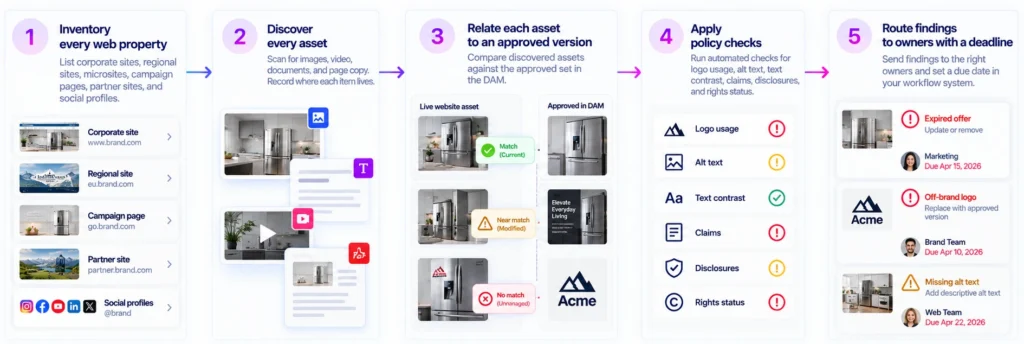
- Inventory every web property. List corporate sites, regional sites, microsites, campaign pages, partner-managed sites, and social profiles. Include the properties no one remembers launching. Agency-built microsites are the usual blind spot.
- Discover every asset on those properties. Scan for images, video, documents, and page copy. Record where each item lives, so a finding points to a specific location.
- Relate each asset to an approved version. Compare discovered assets against the approved set in the DAM. A match confirms the item is current. A near match suggests a modified derivative. No match flags an unmanaged asset.
- Apply policy checks. Run automated checks for logo usage, alt text, text contrast, claims, disclosures, and rights status. Reserve human review for the exceptions the checks flag.
- Route findings to owners with a deadline. A finding without an owner and a due date stays open. Connect the audit output to the workflow system the team already uses.
The relate step separates a governance audit from a technical crawl. Without an approved reference, a scan can say that an image lacks alt text but cannot say that the image is the wrong version of the logo. With the DAM as the reference, the scan can state both.
How Mature Is Your Content Governance?
Benchmark where your content governance program stands today, then see where to focus first.
Which Approach Works Best: Manual Sampling, Site Crawlers, or Automated Governance?
Automated governance works best for brand and compliance audits because it is the only approach that covers every asset against an approved reference. Manual sampling suits small portfolios, and site crawlers suit technical SEO, but neither compares live content to approved versions.
| Approach | Coverage | What it detects | Main limit |
|---|---|---|---|
| Manual sampling | A small share of pages | Anything a reviewer notices | Cannot repeat often, so drift goes unseen |
| Site crawler | All crawlable pages on known domains | Broken links, missing tags, speed issues | Has no approved brand or rights reference |
| Automated governance | All discoverable assets across properties | Mismatches against approved versions, policy violations, expired content | Needs an approved source of truth to compare against |
The comparison shows why the choice depends on the question. If the question is whether a site loads quickly, a crawler answers it. If the question is whether the site shows only approved, current, compliant assets, only a method that holds an approved reference can answer it.
Automated governance also changes the review burden. Reviewers inspect the exceptions the system flags instead of every page. That shift makes continuous coverage affordable, which a manual program cannot achieve at any staffing level.
How Should You Prioritize What the Audit Finds?
Prioritize findings by combining severity, exposure, and time live. An expired license on a high-traffic page outranks a color mismatch on a retired microsite.
A first audit of a large portfolio often returns thousands of findings. Treating all of them equally guarantees that the serious ones wait behind the trivial ones. A workable scoring model weighs four factors:
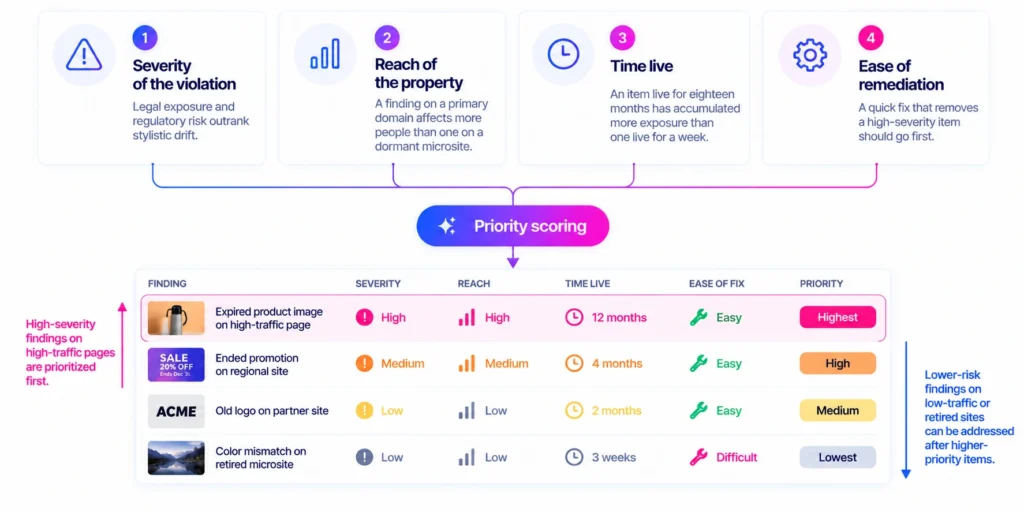
- Severity of the violation. Legal exposure and regulatory risk outrank stylistic drift.
- Reach of the property. A finding on a primary domain affects more people than one on a dormant microsite.
- Time live. An item live for eighteen months has accumulated more exposure than one live for a week.
- Ease of remediation. A quick fix that removes a high-severity item should go first.
Grouping findings by region, brand, and asset type helps leaders see where risk concentrates. A pattern, such as one region producing most of the violations, points to a process problem rather than a series of isolated errors. Fixing the process prevents the next hundred findings.
Where Does Content Portfolio Management Fit in a Web Content Audit?
Content portfolio management software automates the discover, relate, and check steps across web properties as well as other content sources. Aprimo Content Portfolio Management (CPM) is one example of this category.
CPM uses a capability called Mesh to scan websites or other sources, fingerprint each asset, then map it to its source location. Mesh compares discovered assets against approved content in the DAM. Compliance, Critic, and Librarian agents then check the discovered content. A risk dashboard ranks the findings by region, brand, asset type, and severity. The launch announcement describes this flow in detail. Helen of Troy, for example, uses CPM compliance agents to flag accessibility and ADA risks across its brands.
Whatever tool a team selects, three criteria separate a governance audit from a crawl. The tool must discover assets rather than only pages. It must compare them to an approved reference. It must rank findings so that people see the highest risks first. The Content Governance Maturity Assessment offers a way to benchmark how far a current program meets those criteria.
For background on the policy layer behind these checks, the ultimate guide to content governance covers frameworks, roles, and workflows. For the lifecycle side, see content lifecycle management.
Conclusion
Finding expired, off-brand, and non-compliant web content is a comparison problem. The work consists of knowing what is live, knowing what is approved, and measuring the distance between them on a recurring schedule. Teams that treat it as a periodic cleanup project will keep rediscovering the same violations, because the distance reopens every time someone publishes.
The durable fix is to make the approved version the reference for every check, extend the scan beyond the properties the team happens to remember, and rank results so the most serious items reach an owner first. Organizations that build this loop stop learning about violations from outsiders. The open question for most brands is no longer whether they can afford continuous coverage, but how long they can afford the months-long gaps that sampling leaves open.
FAQ
How often should a web content audit run?
Continuous or at least weekly scanning suits large portfolios, because content changes daily. A quarterly manual audit only captures one moment, so drift between audits goes undetected. Match the cadence to how often the properties change.
Can a standard SEO crawler find off-brand content?
A crawler finds technical issues such as broken links, redirects, and missing metadata. It does not hold an approved set of brand assets, so it cannot tell that an image is a retired logo. Pair a crawler with a governance method for brand checks.
What is the difference between content governance and a content audit?
Content governance defines the policies, roles, and workflows. A content audit measures whether live content follows them. Governance sets the rules, and the audit produces the evidence of compliance or violation.
Do the assets need to be in a DAM for an audit to work?
The audit needs an approved reference, and a DAM is the most common one. Without a DAM, a scan can still check rules such as accessibility, duplicates, and unmanaged assets, but it cannot confirm that an asset matches an approved version.
Who should own the audit results?
Assign each finding to the owner of the property where it appears, with a named escalation path for the brand or compliance lead. A shared dashboard gives leaders the portfolio view, while property owners handle the fixes.
How do you audit sites owned by agencies or partners?
Scan them as external properties and group findings by owner. Contract terms usually define brand standards for partner content, so the results give the evidence needed to start a correction conversation. Legal counsel should confirm enforcement options for a given agreement.
Related reading: governing content outside the DAM, finding expired campaign content, monitoring dealer sites.