
Most teams do not start looking for digital asset management because they want new software. They start because content is getting harder to control, harder to find, and harder to move through the business.
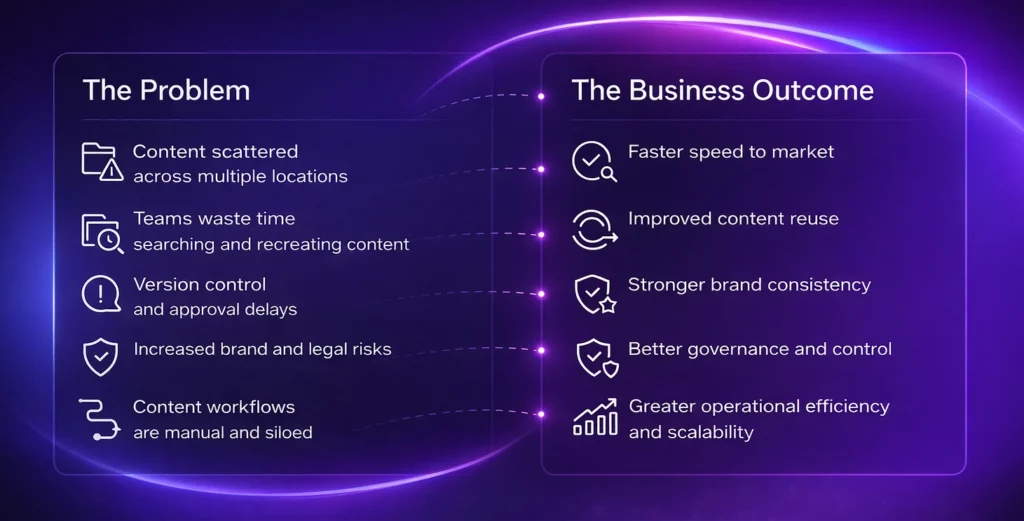
Assets live in too many places. Teams waste time searching for the right version. Duplicate content gets created because no one knows what already exists. Approvals take longer than they should. Brand and legal risk increase when outdated or unapproved assets are used in market. What looks like a content organization problem on the surface is often a much broader business problem underneath.
That is why building a business case for DAM matters. If you want leadership buy-in, the conversation cannot stop at storage or search. The business case needs to show how DAM helps the organization work more efficiently, govern content more effectively, and scale content operations with less friction.
TL;DR
Building a business case for DAM starts with showing that the problem is bigger than disorganized files. It is a business efficiency, governance, and growth issue. When teams cannot find approved assets, duplicate existing content, struggle with version control, or spend too much time on manual workflows, the cost adds up quickly across marketing, creative, operations, and sales.
A strong DAM business case connects those day-to-day pain points to measurable business outcomes. That includes faster speed to market, improved content reuse, stronger brand consistency, better governance, lower operational waste, and a more scalable foundation for growth. The most effective business cases also show how DAM supports long-term content operations, not just short-term file management.
Why companies invest in DAM
Organizations invest in DAM when content volume, team complexity, and operational demands outgrow manual ways of working. What may have worked for a smaller team or simpler environment often breaks down as more assets, users, channels, and approval steps are added.
At that point, the problem is not just where files are stored. The real issue is how content moves through the business. Teams need a way to centralize approved assets, improve discoverability, support reuse, manage permissions, and reduce the operational drag that comes from disconnected systems and inconsistent processes.
DAM becomes valuable because it helps solve those issues in a structured way. It gives teams a central source of truth for digital assets while also supporting better governance, stronger collaboration, and more efficient execution across the content lifecycle.
The common business problems a DAM business case should highlight
A strong business case starts by making the current problems visible. Most organizations already feel the pain of poor asset management, but the challenge is turning that pain into language leadership recognizes as business impact.
One common issue is time waste. Creative, marketing, and sales teams often spend far too much time searching for files, confirming whether assets are approved, or recreating content that already exists. Those inefficiencies are easy to normalize, but across teams and months, they represent a major operational cost.
Another issue is poor content reuse. Without a central system and clear metadata, valuable assets are often underused or lost entirely. Teams create net-new content when existing content could have been adapted or reused, increasing production costs and slowing time to market.
Governance is another major factor. When teams cannot easily control access, versions, rights, and approvals, the risk of off-brand or noncompliant content increases. That risk becomes even more significant for enterprises operating across multiple brands, business units, or regulated environments.
There is also a scalability issue. As organizations grow, content operations become more complex. More teams need access. More stakeholders are involved in review and approval. More content needs to be managed across more channels. A DAM business case should make it clear that without the right operational foundation, growth creates friction instead of efficiency.
How to build a business case for DAM
Start with the current-state pain
Begin by documenting the problems your teams are experiencing today. Focus on issues that show up repeatedly across departments, such as time spent searching for assets, content duplication, inconsistent brand usage, approval delays, limited visibility into asset status, and difficulty managing permissions or usage rights.
This step matters because a strong business case is rooted in operational reality. The goal is to show that DAM is not a nice-to-have improvement. It is a solution to real inefficiencies that affect productivity, execution, and risk.
Quantify the cost of inefficiency
Once the pain points are clear, connect them to measurable impact. Estimate how much time teams spend searching for assets, recreating existing work, managing manual approvals, or resolving version confusion. Look at how often content is duplicated, how long campaign launches are delayed, or how much effort is spent answering asset-related requests.
Even directional numbers can be powerful. Leadership responds when inefficiency is translated into time, cost, and business impact rather than described only as frustration.
Tie DAM to strategic business outcomes
The strongest DAM business cases are not framed around features alone. They connect the solution to goals leadership already cares about. That may include faster speed to market, stronger brand consistency, better compliance, improved content reuse, reduced operational waste, or greater scalability across teams and regions.
This is where the case becomes more strategic. DAM is not just about better organization. It is about helping the business move faster, reduce risk, and get more value from its content investments.
Show cross-functional value
DAM is rarely a single-team solution. Marketing needs faster access to approved campaign assets. Creative needs better visibility, version control, and reuse. Brand teams need consistency. Sales needs easy access to current content. Legal and compliance teams need stronger governance. Operations needs more efficient workflows.
A good business case shows that the value of DAM is multiplied when it supports multiple functions across the organization. This also helps strengthen internal alignment and broaden executive support.
Build the case for scale
It is important to show not only what DAM solves today, but what it enables tomorrow. As the business grows, content demands usually grow with it. More channels, more markets, more stakeholders, and more assets all put pressure on manual systems.
DAM creates a stronger operational foundation for that future state. A business case should explain how the platform helps the organization scale content without scaling chaos.
The core benefits to include in a DAM business case
Faster content discovery
Teams can find approved assets faster, which reduces wasted time and improves productivity across marketing, creative, and downstream users.
Better content reuse
A centralized, searchable asset library helps teams reuse and repurpose existing content instead of recreating it, reducing production costs and speeding execution.
Stronger brand consistency
DAM helps teams work from approved, up-to-date assets, which supports more consistent brand experiences across channels and regions.
Improved governance and control
Permissions, approvals, versioning, and asset visibility help reduce risk and support better control over how content is used.
Greater operational efficiency
By reducing manual search, duplicate work, and workflow friction, DAM helps teams spend less time managing content and more time using it effectively.
Better scalability
DAM gives organizations a structure for managing growing content volumes, more users, and more complex content operations over time.
What stakeholders want to hear
Different stakeholders care about different outcomes, so the business case should reflect that.
Executive leadership wants to understand cost, efficiency, risk reduction, and scalability. Marketing leaders care about speed to market, campaign execution, and content reuse. Creative teams care about findability, version control, and reducing repetitive work. Brand and compliance stakeholders care about governance and consistency. IT and operations teams care about system structure, user control, and long-term manageability.
The more clearly you connect DAM value to each stakeholder group’s priorities, the stronger the case becomes.
How to make the business case more persuasive
A persuasive business case combines qualitative pain with quantitative impact. It includes real examples from teams, estimated time or cost savings, and a clear picture of what improves when DAM is in place.
It also helps to show the cost of doing nothing. If the business continues managing assets through disconnected folders, shared drives, email, or ad hoc systems, inefficiencies and risks usually increase as content demands grow. In many organizations, the status quo is more expensive than it appears.
Finally, keep the recommendation practical. The best business case is not overly technical or overloaded with platform language. It should clearly explain the problem, the business impact, the desired future state, and why DAM is the right investment to close the gap.
Conclusion
If you want approval for DAM, the business case needs to go beyond storage and search. It should show how poor asset management creates real costs across productivity, governance, content reuse, brand consistency, and scalability.
The strongest business case for DAM makes one point clear: this is not just a content management issue. It is an operational and business performance issue. When teams can find, govern, reuse, and activate content more effectively, the organization works faster, reduces risk, and gets more value from every asset it creates.
That is what turns DAM from a software purchase into a strategic investment.
FAQ
How do you build a business case for DAM?
You build a business case for DAM by identifying current content management problems, quantifying inefficiencies, and connecting DAM to business outcomes such as faster speed to market, improved content reuse, stronger governance, and better operational scalability.
What should a DAM business case include?
A DAM business case should include current pain points, the cost of inefficiency, business risks, expected operational improvements, strategic outcomes, and the value DAM will provide across teams such as marketing, creative, operations, sales, and compliance.
Why do companies invest in digital asset management?
Companies invest in digital asset management to centralize assets, improve discoverability, increase content reuse, strengthen governance, reduce wasted time, and support content operations as the business grows.
How do you justify DAM to leadership?
To justify DAM to leadership, focus on measurable business impact. Show how inefficient asset management affects time, cost, risk, execution speed, and scalability, then explain how DAM helps solve those problems in a structured and sustainable way.
What are the business benefits of DAM?
The business benefits of DAM include faster asset discovery, stronger content reuse, improved brand consistency, better governance, reduced operational waste, and a more scalable foundation for managing content across the enterprise.
When does a company need a DAM platform?
A company typically needs a DAM platform when content is spread across multiple systems, teams struggle to find approved assets, duplicate work becomes common, approvals are inefficient, and governance becomes harder to maintain at scale.