If you can’t see where your content is in the journey or how it’s performing, you can’t improve it.

The Dawn of Intelligent Asset Management
In 2026, Digital Asset Management (DAM) is shifting from a static repository to an intelligent layer powering the entire content ecosystem. Modern DAM platforms don’t just store assets; they orchestrate creation, personalization, governance, and delivery at scale.
Fueled by AI, modular content architectures, and composable martech, content operations are moving from automated to truly autonomous. DAM is becoming a decisioning system, a compliance guardian, a personalization engine, and a performance hub.
The winners in this new era will be those who move fastest, from content chaos to content intelligence.
We’re entering an era where content operations aren’t just automated—they’re autonomous, adaptive, and accountable to business outcomes.
These trends are not hypothetical. They are already materializing inside organizations that treat content as an enterprise asset and DAM as a core operating system for digital execution.
Aprimo is proud to help shape this evolution. With intelligent asset management at its core, Aprimo continues to lead the market in enabling content-rich organizations to move faster, govern smarter, and scale personalization with confidence.
The future of DAM runs on intelligence.
TABLE OF CONTENTS
TREND 1
The next generation of Digital Asset Management is being shaped by autonomous, domain-specific AI agents. These agents don’t just accelerate tasks; they make decisions, evaluate risk, and interpret business context across the full content journey, operating automatically, adaptively, and at scale.
In 2026, basic AI features like tagging or search are no longer differentiators. Instead, DAM platforms are evolving into environments where AI agents act like embedded teammates, streamlining operations so human teams can focus on creativity and strategy.
These agents can be deployed on demand, triggered by workflows, or chained together into orchestrated processes that enable true high-velocity content operations.


Planning Agents
Generate content briefs based on past performance and brand parameters.

Librarian Agents
Classify and enrich assets using brand-trained vocabularies and dynamic metadata.

Compliance Agents
Flag legal or brand violations before content goes to market.

Critic Agents
Assess tone, readability, and alignment to guidelines.

Production Agents
Handle transformation, variant creation, localization, and more.

Orchestration Agents
Coordinate projects, tasks, content delivery, personalization, and routing across systems.
Over 70% of enterprise DAM buyers will require agent orchestration frameworks as a core capability.
Intelligent agents to drive a 50% reduction in content cycle time.
Organizations to deploy custom-trained agents that reflect their unique voice, risk posture, and governance models.
TREND 2
Content performance used to be measured after the fact. In 2026, it’s built in from the start.
DAM platforms are evolving into systems that provide predictive insights about content effectiveness before assets are even deployed. This capability is helping organizations move from reactive reporting to proactive content strategy.
As modular content, AI-driven personalization, and omnichannel delivery models scale, teams can’t afford to guess what will work. They need intelligence woven into the planning process.
If DAM was once a storage layer, it is now becoming a strategic analytics layer, translating content activity into business action.
We’re seeing the adoption of predictive features that help guide creative investment and decision-making.

Content scoring models that assess reuse potential, freshness, and optimization need
Integration with CDPs and analytics platforms to close the loop between asset usage and customer behavior
Asset-level insights that flag which formats, messages, or themes drive the strongest results
Dashboards that surface content gaps or saturation points across regions, personas, or stages of the buyer journey
Content ROI dashboards become standard in all enterprise DAM evaluations.
Predictive scoring embedded in campaign planning.
Lifecycle health metrics influence how teams allocate content budgets.
TREND 3
With personalization now essential, brands face pressure to produce more content, faster and in more variations than ever before. The only scalable path forward is modular content.
Modular content breaks assets into structured, reusable components such as copy blocks, visuals, CTAs, compliance elements, and claims. It uses AI to dynamically assemble variants for specific audiences, channels, or moments. It’s not just a production method; it’s a personalization strategy.
These capabilities are increasingly being built into workflows, connected to planning tools, and surfaced in downstream channels through integrations with CMS and personalization platforms.

Controlled self-service editing and localization
Image and text transformations based on brand, audience, or placement
Dynamic variant creation for web, email, social, and commerce
Rules-based personalization engines that adapt content at the point of delivery
80% of enterprise content operations adopt modular content frameworks.
Over 50% of content variants generated using AI.
Dynamic delivery models replacing static campaign builds in high-performing teams.
TREND 4
Traditional search can’t keep up with modern content ecosystems. As asset libraries scale and campaigns get more complex, teams need search that understands context, not just keywords.
In 2026, semantic and AI-powered search is a baseline expectation. The new standard is systems that interpret natural language, predict intent, and recommend content before you even know what you’re looking for.
The future of DAM search is not about finding an asset; it’s about discovering the right content for the right moment, with no friction.

Natural language search and intent interpretation
Smart facet generation based on dynamic content structure
Visual similarity search across tone, composition, and branding
Predictive autocomplete and content recommendation
Role- and workflow-aware search experiences
60% of enterprise DAMs support semantic or conversational search.
Search behavior directly influences personalization and content scoring.
Discoverability become a core metric for DAM ROI.
TREND 5
McKinsey expects AI to increase marketing productivity by 5 to 15% of total spend. Marketing’s content supply chain is now AI-augmented, fast-moving, and increasingly decentralized. That speed introduces risk.
In 2026, content governance must extend beyond approvals and into detection, traceability, and policy automation. Content authenticity and compliance must be built into DAM workflows from the ground up.
AI has changed the speed of content creation. Governance is what ensures it doesn’t outrun control.
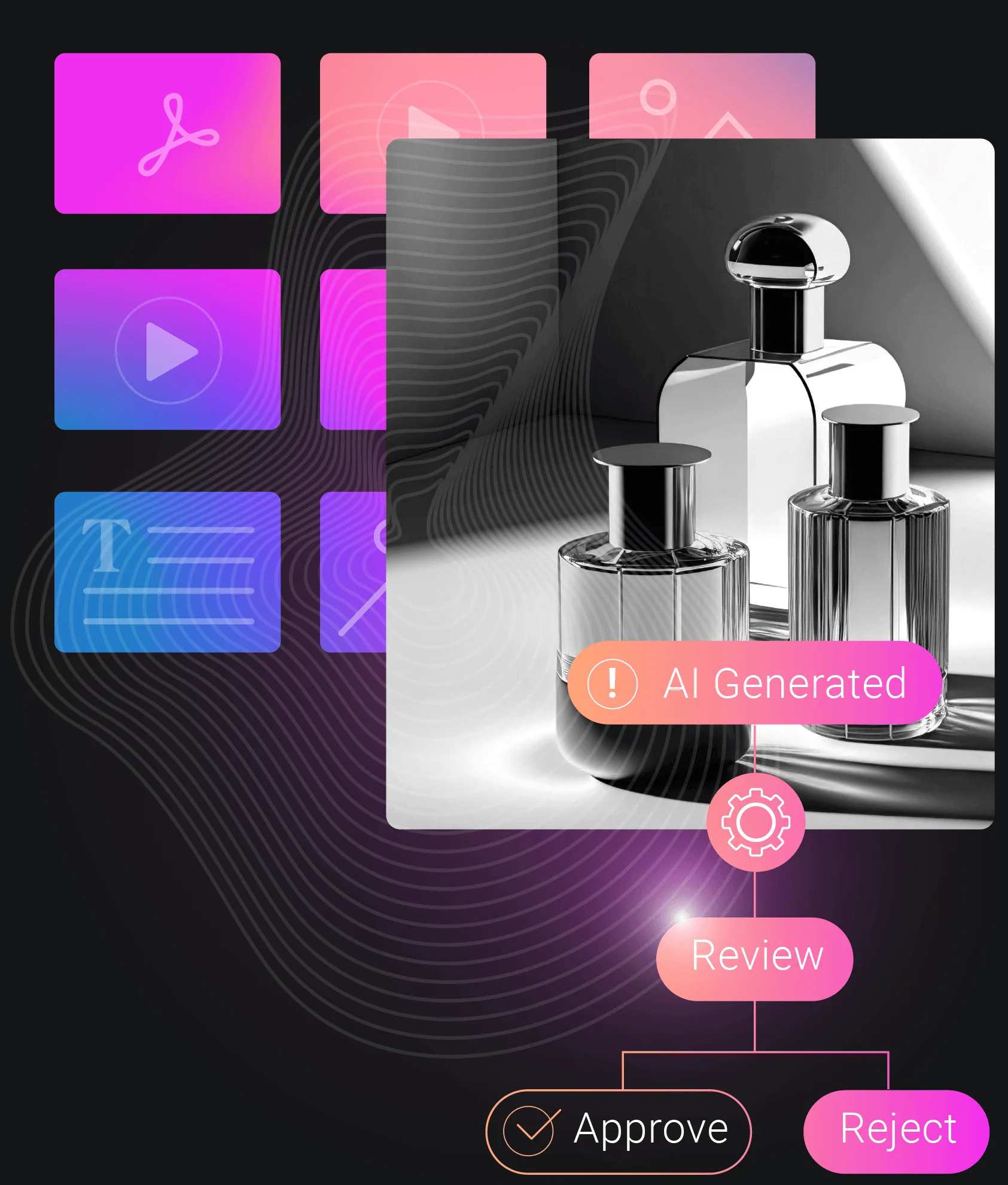
AI-generated content detection and labeling
Provenance metadata, including edit history and training data transparency
Digital rights enforcement with smart expiration and usage control
Automated regulatory compliance checks for sectors like finance and life sciences
Personalized watermarking and audit-friendly review records
Provenance tracking and DRM become standard DAM capabilities.
Over 50% of AI-generated content automatically flagged and routed.
Governance policies enforced dynamically at the point of content use.
TREND 6
Digital ecosystems are growing more complex. Organizations are moving from monolithic platforms to composable, best-of-breed stacks that integrate flexibly across functions. Gartner predicts at least 60% of new B2C and B2B digital commerce solutions, developed for the cloud, will be aligned with MACH architecture principles by 2027.
DAM is no exception. In 2026, it must act as an adaptable layer—deeply connected, API-first, and ready to plug into whatever architecture the business demands.
In the composable era, DAM is not the destination. It’s the connective tissue.

MACH-based architectures (Microservices, API-first, Cloud-native, Headless)
Prebuilt and custom connectors across CMS, PIM, CRM, and personalization tools
Headless and SDK-based experiences integrated into creative and marketing tools
Workflow orchestration that spans systems, roles, and locations
Support for new content types, formats, and delivery endpoints
Composability become a top-three DAM purchase driver.
Over 70% of DAMs run in distributed, multi-system environments.
Embedded DAM interfaces in tools like Teams, Slack, and Figma become common.
TREND 7
Content meets the moment—automated, adaptive, and audience-specific
Personalization has traditionally happened just before a customer sees an experience. Think email subject lines, website banners, product recommendations, the content swaps are made in the moment, based on who someone is or what they’ve done. But this approach is only as strong as the content that’s available to personalize with. And it’s clearly not working – 50%+ consumers on an Deloitte Digital Study said personalization doesn’t meet their needs, interests, or preferences.
To scale meaningful personalization, we need to “move left” into the planning, creation and management stages of the content lifecycle. That means understanding which audiences matter most, what journeys they’re on and where the content gaps are before activation happens.
By using AI to connect behavioral signals to the content supply chain, brands can stop reacting in the moment and start creating with intent. Personalization shifts from being a last-mile delivery problem to a strategic, upstream opportunity and one that improves marketing ROI by 10-30% (source: McKinsey).

Dynamic content rendering based on user signals
Automated image/text swaps by audience or locale
Personalized variants delivered across web, email, ads, and apps
Compliance-aware personalization that still respects governance rules
Real-time feedback loops into campaign performance and reuse
Over 50% of enterprises use real-time, DAM-integrated personalization.
A 30–50% lift in engagement driven by dynamic content delivery.
Global teams balance personalization with brand and legal control.
TREND 8
Organizations are building smarter content operations by managing from intake and planning through activation and eventual sunset.
The focus has shifted from production alone to performance over time. Lifecycle visibility is helping teams reduce waste, drive reuse, and measure ROI in ways that matter.
If you can’t see where your content is in the journey or how it’s performing, you can’t improve it.

Lifecycle state management for aging, expiry, and re-review
Visibility across portfolios, campaigns, and content types
AI-assisted routing and planning tied to lifecycle health
Feedback loops from downstream systems to re-prioritize assets
Time-based and usage-based triggers for content deprecation or refresh
Lifecycle scoring used in planning, budgeting, and reviews.
Smart archiving reduces content debt and risk.
Reuse rates treated as a core performance metric.
TREND 9
DAM is no longer an operational tool. It is becoming a strategic system—used to align creative execution with business outcomes.
By connecting performance data, planning inputs, and delivery insights, DAM platforms are informing how and where organizations invest their content efforts.
In leading organizations, DAM is not just a platform. It’s a nerve center for content operations.

Informing content strategy with usage and performance data
Prioritizing production based on ROI, reuse, and lifecycle health
Acting as a bridge between planning tools, CDPs, and execution platforms
Recommending next-best actions based on gaps, trends, and saturation
Tying content performance to campaign impact and sales outcomes
DAM central in quarterly and annual content planning.
AI recommendations influence creative prioritization.
Content strategy evolves into a closed-loop system, powered by DAM.
TREND 10
The most transformative trend is also the most foundational. Content operations are shifting from human-led workflows powered by AI to AI-native workflows guided by humans.
This isn’t about applying AI to old processes. It’s about building new ones—designed for autonomy, responsiveness, and scale.
This is not about optimizing yesterday’s processes. It’s about building the new operating model for content.

Agent-based workflows that chain together tasks without manual intervention
Generative creation of text, images, and even campaign structures
Adaptive routing based on performance, compliance, or complexity
Self-optimizing approvals and real-time escalation paths
Continuous model training using engagement and usage data
AI-native workflows support the majority of content production in enterprise teams.
Cycle times drop by 30–60% across high-volume teams.
AI agents will be managed, governed, and measured like human team members.
CONCLUSION
The platforms that support modularity, composability, governance, real-time orchestration, and AI-native workflows will become the foundational layer of modern content supply chains.
As organizations scale content to meet rising expectations, those who embrace intelligent asset management will outpace their competitors. The trends are already in motion—shaping the next decade of digital execution.
The 2026 DAM landscape is defined by intelligence, not infrastructure.